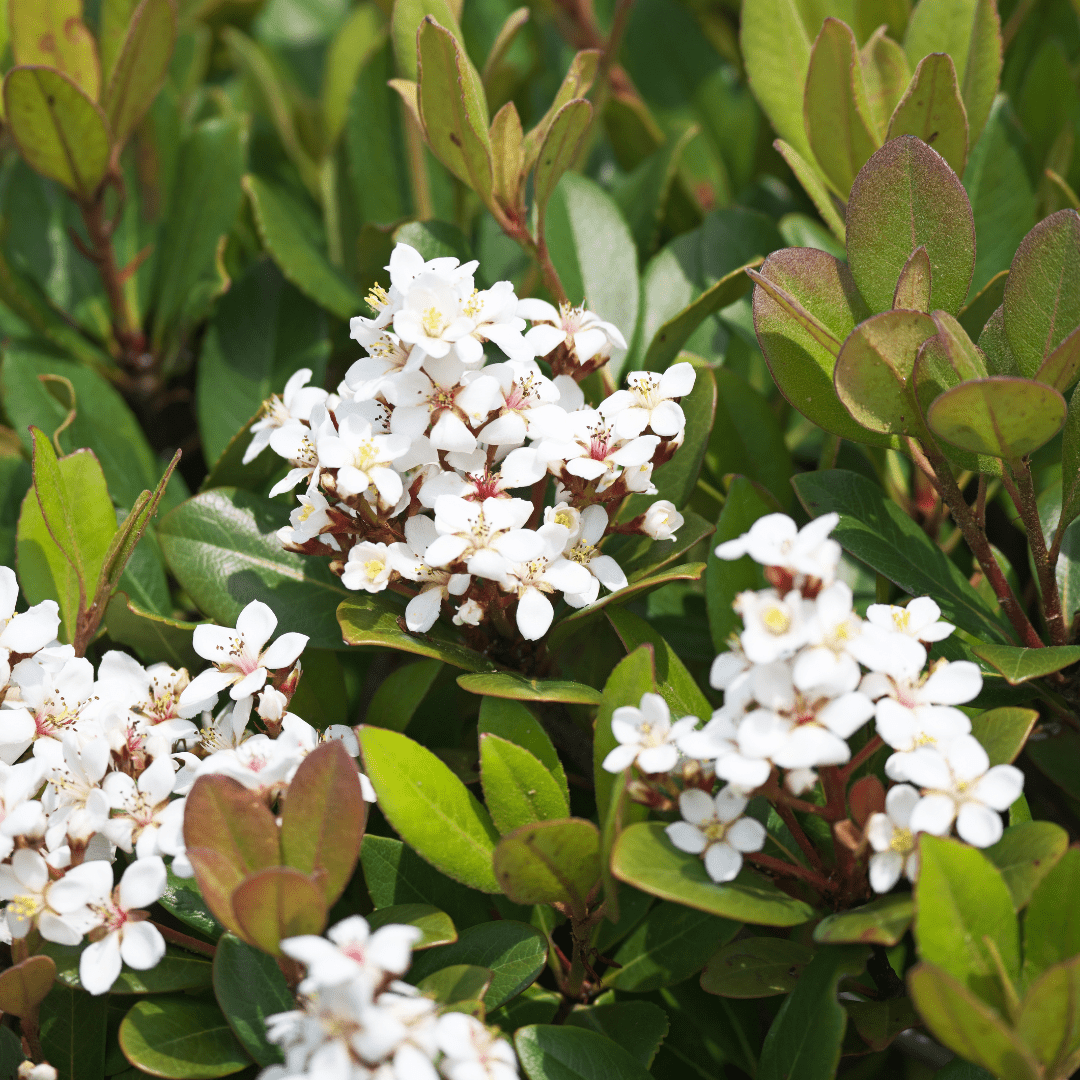


White Indian Hawthorne
White Indian Hawthorne
Couldn't load pickup availability
The Best Evergreen Flowering Shrub for Phoenix Foundation Plantings
White Indian Hawthorne (Rhaphiolepis indica 'Alba') is one of the most reliable and attractive evergreen shrubs for Phoenix Valley landscapes. This compact, rounded shrub produces clusters of pure white flowers in spring, followed by dark blue-black berries that attract birds. Its dense, leathery dark-green foliage stays attractive year-round with minimal maintenance. Whether you're building a polished Scottsdale foundation planting, creating a low hedge in Chandler, or adding flowering structure to a Gilbert front yard — White Indian Hawthorne delivers year-round beauty with low water needs.
White Indian Hawthorne Plant Details
| Attribute | Detail |
|---|---|
| Scientific Name | Rhaphiolepis indica 'Alba' |
| Common Names | White Indian Hawthorne, White Indian Hawthorn, India Hawthorn |
| Mature Height | 3–6 feet |
| Mature Width | 3–6 feet |
| Growth Rate | Moderate — 1–2 feet per year in Phoenix |
| Sun | Full sun to partial shade. Handles reflected heat from walls. |
| Water | Low to moderate once established. |
| USDA Zones | 8–11 (Phoenix is Zone 9b–10a) |
| Soil | Well-draining. Adapts to Arizona caliche soils. |
| Foliage | Evergreen — dense, leathery dark-green leaves year-round |
| Bloom Season | Spring — clusters of white flowers followed by dark berries |
White Indian Hawthorne Uses in Phoenix Landscapes
Foundation & Entryway Plantings
White Indian Hawthorne is one of the most popular foundation shrubs in the Phoenix Valley. Its compact, rounded form stays tidy with minimal pruning and the dense foliage creates a polished look along house fronts, entryways, and courtyard walls. Space plants 3–4 feet apart for a continuous foundation border. The spring white flowers add seasonal interest without overwhelming the design — a proven choice for Scottsdale, Paradise Valley, and Mesa homes.
Low Hedge & Border
Plant White Indian Hawthorne 3 feet apart for a dense, evergreen hedge along driveways, walkways, or property lines. The natural rounded habit means minimal shaping is needed. The dark-green foliage provides a clean backdrop for seasonal flower beds or accent plants. An excellent choice for HOA-compliant landscapes in Gilbert, Queen Creek, and Chandler.
Mixed Desert & Traditional Beds
White Indian Hawthorne bridges the gap between traditional and desert landscaping styles. Use it alongside desert-adapted plants like Texas Sage, Red Hesperaloe, and Yellow Bells for a landscape that feels lush but stays water-wise. The white spring blooms complement the purple monsoon flowers of nearby Texas Sage varieties beautifully in Peoria, Glendale, and Tempe neighborhoods.
Best Time to Plant White Indian Hawthorne in Phoenix
Fall (October–November) is the ideal planting window. Warm soil encourages rapid root establishment while cooler air reduces transplant stress. Your shrub gets 6–8 months of root growth before its first Phoenix summer. Spring (February–April) is the second-best option. Avoid planting in peak summer when possible.
How to Plant White Indian Hawthorne
- Dig wide, not deep — 2–3x the root ball width, same depth as the nursery container.
- Check for caliche — break through any hardpan layer for drainage.
- Backfill with native soil — a light 20% organic blend is fine for this adaptable shrub.
- Spacing — 3 feet apart for hedges; 4–5 feet for standalone specimens.
- Water basin — build a 3–4 inch ring to direct water to roots during establishment.
- Mulch — 2–3 inches of bark or gravel mulch to retain moisture and suppress weeds.
Watering White Indian Hawthorne in Phoenix
First Year Watering Schedule
- Weeks 1–2: Every 1–2 days, deep and slow (20–30 min)
- Month 1–3: Every 3–4 days
- Month 3–6: Every 5–7 days (every 3–4 days in peak summer)
- After Year 1: Every 7–14 days in summer; every 2–3 weeks in winter
Drip Irrigation
Place two 1 GPH emitters 12 inches from the base on opposite sides. Once established, Indian Hawthorne is fairly drought-tolerant but performs best with consistent deep watering every 1–2 weeks in summer.
How fast does White Indian Hawthorne grow in Phoenix?
At a moderate pace of 1–2 feet per year, reaching its full 3–6 foot size in 3–4 years. Larger nursery sizes (10–15 gallon) provide near-instant hedge coverage.
Does it need pruning?
Very little. The natural rounded form stays tidy on its own. Light tip-pruning after flowering can encourage denser growth. Avoid hard pruning, which removes next year's flower buds.
Can it handle full Phoenix summer sun?
Yes, especially with afternoon shade during the hottest months. In full sun with reflected heat, it benefits from slightly more frequent watering but stays healthy and attractive year-round.
Does it attract wildlife?
Yes — the spring flowers attract bees and butterflies, and the dark berries that follow are a favorite food source for birds throughout the Valley.
You May Also Like
- White Cloud — A white-flowering Texas Sage with silvery foliage for ultra-low-water landscapes.
- Society Garlic — A low-growing, purple-flowering perennial that pairs well as a border plant.
- Scarlet Firethorn — An evergreen shrub with white flowers and bright red berries for seasonal color.
- Sea Green Juniper — A low-maintenance evergreen groundcover shrub for foundation plantings.
How Many White Indian Hawthorne Do I Need?
For a continuous low hedge or foundation border, space plants about 3 feet on center. Use this guide to estimate plant counts by run length:
| Hedge Run Length | Plants Needed (3 ft spacing) |
|---|---|
| 10 feet | 4 plants |
| 20 feet | 7 plants |
| 30 feet | 11 plants |
| 40 feet | 14 plants |
For standalone foundation specimens, allow 4 to 5 feet between plants so each shrub keeps its natural rounded form.
White Indian Hawthorne Season-by-Season in Phoenix
- Spring (Feb–Apr): Peak bloom. Clusters of white flowers cover the shrub and draw bees and butterflies, followed by dark blue-black berries. New foliage flushes. A strong second planting window.
- Summer (May–Sep): Holds up to Phoenix heat and reflected heat off walls. Deep-water every 7 to 14 days. In the hottest, most exposed western exposures, light afternoon shade keeps foliage looking its best.
- Fall (Oct–Nov): Prime planting season. Berries persist and feed birds. Cooler air lets new plants root in fast before winter.
- Winter (Dec–Jan): Stays fully evergreen for year-round structure. Cold-hardy to about 15°F, so it sails through normal Valley winters with no frost protection needed.
At a Glance
✔ Evergreen ✔ Heat-Loving (Reflected-Heat Tolerant) ✔ Drought-Tolerant ✔ Low-Maintenance ✔ Pollinator-Friendly ✔ Deer & Rabbit-Resistant ✔ Cold-Hardy to 15°F
Plant It With
- White Cloud: a white-blooming Texas Sage that echoes the white flowers while cutting water use even further.
- Bay Breeze Indian Hawthorn: a pink-flowering cousin for layered Rhaphiolepis hedging.
- Texas Sage: a tough purple-flowering desert shrub that backs the hedge with monsoon color.
- Yellow Bells: a heat-loving golden bloomer that adds height and contrast behind the hawthorne.
Is White Indian Hawthorne Right for Your Yard?
White Indian Hawthorne thrives in full sun to partial shade, tolerates reflected heat off walls and pavement, and adapts to Arizona caliche as long as the planting hole drains. It is ideal for tidy foundation rows, low evergreen hedges, and HOA-friendly front yards that need flowers without high upkeep. It is not the best fit if you want a fast, tall privacy screen or a strictly no-litter poolside planting, since it stays compact and drops spent flowers and berries.
Share