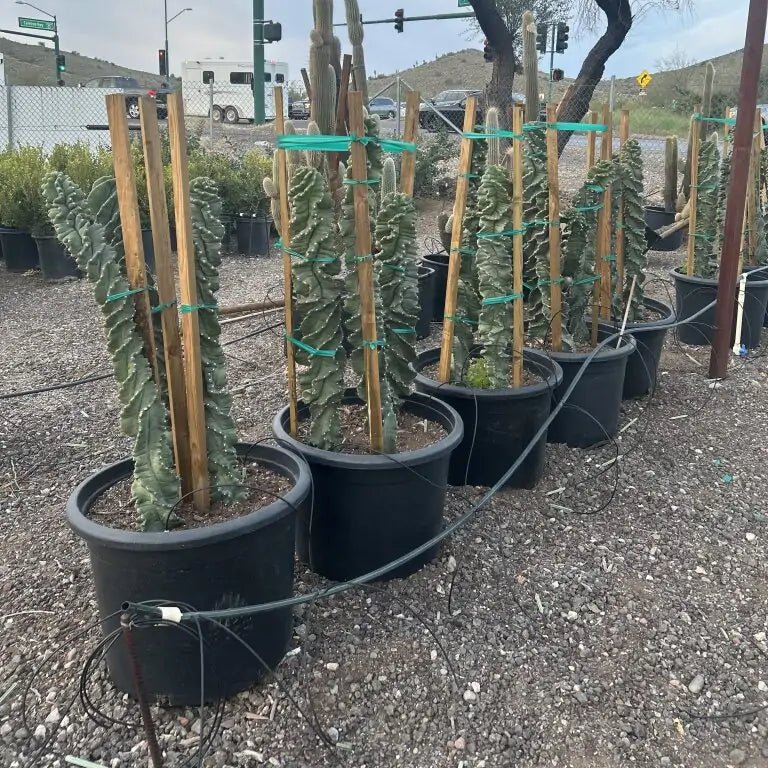


Spiral Cereus
Spiral Cereus
Couldn't load pickup availability
Phoenix's Most Dramatic Sculptural Cactus — Spiral Cereus
Spiral Cereus (Cereus forbesii 'Spiralis') is one of the most visually striking columnar cacti you can grow in the Phoenix Valley. Its twisted, corkscrew ribs spiral up blue-green columns that look like living sculptures, creating a focal point no other plant can match. Despite its exotic appearance, Spiral Cereus is tough, heat-loving, and extremely low-maintenance once established. Whether you're designing a modern desert courtyard in Scottsdale, adding drama to a xeriscape bed in Chandler, or building a statement entry in Mesa — Spiral Cereus delivers year-round architectural impact with almost zero effort.
Spiral Cereus Plant Details
| Attribute | Detail |
|---|---|
| Scientific Name | Cereus forbesii 'Spiralis' |
| Common Names | Spiral Cereus, Twisted Cereus, Spiraled Cereus |
| Mature Height | 10–15 feet |
| Mature Width | 3–5 feet (multi-branching with age) |
| Growth Rate | Moderate to Fast — 1–2 feet per year in Phoenix |
| Sun | Full sun (6+ hrs). Handles reflected heat from walls and pavement. |
| Water | Very low once established. Highly drought-tolerant. |
| USDA Zones | 9–11 (Phoenix is Zone 9b–10a) |
| Soil | Well-draining. Adapts to Arizona caliche and rocky desert soils. |
| Foliage | Evergreen — blue-green columns year-round |
| Bloom | Large white night-blooming flowers in summer |
Spiral Cereus Uses in Phoenix Landscapes
Statement Focal Point
Nothing grabs attention like the twisted, spiraling columns of this cactus. Plant a single Spiral Cereus in a prominent spot — a courtyard center, entry garden, or pool deck corner — and it becomes an instant conversation piece. Pair with low groundcovers like Angelita Daisy or Trailing Lantana to let the sculptural form stand out.
Modern Desert Garden Design
Spiral Cereus is a favorite of landscape designers creating contemporary desert aesthetics in Scottsdale, Paradise Valley, and Gilbert. Its geometric spiral pattern pairs beautifully with clean-lined hardscape, decomposed granite, and architectural companions like Mexican Fence Post or Blue Ghost Cereus. Group 3–5 specimens of varying heights for a gallery-style cactus display.
Low-Water Xeriscape Beds
For Phoenix homeowners looking to slash water bills without sacrificing curb appeal, Spiral Cereus is a top pick. Once established, it thrives on rainfall alone with occasional deep watering in peak summer. Combine with Desert Spoon, Golden Barrel, and Texas Sage for a lush-looking xeriscape bed that uses a fraction of the water.
Container & Patio Accent
Younger 3–5 gallon Spiral Cereus plants thrive in large decorative containers on patios, pool decks, and balconies across Tempe, Peoria, and Glendale. The twisted form adds instant character to any outdoor living space. Use a well-draining cactus mix and a pot with drainage holes.
Best Time to Plant Spiral Cereus in Phoenix
Fall (October–November) is the ideal planting window. Soil is still warm enough to encourage root growth, while cooler air temperatures reduce transplant stress. Your Spiral Cereus gets 6–8 months of root establishment before facing its first Phoenix summer. Spring (February–April) is the second-best window. Avoid planting in the peak summer months if possible.
How to Plant Spiral Cereus
- Dig wide, not deep — excavate a hole 2–3× the root ball width, same depth as the container.
- Check for caliche — if you hit a hardpan layer, break through it completely to ensure drainage. Cacti rot in standing water.
- Backfill with native soil — do not amend heavily. A light 20% cactus mix blend is fine for loosening clay.
- Spacing — plant 4–6 feet apart for a grouped display; 8–10 feet apart for stand-alone specimens.
- Water basin — build a 3–4 inch soil ring around the root zone to direct water to the roots during establishment.
- Mulch — 2–3 inches of rock or gravel mulch (not bark) around the base to retain moisture and keep roots cool.
Watering Spiral Cereus in Phoenix
First Year Watering Schedule
- Weeks 1–2: Every 3–4 days, deep and slow (15–20 min drip).
- Month 1–3: Every 7–10 days.
- Month 3–6: Every 10–14 days (weekly in peak summer heat).
- After Year 1: Every 2–3 weeks in summer; monthly or less in winter. Established Spiral Cereus is extremely drought-tolerant.
Drip Irrigation
Place 1–2 emitters 12–18 inches from the trunk, each delivering 1–2 GPH. Run for 30–45 minutes per watering session. Once established (after 12–18 months), Spiral Cereus needs very little supplemental irrigation — just occasional deep soaks during extended dry periods in summer.
How fast does Spiral Cereus grow in Phoenix?
In Phoenix's long, hot growing season, Spiral Cereus typically adds 1–2 feet of height per year. Larger nursery stock (15–25 gallon) may grow faster initially because the root system is already well-developed. Expect multi-branching to begin once the plant reaches 4–5 feet tall.
Is Spiral Cereus drought tolerant?
Extremely. Once established (12–18 months after planting), Spiral Cereus can survive on natural rainfall alone in most Phoenix-area years. A deep soak every 2–3 weeks in summer keeps it looking its best, but it won't die without supplemental water.
What makes Spiral Cereus different from regular Cereus?
The 'Spiralis' cultivar has genetically twisted ribs that corkscrew up each column, creating a dramatic sculptural effect that standard Cereus species don't have. The spiral pattern is present from a young age and becomes more pronounced as the plant grows.
Does Spiral Cereus bloom?
Yes — Spiral Cereus produces large, showy white flowers that open at night during summer months. The blooms are pollinated by bats and moths and typically last one night, but established plants can produce dozens of flowers over the blooming season.
Can Spiral Cereus handle Phoenix's reflected heat?
Absolutely. Spiral Cereus thrives in full sun and handles the reflected heat from block walls, concrete driveways, and west-facing exposures that would stress many other plants. It's one of the toughest ornamental cacti for the hottest microclimates in the Valley.
You May Also Like
- Blue Ghost Cereus — Stunning powdery-blue columnar cactus with a ghostly appearance. Another top-tier sculptural accent.
- Totem Pole Cactus — Smooth, knobby columns with no spines. Perfect companion for a modern cactus garden.
- Mexican Fence Post — Classic columnar form with clean vertical lines. Great contrast to Spiral Cereus's twisted ribs.
- Golden Torch — Bright golden-spined clusters that pair beautifully with the blue-green tones of Spiral Cereus.
- San Pedro Cactus — Fast-growing blue-green columns that complement the Spiral Cereus growth habit.
How Many Spiral Cereus Do I Need?
Spiral Cereus is a sculptural specimen cactus, not a hedge plant, so think in terms of focal placement and clean spacing rather than a continuous run. At a mature width of 3 to 5 feet with multi-branching age, give each column room to be seen in the round.
| Planting Goal | Spacing | Notes |
|---|---|---|
| Single focal point | Stand-alone | One specimen in a courtyard, entry, or pool-deck corner with 8 to 10 ft of open clearance so the spiral reads from every angle. |
| Sculptural grouping | 4 to 6 ft apart | Plant in odd-numbered clusters of 3 or 5 at staggered heights so each twisted column stands clear of the next. |
| Loose vertical screen | 4 ft on center | A 20 ft stretch takes about 5 to 6 plants for an open, see-through accent line, not a solid wall. |
Keep specimens at least 3 to 4 feet back from walkways, patios, and pool edges so the ribbed columns are out of foot traffic.
Spiral Cereus Season-by-Season in Phoenix
- Spring (Feb–Apr): Growth resumes as nights warm. This is the second-best planting window and a good time to set drip and add a fresh gravel mulch ring.
- Summer (May–Sep): Peak growth season. The blue-green columns shrug off reflected heat from west walls and pavement, and large white flowers open at night through the warm months, drawing moths and bats. A deep soak every 2 to 3 weeks keeps it plump.
- Fall (Oct–Nov): The prime planting window. Warm soil plus cooling air gives roots 6 to 8 months to establish before next summer.
- Winter (Dec–Jan): Evergreen and mostly dormant. Spiral Cereus is frost-sensitive: protect from hard freezes below about 30°F and cover young or recently planted columns on frost nights, especially in low-lying Valley cold pockets.
At a Glance
✔ Heat-Loving (Reflected-Heat Tolerant) ✔ Drought-Tolerant ✔ Pollinator-Friendly ✔ Evergreen ✔ Low-Maintenance ✔ Deer & Rabbit-Resistant
Plant It With
- Blue Ghost Cereus: powdery-blue columns that echo the sculptural, vertical theme.
- Totem Pole Cactus: smooth spineless columns that contrast the twisted ribs in a modern grouping.
- Mexican Fence Post: clean straight columns that set off the corkscrew form.
- San Pedro: fast blue-green columns that fill in around the specimen for layered height.
Is Spiral Cereus Right for Your Yard?
Spiral Cereus thrives in full sun and the hottest reflected-heat microclimates, in fast-draining or caliche soil broken for drainage, where it has room to stand as a focal column and stay clear of foot traffic. It is not the right pick if your only space is a frost-prone low spot you cannot cover on cold nights, or a high-traffic walkway edge where the ribbed columns would be brushed against.
Customer Reviews
I love the Spiral cactus. I first saw them in a yard in my housing community. After not being able to find them at local nurseries and only finding very small ones on line, I stumbled across Three Timbers. They had all sizes and good quality plus I got free delivery and they planted
Prompt and professional. Couldn’t ask for more ! Will certainly be using in the future any chance I get !
Share