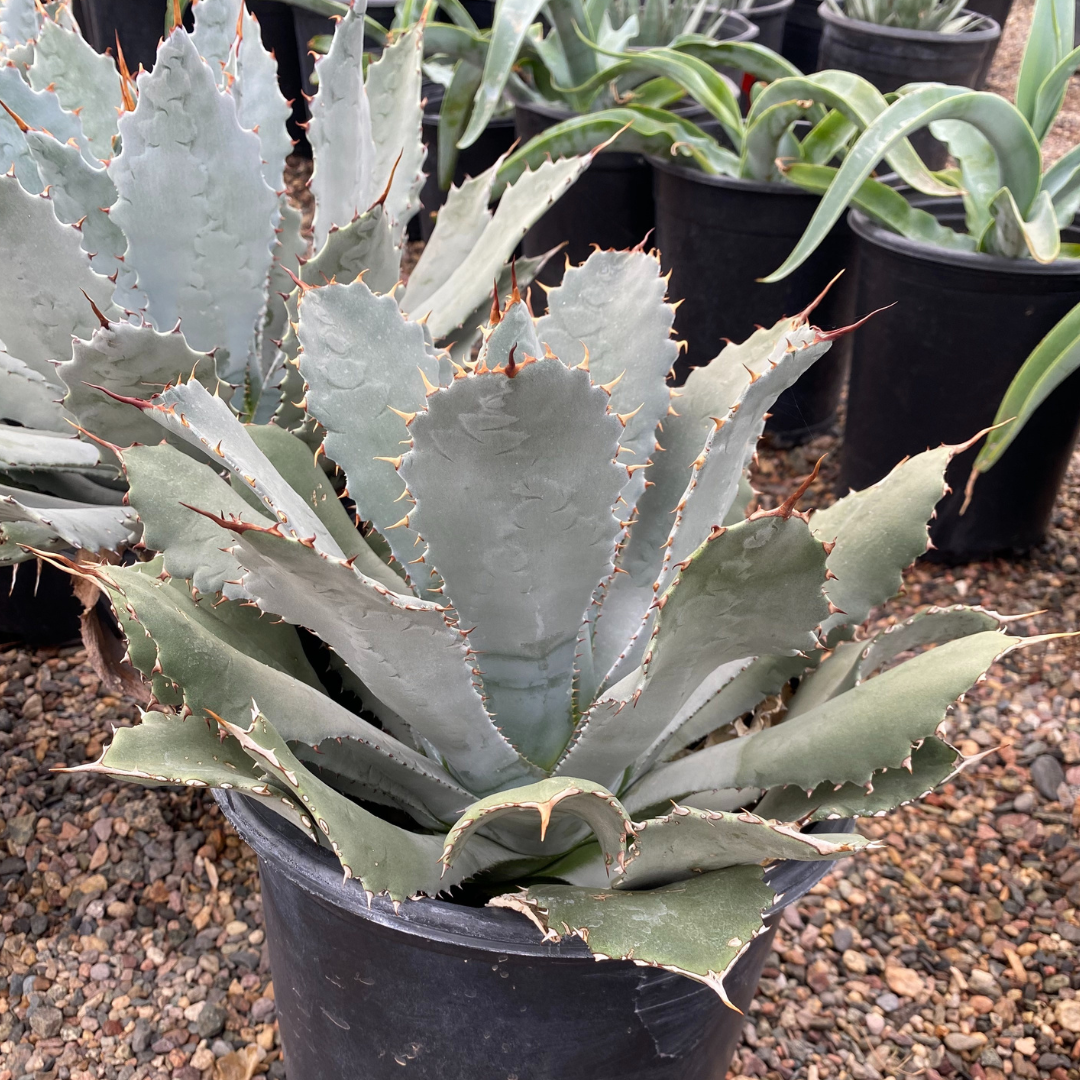

Agave Guadalajarana
Agave Guadalajarana
Couldn't load pickup availability
A Majestic Blue-Gray Agave That Commands Attention in Any Phoenix Garden
Agave Guadalajarana (Agave guadalajarana) is a breathtaking large-scale agave native to the Jalisco region near Guadalajara, Mexico. This striking succulent forms a wide, open rosette of broad, powdery blue-gray leaves that can reach 3–5 feet tall and 4–6 feet wide at maturity — creating an instant architectural statement in any desert landscape. The leaves are thick and paddle-shaped with distinctive reddish-brown terminal spines and subtle teeth along the margins, giving it a bold, sculptural presence. Whether you're anchoring a Scottsdale xeriscape with a show-stopping specimen, designing a dramatic entrance planting in Paradise Valley, or building a collector-grade agave garden in Mesa — Agave Guadalajarana delivers the scale, color, and desert gravitas that few other plants can match.
Agave Guadalajarana Plant Details
| Attribute | Detail |
|---|---|
| Scientific Name | Agave guadalajarana |
| Common Names | Guadalajara Agave, Agave Guadalajarana |
| Mature Height | 3–5 feet |
| Mature Width | 4–6 feet |
| Growth Rate | Slow — reaches full size in 5–8 years in Phoenix |
| Sun | Full sun (6+ hrs). Handles reflected heat from walls and pavement. |
| Water | Very low once established. Extremely drought-tolerant. |
| USDA Zones | 8–11 (Phoenix is Zone 9b–10a) |
| Soil | Well-draining required. Thrives in Arizona caliche and rocky native soils. |
| Foliage | Evergreen — broad, powdery blue-gray leaves with reddish-brown terminal spines |
| Bloom | Yellow flower spike up to 15 feet tall (monocarpic — blooms once after many years) |
Agave Guadalajarana Uses in Phoenix Landscapes
Statement Specimen & Focal Point
At 4–6 feet wide, Agave Guadalajarana commands attention as a standalone specimen in any landscape. Place it at a prominent intersection of garden paths, at the center of a circular gravel bed, or flanking an entryway for instant desert drama. The powdery blue-gray color is particularly striking against warm-toned decomposed granite and rust-colored boulders.
Large-Scale Xeriscape Design
This agave's generous proportions make it ideal for commercial landscapes, resort-style gardens, and large residential properties where smaller agaves would get lost. Group 3 specimens at staggered sizes for a gallery-quality desert garden, or pair with complementary large-scale plants like Desert Spoon and Ocotillo for a bold, architectural composition.
Collector Agave Garden
Agave Guadalajarana is a prized collector species that adds serious depth to any agave collection. Its distinctive blue-gray coloring provides beautiful contrast alongside green-toned species like Agave Chiapensis and Agave chazaroi. The broad leaf form creates textural variety next to narrow-leaved agaves.
Best Time to Plant Agave Guadalajarana in Phoenix
Fall (October–November) is the ideal planting window. Warm soil promotes root growth while cooler air reduces transplant stress. Spring (February–April) is a strong second option. Avoid summer planting — this large agave needs time to establish roots before facing extreme Phoenix heat.
How to Plant Agave Guadalajarana
- Dig wide, not deep — hole should be 2–3x the root ball width, same depth as the container.
- Check for caliche — break through any hardpan layer. Standing water will rot the roots quickly.
- Backfill with native soil — no amendments needed. Avoid rich compost.
- Spacing — 5–6 feet apart for groupings; 8+ feet for individual specimens with room to mature.
- Water basin — build a shallow 3-inch ring for initial watering; remove after establishment.
- Mulch — 2–3 inches of gravel or decomposed granite. Never bark mulch against the rosette.
Watering Agave Guadalajarana in Phoenix
First Year Watering Schedule
Weeks 1–2: Every 3–4 days, deep and slow. Month 1–2: Every 5–7 days. Month 3–6: Every 10–14 days. After Year 1: Every 3–4 weeks in summer; monthly or less in winter. Established Agave Guadalajarana is extremely drought-tolerant.
Drip Irrigation
Place one 2-GPH emitter 18–24 inches from the plant base. For larger specimens, two emitters on opposite sides work well. Overwatering is the most common cause of failure — always err dry.
How big does Agave Guadalajarana get?
In Phoenix, expect 3–5 feet tall and 4–6 feet wide at maturity. Allow at least 5–6 feet of clear space around the plant so it can develop its full rosette without crowding. The broad leaves need room to spread.
Is Agave Guadalajarana rare?
It's uncommon in the general nursery trade but available at specialty desert plant nurseries like Three Timbers. It's a collector-grade species that you won't find at big-box garden centers.
Does Agave Guadalajarana produce pups?
Sparingly. Unlike some agaves that offset freely, Guadalajarana tends to remain as a solitary rosette for most of its life. This makes each plant a true specimen — and increases its collector value.
How cold hardy is Agave Guadalajarana?
Hardy to about 20°F, which covers all standard Phoenix Valley locations. It handles typical winter cold snaps with ease and doesn't need frost protection in most residential settings.
You May Also Like
Agave Colorata x Celsii — A compact hybrid with similar blue-gray coloring in a smaller package.
Desert Spoon — Another large-scale rosette succulent for dramatic pairing with Guadalajarana.
Agave Chiapensis — Green-toned agave for color contrast in collector gardens.
Agave Celsii 'Nova' — Compact blue-green agave to plant as a foreground companion.
Red Yucca — Coral flower spikes add vertical interest and warm color alongside the cool blue tones of Guadalajarana.
Share