

Trailing Rosemary
Trailing Rosemary
Couldn't load pickup availability
The Best Low-Water Groundcover for Phoenix & Scottsdale — Trailing Rosemary
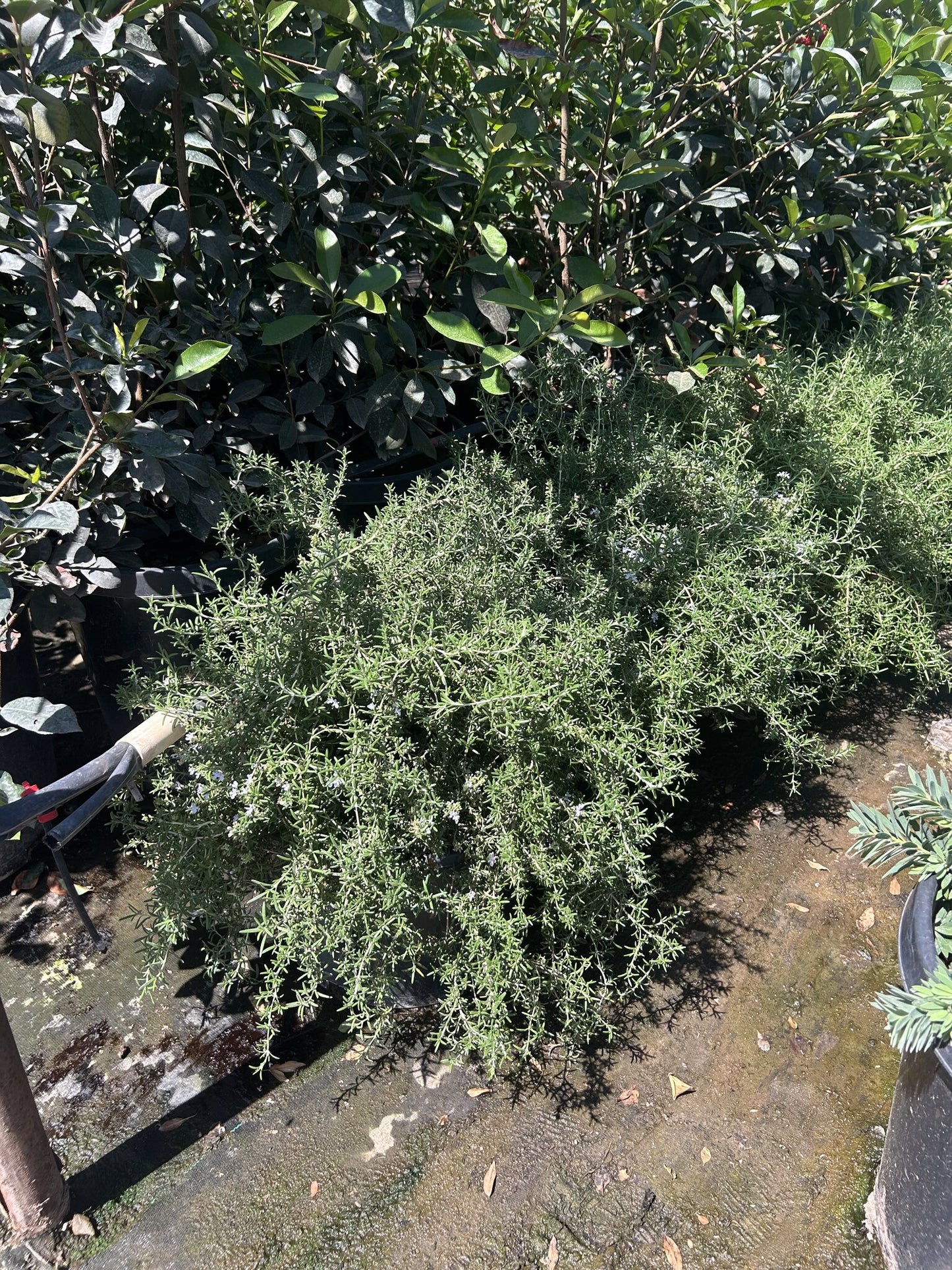
Trailing Rosemary (Rosmarinus officinalis) is one of Phoenix Valley's most versatile and dependable low-water groundcovers, combining ornamental beauty with extraordinary drought-tolerance. This sprawling perennial spreads 4–8 feet wide while staying just 1–2 feet tall, making it the ideal living mulch for slopes, borders, and rock gardens across the Valley. Covered in fragrant, needle-like foliage and lavender-blue blooms nearly year-round, Trailing Rosemary is both beautiful and functional. Whether you're designing a water-smart front yard in Scottsdale, carpeting a sunny slope in Chandler, or filling in a xeriscape border in Gilbert, Trailing Rosemary gets the job done.
Trailing Rosemary Plant Details
| Attribute | Detail |
|---|---|
| Scientific Name | Rosmarinus officinalis (syn. Salvia rosmarinus) |
| Common Names | Trailing Rosemary, Prostrate Rosemary, Creeping Rosemary |
| Mature Height | 1–2 feet |
| Mature Width | 4–8 feet |
| Growth Rate | Moderate — 1–2 feet per year in Phoenix |
| Sun | Full sun (6+ hrs). Handles reflected heat from walls and pavement. |
| Water | Low once established. Highly drought-tolerant. |
| USDA Zones | 8–11 (Phoenix is Zone 9b–10a) |
| Soil | Well-draining. Adapts to Arizona caliche soils — break through hardpan at planting. |
| Foliage | Evergreen — stays fragrant and green year-round |
| Bloom Color | Pale blue to lavender-blue flowers |
Trailing Rosemary Uses in Phoenix Landscapes
Drought-Tolerant Groundcover & Living Mulch
Trailing Rosemary is one of the best groundcovers for replacing water-thirsty turf in Phoenix and Scottsdale landscapes. Its sprawling habit covers bare soil quickly, suppressing weeds and retaining soil moisture in the process. Plant 3–4 feet apart for a continuous carpet effect, and you'll have full coverage within two growing seasons. It's a top choice for slopes and hillsides where erosion control meets desert beauty.
Border Planting & Rock Garden Accent
With its trailing, mounding form and silvery-green needled foliage, Trailing Rosemary provides excellent texture contrast along rock garden edges, raised beds, and low borders. It pairs beautifully with Yellow Bells (Tecoma stans), Desert Marigold, and Texas Sage for a layered, low-maintenance border that blooms through spring, fall, and even mild Phoenix winters.
Pool-Friendly & Fragrant Landscape Plant
Trailing Rosemary is one of the few fragrant groundcovers that thrives in Phoenix's full-sun, reflected-heat environment near pools and patios. Unlike many groundcovers, it doesn't produce messy litter and its small needle-like leaves are pool-friendly. The culinary fragrance is a bonus — brush against the foliage and enjoy the fresh rosemary scent throughout your outdoor living space.
Slope Stabilization & Erosion Control
On sloped areas where lawn and traditional plants struggle, Trailing Rosemary's spreading root system anchors soil effectively. For a 20 ft slope — use 5–7 plants spaced 3 ft apart. For a 40 ft slope — use 12–15 plants. Once established, the plants knit together and require virtually no maintenance, just an occasional deep irrigation in peak summer heat.
Best Time to Plant Trailing Rosemary in Phoenix
Fall planting (October–November) is ideal for Trailing Rosemary in the Phoenix Valley. Cooler air temperatures reduce transplant stress while the soil stays warm enough for root establishment. Plants get 6–8 months to root in before their first Phoenix summer. Spring planting (February–April) works well too. Avoid summer planting if possible — if you must plant in summer, provide afternoon shade and water every 1–2 days for the first month.
How to Plant Trailing Rosemary
- Dig wide, not deep — excavate 2–3x the root ball width, same depth as the container.
- Check for caliche — break through any hardpan layer to ensure proper drainage. Rosemary roots rot in standing water.
- Backfill with native soil — a light 20% organic amendment blend is fine, but avoid heavy organic soils.
- Spacing — 3–4 ft apart for groundcover; 4–5 ft for standalone or accent planting.
- Water basin — build a 3–4 inch soil ring around each plant to direct water to the root zone.
- Mulch — apply 2–3 inches of gravel or bark mulch to retain moisture and regulate soil temperature.
Watering Trailing Rosemary in Phoenix
First Year Watering Schedule
Weeks 1–2: Water every 1–2 days, deep and slow (20–30 min drip). Month 1–2: Reduce to every 3–4 days. Month 3–6: Water every 7–10 days (every 5–7 days during peak summer). After Year 1: Every 10–14 days in summer; every 3–4 weeks in winter. Established Trailing Rosemary is remarkably drought-tolerant and rarely needs supplemental water after its first Phoenix summer.
Drip Irrigation
Place emitters 18–24 inches from the center of each plant. Use 1 GPH emitters running 30–45 minutes per cycle. Once established, Trailing Rosemary thrives on minimal water — overwatering is the most common cause of failure with this plant in Arizona.
Does Trailing Rosemary really survive Phoenix summers? Yes — once established (after the first year), Trailing Rosemary is one of the most heat-tolerant groundcovers available for Phoenix landscapes. It handles reflected heat from walls and concrete and stays evergreen through our hottest months.
How fast does Trailing Rosemary spread in Phoenix? Expect 12–24 inches of new spread per year once established. It grows more slowly in its first season while focusing on root development, then spreads vigorously in year two and beyond.
Is Trailing Rosemary deer resistant? Yes — deer strongly dislike the aromatic foliage of rosemary. It's an excellent choice for properties near desert preserves in Scottsdale, North Phoenix, and Cave Creek.
What's the difference between Trailing Rosemary and upright Rosemary? Trailing Rosemary (prostrate form) spreads horizontally, staying 1–2 ft tall with a spreading habit ideal for groundcover use. Upright rosemary varieties grow 3–5 ft tall in a more shrub-like form. Both are equally drought-tolerant and fragrant.
You May Also Like
If you love Trailing Rosemary, you might also enjoy these Three Timbers favorites: Texas Sage (Leucophyllum frutescens) — a silvery-foliaged, rain-triggered bloomer that pairs beautifully with rosemary in Southwest borders. Sandpaper Verbena — a fast-spreading groundcover with purple blooms perfect for sunny slopes. Confetti Lantana — a colorful, heat-loving groundcover with multicolored blooms from spring through fall. Desert Marigold (Baileya multiradiata) — a bright yellow wildflower perennial that thrives in the same full-sun, low-water conditions.
How Many Trailing Rosemary Do I Need?
Trailing Rosemary is a wide spreader, reaching 4 to 8 feet across while staying low, so each plant covers a lot of ground. For a continuous carpet on slopes and beds, space plants about 3.5 feet on center. Use this coverage guide:
| Area to Cover | Plants Needed (3.5 ft spacing) |
|---|---|
| 50 sq ft | 5 plants |
| 100 sq ft | 8 plants |
| 200 sq ft | 16 plants |
| 300 sq ft | 24 plants |
For erosion control on a slope, set plants 3 feet apart so the roots knit together and anchor the soil faster.
Trailing Rosemary Season-by-Season in Phoenix
- Spring (Feb to Apr): Pale blue to lavender-blue flowers cover the plant and draw bees. Strong new growth flushes and starts trailing. A good second planting window.
- Summer (May to Sep): One of the most heat-proof groundcovers for the Valley. Holds evergreen and fragrant through full sun and reflected heat off walls and paving. Established plants need very little water, and overwatering in summer heat is the main cause of failure. Welcomes monsoon rain.
- Fall (Oct to Nov): Prime planting season. Cooler air and warm soil drive fast rooting, and a second flush of bloom is common.
- Winter (Dec to Jan): Stays evergreen and often keeps light bloom through mild Valley winters. Cold-hardy well below typical Phoenix lows, so no frost protection is needed.
At a Glance
✔ Pollinator-Friendly ✔ Heat-Loving (Reflected-Heat Tolerant) ✔ Drought-Tolerant ✔ Pool-Friendly (Low-Litter) ✔ Evergreen ✔ Low-Maintenance ✔ Edible ✔ Deer & Rabbit-Resistant ✔ Cold-Hardy to 15°F
Plant It With
- Texas Sage: a silvery, rain-triggered bloomer that pairs beautifully with rosemary in Southwest borders.
- Sandpaper Verbena: a fast-spreading purple-flowering groundcover for sunny slopes.
- Desert Marigold: bright yellow blooms in the same full-sun, low-water conditions.
- Trailing Germander: another low, fragrant evergreen groundcover for a layered carpet of texture.
Is Trailing Rosemary Right for Your Yard?
Trailing Rosemary is right for you if you want a fragrant, evergreen, very low-water carpet for slopes, borders, or poolside beds in full sun and reflected heat, and you have fast-draining or caliche soil. It is one of the toughest desert groundcovers once established. It is not a fit for a low spot or heavy soil that stays wet, since soggy roots rot quickly, and it spreads wide, so give it room rather than tucking it into a tight space.
Share