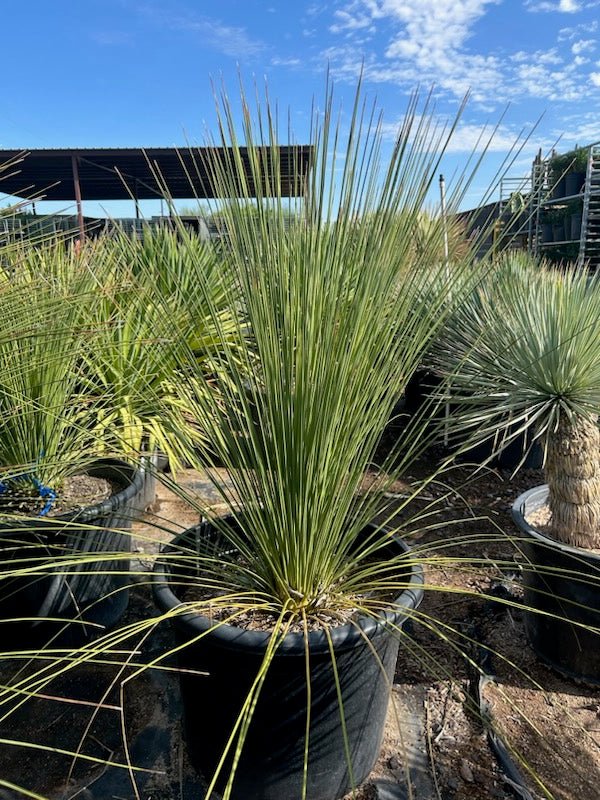


Smooth Spoon sizes, side by side
Typical height of the plants we have in stock now, measured from the soil to the top. Every plant is a little different.
| Size | At delivery | Price |
|---|
Smooth Spoon
Smooth Spoon
Couldn't load pickup availability
Phoenix's Most Striking Desert Accent Plant — Smooth Edged Desert Spoon
Smooth Edged Desert Spoon (Dasylirion longissimum), also called Mexican Grass Tree or Toothless Sotol, is the bold, architectural accent plant that makes every Phoenix landscape look intentional. Native to northeastern Mexico, it forms a rounded fountain of hundreds of long, narrow, four-sided green leaves, slowly lifts itself on a trunk with age, and sends up dramatic bloom spikes reaching 6 to 15 feet. It delivers year-round structure and desert drama with very little maintenance. Unlike standard Desert Spoon, its leaves have no marginal teeth, which makes it safer around pathways and pool areas. Whether you're creating a desert-modern focal point in Scottsdale, adding drama to a front yard in Chandler, or screening with structural plants in Gilbert — Smooth Edged Desert Spoon is the showstopper your landscape needs.
Smooth Edged Desert Spoon Plant Details
| Attribute | Detail |
|---|---|
| Scientific Name | Dasylirion longissimum (syn. Dasylirion quadrangulatum) |
| Common Names | Smooth Spoon, Smooth Edged Desert Spoon, Mexican Grass Tree, Toothless Sotol |
| Mature Height | 4–6 feet as a young rosette; slowly forms a trunk up to about 10 feet with age; bloom spikes 6–15 feet |
| Mature Width | 6–8 feet |
| Growth Rate | Slow, builds a fuller rosette each year and a trunk over many years |
| Sun | Full sun (6+ hrs). Handles reflected heat from walls. |
| Water | Low once established. Deep water every 2 to 4 weeks in summer for the best look. |
| USDA Zones | 8b–11 (Phoenix is Zone 9b–10a) |
| Soil | Well-draining. Tolerates Arizona caliche soils. |
| Foliage | Evergreen, rounded fountain of long, narrow, four-sided green leaves year-round |
| Leaf Edge | Smooth, with no marginal teeth (unlike Desert Spoon); leaf tips are pointed |
Smooth Edged Desert Spoon Uses in Phoenix Landscapes
Bold Focal Point & Specimen Planting
Smooth Edged Desert Spoon is one of Phoenix's premier specimen plants. Its fountain-like form and fine green texture create an eye-catching focal point in entry courts, driveways, and garden beds. When in bloom, the 6 to 15 foot flowering spike draws attention from across the yard. Plant solo in a well-draining rock bed or pair with Blue Nolina and Bear Grass for a dramatic accent trio.
Pool-Safe Desert Accent
Unlike the toothed standard Desert Spoon, Smooth Edged Desert Spoon has flexible leaves with no marginal teeth, which makes it the preferred choice near pools, pathways, and areas with foot traffic, as long as the pointed leaf tips sit a foot or two back from where people walk. It tolerates reflected heat from pool decking and concrete and drops very little debris, since old leaves stay attached as a skirt until you trim them. It's one of the cleanest, most carefree accent plants for Phoenix pool landscapes.
Modern Desert & Xeriscape Design
Smooth Edged Desert Spoon pairs perfectly with decomposed granite, boulders, steel landscape edging, and modern architectural homes. Its geometry looks intentional and designed — equally at home in a minimalist Scottsdale estate garden or a low-water xeriscape in Mesa or Tempe. Plant in clusters of 3–5 for maximum visual impact.
Slope & Hot Wall Planting
Thriving in extreme heat and poor soil, Smooth Edged Desert Spoon is ideal for harsh south- and west-facing exposures where most plants fail. Its deep root system stabilizes slopes while the evergreen foliage provides structure and color year-round. Occasional deep summer water keeps it looking its best once established.
Best Time to Plant Smooth Edged Desert Spoon in Phoenix
Fall (October–November) is ideal — warm soil encourages deep root establishment while cooler air minimizes transplant stress. Spring (February–April) is the second-best window. Avoid summer planting if possible; while this plant is extremely heat-tolerant once established, new plants appreciate moderate temperatures during establishment.
How to Plant Smooth Edged Desert Spoon
- Dig wide, not deep — 2–3x the root ball width, same depth as the container.
- Check for caliche — break through any hardpan layer for essential drainage.
- Backfill with native soil — Desert Spoon prefers lean, gritty soil; avoid over-amending.
- Spacing: about 6 ft apart for clusters; 8 ft or more for individual specimens.
- Water basin — build a 3–4 inch earthen ring to direct water to roots.
- Mulch — gravel mulch is ideal; maintains the natural desert aesthetic and aids drainage.
Watering Smooth Edged Desert Spoon in Phoenix
First Year Watering Schedule
- Weeks 1–2: Every 2–3 days, deep and slow (20–30 min drip)
- Months 1–2: Every 5–7 days
- Months 3–6: Every 10–14 days (every 7–10 days in peak summer)
- After Year 1: Monthly in summer; rainfall only in winter
Drip Irrigation
A single 1 GPH emitter placed 12–18 inches from the center is sufficient during establishment. Once mature, Smooth Edged Desert Spoon gets by on little water, but it looks best with a deep soak every 2 to 4 weeks in summer and only occasional water in winter.
How fast does Smooth Edged Desert Spoon grow in Phoenix?
Slowly. It builds a fuller rosette each year and forms a trunk only over many years. Established plants send up a bloom stalk that can shoot up 6 to 15 feet in a single season. Larger gallon sizes from Three Timbers give you an immediate bold presence while the plant establishes.
Is Smooth Edged Desert Spoon safe near kids and pets?
Its leaves have no marginal teeth and are fairly flexible, a major advantage over toothed Desert Spoon near walkways, play areas, and pool surrounds. The leaf tips are still pointed, so keep it a foot or two back from where people brush past. Dasylirion is not listed as toxic by the ASPCA, but discourage pets from chewing the leaves.
What is the difference between Smooth Edged Desert Spoon and regular Desert Spoon?
Standard Desert Spoon (Dasylirion wheeleri) has flat, blue-gray leaves lined with small hooked teeth. Smooth Edged Desert Spoon (Dasylirion longissimum) has narrow, four-sided green leaves with no teeth and slowly forms a trunk like a small grass tree. Smooth Edged is preferred for high-traffic areas, while Desert Spoon is the more cold-hardy Arizona native. Both are drought-tolerant and heat-adapted.
Does Smooth Edged Desert Spoon bloom?
Yes. Established plants send up dramatic flowering stalks 6 to 15 feet tall topped with tiny cream to tan flowers. Plants are either male or female. Mature plants usually bloom in late spring to summer, though not every year. It is a spectacular landscape event. Unlike many agaves, Desert Spoon does not die after flowering; the plant keeps growing and can bloom again.
Can it handle Phoenix reflected heat?
Absolutely. As a Mexican desert native, it thrives in full sun, reflected heat, and poor rocky soil. South- and west-facing walls, caliche soil, and gravel beds are ideal growing conditions.
You May Also Like
- Blue Nolina — A complementary accent with striking blue-gray foliage — pairs beautifully with Smooth Edged Desert Spoon in desert-modern designs.
- Bear Grass — A lower-growing, clumping Nolina that works as a groundcover or border plant around Desert Spoon specimens.
- Tree Bear Grass — A taller, tree-forming Nolina for dramatic vertical screening alongside Desert Spoon.
- Purple Hopseed — A fast-growing evergreen shrub that provides privacy screening while Desert Spoon establishes as a focal point.
- Arizona Rosewood — A native evergreen shrub with fragrant white flowers that pairs well with Desert Spoon in naturalistic desert plantings.
How Many Smooth Edged Desert Spoon Do I Need?
This is an architectural specimen, not a hedge, so think in single accents and odd-numbered groupings rather than rows. Plant one as a standalone focal point, or cluster 3 to 5 spaced about 6 feet apart so each green fountain stands clear and reads as a sculptural group. For specimens given room to spread, allow 8 feet or more. The toothless leaf margins mean you can place it closer to walkways and pool decks than serrated Desert Spoon, though the leaf tips are still pointed, so keep them back a foot or two from where people brush past.
Smooth Edged Desert Spoon Season-by-Season in Phoenix
- Spring (Feb to Apr): New leaves push from the center and the fountain fills out. Excellent second planting window before the heat.
- Summer (May to Sep): Thrives in extreme and reflected heat with no afternoon shade. Mature plants may send up a towering 6 to 15 foot bloom spike. Monsoon rain covers much of its water; give a deep soak every 2 to 4 weeks in dry stretches.
- Fall (Oct to Nov): Prime planting season. Cooler air and warm soil drive strong root establishment.
- Winter (Dec to Jan): Holds its evergreen form through Valley winters. Hardy to about 15°F, so no frost protection is needed in Phoenix.
At a Glance
✔ Evergreen ✔ Heat-Loving (Reflected-Heat Tolerant) ✔ Drought-Tolerant ✔ Pool-Friendly (Low-Litter) ✔ Low-Maintenance ✔ Deer & Rabbit-Resistant ✔ Cold-Hardy to 15°F
Plant It With
- Desert Spoon: the serrated native cousin, repeat the rosette form through a bed for rhythm.
- Green Desert Spoon: a toothed, spoon-leaved sotol whose broader blades contrast with these fine, narrow leaves.
- Purple Hopseed: fast evergreen screen that gives the specimen a backdrop while it establishes.
- Arizona Rosewood: native evergreen shrub for a naturalistic desert planting around the accent.
Is Smooth Edged Desert Spoon Right for Your Yard?
Smooth Edged Desert Spoon is ideal for full-sun, low-water spots that need bold structure, including harsh south and west exposures, slopes, gravel beds, and pool surrounds where its smooth margins are safer than serrated sotol. It thrives on caliche and neglect once established. It is not a fit for shady or poorly drained beds, where it will rot, and the pointed leaf tips mean it should not be planted right against a high-traffic narrow path.
Share