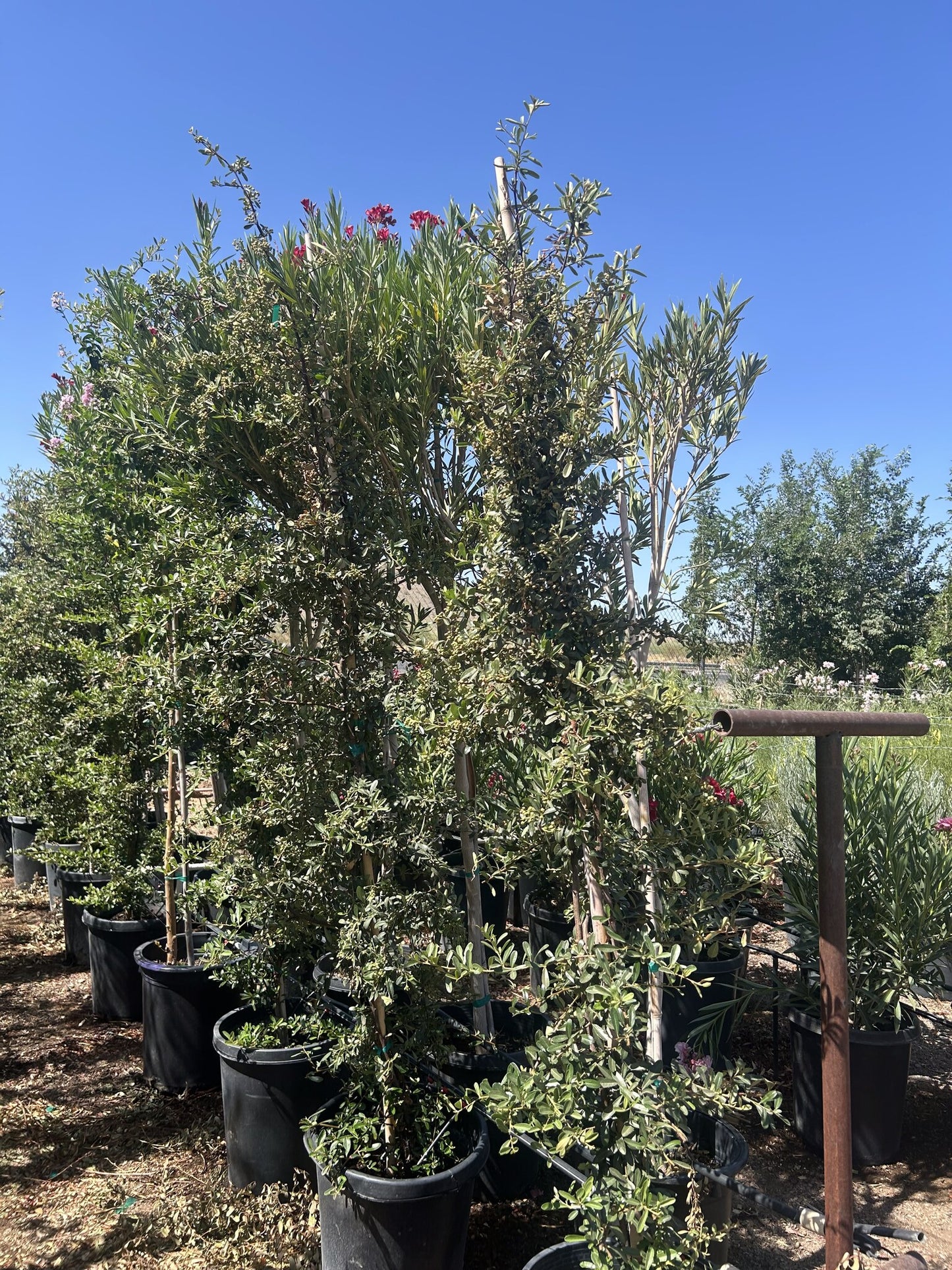


Scarlet Firethorn
Scarlet Firethorn
Couldn't load pickup availability
The Ultimate Security Hedge with Red Winter Berries — Scarlet Firethorn
Scarlet Firethorn (Pyracantha coccinea) is a tough, thorny evergreen shrub that delivers year-round interest with glossy green foliage, white spring flowers, and brilliant red berry clusters that last through winter. Growing 3–6 feet tall and 4–6 feet wide, this versatile shrub serves as both a beautiful ornamental and an effective security barrier. Birds flock to the colorful berries, making it a wildlife favorite in Scottsdale, Chandler, Mesa, Gilbert, Tempe, and Peoria landscapes.
Scarlet Firethorn Plant Details
| Attribute | Detail |
|---|---|
| Scientific Name | Pyracantha coccinea |
| Common Names | Scarlet Firethorn, Pyracantha, Fire Thorn |
| Mature Height | 3–6 feet |
| Mature Width | 4–6 feet |
| Growth Rate | Moderate to fast |
| Sun | Full sun to partial shade. Best berry production in full sun. |
| Water | Low to moderate once established. |
| USDA Zones | 6–10 (Phoenix is Zone 9b–10a) |
| Soil | Well-draining. Adapts to Arizona caliche and sandy soils. |
| Flower Color | White (spring) |
| Berry Color | Bright scarlet red (fall through winter) |
Why Scarlet Firethorn Thrives in Phoenix Landscapes
Native to southeastern Europe and western Asia, Pyracantha coccinea is well-adapted to hot, dry climates with well-draining soils — conditions that the Phoenix Valley provides in abundance. Once established, Scarlet Firethorn is surprisingly drought-tolerant for such a lush-looking shrub. Its dense thorny branches create an impenetrable barrier that deters intruders and unwanted foot traffic, while its seasonal display of white flowers followed by masses of red berries provides beauty and wildlife habitat year-round.
Perfect Uses for Scarlet Firethorn
Scarlet Firethorn excels as a security hedge along property boundaries, below windows, and around perimeters where you want both beauty and protection. Train it as an espalier against walls and fences for a dramatic flat display of berries in fall and winter. Use as a standalone specimen shrub in mixed borders or foundation plantings. The dense branching provides excellent nesting habitat for birds, making it a top choice for wildlife gardens. Plant along pool fences or courtyard walls in Scottsdale and Paradise Valley homes for year-round visual interest.
How to Plant Scarlet Firethorn in Arizona
Plant in full sun to partial shade with well-draining soil. Dig a hole twice the width of the root ball and the same depth. Backfill with native soil and water deeply. Space plants 3–4 feet apart for a continuous hedge, or 5–6 feet apart for standalone specimens. Apply 2–3 inches of gravel or rock mulch around the base. Wear thick gloves when handling — the thorns are sharp. Fall and spring are ideal planting times in Phoenix.
How to Water Scarlet Firethorn in Phoenix
During establishment (first 6–8 weeks), water every 3–4 days. Once roots are set, transition to deep watering once a week in summer and every 2–3 weeks in winter. Established Scarlet Firethorn is quite drought-tolerant but produces the best berry display with consistent moderate watering during the growing season. Avoid overwatering — ensure soil dries between waterings to prevent root issues.
Frequently Asked Questions
Do birds eat the Firethorn berries?
Yes, Scarlet Firethorn berries are a favorite food source for many bird species including mockingbirds, thrashers, robins, and waxwings. The berries ripen in fall and persist through winter, providing critical food when other sources are scarce. This makes Pyracantha one of the best bird-attracting shrubs for Arizona gardens.
Are Firethorn berries poisonous?
Pyracantha berries are not toxic to humans or pets, though they are quite bitter when raw. The seeds contain small amounts of cyanogenic compounds but are not considered dangerous. Birds consume them freely with no ill effects.
How do I prune Scarlet Firethorn?
Prune after the berry display fades in late winter or early spring. Remove dead, damaged, or crossing branches. For hedges, shape lightly after flowering to preserve developing berry clusters. Avoid heavy pruning during summer, as this removes the berry-bearing wood. Always wear heavy leather gloves when pruning due to the sharp thorns.
Can Scarlet Firethorn be trained as an espalier?
Absolutely. Pyracantha is one of the best shrubs for espalier training against walls and fences. The flexible young branches can be trained horizontally along wires, creating a flat, decorative display that showcases the berries beautifully against a wall background.
You May Also Like
Pyracantha Staked · Indian Hawthorne · Privet Wax Leaf · Texas Sage · Oleander
How Many Scarlet Firethorn Do I Need?
For a continuous security hedge, space plants about 4 feet on center so the thorny branches knit into a solid barrier.
| Hedge Length | Plants Needed (4 ft spacing) |
|---|---|
| 8 ft | 2 |
| 16 ft | 4 |
| 24 ft | 6 |
| 40 ft | 10 |
As a standalone specimen or espalier panel, give each plant 5 to 6 feet of clearance.
Scarlet Firethorn Season-by-Season in Phoenix
- Spring (Feb to Apr): Clusters of white flowers cover the shrub and draw bees, and new growth flushes. This is a strong second planting window.
- Summer (May to Sep): Holds glossy evergreen foliage through reflected heat while green berries swell. Monsoon rains support steady growth. Deep-water weekly in peak heat for the best fall berry set.
- Fall (Oct to Nov): Prime planting season. Berries ripen to brilliant scarlet and begin their long winter show.
- Winter (Dec to Jan): Berries persist and feed birds while foliage stays evergreen. Cold-hardy well below Phoenix lows (to about 0°F), so no frost protection is needed here.
At a Glance
✔ Pollinator-Friendly ✔ Heat-Loving (Reflected-Heat Tolerant) ✔ Drought-Tolerant ✔ Evergreen ✔ Low-Maintenance ✔ Deer & Rabbit-Resistant ✔ Cold-Hardy to 0°F
Plant It With
- Pyracantha Espalier: the same plant trained flat for a berry-covered wall.
- Bay Breeze Indian Hawthorn: a lower evergreen with spring bloom to soften the thorny hedge.
- Wax Leaf Privet: a fast, dense companion screen.
- Texas Sage: silver foliage and purple bloom contrast the dark green berries.
Is Scarlet Firethorn Right for Your Yard?
Firethorn is a strong fit for a full-sun security boundary, perimeter screen, or espalier on fast-draining soil, where its thorns deter foot traffic and its berries feed birds all winter. It is cold-hardy and heat-tolerant across the Valley. Not a fit right at a pool or a busy walkway: the sharp thorns and dropped berries make tight, high-traffic spots a poor choice, so give it room away from bare feet.
Share