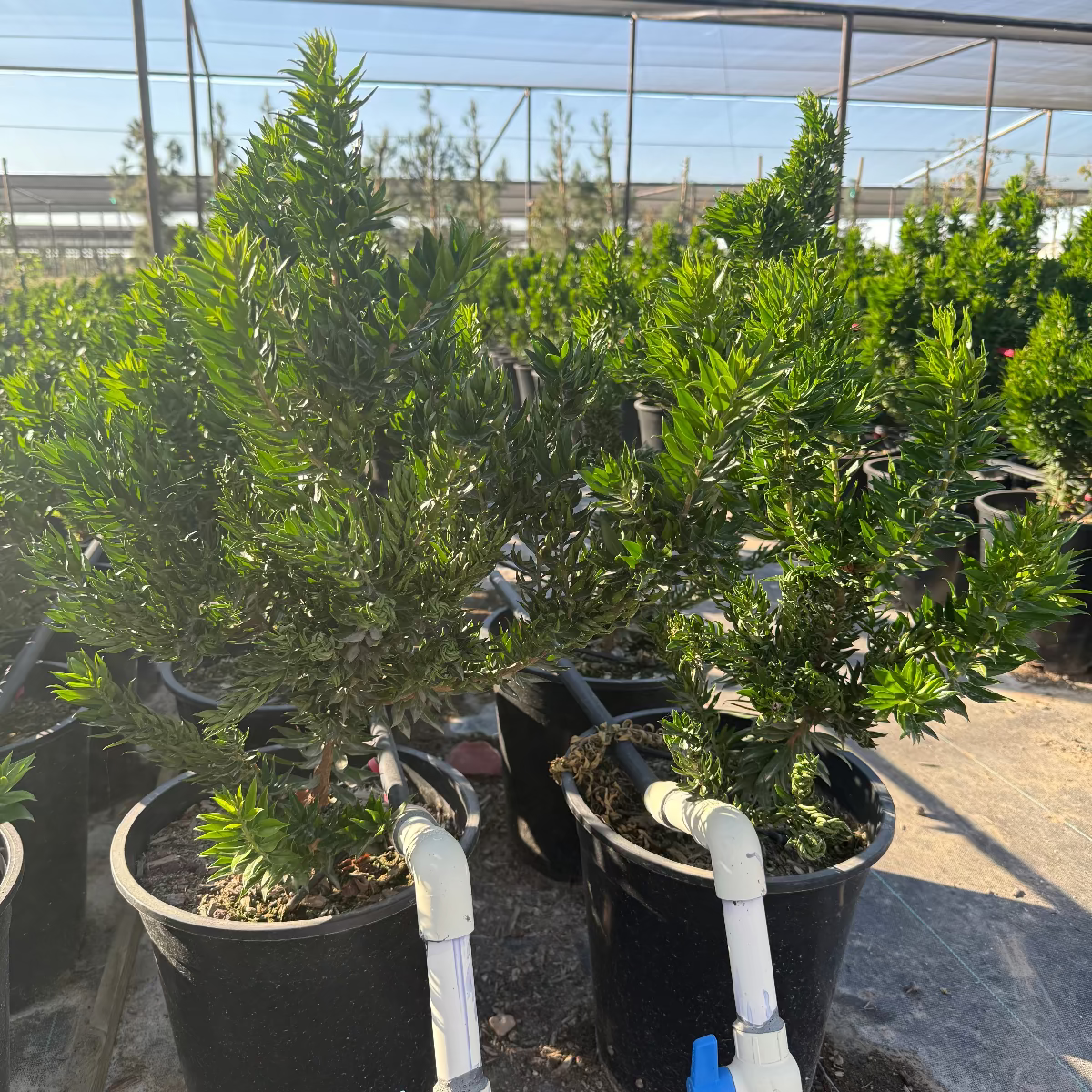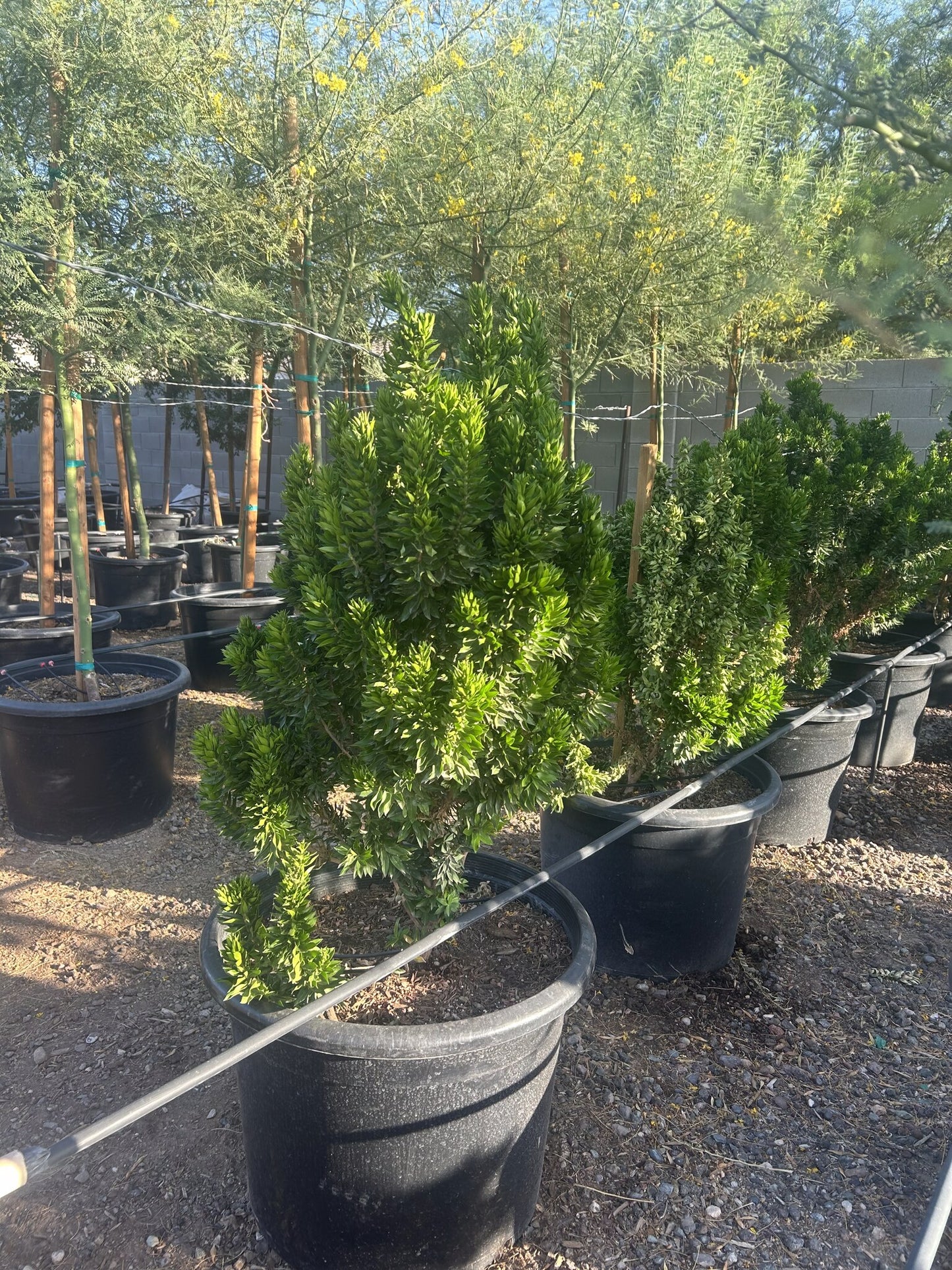


Roman Myrtle
Roman Myrtle
Couldn't load pickup availability
Phoenix's Best Fragrant Evergreen Privacy Hedge — Roman Myrtle
Roman Myrtle (Myrtus communis) is the Mediterranean evergreen that brings fragrance, texture, and lasting privacy to Phoenix Valley landscapes. Growing 6–8 feet tall with a naturally dense, upright form, it creates a lush green privacy screen that stays attractive year-round with minimal maintenance. Clusters of small white fragrant flowers appear in spring and summer, followed by dark berries that attract birds. Whether you're building a privacy hedge in Scottsdale, adding a formal screen along a wall in Chandler, or creating a Mediterranean courtyard feel in Tempe — Roman Myrtle is the aromatic, low-maintenance choice that delivers results.
Roman Myrtle Plant Details
| Attribute | Detail |
|---|---|
| Scientific Name | Myrtus communis |
| Common Names | Roman Myrtle, True Myrtle, Mediterranean Myrtle |
| Mature Height | 6–8 feet |
| Mature Width | 4–6 feet |
| Growth Rate | Moderate — 1–2 feet per year in Phoenix |
| Sun | Full sun to partial shade. Handles reflected heat from walls. |
| Water | Low to moderate once established. Drought-tolerant. |
| USDA Zones | 8–11 (Phoenix is Zone 9b–10a) |
| Soil | Well-draining. Adapts to Arizona caliche soils. |
| Foliage | Evergreen — glossy, aromatic foliage year-round |
| Bloom Color | White, fragrant; spring through summer |
Roman Myrtle Uses in Phoenix Landscapes
Privacy Hedges and Screens
Roman Myrtle is one of the best medium-height privacy hedges available for the Phoenix Valley. Its naturally dense, upright growth fills in quickly to create a solid green wall between properties, along fences, and beside patios. Plant 3–4 feet apart for a continuous hedge — a 20-foot fence line needs 5–7 plants, a 40-foot fence needs 10–13 plants. Pairs beautifully with Purple Hopseed Bush for alternating texture and color along property lines.
Mediterranean and Formal Garden Designs
Roman Myrtle is a signature plant in Mediterranean, Italian, and Tuscan-inspired Phoenix landscapes. Its small, aromatic leaves, fragrant white blooms, and classic upright form give gardens a refined Old World elegance. Pair with Lavender, Rosemary, Dwarf Myrtle, or Desert Olive for an authentic Mediterranean aesthetic that thrives in Phoenix's dry heat.
Pool-Friendly Screening
Roman Myrtle's small leaf size and clean growth habit mean minimal pool debris — making it a popular privacy screen around pool decks in Scottsdale, Paradise Valley, and Gilbert. Its fragrant blooms add sensory appeal in outdoor living spaces. Plant 3 feet apart along the pool perimeter for a lush, private screen that reaches privacy height within 2–3 growing seasons.
Container and Topiary Applications
Roman Myrtle is one of the best shrubs for topiary and formal shaping in Phoenix. Its dense branching structure and small leaves take shearing beautifully, making it ideal for spiral, ball, and column forms in large containers. It's a long-lived container plant that rewards regular light pruning with increasingly dense, elegant structure.
Best Time to Plant Roman Myrtle in Phoenix
Fall (October–November) is the ideal planting window. Warm soil temperature encourages root development while cooler air reduces transplant stress. Plants have 6–8 months to establish before their first Phoenix summer. Spring (February–April) is the second-best option — just water more frequently as temperatures rise through May and June. Avoid summer planting if possible, as new root systems need careful management through Phoenix's extreme heat.
How to Plant Roman Myrtle
- Dig wide, not deep — 2–3x the root ball width, same depth to encourage wide lateral root spread in Phoenix's hard soils.
- Check for caliche — break through any hardpan layer to ensure proper drainage beneath the planting hole.
- Backfill with native soil — a 20% organic amendment blend is fine; avoid over-amending in caliche-heavy areas.
- Spacing — 3–4 feet apart for hedges and screens; 5–6 feet for individual specimen plants and topiaries.
- Water basin — build a 3–4 inch soil ring around the plant to direct irrigation to the root zone.
- Mulch — apply 2–3 inches of bark or gravel mulch to retain soil moisture and regulate root temperature through Phoenix summers.
Watering Roman Myrtle in Phoenix
First Year Watering Schedule
Weeks 1–2: Water every 1–2 days, deep and slow (20–30 minutes). Month 1–2: Reduce to every 3–4 days. Month 3–6: Water every 7–10 days (every 5–7 days during peak summer). After Year 1: Every 10–14 days in summer; every 3–4 weeks in winter. Roman Myrtle establishes quickly and becomes progressively more drought-tolerant as its root system expands through Phoenix's soil.
Drip Irrigation
Place one or two drip emitters (1–2 GPH) 18–24 inches from the trunk. Run for 30–45 minutes per session. For hedge plantings, space emitters evenly between plants. Established Roman Myrtle in Phoenix requires minimal supplemental water — particularly when planted with 2–3 inches of mulch to conserve soil moisture.
How fast does Roman Myrtle grow in Phoenix?
Roman Myrtle grows moderately fast in Phoenix — expect 1–2 feet of growth per year. Starting from a 5-gallon plant, it typically reaches privacy height (6+ feet) within 3–4 growing seasons. Planting a 15-gallon specimen gives you an immediate privacy presence.
Is Roman Myrtle drought tolerant once established?
Yes — once fully established after 1–2 growing seasons, Roman Myrtle is drought tolerant and handles Phoenix's dry summers with supplemental drip irrigation. It's more water-efficient than most traditional privacy hedges like ficus or photinia.
What's the difference between Roman Myrtle and Dwarf Myrtle?
Roman Myrtle (Myrtus communis) grows 6–8 feet tall and is ideal for privacy hedges and screens. Dwarf Myrtle ('Compacta') stays at 2–3 feet and is best for low borders, containers, and formal edging. Both have the same aromatic foliage and white flowers.
Does Roman Myrtle work in partial shade?
Yes — Roman Myrtle tolerates partial shade well, making it one of the few good privacy hedge options for north-facing or shaded walls and courtyards in Phoenix. It grows a bit slower in shade but maintains its dense form and fragrant blooms.
Does Roman Myrtle attract birds or wildlife?
Yes — the white flowers attract pollinators in spring and summer, and the small dark berries that follow are a food source for songbirds. Roman Myrtle is a beautiful, ecologically beneficial hedge choice for Phoenix wildlife gardens.
You May Also Like
Dwarf Myrtle — The compact 2–3 foot version of the same Mediterranean classic — ideal for low borders and container plantings.
Wax Leaf Privet — A faster-growing alternative privacy hedge with larger, glossier foliage and fragrant white blooms in spring.
Purple Hopseed Bush — A fast-growing bronze-purple privacy plant that creates dramatic color contrast alongside the green Roman Myrtle.
Green Hopseed Bush — Phoenix's most popular fast-growing privacy hedge — pairs beautifully with Roman Myrtle for mixed-texture screening.
Dwarf Pittosporum — A compact, fast-growing evergreen that complements Roman Myrtle in formal mixed hedge designs.
How Many Roman Myrtle Do I Need?
For a dense fragrant privacy hedge, space Roman Myrtle about 3.5 feet apart (its mature spread is 4 to 6 feet). For specimen plants or topiary forms, give each 5 to 6 feet. Use this table to size a hedge run:
| Run Length | Plants Needed (3.5 ft spacing) |
|---|---|
| 10 ft | 3 plants |
| 20 ft | 6 plants |
| 30 ft | 9 plants |
| 40 ft | 12 plants |
| 50 ft | 15 plants |
Roman Myrtle Season-by-Season in Phoenix
- Spring (Feb-Apr): Fresh growth pushes and the fragrant white bloom begins. A prime planting and topiary-shaping window.
- Summer (May-Sep): Flowering continues into summer. It handles reflected heat off walls and, once established, stays drought-tolerant with modest drip. Monsoon humidity (Jul-Sep) asks for little extra.
- Fall (Oct-Nov): Small dark berries form behind the flowers, feeding songbirds. Prime planting season for root establishment.
- Winter (Dec-Jan): Reliably evergreen, holding its glossy aromatic foliage. Hardy to about 15°F and dependable through Valley winters.
At a Glance
✔ Evergreen ✔ Drought-Tolerant ✔ Heat-Loving (Reflected-Heat Tolerant) ✔ Pool-Friendly (Low-Litter) ✔ Low-Maintenance ✔ Pollinator-Friendly ✔ Cold-Hardy to 15°F
Plant It With
- Dwarf Myrtle: The compact 2 to 3 ft version of the same myrtle, for a matching low border or edge.
- Purple Hopseed: Bronze-purple foliage for dramatic contrast along the same property line.
- Green Hopseed: A fast-growing green screen to mix in for quicker height and texture.
- Dwarf Pittosporum: A compact evergreen that rounds out a formal mixed hedge.
Is Roman Myrtle Right for Your Yard?
Roman Myrtle suits full sun to part shade in well-drained soil with low to moderate water, and it is hard to beat for fragrant hedges, Mediterranean gardens, topiary, and pool screens. It is not a fit if you need an instant tall screen, since it grows at a moderate pace, or if the soil stays constantly wet.
Customer Reviews
Found a listing for local for Myrtus communis 'Boetica', a very interesting and sculptural specimen tree. The leaves smell fantastic and can be used in place of bay trees. The fruits are edible and can be used for seasoning meats or creating a liquor. Communication was great, delivery was great. Very pleased with the trees.
Share