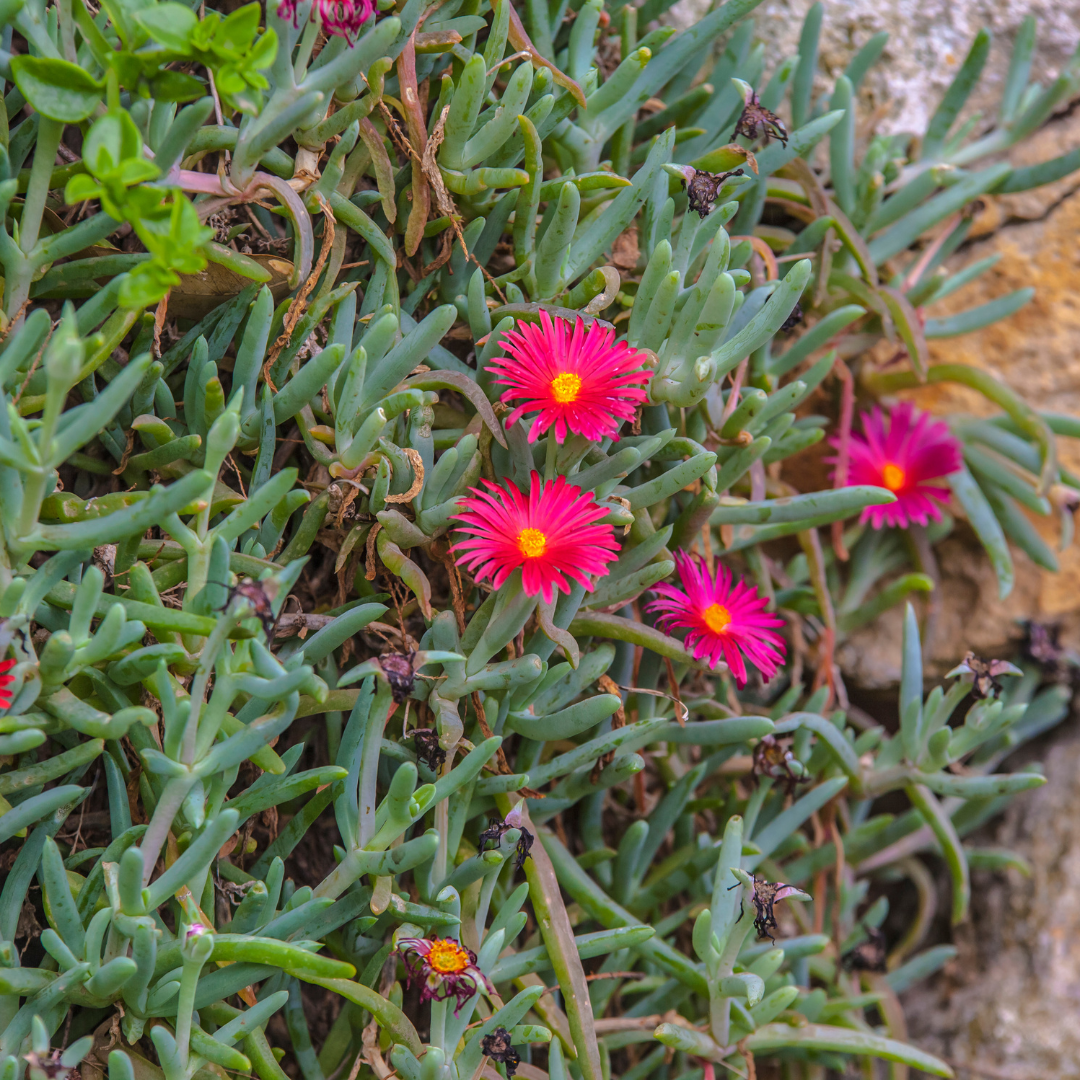


Red Spike Ice Plant
Red Spike Ice Plant
Couldn't load pickup availability
Drought-Tolerant Red Groundcover for Phoenix Sun
Red Spike Ice Plant (Cephalophyllum 'Red Spike') is one of the toughest and most colorful groundcover succulents you can plant in the Phoenix Valley. This low-growing succulent produces masses of brilliant red, daisy-like flowers in late winter and early spring — right when your landscape needs color the most. Its finger-like succulent leaves stay green year-round, creating a dense mat that chokes out weeds and stabilizes soil. It thrives in full Arizona sun, handles reflected heat, and needs almost no water once established. Whether you're covering a slope in Scottsdale, edging a pathway in Mesa, or filling a rock garden in Chandler — Red Spike Ice Plant delivers vivid color with virtually zero maintenance.
Red Spike Ice Plant Details
| Attribute | Detail |
|---|---|
| Scientific Name | Cephalophyllum 'Red Spike' |
| Common Names | Red Spike Ice Plant, Red Ice Plant |
| Mature Height | 3–6 inches |
| Mature Width | 18–24 inches per plant (spreads to form dense mats) |
| Growth Rate | Moderate to Fast — fills in within 1–2 seasons |
| Sun | Full sun (6+ hrs). Thrives in reflected heat from walls and pavement. |
| Water | Very low. Extremely drought-tolerant once established. |
| USDA Zones | 9–11 (Phoenix is Zone 9b–10a) |
| Soil | Well-draining. Thrives in sandy, rocky, and gravelly Arizona soils. Tolerates caliche. |
| Foliage | Evergreen succulent — green finger-like leaves year-round |
| Bloom Color | Brilliant red, late winter through spring |
Red Spike Ice Plant Uses in Phoenix Landscapes
Groundcover & Mass Planting
Red Spike Ice Plant is one of the best succulent groundcovers for Phoenix. Plant them 18–24 inches apart and they'll knit into a solid carpet of green with seasonal bursts of red blooms. Perfect for covering large areas where you want zero-irrigation color. A 100-square-foot bed needs about 30–40 plants.
Slope & Erosion Control
The dense root system and spreading habit make Red Spike excellent for stabilizing slopes, berms, and embankments. It handles the harsh conditions of south-facing slopes — full sun, reflected heat, and zero supplemental water — better than almost any other flowering groundcover.
Rock Garden & Xeriscape Accent
Tuck Red Spike into gaps between boulders, along dry creek beds, and around decomposed granite pathways. The succulent texture and seasonal red blooms pop against gravel and stone in Tempe, Peoria, and Gilbert desert landscapes.
Border & Edging
At just 3–6 inches tall, Red Spike makes a perfect low border along walkways, driveways, and garden beds without blocking sightlines. The evergreen succulent foliage looks tidy year-round.
Best Time to Plant Red Spike Ice Plant in Phoenix
Fall (October–November) is the ideal window. Cooler temperatures and warm soil promote fast root establishment. Your ice plant gets months to root in before summer. Spring (February–April) is the second-best window. Avoid planting in peak summer heat.
How to Plant Red Spike Ice Plant
- Dig a shallow hole — Just deep enough for the root ball and 2x as wide. Ice plants have shallow roots.
- Ensure drainage — Break through any caliche layer. Succulents rot in standing water.
- Backfill with native soil — No amendments needed. Ice plants prefer lean, fast-draining soil.
- Spacing — 18–24 inches apart for groundcover; 12 inches for faster fill-in.
- No mulch needed — Gravel or decomposed granite is fine around ice plants. Avoid bark mulch which retains too much moisture around succulent stems.
Watering Red Spike Ice Plant in Phoenix
First Year Watering Schedule
Weeks 1–2: Water every 3–4 days, light. Month 1–3: Every 7–10 days. After Month 3: Every 14–21 days. After Year 1: Monthly or less in summer; almost nothing in winter. Overwatering is the #1 cause of ice plant failure.
Drip Irrigation
One 0.5-GPH emitter per plant during establishment. For mass plantings, use drip tubing with emitters every 18 inches. Reduce or eliminate irrigation once established — these are true desert succulents.
When does Red Spike Ice Plant bloom in Phoenix?
Late winter through early spring (January–March) is peak bloom time. The brilliant red flowers create a stunning display right when most other plants are dormant. Some sporadic blooming may occur into early summer.
Is Red Spike Ice Plant truly drought tolerant?
Extremely. Once established, Red Spike Ice Plant can survive on rainfall alone in the Phoenix area. It stores water in its succulent leaves and needs far less irrigation than any flowering groundcover alternative.
What's the difference between Red Spike Ice Plant and Red Ice Plant?
Red Spike (Cephalophyllum) has upright, finger-like leaves and blooms primarily in winter-spring. Both are succulent groundcovers that thrive in Phoenix. Three Timbers carries both varieties.
Does ice plant attract pests?
Rarely. Ice plants are virtually pest-free in the Phoenix area. The biggest threat is overwatering, which can cause root rot. In dry, sunny conditions, they're among the most trouble-free plants available.
You May Also Like
Red Ice Plant — Another red-flowering succulent groundcover with slightly different growth habit.
Red Gazania — A flowering groundcover with bold red daisy-like blooms for sunny spots.
Yellow Gazania — Bright yellow groundcover blooms that pair well with red ice plant.
Lantana — A colorful, spreading groundcover shrub for borders and mass plantings.
Desert Spoon — A sculptural desert accent that pairs beautifully with low groundcovers.
How Many Red Spike Ice Plant Do I Need?
Red Spike spreads 18 to 24 inches wide, so space plants about 18 inches on center for a solid succulent mat. Use this coverage guide:
| Area to Cover | Plants Needed (18 in spacing) |
|---|---|
| 25 sq ft | about 12 plants |
| 50 sq ft | about 22 plants |
| 100 sq ft | about 44 plants |
| 200 sq ft | about 89 plants |
Tighten to 12 inches on center for faster fill-in on slopes and erosion-control plantings.
Red Spike Ice Plant Season-by-Season in Phoenix
- Spring (Feb to Apr): Peak color winds down from the winter-spring bloom as masses of red flowers carry into March. New succulent growth flushes with warming soil. A good second planting window.
- Summer (May to Sep): Tough through extreme and reflected heat. Growth slows in the hottest stretch. Cut irrigation back hard: overwatering in summer, not heat, is what rots ice plant. Monsoon humidity is tolerated as long as soil drains fast.
- Fall (Oct to Nov): Prime planting season. Warm soil and cooling air drive fast root establishment before winter bloom sets buds.
- Winter (Dec to Jan): The main event. Brilliant red daisy-like flowers open in the low desert when most plants are bare. Foliage stays evergreen. Can show tip damage in a hard frost below about 25°F, so cover in a rare cold snap and it bounces back fast.
At a Glance
✔ Drought-Tolerant ✔ Heat-Loving (Reflected-Heat Tolerant) ✔ Pool-Friendly (Low-Litter) ✔ Pollinator-Friendly ✔ Evergreen ✔ Low-Maintenance
Plant It With
- Red Ice Plant: a companion red-flowering succulent mat with a trailing habit for layered groundcover color.
- Purple Ice Plant: magenta blooms that contrast the red and bloom in a different season for longer color.
- AZ Ice Plant-Copper: warm copper-orange tones to blend a multi-color ice plant carpet.
- Desert Spoon: a sculptural desert accent that rises above the low mat for height and structure.
Is Red Spike Ice Plant Right for Your Yard?
Red Spike thrives in full sun and reflected heat, in lean sandy or gravelly soil that drains fast, on slopes, rock gardens, and hot xeriscape beds where almost nothing else flowers in winter. Break through caliche so water never stands around the crown. It is not a fit if your site is shady, holds water after rain, or gets regular irrigation: soggy roots and overwatering are the only things that reliably kill it.
Share