

Red Oleander Tree
Red Oleander Tree
Couldn't load pickup availability
Phoenix's Most Vivid Privacy Tree — Red Oleander Tree
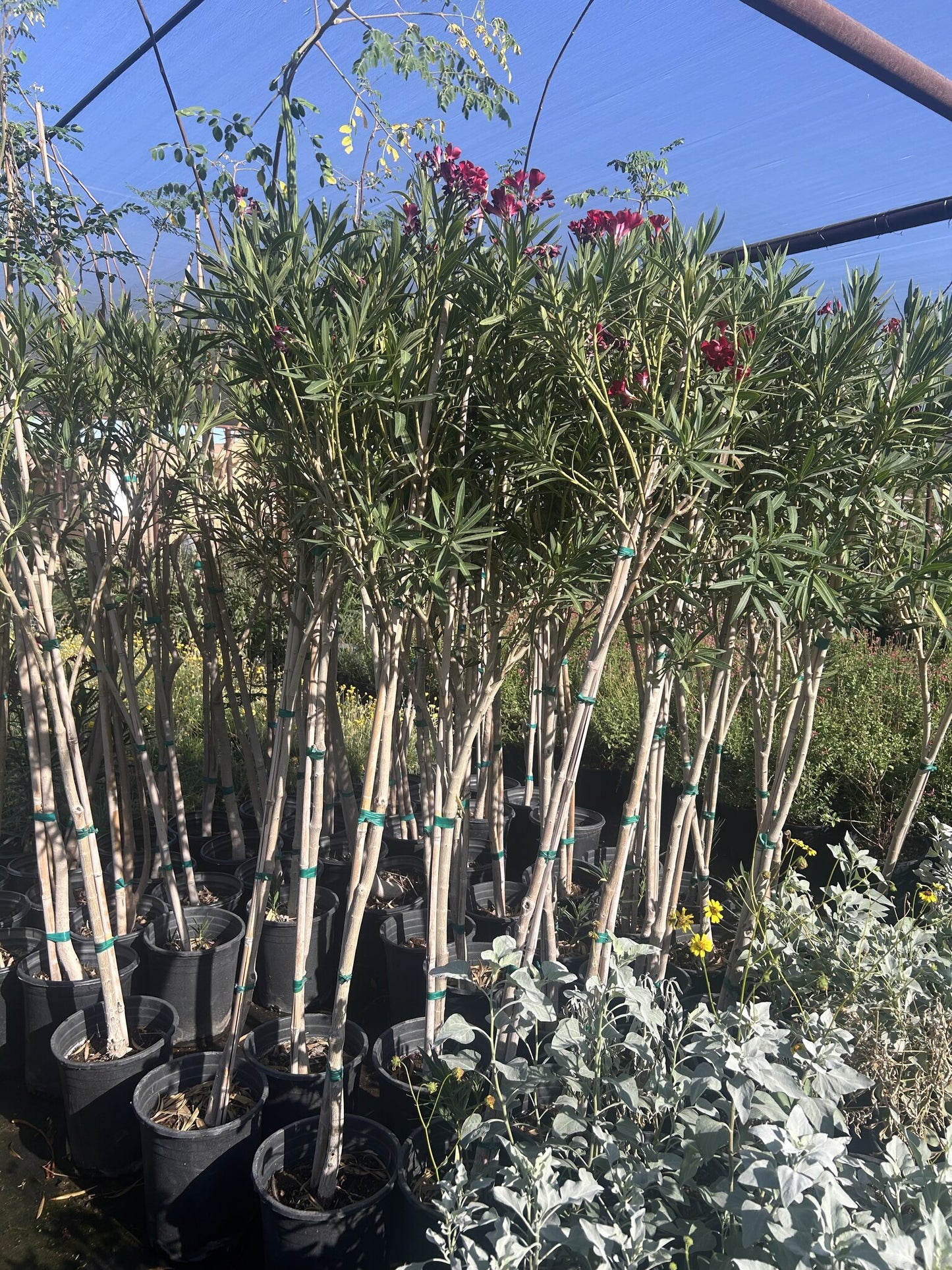
Red Oleander Tree (Nerium oleander 'Red') is Phoenix's boldest and most colorful privacy tree. With clusters of deep red trumpet flowers blooming continuously from spring through fall, an upright tree form, and year-round evergreen foliage, it delivers privacy and showstopping color like nothing else in the Phoenix Valley. Once established, it's virtually indestructible — tolerating extreme heat, drought, and neglect while still flowering prolifically. Whether you're creating a vivid privacy screen in Scottsdale, adding dramatic color along a fence in Chandler, or bringing year-round structure to a Tempe or Gilbert backyard — Red Oleander Tree gets the job done.
Red Oleander Tree Plant Details
| Attribute | Detail |
|---|---|
| Scientific Name | Nerium oleander (Red cultivar) |
| Common Names | Red Oleander Tree, Red Oleander |
| Mature Height | 8–12 feet |
| Mature Width | 6–10 feet |
| Growth Rate | Fast — 3–5 feet per year in Phoenix |
| Sun | Full sun (6+ hrs). Thrives in reflected heat from walls and pavement. |
| Water | Very low once established. One of the most drought-tolerant flowering trees in Arizona. |
| USDA Zones | 8–11 (Phoenix is Zone 9b–10a) |
| Soil | Well-draining. Adapts to Arizona caliche soils. |
| Foliage | Evergreen — glossy, lance-shaped dark green leaves year-round |
| Flower Color | Deep red; blooms spring through fall — one of Phoenix's longest-blooming trees |
| Toxicity Note | All parts are toxic if ingested. Plant away from areas accessible to children and pets. |
Red Oleander Tree Uses in Phoenix Landscapes
Flowering Privacy Screen
Red Oleander Tree's upright form and dense foliage makes it one of the most effective privacy screens available in Phoenix landscaping. Unlike shrub-form oleanders, the tree form is pruned to a single or multi-trunk structure that provides clean, upright privacy coverage without sprawling. For a 20-foot fence screen, plant 2–3 trees spaced 6–8 feet apart; for a 40-foot boundary, plant 4–5 trees. Pair with Green Hopseed Bush or Desert Spoon along the base for a layered screen. Red flowers add dramatic visual interest that flat green hedges simply cannot match.
Low-Water Windbreak & Color Accent
Red Oleander Tree's dense evergreen foliage provides meaningful wind and dust buffering along property lines and open desert exposures. Its fast growth rate (3–5 ft per year) means it establishes a windbreak faster than almost any other privacy tree in Phoenix. As a bonus, the continuous red blooms turn a utilitarian windbreak into a stunning landscape feature. Plant along west- or north-facing exposures in Peoria, Surprise, or Goodyear where dust storms regularly roll through.
Pool-Area Screening Tree
Red Oleander Tree is a popular choice for pool-area privacy in Phoenix and Scottsdale. Its non-invasive roots won't crack pool decking, and its upright tree form provides overhead privacy screening without overwhelming small outdoor spaces. Red oleander flowers drop cleanly and are minimal compared to other flowering trees. Note: oleander is toxic — ensure pets and young children don't have access to plant material. Plant on the perimeter of pool areas at least 8–10 feet from the water's edge.
Specimen Color Tree for Modern Desert Design
With its sleek tree form and vivid red flowers, Red Oleander Tree is an outstanding specimen accent for modern desert landscapes, xeriscape gardens, and contemporary Phoenix-area homes. The deep red blooms contrast brilliantly against white stucco walls, grey decomposed granite, and the earthy tones typical of Arizona hardscapes. Pair with Yellow Oleander Tree or Pink Oleander Tree for a multi-color flowering privacy screen that blooms all season long.
Best Time to Plant Red Oleander Tree in Phoenix
Fall planting (October–November) is ideal for Red Oleander Tree in Phoenix. Warm soil temperatures encourage fast root establishment, while cooler air dramatically reduces transplant stress. A fall-planted Red Oleander gets a full 6–8 months of root development before its first Phoenix summer. Spring planting (February–April) is the second-best window. Avoid planting in June–August; summer heat significantly stresses transplants even for drought-tolerant species.
How to Plant Red Oleander Tree
- Dig wide, not deep — excavate a hole 2–3x the width of the root ball but no deeper than the root ball height.
- Check for caliche — probe the hole bottom for hardpan. If found, break through for proper drainage.
- Backfill with native soil — Red Oleander thrives in unamended desert soil. Light 20% organic blend is fine.
- Spacing — plant 6–8 ft apart for a privacy screen; 10–12 ft apart as individual specimen trees.
- Build a water basin — form a 3–4 inch earthen ring around the drip line to focus irrigation.
- Mulch — apply 2–3 inches of bark mulch or decomposed granite to retain moisture.
Watering Red Oleander Tree in Phoenix
First Year Watering Schedule
Red Oleander Trees need consistent watering during their first year to establish:
- Weeks 1–2: Water every 1–2 days, deeply and slowly (20–30 min)
- Months 1–2: Water every 3–4 days
- Months 3–6: Water every 7–10 days (every 5–7 days in peak summer)
- After Year 1: Every 10–14 days in summer; every 3–4 weeks in winter
Drip Irrigation
Position drip emitters 18–24 inches from the trunk. Use 2–4 GPH emitters and run 45–60 minutes per cycle for deep penetration. Once fully established (2–3 years in Phoenix), Red Oleander Trees are extremely drought-tolerant and may need supplemental irrigation only in peak summer months (June–August).
How fast does Red Oleander Tree grow in Phoenix?
Red Oleander Tree is one of the fastest-growing privacy trees available in Phoenix, typically putting on 3–5 feet of growth per year under good conditions. In its first year, growth may be slightly slower as the tree focuses on root establishment. By year 2–3, a well-established tree can reach full screening height quickly.
How does Red Oleander Tree differ from Red Oleander shrub?
The tree form is trained to a single or multi-trunk structure with a clear trunk rising before the canopy begins, creating an upright, tidy appearance compared to the sprawling form of shrub oleanders. Tree-form oleanders provide more focused, vertical screening and fit better in narrow spaces. They're also easier to walk under and maintain in formal or semi-formal landscape designs.
Is Red Oleander Tree truly drought-tolerant once established?
Yes — oleanders in general are among the most drought-tolerant flowering trees in Arizona. Once established in Phoenix (typically 2 full growing seasons), Red Oleander Trees often survive on minimal supplemental irrigation outside of peak summer. They're regularly planted along freeways and commercial properties across the Phoenix Valley precisely because of their extreme toughness.
Can Red Oleander Tree handle Phoenix summer heat?
Absolutely. Red Oleander Tree is one of the toughest heat-tolerant trees in Arizona. It actually flowers more prolifically in Phoenix's intense summer heat than in cooler climates. It handles reflected heat from stucco walls, concrete, and pavement with no stress — making it ideal for west-facing or south-facing exposures.
Is Red Oleander Tree safe near pools?
Red Oleander Tree can work near pools but requires some precautions due to its toxicity. All parts of oleander are toxic if ingested. Plant at least 8–10 feet from pool edges, and avoid placing it where fallen flowers or leaves drop directly into the water. Its non-invasive root system won't damage pool decking or plumbing.
You May Also Like
- White Oleander Tree — Same upright tree form with pristine white flowers; elegant complement to red oleander.
- Pink Oleander Tree — Soft pink flowering privacy tree; pairs beautifully with red for multi-color screens.
- Yellow Oleander Tree — Bright yellow blooms on a related but distinct species; dramatic color contrast to red.
- Green Hopseed Bush — Fast-growing evergreen privacy shrub ideal for base planting under oleander trees.
- Texas Olive — White-flowering, thornless privacy tree; great companion or alternative to Red Oleander.
How Many Red Oleander Trees Do I Need?
Red Oleander matures to 6 to 10 ft wide, so space trees about 8 ft on center for a solid screen (closer at 6 ft for a faster, denser wall; wider at 10 ft to read as individual specimens).
| Run Length | Trees Needed (8 ft spacing) |
|---|---|
| 16 ft | 2 to 3 |
| 24 ft | 3 to 4 |
| 40 ft | 5 to 6 |
| 80 ft | 10 to 11 |
Red Oleander Tree Season-by-Season in Phoenix
- Spring (Feb to Apr): A strong flush of new growth and the start of the long red bloom. Best secondary planting window after fall. Light shaping now sets the canopy for the season.
- Summer (May to Sep): Peak performance. Red Oleander flowers hardest in extreme heat and shrugs off reflected heat from stucco and pavement. Monsoon humidity and rain are no problem. Established trees need only occasional deep soaks.
- Fall (Oct to Nov): Blooming continues and this is the prime planting season in Phoenix, giving roots months to establish before summer.
- Winter (Dec to Jan): Stays evergreen and holds its structure. Hardy to about 20°F, so Valley winters rarely faze it; a hard cold snap may nip tender tips that flush back in spring.
At a Glance
✔ Heat-Loving (Reflected-Heat Tolerant) ✔ Drought-Tolerant ✔ Evergreen ✔ Low-Maintenance ✔ Deer & Rabbit-Resistant ✔ Cold-Hardy to 20°F
Plant It With
- White Oleander Tree: same tidy tree form in white for a two-tone flowering screen.
- Pink Oleander Tree: soft pink blooms that blend into a multi-color privacy row.
- Green Hopseed: fast evergreen shrub to fill in the base below the trunks.
- Texas Olive: thornless white-flowering tree as a non-toxic companion farther from play areas.
Is Red Oleander Tree Right for Your Yard?
Red Oleander Tree thrives in full sun and reflected heat, drains-fast caliche or amended soil, and tight spots where you need fast vertical privacy with color on very little water. It is one of the toughest, lowest-care flowering trees for the Valley. Not a fit if you have young children or pets who might chew foliage, or if you want a tree directly over a pool, since every part of oleander is toxic and is best sited away from play and swim areas.
Share