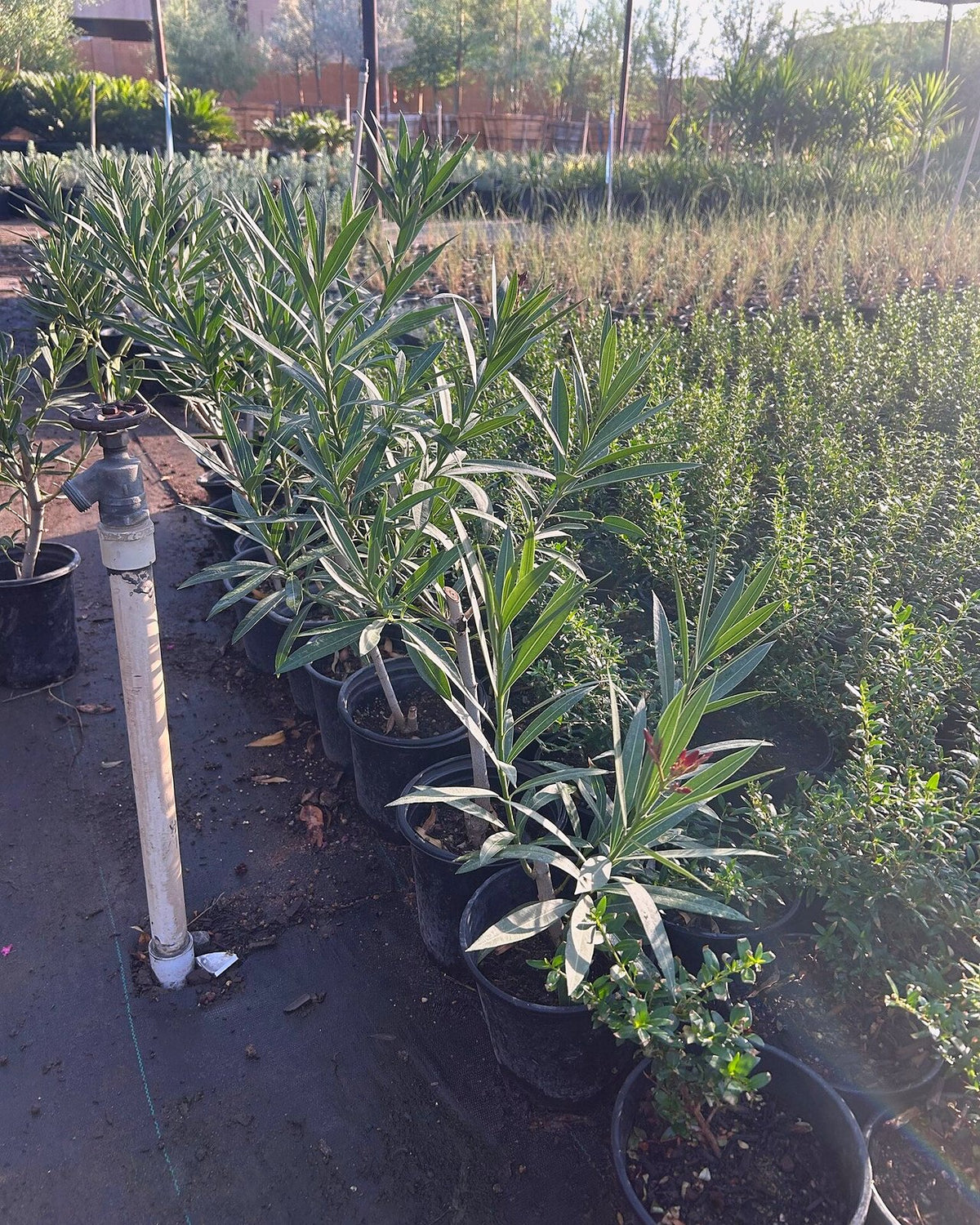


Red Oleander
Red Oleander
Couldn't load pickup availability
Phoenix's Boldest Drought-Tolerant Privacy Shrub — Red Oleander
Red Oleander (Nerium oleander) is the most striking privacy and screening shrub available for Phoenix landscapes. This fast-growing evergreen produces stunning clusters of deep red blooms from spring through fall while forming a dense, heat-proof barrier that handles Arizona summers with ease. Whether you're screening a fence line in Scottsdale, building a color-filled hedge in Chandler, or adding bold year-round structure to a landscape in Mesa — Red Oleander delivers unmatched performance and beauty. Note: All parts of Oleander are toxic if ingested — plant away from children and pets.
Red Oleander Plant Details
| Attribute | Detail |
|---|---|
| Scientific Name | Nerium oleander |
| Common Names | Red Oleander, Oleander |
| Mature Height | 8–12 feet |
| Mature Width | 6–10 feet |
| Growth Rate | Fast — 2–3 feet per year in Phoenix |
| Sun | Full sun (6+ hrs). Thrives in reflected heat from walls and pavement. |
| Water | Low once established. One of Arizona's most drought-tolerant shrubs. |
| USDA Zones | 9–11 (Phoenix is Zone 9b–10a) |
| Soil | Well-draining. Adapts to Arizona caliche soils. |
| Foliage | Evergreen — stays green year-round |
| Flower Color | Deep red (clusters, blooms spring through fall) |
| Toxicity | All parts toxic if ingested — keep away from children and pets |
Red Oleander Uses in Phoenix Landscapes
Privacy Hedge and Screen
Red Oleander is one of the fastest-growing and most effective privacy hedges available in the Phoenix Valley. Its dense, upright growth habit quickly creates a solid 8–12 foot screen that blocks views, reduces noise, and stays green year-round. Plant 4–6 feet apart for a continuous hedge — for a 20 ft fence line, use 4–5 plants; for a 40 ft fence line, plan on 7–10 plants.
Fence Line and Block Wall Accent
Red Oleander's bold crimson blooms make it one of the most visually striking choices for fence lines and block walls throughout Scottsdale, Gilbert, and Tempe. The fiery red flowers create a dramatic color statement that few other shrubs can match, while its thick foliage softens hard landscape elements year-round.
Color-Focused Desert Garden
Blooming from spring through fall — and even into winter during warm years — Red Oleander provides more sustained color than nearly any other drought-tolerant shrub in the Phoenix area. Pair it with Texas Sage for a classic red-and-purple Arizona color combination, or with Desert Spoon for bold textural contrast in Peoria or Glendale landscapes.
Highway and Road Median Screening
Red Oleander is one of the most common highway and median plants in the Phoenix Valley for good reason — it's almost indestructible. It tolerates car exhaust, reflected heat from asphalt, extreme drought, and hard-packed soils that would kill most shrubs. For residential applications near busy streets in Mesa or Chandler, it creates an effective sound and visual buffer.
Best Time to Plant Red Oleander in Phoenix
Fall planting (October through November) is ideal for Red Oleander in the Phoenix Valley. Warm soil temperatures encourage rapid root establishment while cooler air reduces transplant stress — giving the plant a full 6–8 months to establish before its first Phoenix summer. Spring planting (February through April) is an excellent second option. Avoid summer planting when possible, though established Red Oleander is remarkably tough even in extreme heat.
How to Plant Red Oleander
- Dig wide, not deep — dig the hole 2–3x the width of the root ball, same depth
- Check for caliche — break through any hardpan layer to ensure proper drainage
- Backfill with native soil — minimal amendment needed; Oleander adapts to almost any soil
- Spacing — 4–6 feet apart for a privacy hedge; 6–8 feet for specimen plants
- Water basin — build a 3–4 inch ring around the base to direct water to roots
- Mulch — apply 2–3 inches of bark or gravel mulch to conserve moisture
Watering Red Oleander in Phoenix
First Year Watering Schedule
- Weeks 1–2: Water every 1–2 days, deep and slow (20–30 minutes)
- Month 1–2: Reduce to every 3–4 days
- Month 3–6: Water every 7–10 days (every 5–7 days during peak summer)
- After Year 1: Every 14–21 days in summer; monthly or less in winter
Drip Irrigation
Use 2-GPH emitters placed 18–24 inches from the trunk. Red Oleander is exceptionally drought-tolerant once established and can survive extended dry periods in Phoenix with minimal supplemental irrigation. Mature plants often thrive on natural rainfall alone during cooler months.
How fast does Red Oleander grow in Phoenix?
In the Phoenix Valley, Red Oleander typically grows 2–3 feet per year. It's one of the faster-growing privacy shrubs available and can reach full privacy height (8–10 feet) within 3–4 seasons from a 1-gallon plant or 1–2 seasons from a 10–15 gallon plant.
How long does Red Oleander bloom?
Red Oleander blooms prolifically from spring through fall in Phoenix, with flowers often continuing through warm winter periods. It provides one of the longest bloom seasons of any drought-tolerant privacy shrub in Arizona.
Is Red Oleander toxic?
Yes — all parts of Nerium oleander are toxic if ingested, including leaves, flowers, and sap. It's one of the most widely planted landscape shrubs in Phoenix despite its toxicity because of its exceptional heat tolerance, drought resistance, and beauty. Plant in areas away from children and pets.
Can Red Oleander handle Phoenix summer heat?
Red Oleander is arguably the single most heat-resilient shrub available for Phoenix landscaping. It handles temperatures well above 110°F, reflected heat from walls and pavement, and extended drought without complaint — making it a staple of desert landscaping throughout the Valley.
What's the difference between Red Oleander and other Oleander colors?
Red, White, and Pink Oleanders are all varieties of Nerium oleander with the same growth habit, drought tolerance, and care requirements. The primary difference is flower color — red provides the boldest, most dramatic look, while white and pink offer softer alternatives. All are excellent privacy shrubs for Phoenix.
You May Also Like
White Oleander — A clean, classic white-blooming Oleander variety ideal for bright, sophisticated privacy hedges in Phoenix.
Pink Oleander — A soft, elegant pink-blooming alternative with identical tough performance as Red Oleander.
Yellow Oleander — A golden-yellow blooming privacy shrub with slightly more compact growth habit than Nerium varieties.
Purple Hopseed — A non-toxic, fast-growing privacy shrub with striking purple foliage — excellent where child and pet safety is a priority.
Texas Sage — A stunning silver-leafed native shrub with purple blooms that pairs beautifully with Red Oleander in Phoenix desert gardens.
How Many Red Oleander Do I Need?
For a tall privacy screen, space Red Oleander about 5 feet apart (its mature spread is 6 to 10 feet, so 5 ft gives a solid wall as plants fill in). For specimen plants, give each 6 to 8 feet. Use this table to size a hedge run:
| Run Length | Plants Needed (5 ft spacing) |
|---|---|
| 10 ft | 2 plants |
| 20 ft | 4 plants |
| 30 ft | 6 plants |
| 40 ft | 8 plants |
| 50 ft | 10 plants |
Red Oleander Season-by-Season in Phoenix
- Spring (Feb-Apr): New growth flushes and the first heavy bloom opens by late spring. A prime planting window before summer.
- Summer (May-Sep): Peak bloom straight through the most extreme heat. It thrives on reflected heat off block walls and pavement that scorches most shrubs, and asks for very little water. Monsoon rains (Jul-Sep) are a bonus.
- Fall (Oct-Nov): Bloom continues, often into warm winters. Prime planting season for establishment.
- Winter (Dec-Jan): Evergreen and hardy to about 15°F. Foliage may bronze and tips can nip in a hard freeze, but it recovers fast in spring.
At a Glance
✔ Evergreen ✔ Heat-Loving (Reflected-Heat Tolerant) ✔ Drought-Tolerant ✔ Pool-Friendly (Low-Litter) ✔ Low-Maintenance ✔ Pollinator-Friendly ✔ Deer & Rabbit-Resistant ✔ Cold-Hardy to 15°F
Plant It With
- White Oleander: The white-flowered twin for a red-and-white screen with identical care.
- Pink Oleander: A softer pink alternate with the same tough performance.
- Purple Hopseed: A non-toxic privacy shrub to use where children and pets are a concern.
- Texas Sage: Silver foliage and purple bloom for the classic red-and-purple desert combo.
Is Red Oleander Right for Your Yard?
Red Oleander is the workhorse choice for fast, tall, low-water privacy in full sun and brutal reflected heat, in any well-drained soil. It is not a fit where children or pets might chew the foliage, since all parts are toxic, or where you want a low, compact hedge, since it wants to grow 8 to 12 feet tall.
Share