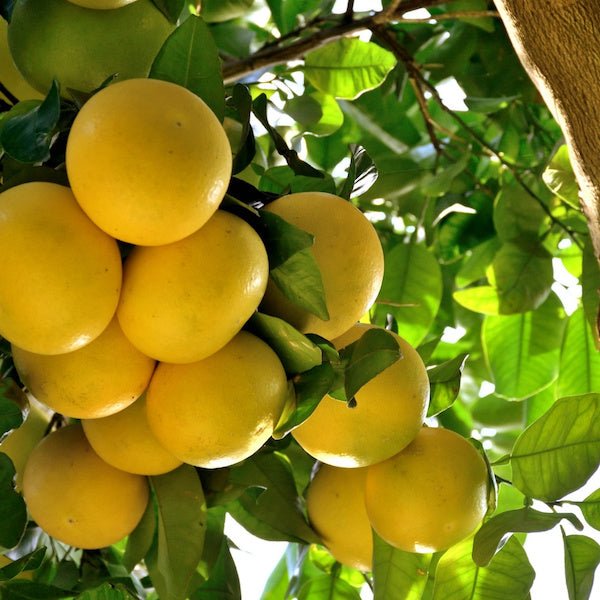

Red Grapefruit
Red Grapefruit
Couldn't load pickup availability
Arizona's Classic Backyard Grapefruit Tree
Red Grapefruit (Citrus × paradisi) is the quintessential Arizona citrus tree — and Phoenix is one of the best places on earth to grow it. This evergreen tree reaches 20–24 feet tall and produces heavy crops of large, juicy, ruby-red grapefruit with the perfect balance of sweet and tangy. Phoenix's warm winters and long growing season let grapefruit develop unmatched sweetness you simply can't get from store-bought fruit. Whether you're planting a citrus grove in Scottsdale, adding a backyard fruit tree in Mesa, or growing fresh citrus in Gilbert — Red Grapefruit is the Arizona homeowner's favorite tree.
Red Grapefruit Plant Details
| Attribute | Detail |
|---|---|
| Scientific Name | Citrus × paradisi |
| Common Names | Red Grapefruit, Ruby Red Grapefruit, Rio Red Grapefruit |
| Mature Height | 20–24 feet |
| Mature Width | 7–9 feet |
| Growth Rate | Moderate — 1–2 feet per year in Phoenix |
| Sun | Full sun (6+ hrs). Handles reflected heat from walls. |
| Water | Moderate. Deep watering on a regular schedule. |
| USDA Zones | 9–11 (Phoenix is Zone 9b–10a) |
| Soil | Well-draining. Adapts to Arizona caliche soils with amendment. |
| Foliage | Evergreen — stays green year-round |
| Bloom Color | White, intensely fragrant — spring |
| Fruit Season | November through April (peak sweetness January–March) |
Red Grapefruit Uses in Phoenix Landscapes
Backyard Citrus Grove
Red Grapefruit is the anchor of any Arizona citrus collection. Plant alongside Improved Meyer Lemon, navel oranges, and tangerines for a year-round citrus harvest. A single mature tree can produce 200+ pounds of fruit per season — enough to eat, juice, and share with the entire neighborhood.
Shade & Evergreen Screening
With its dense, glossy evergreen canopy, Red Grapefruit provides year-round shade and privacy. Plant along a south or west-facing wall for a productive living screen that blocks hot afternoon sun. The fragrant white spring blossoms are an added bonus that fills your yard with the smell of citrus.
Pool-Friendly Fruit Tree
Red Grapefruit's upright growth habit and relatively narrow spread (7–9 feet) make it a great choice for planting near pool areas when positioned at least 8–10 feet from the pool edge. The evergreen foliage creates minimal leaf litter compared to deciduous fruit trees.
Best Time to Plant Red Grapefruit in Phoenix
Spring (March–May) is the ideal planting window for citrus in Phoenix. The warming temperatures encourage rapid root establishment and new growth. Fall (October–November) is the second-best window. Avoid planting in peak summer or during winter cold snaps — citrus is frost-sensitive and young trees need protection when temps drop below 32°F.
How to Plant Red Grapefruit
- Dig wide, not deep — Excavate a hole 2–3x the root ball width, same depth as the container. Never bury the graft union.
- Check for caliche — Break through any hardpan layer for drainage. Citrus roots cannot tolerate standing water.
- Backfill with native soil — A light 20% compost blend is fine. Avoid heavy amendments that hold too much moisture.
- Spacing — Plant 12–15 feet apart for multiple trees; allow 8 feet from walls or structures.
- Water basin — Build a 3–4 inch soil ring to direct water to the root zone.
- Mulch — Apply 2–3 inches of bark or gravel mulch to retain moisture. Keep mulch 6 inches from the trunk to prevent rot.
Watering Red Grapefruit in Phoenix
First Year Watering Schedule
- Weeks 1–2: Every 2–3 days, deep and slow (30+ minutes per session)
- Months 1–3: Every 4–5 days
- Months 3–12: Every 7–10 days (every 5–7 days in peak summer)
- After Year 1: Every 7–14 days in summer; every 3–4 weeks in winter
Drip Irrigation
Place two 2-GPH emitters 18–24 inches from the trunk. As the tree matures, expand the emitter ring to the drip line with 4–6 emitters. Citrus prefers deep, infrequent watering — avoid shallow daily watering which encourages surface roots.
How fast does Red Grapefruit grow in Phoenix?
Red Grapefruit grows at a moderate rate of 1–2 feet per year in Phoenix. Trees typically begin producing fruit within 2–3 years of planting and reach full production within 5–7 years.
When do grapefruit ripen in Phoenix?
In Phoenix, Red Grapefruit begins ripening in November and stays on the tree through April. Peak sweetness is typically January through March — the longer you leave them on the tree, the sweeter they get.
Is Red Grapefruit frost sensitive?
Young grapefruit trees need frost protection when temperatures drop below 32°F. Cover with frost cloth on cold nights during the first few winters. Mature trees can handle brief dips to 28°F but sustained freezes can damage fruit and foliage.
How much fruit does a Red Grapefruit tree produce?
A mature Red Grapefruit tree in Phoenix can produce 200+ pounds of fruit per season. Even young trees produce impressive crops within a few years of planting.
You May Also Like
- Lemon Improved Meyer — The most popular backyard lemon for Phoenix with sweet, juicy fruit nearly year-round.
- Pineapple Guava Tree — A unique evergreen fruit tree with tropical-flavored fruit and edible flower petals.
- Fig Tree — One of the easiest fruit trees for Arizona, producing multiple harvests per season.
- Desert Gold Peach Tree — An ultra-low-chill stone fruit with sweet golden peaches by late April.
- Pomegranate — A drought-tough, heat-loving fruit tree perfectly adapted to Phoenix landscapes.
How Many Red Grapefruit Trees Do I Need?
Red Grapefruit is an upright evergreen citrus with a 7 to 9 foot mature spread, so it works as a single backyard specimen or in an orchard row. For multiple trees, space them about 14 feet on center so each canopy gets full sun and air movement.
| Row Length | Trees Needed (14 ft spacing) |
|---|---|
| 14 ft | 1 to 2 trees |
| 28 ft | 3 trees |
| 42 ft | 4 trees |
| 56 ft | 5 trees |
As a single specimen, give it 8 feet of clearance from walls, structures, and pool edges so the canopy and roots have room.
Red Grapefruit Season-by-Season in Phoenix
- Spring (Feb to Apr): Intensely fragrant white blossoms open and draw bees. This is the prime planting window and the start of the new growth flush. Late-hanging fruit from the prior season is at peak sweetness.
- Summer (May to Sep): Heat-loving and reflected-heat tolerant. Fruit sizes up through the long Valley summer. Keep deep, regular irrigation going during the hottest weeks and through the monsoon so the developing crop does not stall.
- Fall (Oct to Nov): Second-best planting window as nights cool. Fruit begins coloring and ripening in November.
- Winter (Dec to Jan): Evergreen canopy holds through the season while fruit sweetens on the tree. Honest frost note: young trees need frost cloth below 32°F; mature trees tolerate brief dips to about 28°F but sustained freezes can damage fruit and foliage.
At a Glance
✔ Edible ✔ Evergreen ✔ Heat-Loving (Reflected-Heat Tolerant) ✔ Pollinator-Friendly ✔ Shade-Providing ✔ Low-Maintenance ✔ Cold-Hardy to 28°F
Plant It With
- Meyer Lemon: pairs in a backyard citrus grove for nearly year-round lemon and grapefruit harvests.
- Navel Orange: another evergreen sweet citrus that ripens alongside grapefruit for a mixed grove.
- Fig Tree: an easy deciduous fruit tree that adds summer harvests to the orchard.
- Pomegranate: a drought-tough, heat-loving fruit tree that complements the citrus grove with fall fruit.
Is Red Grapefruit Right for Your Yard?
Red Grapefruit thrives in full sun with reflected heat, in well-draining soil where any caliche layer has been broken through, with deep and regular irrigation and at least 8 feet of clearance. It is not a fit if your only space is deep shade, if drainage stays soggy, or if you cannot cover a young tree on hard frost nights below 32°F.
Share