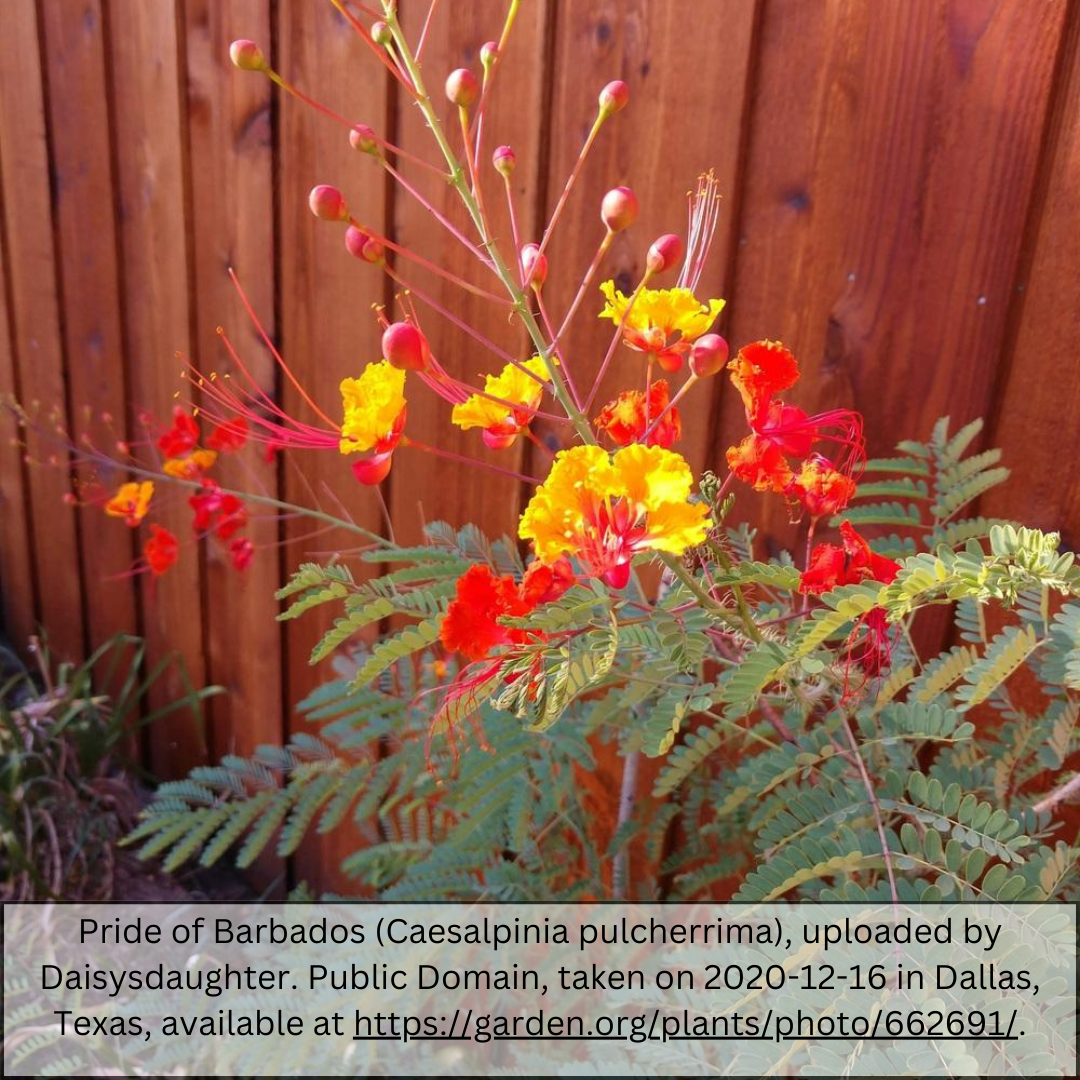


Red Bird of Paradise
Red Bird of Paradise
Fiery orange blooms that peak in the worst heat
Couldn't load pickup availability
Phoenix's Most Vibrant Desert Shrub — Red Bird of Paradise
Red Bird of Paradise (Caesalpinia pulcherrima) is Phoenix's most spectacular low-water flowering shrub. With fiery orange-red blooms and graceful, fern-like foliage, it delivers tropical drama with true desert toughness. Fast-growing to 6–10 feet, it thrives on neglect once established — no babying needed. Whether you're creating a bold accent in Scottsdale, a hummingbird garden in Chandler, a hot west-wall accent in Gilbert, or a low-water border in Mesa — Red Bird of Paradise gets the job done with blazing color from late spring through fall.
Red Bird of Paradise Plant Details
| Attribute | Detail |
|---|---|
| Scientific Name | Caesalpinia pulcherrima |
| Common Names | Red Bird of Paradise, Dwarf Poinciana, Pride of Barbados |
| Mature Height | 6–10 feet |
| Mature Width | 6–8 feet |
| Growth Rate | Fast — 2–4 feet per year in Phoenix |
| Sun | Full sun (6+ hrs). Handles reflected heat from walls and pavement. |
| Water | Low once established. Highly drought-tolerant. |
| USDA Zones | 9–11 (Phoenix is Zone 9b–10a) |
| Soil | Well-draining. Adapts to Arizona caliche soils. |
| Foliage | Semi-evergreen to deciduous — may drop leaves in cold winters |
| Bloom Color | Orange-red with yellow edges; long red stamens |
| Bloom Season | Late spring through fall (May–November in Phoenix) |
Red Bird of Paradise Uses in Phoenix Landscapes
Hummingbird and Pollinator Gardens
The showy, long-stamened flowers of Red Bird of Paradise are irresistible to hummingbirds, bees, and butterflies — making it the #1 choice for pollinator gardens throughout the Phoenix Valley. Plant it near patios or windows for a front-row seat to the wildlife show all summer long.
Bold Accent and Focal Point Planting
Few plants command attention like a Red Bird of Paradise in full bloom. Use it as a dramatic specimen at entry gates, driveway corners, or pool equipment screens. Its upright, airy form adds height without bulk, and the flowers provide non-stop color from late May through November.
Low-Water Colorful Borders
Pair Red Bird of Paradise with desert perennials like Desert Marigold, Damianita, and Autumn Sage for a low-water border that blooms in rotating waves. Space plants 4–5 feet apart for a full border; 6–8 feet for individual specimens. Its green foliage reads as lush even between bloom cycles.
Near Pools: Keep It Back from the Water
Red Bird of Paradise gives a pool area a tropical resort feel, but it is not a low-litter plant: it drops spent flowers, flat seed pods that split open, and leaves when it freezes back in winter, and the seeds are toxic if eaten. Plant it several feet back from the water and the deck so the litter lands in the bed, not the pool.
Best Time to Plant Red Bird of Paradise in Phoenix
Fall planting (October–November) is ideal — warm soil encourages fast root establishment, cooler air reduces transplant stress, and your plant gets 6–8 months of root development before its first Phoenix summer. Spring (February–April) is the second-best window. Avoid summer planting if possible, as extreme heat makes establishment difficult without intensive daily watering.
How to Plant Red Bird of Paradise
- Dig wide, not deep — 2–3x the root ball width, same depth as the container.
- Check for caliche — break through any hardpan layer so water can drain freely.
- Backfill with native soil — a light 20% organic amendment blend is fine; avoid heavy compost.
- Spacing — 4–5 ft apart for border planting; 6–8 ft for individual specimens.
- Water basin — build a 3–4 inch earthen ring around the root zone to direct water to roots.
- Mulch — apply 2–3 inches of gravel or bark mulch to retain moisture and reduce soil temperature.
Watering Red Bird of Paradise in Phoenix
First Year Watering Schedule
- Weeks 1–2: Every 1–2 days, deep and slow (20–30 min drip)
- Month 1–2: Every 3–4 days
- Month 3–6: Every 7–10 days (every 5–7 days in peak summer heat)
- After Year 1: Every 10–14 days in summer; every 3–4 weeks in winter
Drip Irrigation
Place emitters 18–24 inches from the base, using 1–2 GPH emitters. Mature plants are remarkably drought-tolerant and thrive on minimal supplemental irrigation — just enough to maintain their lush appearance during Phoenix's hottest months.
Is Red Bird of Paradise truly drought-tolerant?
Yes — once established (typically after the first full growing season), Red Bird of Paradise survives on minimal irrigation in Phoenix. It's one of the few flowering shrubs that can handle extreme heat and reflected heat from walls, making it a top pick for hot west and south exposures where most plants struggle.
How fast does it grow in Phoenix?
Expect 2–4 feet of growth per year under normal Phoenix conditions. In ideal spots with good drainage and regular summer watering, it can grow even faster. Most plants reach full size within 2–3 years of planting.
Does it come back after a frost kills it to the ground?
Yes. Red Bird of Paradise freezes back in hard winters (below 28°F) but re-sprouts vigorously from the root base come spring. Don't cut the dead stems until late February — they provide some frost protection for the roots below.
Can I keep it smaller with pruning?
Absolutely. Red Bird of Paradise responds well to hard pruning in early spring. Cut it back to 12–18 inches from the ground in February and it will flush out with dense new growth and heavy bloom production by late spring.
Is it safe near pools?
Plant it a few feet back. Its fine leaves are small, but it drops spent flowers and messy seed pods, and it loses most of its leaves when it freezes back, so keep it several feet from the water. The seeds and pods are also toxic if eaten, so keep it away from pets and kids who chew plants.
You May Also Like
- Yellow Bird of Paradise — Same tough desert habit, golden-yellow blooms; pairs beautifully with Red BOP for a two-tone border.
- Desert Marigold — Low groundcover with cheerful yellow flowers that complement Red Bird of Paradise all season long.
- Baja Fairy Duster — Feathery pink blooms and fine texture; great companion plant for hummingbird gardens.
- Autumn Sage — Compact red-flowering perennial that blooms in cooler months when Red BOP slows down.
- Damianita — Low, golden-yellow flowering groundcover — great at the feet of Red Bird of Paradise for layered color.
How Many Red Bird of Paradise Do I Need?
For a colorful low-water border or informal screen, space Red Bird of Paradise about 4.5 feet apart (its mature spread is 6 to 8 feet, so plants overlap into a full border). For standalone specimens, give each plant 6 to 8 feet so its airy, vase-shaped form can show. Use this table for border or mass plantings:
| Run Length | Plants Needed (4.5 ft spacing) |
|---|---|
| 10 ft | 3 plants |
| 20 ft | 5 plants |
| 30 ft | 7 plants |
| 40 ft | 9 plants |
| 50 ft | 12 plants |
Red Bird of Paradise Season-by-Season in Phoenix
- Spring (Feb-Apr): Leafs out from any winter dieback and pushes vigorous new growth. The first orange-red flush opens by late spring. This is a good second planting window before the heat arrives.
- Summer (May-Sep): Peak bloom straight through the hottest months. It thrives on reflected heat off west and south walls where most shrubs scorch. Monsoon rains (Jul-Sep) trigger a fresh surge of growth and color, and established plants need only modest supplemental water.
- Fall (Oct-Nov): Bloom continues into November. This is the prime planting season for fast root establishment before winter.
- Winter (Dec-Jan): Semi-evergreen in mild winters but freezes back below about 28°F, which happens most Valley winters. It re-sprouts reliably from the base in spring, so leave the dead stems until February for root protection.
At a Glance
✔ Pollinator-Friendly ✔ Hummingbird-Friendly ✔ Heat-Loving (Reflected-Heat Tolerant) ✔ Drought-Tolerant ✔ Low-Maintenance
Plant It With
- Yellow Bird of Paradise: Golden-yellow twin with the same desert toughness, for a striking two-tone border.
- Desert Marigold: Low yellow-flowering filler at its feet for layered, season-long color.
- Baja Fairy Duster: Feathery pink blooms and fine texture that keep the hummingbirds coming.
- Autumn Sage: Compact red salvia that carries bloom into the cooler months when Red BOP slows.
Is Red Bird of Paradise Right for Your Yard?
Full sun and reflected heat are exactly where this plant shines, in well-drained ground (break through any caliche at planting). Give it room: 6 to 8 feet wide and up to 6 to 10 feet tall. It is not a fit if you want a tidy evergreen hedge or a plant that holds its leaves and shape through a cold Valley winter, since it dies back in hard frosts and resprouts in spring.
Customer Reviews
Nice! Doing well
Great specimen
The 10/15 gallon Red Bird of Paradise plant we ordered is spectacular. Very nice branch structute and was vlearly well-maintained by the nursery.
Share