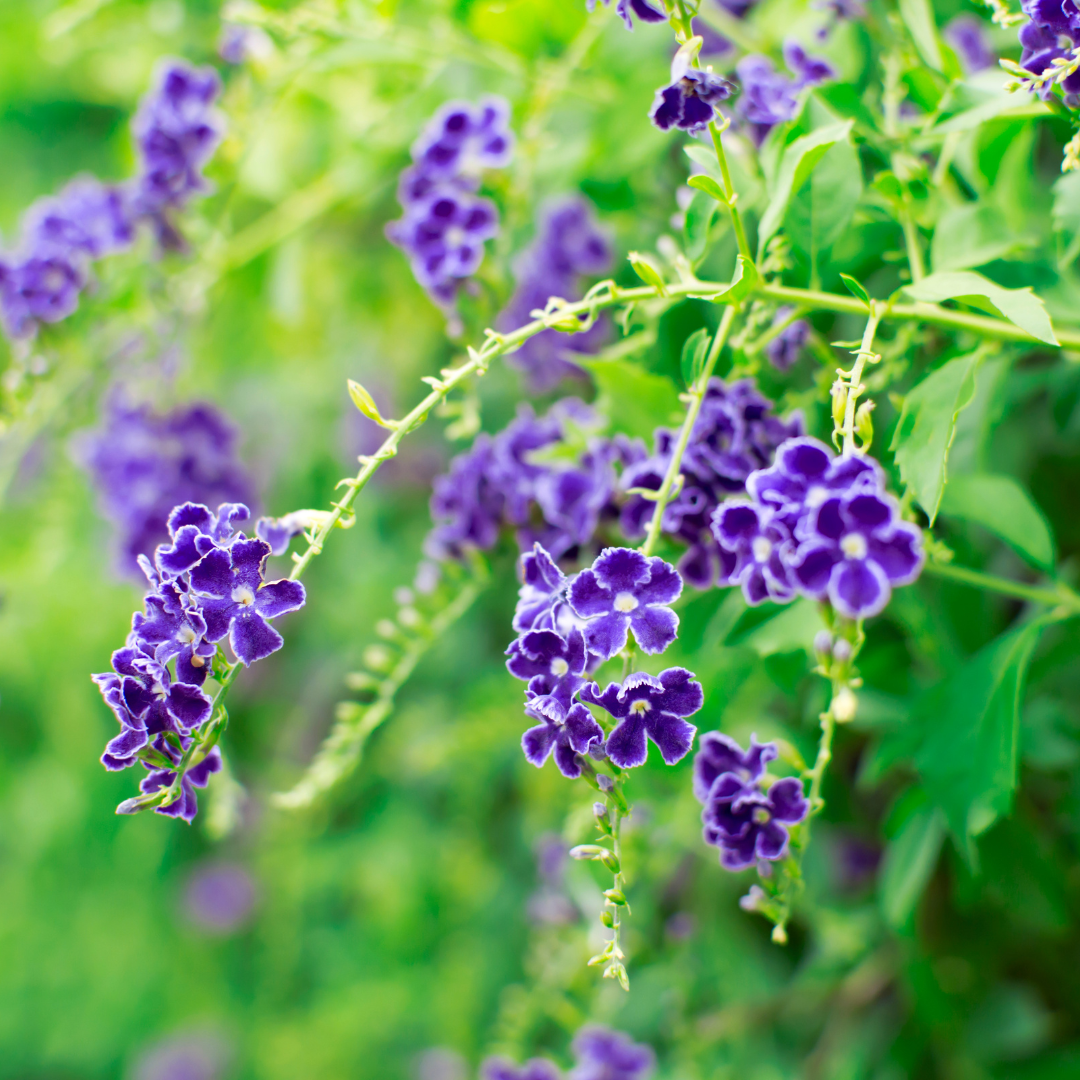


Purple Sky Flower Bush
Purple Sky Flower Bush
Couldn't load pickup availability
Lush Tropical Color for Phoenix Gardens — Purple Sky Flower Bush
Purple Sky Flower Bush (Duranta erecta 'Purple') is a vibrant, fast-growing ornamental shrub that delivers cascading clusters of rich purple flowers from spring through late fall. In bush form, this Duranta maintains a full, rounded shape that works beautifully as a standalone accent, colorful hedge, or background planting in any Phoenix landscape. Growing 4–15 feet tall depending on pruning, Purple Sky Flower Bush combines tropical lushness with surprising desert toughness. Whether you're adding vibrant color to a Scottsdale courtyard, creating a butterfly garden in Mesa, or building a flowering screen in Chandler — this bush delivers months of non-stop purple blooms.
Purple Sky Flower Bush Plant Details
| Attribute | Detail |
|---|---|
| Scientific Name | Duranta erecta 'Purple' |
| Common Names | Purple Sky Flower Bush, Duranta Bush, Golden Dewdrop |
| Mature Height | 4–15 feet (easily maintained smaller with pruning) |
| Mature Width | 4–8 feet |
| Growth Rate | Fast — 2–4 feet per year in Phoenix |
| Sun | Full sun to partial shade. Handles reflected heat. |
| Water | Moderate. More water = more blooms. |
| USDA Zones | 9–11 (Phoenix is Zone 9b–10a) |
| Soil | Well-draining. Adapts to Arizona caliche soils. |
| Foliage | Evergreen to semi-evergreen — bright green leaves year-round |
| Bloom Season | Spring through fall (March–November in Phoenix) |
Purple Sky Flower Bush Uses in Phoenix Landscapes
Colorful Hedge & Privacy Screen
In bush form, Purple Sky Flower creates a dense, full hedge when planted 4–5 feet apart. The fast growth fills in quickly, and the cascading purple flower clusters provide stunning seasonal color along fence lines and property borders. Maintain at 5–6 feet for a manageable flowering hedge, or let it grow taller for more privacy.
Accent & Specimen Plant
A single Purple Sky Flower Bush in full bloom is a landscape showpiece. Its rounded, bushy form makes it an ideal focal point near patios, pool areas, and entryways. The rich purple flowers contrast beautifully with yellow-blooming companions like Yellow Bells or gold-leaved plants.
Butterfly & Wildlife Garden
The abundant purple flowers are a top nectar source for butterflies, bees, and hummingbirds throughout the Phoenix growing season. Following the blooms, golden berries attract songbirds in fall and winter. Plant alongside Red Justica, Salvia, and Lantana for a complete pollinator garden.
Best Time to Plant Purple Sky Flower Bush in Phoenix
Spring (March–April) is the ideal planting window — warm soil and the long growing season give this fast grower maximum establishment time. Fall (October–November) is the second-best window. Avoid planting in peak summer heat or winter cold snaps, as Duranta is frost-sensitive.
How to Plant Purple Sky Flower Bush
- Dig wide, not deep — 2–3x the root ball width, same depth
- Check for caliche — break through any hardpan layer for drainage
- Backfill with native soil amended with 20–30% compost
- Spacing — 4–5 ft apart for hedges; 6+ ft for individual specimens
- Water basin — build a 3–4 inch ring to direct water to roots
- Mulch — 2–3 inches of bark mulch to retain moisture
Watering Purple Sky Flower Bush in Phoenix
First Year Watering Schedule
Weeks 1–2: Every 1–2 days, deep and slow. Month 1–2: Every 3–4 days. Month 3–6: Every 4–5 days (every 2–3 days in peak summer). After Year 1: Every 5–7 days in summer; every 10–14 days in winter.
Drip Irrigation
Place two 2 GPH emitters 18–24 inches from the base on opposite sides. Consistent moisture produces significantly more blooms. Reduce watering in winter when the plant is semi-dormant.
What's the difference between Purple Sky Flower and Purple Sky Flower Bush?
Both are Duranta erecta. The bush form is maintained with a full, rounded shape from the base — ideal for hedging and mass planting. The standard or tree form is trained with a single trunk for a more formal look. Both produce the same cascading purple flowers.
Is Purple Sky Flower Bush frost hardy in Phoenix?
It handles light frost (down to about 28°F) but can suffer tip dieback during hard freezes. In most Phoenix Valley locations it performs well year-round. Prune any frost damage in late February — it rebounds fast in spring.
Does Purple Sky Flower Bush attract butterflies?
Yes — it's one of the best butterfly-attracting shrubs for Phoenix gardens. The continuous purple flowers draw butterflies, bees, and hummingbirds from spring through fall.
How do I keep Purple Sky Flower Bush compact?
Prune 2–3 times per year to maintain the desired size and shape. Hard pruning in late February removes any winter damage and encourages dense, bushy regrowth. Light tip-pruning during the growing season promotes more branching and heavier flowering.
You May Also Like
Purple Sky Flower (Standard) — The tree-form version of Duranta for a more formal, upright look with cascading purple blooms.
Yellow Bells — A fast-growing shrub with bright yellow flowers for bold color contrast alongside purple Duranta.
Texas Sage — A drought-tolerant flowering shrub with purple blooms triggered by humidity.
Bougainvillea — A vigorous flowering vine or shrub with brilliant magenta, red, or orange blooms for tropical-style gardens.
How Many Purple Sky Flower Bush Do I Need?
For a full, fast-filling flowering hedge, space the bushes about 4 ft on-center. Give individual specimens room for their 4 to 8 ft spread. Use this guide for a single hedge run:
| Hedge Length | Plants at 4 ft spacing |
|---|---|
| 10 ft | 4 |
| 20 ft | 6 |
| 30 ft | 9 |
| 40 ft | 11 |
As a standalone accent, a single bush fills a 6 to 8 ft footprint. Plan on light shaping a few times a year to keep a hedge tidy, since this Duranta grows fast.
Purple Sky Flower Bush Season-by-Season in Phoenix
- Spring (Feb–Apr): Vigorous new growth and the first heavy purple bloom flush. Best planting window. Do the hard renewal prune now to clear winter frost damage and drive dense, bushy regrowth.
- Summer (May–Sep): Peak, near-continuous bloom through extreme and reflected heat. Monsoon humidity and rain (Jul–Sep) fuel the heaviest flowering and fastest growth. Keep water steady for maximum color.
- Fall (Oct–Nov): Bloom continues and golden berry clusters form, drawing songbirds. Strong secondary planting window.
- Winter (Dec–Jan): Holds foliage in mild winters and may bloom in warm years. Light frost is tolerated to about 28°F; a hard freeze causes tip dieback. Cover in colder pockets, or prune damage in late February: it rebounds fast.
At a Glance
✔ Pollinator-Friendly ✔ Hummingbird-Friendly ✔ Heat-Loving (Reflected-Heat Tolerant) ✔ Low-Maintenance
Plant It With
- Purple Sky Flower (Staked): the single-trunk standard of the same plant, for a formal focal point above the bushy hedge.
- Arizona Yellow Bells: bright yellow trumpets that contrast the purple and match the fast, heat-loving habit.
- Texas Sage: a tougher, lower-water purple-bloomer that echoes the color along the same border.
- Purple Bougainvillea: layers more purple onto a wall or fence behind the hedge.
Is Purple Sky Flower Bush Right for Your Yard?
The bush form is a fit for full-sun Phoenix yards that want a fast, colorful flowering hedge or accent and can give it moderate, consistent water for the best bloom. It adapts to caliche when the hole drains and takes reflected heat off walls. Not a fit if you want a strictly low-water xeriscape plant, a clean pool-side shrub (the toxic golden berries and leaf drop create litter), or a yard with young children or pets who might eat the berries: choose a fruitless flowering shrub in those cases.
Share