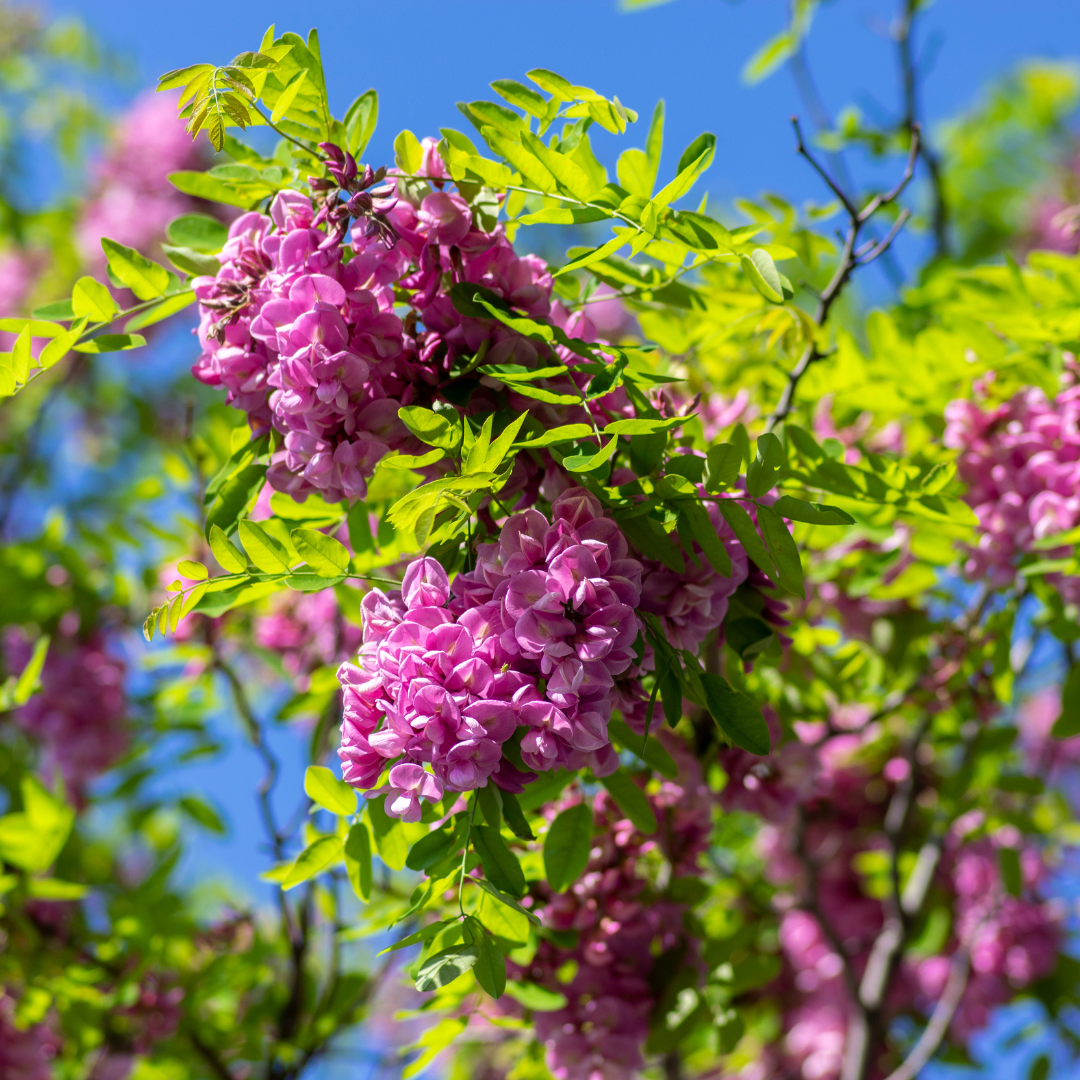

'Purple Robe' Locust
'Purple Robe' Locust
Couldn't load pickup availability
Purple Robe Locust — Fast-Growing Flowering Shade Tree for Phoenix Landscapes
Purple Robe Locust (Robinia pseudoacacia 'Purple Robe') is one of the fastest-growing flowering shade trees you can plant in the Phoenix Valley. Every spring, it erupts with stunning clusters of fragrant purple-pink flowers that rival wisteria — except this tree actually thrives in Arizona's brutal heat and alkaline soils. Growing 2–3 feet per year, it quickly fills in to provide welcome shade over patios, driveways, and outdoor living areas. Whether you're looking for fast shade in a new Gilbert subdivision, a flowering canopy over a Scottsdale patio, or a tough street tree for a Mesa property — Purple Robe Locust delivers dramatic spring color and reliable summer shade.
Purple Robe Locust Plant Details
| Attribute | Detail |
|---|---|
| Scientific Name | Robinia pseudoacacia 'Purple Robe' |
| Common Names | Purple Robe Locust, Purple Robe Black Locust |
| Mature Height | 30–40 feet |
| Mature Width | 25–30 feet |
| Growth Rate | Fast — 2–3 feet per year in Phoenix |
| Sun | Full sun (6+ hrs). Handles reflected heat from walls and pavement. |
| Water | Low to moderate once established. Drought-tolerant. |
| USDA Zones | 4–9 (Phoenix is Zone 9b–10a) |
| Soil | Highly adaptable. Thrives in poor, alkaline, and caliche soils — actually fixes nitrogen. |
| Foliage | Deciduous — drops leaves in winter, allowing winter sun through |
| Flowers | Fragrant purple-pink wisteria-like clusters in spring |
Purple Robe Locust Uses in Phoenix Landscapes
Fast Summer Shade for Patios & Outdoor Living
With its rapid growth rate and broad spreading canopy, Purple Robe Locust is one of the quickest ways to get meaningful shade over a patio, deck, or outdoor kitchen. Plant it 10–15 feet from a patio edge and you'll have dappled shade within 2–3 years. The compound leaves create a pleasant filtered light — not too dense, not too thin. In winter, the deciduous habit lets warm sunlight through when you actually want it.
Stunning Spring Flowering Display
Few trees in Phoenix can match the spring show of Purple Robe Locust. The cascading clusters of fragrant purple-pink flowers appear in late March through April and are absolutely covered in blooms. The flowers attract hummingbirds and bees, adding wildlife value. Plant it where you'll see and smell the blooms — near entryways, along walkways, or flanking a courtyard.
Tough Street Tree & Property Border
Purple Robe Locust is exceptionally tough in urban Phoenix conditions. It handles compacted soil, reflected heat, road salt, air pollution, and poor drainage better than most shade trees. Its nitrogen-fixing roots actually improve the soil over time. Use it as a street tree, driveway border, or property line shade tree where other species struggle. Space 20–25 feet apart for a continuous canopy.
Best Time to Plant Purple Robe Locust in Phoenix
Fall (October–November) is the ideal planting window. Warm soil encourages rapid root establishment while cooler air temps reduce transplant stress. Given this tree's fast growth rate, a fall-planted Purple Robe can put on 2+ feet of growth its first spring. Spring (February–April) is the second-best option. Avoid planting in peak summer heat if possible — though Purple Robe is tougher than most, transplant shock in extreme heat slows initial establishment.
How to Plant Purple Robe Locust
- Dig wide, not deep — Excavate a hole 2–3× the width of the root ball, but only as deep as the root ball itself.
- Check for caliche — Break through any hardpan layer with a pickaxe or drill. Purple Robe tolerates poor soil but still needs drainage.
- Backfill with native soil — This tree fixes its own nitrogen, so rich amendments aren't needed. A light 80/20 native soil and compost mix is plenty.
- Spacing — Plant 20–25 feet apart for a shade canopy row. For standalone specimens, give 15+ feet from structures for the mature spread.
- Water basin — Build a 3–4 inch soil ring around the planting hole to direct water to the root zone during establishment.
- Mulch — Apply 2–3 inches of gravel or bark mulch around the base. Keep mulch 6 inches from the trunk to prevent rot.
Watering Purple Robe Locust in Phoenix
First Year Watering Schedule
- Weeks 1–2: Water every 1–2 days, deep and slow (20–30 minutes per session).
- Months 1–2: Every 3–4 days.
- Months 3–6: Every 7–10 days (every 5–7 days in peak summer).
- After Year 1: Every 10–14 days in summer; monthly in winter. Established trees are quite drought-tolerant.
Drip Irrigation
Place 2–3 drip emitters 18–24 inches from the trunk, rated at 2–4 GPH. As the canopy grows, move emitters outward toward the drip line. After 2–3 years, established Purple Robe Locust trees need minimal supplemental irrigation — their deep roots and nitrogen-fixing ability make them remarkably self-sufficient.
How fast does Purple Robe Locust grow in Phoenix?
Very fast — expect 2–3 feet of growth per year with regular water. A 15-gallon tree can reach 15–20 feet within 4–5 years. It's one of the fastest shade trees available for Phoenix landscapes.
Is Purple Robe Locust drought tolerant?
Yes. Once established (after 1–2 years), it handles extended dry periods well. Its nitrogen-fixing root system and deep taproot give it an advantage over many other shade trees in Arizona's arid climate.
Does it lose its leaves in winter?
Yes, Purple Robe Locust is deciduous. It drops its compound leaves in late November and leafs out again in early spring with fresh green foliage followed by the spectacular purple flower display. The winter dormancy is actually a benefit — it lets warm sunlight through to patios and south-facing windows when you want it most.
Are the flowers messy?
The flowers drop after blooming in spring, creating a brief carpet of purple petals. Most homeowners consider this charming rather than messy. The small leaflets that drop in fall decompose quickly and don't create heavy litter like larger-leaved trees.
Does it have thorns?
The 'Purple Robe' cultivar has fewer thorns than the wild species, but young branches may still develop small spines. Mature branches are generally smooth. Plant away from high-traffic walkways if thorns are a concern.
You May Also Like
- Jacaranda Tree (Jacaranda mimosifolia) — Another stunning purple-flowering shade tree for Phoenix. Blooms in late spring with a different flower form.
- Desert Willow (Chilopsis linearis) — Gorgeous trumpet-shaped flowers in multiple colors. Smaller and more drought-tolerant.
- Chinese Pistache (Pistacia chinensis) — Outstanding fall color shade tree that complements Purple Robe's spring show.
- Cascalote Tree (Caesalpinia cacalaco) — Bright yellow winter flowers and fine-textured foliage for year-round interest.
- Texas Mountain Laurel (Sophora secundiflora) — Fragrant purple flower clusters in spring on a smaller evergreen tree.
How Many Purple Robe Locust Do I Need?
Purple Robe is a fast, upright shade tree (25 to 30 feet wide at maturity), planted as a single flowering specimen or spaced in a row for a shaded driveway or street-tree line. Set spacing from its mature width: 20 to 25 feet apart for a continuous canopy, or 25 to 30 feet for fully separated crowns.
| Row length | Trees needed (at 22 ft spacing) |
|---|---|
| 22 ft (single specimen) | 1 tree |
| 45 ft | 2 to 3 trees |
| 65 ft | 3 trees |
| 90 ft | 4 to 5 trees |
For a single flowering shade tree near a patio, one Purple Robe set 10 to 15 feet from the patio edge gives fast dappled shade within a few seasons.
Purple Robe Locust Season-by-Season in Phoenix
- Spring (Feb to Apr): The headline season. Fresh green compound leaves emerge, followed by cascading fragrant purple-pink flower clusters in late March through April that draw bees and hummingbirds. Best second planting window once frost has passed.
- Summer (May to Sep): Full leafy canopy delivers fast filtered shade and shrugs off 110-plus degree heat and reflected heat. Monsoon storms (Jul to Sep) fuel rapid growth, but stake young trees well since the fast, soft wood can snap in strong wind.
- Fall (Oct to Nov): Prime Phoenix planting season. Small leaflets yellow and drop in late November, decomposing quickly with little litter.
- Winter (Dec to Jan): Fully deciduous and bare, letting warm winter sun reach patios and south windows. Extremely cold-hardy (rated to zone 4), so Valley frost is never a concern.
At a Glance
✔ Pollinator-Friendly ✔ Hummingbird-Friendly ✔ Heat-Loving (Reflected-Heat Tolerant) ✔ Drought-Tolerant ✔ Low-Maintenance ✔ Shade-Providing ✔ Cold-Hardy to -20°F
Plant It With
- Jacaranda Tree: another purple-flowering canopy tree that extends the bloom season into late spring.
- Chinese Pistache 'Red Push': a fall-color shade tree that complements Purple Robe's spring show.
- Cascalote Tree: bright winter-yellow blooms that fill the gap when the locust is bare.
- Desert Willow: a smaller, more drought-tough flowering tree for the sunny edges nearby.
Is Purple Robe Locust Right for Your Yard?
Purple Robe thrives in full sun and reflected heat, adapts to poor alkaline and caliche soils (it fixes its own nitrogen), and wants 25 to 30 feet of width for its canopy. It is one of the fastest ways to get flowering shade in the Valley. It is not the right fit directly over a pool or a barefoot walkway, since young branches can carry small thorns and the fast wood needs staking and occasional pruning to stay strong.
Share