
Purple Potato Bush
Purple Potato Bush
Couldn't load pickup availability
The Most Colorful Purple-Flowering Shrub for Phoenix Gardens
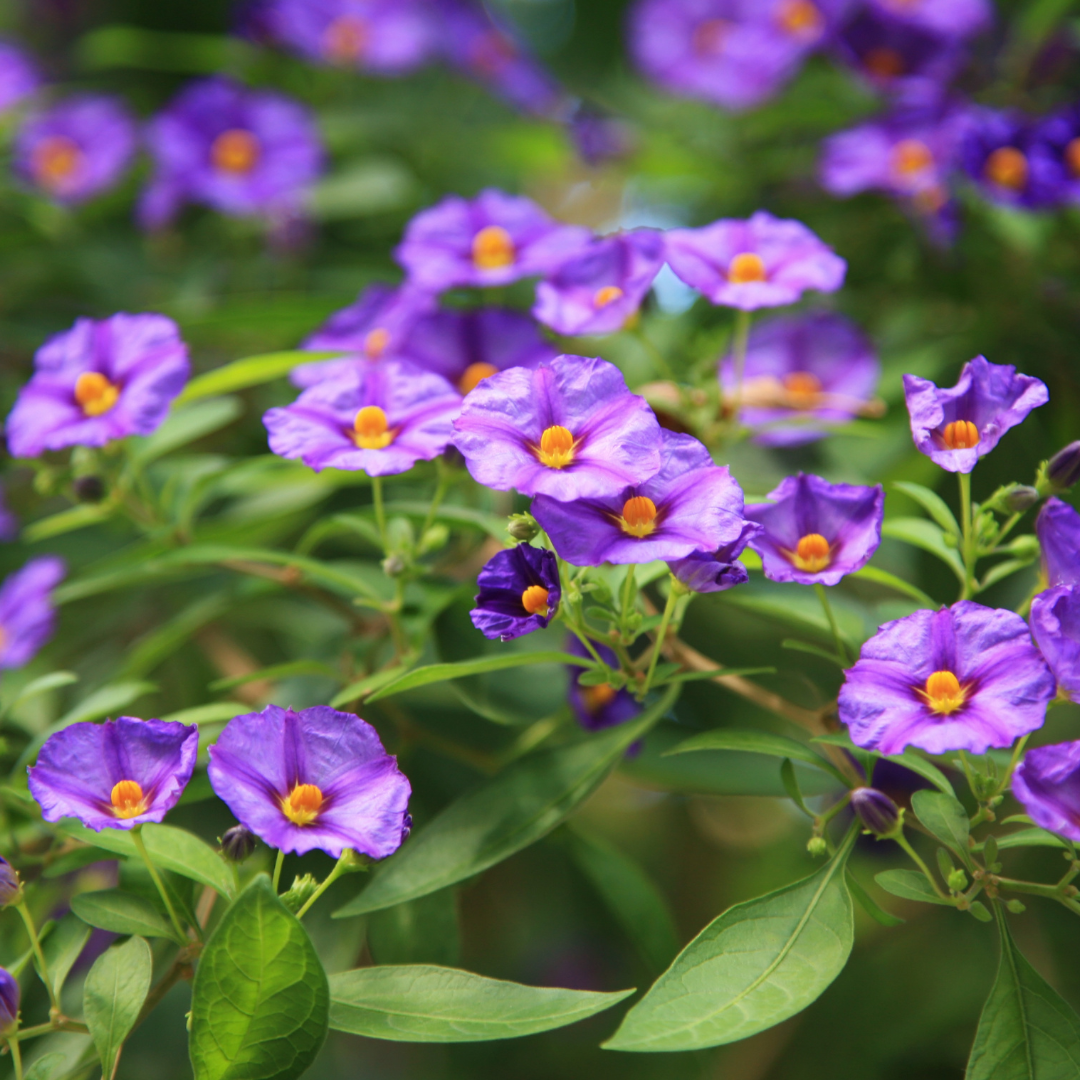
Purple Potato Bush (Lycianthes rantonnetii) is a showstopping ornamental shrub that delivers non-stop purple flowers from spring through fall in the Phoenix Valley. Each bloom features a rich violet-purple petal ring surrounding a bright yellow center, creating a tropical color punch that few other desert-adapted shrubs can match. Growing 4–6 feet tall and wide, this fast-growing South American native thrives in Phoenix heat and adds vibrant color to any landscape. Whether you're filling a sunny border in Scottsdale, creating a colorful backdrop in Mesa, or adding tropical flair to a Gilbert patio — Purple Potato Bush delivers months of bold, beautiful blooms.
Purple Potato Bush Plant Details
| Attribute | Detail |
|---|---|
| Scientific Name | Lycianthes rantonnetii (syn. Solanum rantonnetii) |
| Common Names | Purple Potato Bush, Blue Potato Bush, Paraguay Nightshade |
| Mature Height | 4–6 feet |
| Mature Width | 4–6 feet |
| Growth Rate | Fast — 2–3 feet per year in Phoenix |
| Sun | Full sun (6+ hrs). Handles reflected heat from walls. |
| Water | Moderate. More water = more blooms. |
| USDA Zones | 9–11 (Phoenix is Zone 9b–10a) |
| Soil | Well-draining. Adapts to Arizona caliche soils. |
| Foliage | Semi-evergreen — may drop some leaves in cold winters |
| Bloom Season | Spring through fall (March–November in Phoenix) |
Purple Potato Bush Uses in Phoenix Landscapes
Color Accent & Border Plant
Purple Potato Bush is one of the best shrubs for adding vivid purple color to Phoenix landscapes. Plant it as a color accent in mixed desert beds, along fence lines, or as a backdrop behind lower-growing plants like Yellow Bells, Trailing Lantana, or Ruellia. The continuous bloom cycle means you get color for 8–9 months of the year.
Patio & Pool-Adjacent Planting
With its tropical look and non-stop flowers, Purple Potato Bush is a natural fit for pool areas, patios, and outdoor living spaces. It attracts butterflies and hummingbirds while creating a lush, colorful backdrop. Plant it where you can enjoy the flowers up close — along a patio edge, beside a pool fence, or near a seating area in Scottsdale and Tempe backyards.
Butterfly & Pollinator Garden
The abundant flowers are a major draw for butterflies, bees, and hummingbirds. Include Purple Potato Bush in a pollinator garden alongside other nectar-rich plants like Desert Milkweed, Red Justica, and Salvia for a wildlife-friendly landscape that blooms across multiple seasons.
Best Time to Plant Purple Potato Bush in Phoenix
Spring (March–April) is the ideal planting window — the warming soil and long growing season ahead give the plant maximum time to establish before winter. Fall (October–November) is the second-best window. Avoid planting in peak summer heat or during winter cold snaps, as this tropical species is sensitive to frost.
How to Plant Purple Potato Bush
- Dig wide, not deep — 2–3x the root ball width, same depth
- Check for caliche — break through any hardpan layer for drainage
- Backfill with native soil amended with 30% compost for richer bloom performance
- Spacing — 4–5 ft apart for a continuous border; 6 ft for individual specimens
- Water basin — build a 3–4 inch ring to direct water to roots
- Mulch — 2–3 inches of bark mulch to retain moisture and moderate soil temperature
Watering Purple Potato Bush in Phoenix
First Year Watering Schedule
Weeks 1–2: Every 1–2 days, deep and slow (20–30 min). Month 1–2: Every 3–4 days. Month 3–6: Every 4–5 days (every 2–3 days in peak summer). After Year 1: Every 5–7 days in summer; every 10–14 days in winter.
Drip Irrigation
Place two 2 GPH emitters 12–18 inches from the trunk on opposite sides. Purple Potato Bush is more water-hungry than typical desert shrubs — consistent moisture produces significantly more blooms. Reduce watering in winter when the plant is semi-dormant.
How fast does Purple Potato Bush grow in Phoenix?
Very fast — Purple Potato Bush can add 2–3 feet per year in Phoenix with regular watering. Most 1-gallon plants reach their full 4–6 foot size within 2 growing seasons.
Is Purple Potato Bush frost hardy in Phoenix?
Purple Potato Bush handles light frost (down to about 28°F) but can suffer tip damage during hard freezes. In most Phoenix Valley locations, it performs well year-round. If frost damage occurs, prune back the affected growth in late February — it rebounds quickly in spring.
Does Purple Potato Bush attract butterflies?
Yes — the continuous purple flowers are a top nectar source for butterflies, bees, and hummingbirds in Phoenix gardens. It's one of the best flowering shrubs for pollinator-friendly landscapes.
How do I prune Purple Potato Bush?
Prune in late February before new spring growth. Remove any frost-damaged tips and shape to maintain a compact, bushy form. Light tip-pruning during the growing season encourages more branching and heavier bloom production.
You May Also Like
Ruellia — A low-water perennial with purple trumpet flowers that complements Purple Potato Bush's color palette.
Yellow Bells — A fast-growing shrub with bright yellow flowers for striking purple-and-gold color contrast.
Red Justica — A hummingbird favorite with red tubular flowers that pairs beautifully in mixed flowering borders.
Texas Sage — A tough, drought-tolerant shrub with purple blooms triggered by humidity — a great desert companion.
How Many Purple Potato Bush Do I Need?
For a continuous color border or low informal hedge, space plants about 4.5 feet on center, since each one fills out to 4 to 6 feet wide. For single color accents, set them 6 feet apart so each bush rounds out on its own. Use the table below for a 4.5-foot border spacing.
| Border Length | Plants Needed (4.5 ft spacing) |
|---|---|
| 9 ft | 2 |
| 18 ft | 4 |
| 27 ft | 6 |
| 36 ft | 8 |
Purple Potato Bush Season-by-Season in Phoenix
- Spring (Feb-Apr): New growth flushes and the long bloom cycle of violet-purple, yellow-eyed flowers begins. This is the prime planting window, giving the plant the whole warm season to establish. A late-February prune cleans up any winter tip damage first.
- Summer (May-Sep): Blooms straight through the heat and takes reflected warmth off walls, but unlike true desert shrubs it wants steady, consistent water to keep flowering, so do not let it dry out in peak heat. Butterflies, bees, and hummingbirds work the flowers, and monsoon humidity keeps the bloom heavy.
- Fall (Oct-Nov): Color continues strong into the cooler months and this is a good second planting window.
- Winter (Dec-Jan): Bloom slows and the plant goes semi-dormant, dropping some leaves. It takes light frost to about 28°F but tips can burn in a hard freeze, so cover it on the coldest nights and cut back damage in late winter.
At a Glance
✔ Pollinator-Friendly ✔ Hummingbird-Friendly ✔ Heat-Loving (Reflected-Heat Tolerant) ✔ Low-Maintenance
Plant It With
- Yellow Bells: bright yellow flowers for a bold purple-and-gold color contrast behind or beside it.
- Desert Ruellia: purple trumpet flowers on a tougher, lower-water plant that echoes the color in front.
- Chuparosa: red tubular flowers and heavy hummingbird traffic for a mixed nectar border.
- Texas Sage: a drought-tough purple bloomer that anchors the desert side of the planting.
Is Purple Potato Bush Right for Your Yard?
It is the right pick for a full-sun border, patio, or pool-adjacent bed where you want months of vivid purple color and pollinator traffic, and where you can give it steady, consistent water. It takes reflected heat and caliche soil that drains. It is not a true low-water desert shrub, so skip it for a no-irrigation xeriscape, and note it is in the nightshade family with mildly toxic foliage and berries, so place it away from spots where children or pets might nibble. It can also burn back in a hard freeze, so cover it on the coldest Valley nights.
Share