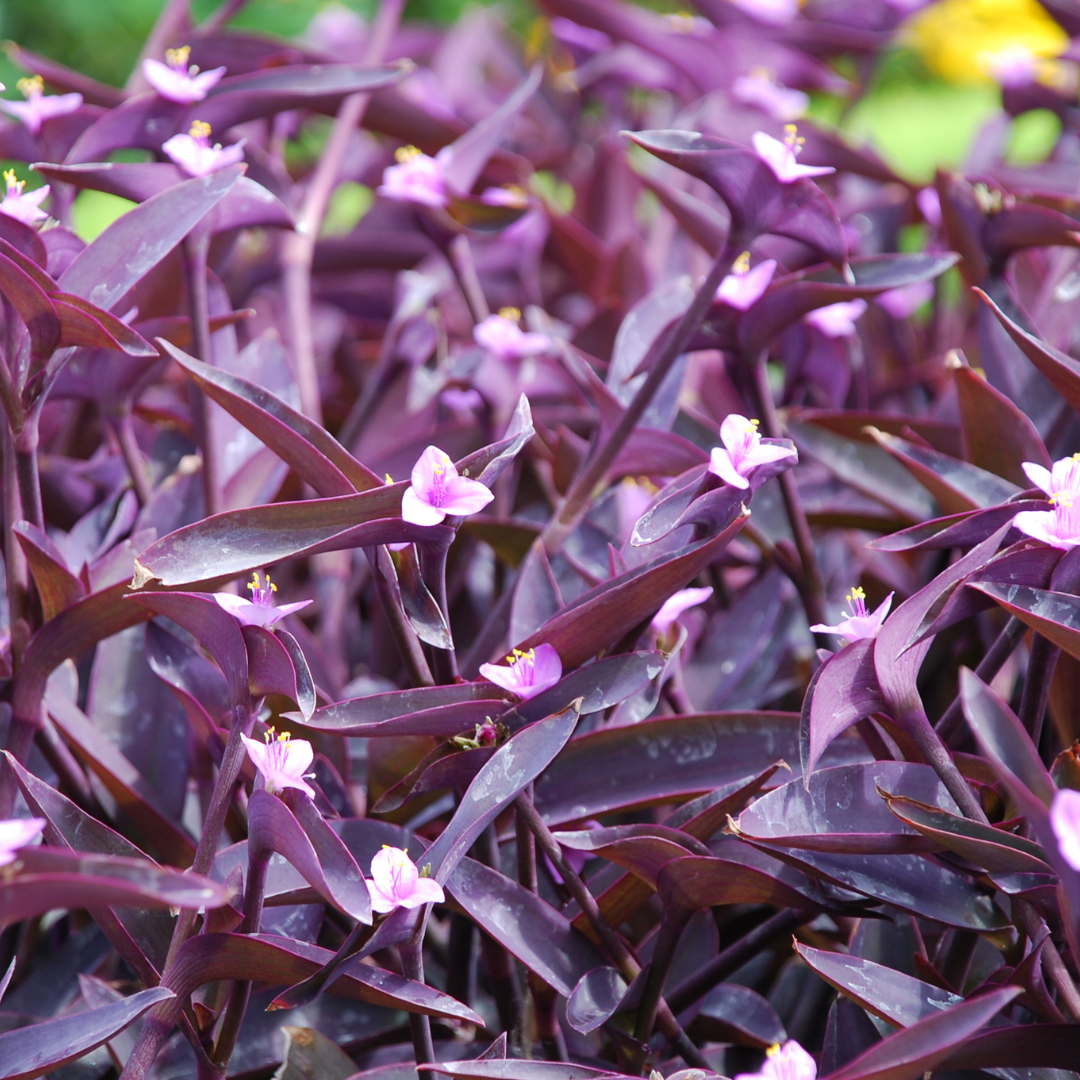


Purple Heart
Purple Heart
Couldn't load pickup availability
The Best Low-Maintenance Purple Groundcover for Phoenix Landscapes
Purple Heart (Tradescantia pallida) is one of the most striking, lowest-maintenance groundcovers you can plant in the Phoenix Valley. Its bold, jewel-toned purple foliage stays vivid all year long, and its spreading, trailing habit fills garden beds, borders, and slopes with color that no other plant can match. Thriving on minimal water and Phoenix's intense summer heat, Purple Heart is the go-to choice for homeowners in Scottsdale, Gilbert, and Tempe who want maximum impact with minimal effort. Whether you're covering a shady corner in Chandler, edging a driveway in Peoria, or filling a modern desert garden bed in Mesa — Purple Heart delivers bold color all season, every season.
Purple Heart Plant Details
| Attribute | Detail |
|---|---|
| Scientific Name | Tradescantia pallida |
| Common Names | Purple Heart, Purple Queen, Wandering Jew (Purple), Trailing Purple Heart |
| Mature Height | 12–18 inches |
| Mature Width | 16–24 inches (spreads and trails) |
| Growth Rate | Fast — spreads aggressively during warm months in Phoenix |
| Sun | Full sun to partial shade. Handles reflected heat. Color is most intense in full sun. |
| Water | Low once established. Highly drought-tolerant. |
| USDA Zones | 7–11 (Phoenix is Zone 9b–10a — ideal) |
| Soil | Well-draining. Adapts to Arizona caliche soils once established. |
| Foliage | Evergreen — bold purple/violet leaves year-round in Phoenix |
| Bloom Color | Pale pink/violet small flowers, spring through fall |
Purple Heart Uses in Phoenix Landscapes
Bold Color Groundcover for Sun or Shade
Purple Heart is one of the few plants that delivers strong color in both full Phoenix sun and partial shade — making it incredibly versatile. In full sun, the foliage turns deep, saturated purple. In partial shade, leaves develop a rich violet-green. Use it to fill problem areas under trees, along north-facing walls, or in spots where other plants struggle. Plant 12–18 inches apart; it fills in within one season.
Erosion Control on Slopes and Banks
Purple Heart's trailing, mat-forming growth makes it an excellent erosion control plant on slopes, embankments, and hillsides throughout Phoenix neighborhoods. Its spreading stems root where they touch the soil, anchoring dirt and suppressing weeds across large areas. For a 20-foot slope, start with 8–10 plants spaced 18 inches apart for full coverage by end of season.
Modern Desert Garden Accent and Border
Purple Heart pairs dramatically with desert silvers and grays — try it alongside Desert Spoon, Agave, or White Cloud Muhly Grass for a stunning color contrast. Its vivid purple foliage pops against decomposed granite and white gravel — a combination you'll see throughout high-end Scottsdale and Paradise Valley landscapes. Use it as a low border along pathways or as a ribbon of color between boulders.
Low-Maintenance Pool Surround and Patio Edging
Purple Heart's compact, trailing habit and minimal debris make it an excellent pool-area and patio edging plant in Tempe, Glendale, and Gilbert. It doesn't drop large leaves or seed pods into the water. Its year-round purple foliage keeps pool areas looking polished even in the off-season when most flowering plants are dormant.
Best Time to Plant Purple Heart in Phoenix
Fall (October–November) is the ideal planting window for Purple Heart in Phoenix. The soil stays warm enough for root establishment, cooler air reduces transplant stress, and plants get 6–8 months of root development before their first Phoenix summer. Spring (February–April) is the second-best window. Avoid summer planting if possible — though Purple Heart is tougher than most, newly transplanted plugs still appreciate cooler temperatures at establishment.
How to Plant Purple Heart
- Dig wide, not deep — 2–3x the width of the root ball at the same depth. Purple Heart has a shallow root system.
- Check for caliche — break through any hardpan layer so water drains freely. Waterlogged soil will rot the crown.
- Backfill with native soil — a light 20% organic amendment is fine, but avoid heavy moisture-retaining mixes.
- Spacing — 12–18 inches apart for groundcover; 24 inches for individual accent plants.
- Water basin — build a 3-inch earthen ring to direct water to the root zone at establishment.
- Mulch — 2–3 inches of gravel or bark mulch to retain moisture and moderate soil temperature.
Watering Purple Heart in Phoenix
First Year Watering Schedule
- Weeks 1–2: Every 2–3 days, deep and slow (15–20 min)
- Month 1–2: Every 4–5 days
- Month 3–6: Every 7–10 days (5–7 days during peak summer heat)
- After Year 1: Every 10–14 days in summer; every 3–4 weeks in winter
Drip Irrigation
Place 1 GPH emitters 12–18 inches from the crown of each plant. Run 20–30 minutes per cycle. Once established, Purple Heart is one of the most drought-tolerant options in the Phoenix landscaping palette — it can survive on rainwater alone during mild winters and needs only modest supplemental irrigation in summer.
How fast does Purple Heart spread in Phoenix?
Very fast. In Phoenix's warm climate, Purple Heart can spread 12–18 inches per season. By summer, 1-gallon plants can fill their 16–24 inch spread. In warm, frost-free winters, spreading continues year-round.
Does Purple Heart die back in winter in Phoenix?
Rarely. Phoenix winters are mild enough that Purple Heart stays lush and purple year-round in most zones. Frost below 28°F can cause tip damage, but the plant bounces back quickly in spring. In Zone 9b–10a (central Phoenix, Scottsdale, Tempe), it's effectively evergreen.
Can it handle Phoenix's full summer sun?
Yes — and it actually colors up best in full sun. The intense Phoenix heat and reflected heat from walls intensifies the purple pigmentation. Provide consistent irrigation during the hottest weeks (June–August) and it will thrive. Partial shade locations also work well and produce a slightly softer color.
Is Purple Heart invasive or hard to control?
Purple Heart spreads readily but is easy to manage — stems snap off cleanly and can be composted. In a contained bed or border, it's straightforward to keep in bounds with seasonal trimming. Unlike true invasive plants, its shallow roots come out easily when you need to contain it.
What sizes are available at Three Timbers?
We carry Purple Heart in 1-gallon and 5-gallon sizes. The 1-gallon is great for filling in beds quickly across a large area, while the 5-gallon gives you an instant, established look for high-visibility spots in your yard.
You May Also Like
Purple Ice Plant — Another vivid purple groundcover from Three Timbers. Ice Plant offers a more compact, carpet-like habit and is even more drought-tolerant once established.
New Gold Lantana — A spreading, heat-loving groundcover that contrasts beautifully with Purple Heart's foliage. Yellow-orange blooms against purple leaves — a classic Phoenix combination.
Ground Morning Glory — Silver-foliaged spreading groundcover that pairs elegantly with Purple Heart in modern desert landscapes.
Texas Sage — Purple-blooming shrub that makes a stunning backdrop for Purple Heart borders in Phoenix water-wise gardens.
How Many Purple Heart Do I Need?
Each plant spreads 16 to 24 inches wide. At 15 inch on-center spacing it knits into a solid purple carpet in a single warm season. Use the table below to estimate plant counts:
| Area to Cover | Plants Needed (15 in o.c.) |
|---|---|
| 25 sq ft | 16 |
| 50 sq ft | 32 |
| 100 sq ft | 64 |
| 200 sq ft | 128 |
For a faster fill, tighten to 12 inch spacing; to stretch a budget across a slope, open to 18 inches and let the trailing stems root in over a season.
Purple Heart Season-by-Season in Phoenix
- Spring (Feb–Apr): Rapid new growth and the start of pale pink-violet flowers. A strong second planting window once nights warm.
- Summer (May–Sep): Peak growth and deepest color. Full sun and reflected heat off walls intensify the purple pigment. Monsoon rain (Jul–Sep) fuels fast spreading; ease back on the drip during wet weeks to keep the shallow crown from rotting.
- Fall (Oct–Nov): Prime planting season and continued bloom and spread as temperatures ease.
- Winter (Dec–Jan): Stays purple and effectively evergreen in central Phoenix. A hard frost below about 28°F can nip the tips, but it rebounds fast in spring; cover or cut back damaged growth in colder outlying yards.
At a Glance
✔ Evergreen ✔ Drought-Tolerant ✔ Heat-Loving (Reflected-Heat Tolerant) ✔ Pool-Friendly (Low-Litter) ✔ Pollinator-Friendly ✔ Low-Maintenance
Plant It With
- Purple Ice Plant: a more compact purple succulent carpet that echoes the color at a lower, tighter scale.
- Texas Sage: a purple-blooming shrub backdrop that frames the foliage ribbon below it.
- Desert Spoon: a silver-blue architectural accent that contrasts dramatically with the purple leaves.
- Red Yucca: red bloom spikes that pop against the purple mat in a low-water bed.
Is Purple Heart Right for Your Yard?
Purple Heart is a top pick for bold year-round color in sun or part shade, on slopes, borders, and pool edges with well-draining soil. It colors up best in full sun and reflected heat and asks for very little water once established. It is not a fit for soggy, poorly drained ground, where the shallow crown can rot, and the sap can irritate sensitive skin, so wear gloves when trimming and keep it away from spots where kids and pets handle plants constantly.
Share