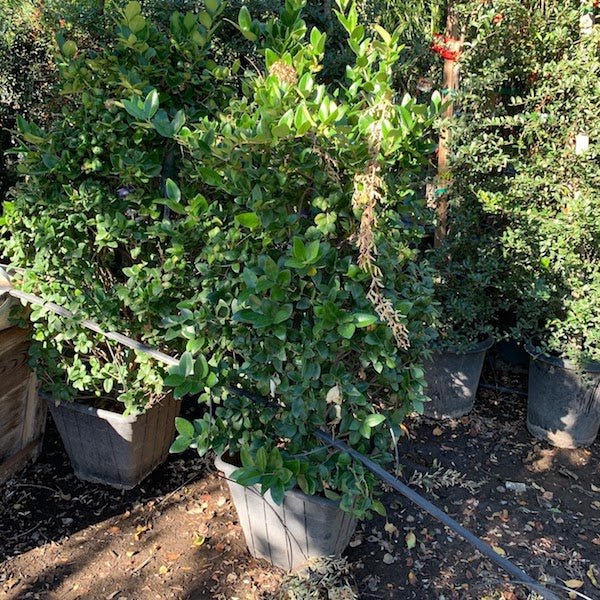

Privet Wax Leaf Cone
Privet Wax Leaf Cone
Couldn't load pickup availability
Phoenix's Top Evergreen Topiary for Formal & Modern Landscapes
Wax Leaf Privet Cone (Ligustrum japonicum 'Texanum') is one of the most versatile evergreen shrubs for Phoenix and Scottsdale landscapes — and in cone form, it delivers instant architectural structure with a polished, formal look. Growing 6–12 feet tall with dense, glossy dark green foliage, this pre-shaped topiary adds vertical elegance to entryways, courtyards, and garden focal points. Whether you're flanking a front door in Scottsdale, lining a driveway in Chandler, or creating formal structure in a Mesa courtyard — Wax Leaf Privet Cone gives your landscape a manicured look with minimal ongoing effort.
Wax Leaf Privet Cone Plant Details
| Attribute | Detail |
|---|---|
| Scientific Name | Ligustrum japonicum 'Texanum' |
| Common Names | Wax Leaf Privet, Waxleaf Privet Cone, Texas Privet |
| Mature Height | 6–12 feet (maintained smaller with pruning) |
| Mature Width | 6–8 feet (cone form is 2–4 feet wide) |
| Growth Rate | Moderate to fast — 1–2 feet per year in Phoenix |
| Sun | Full sun to partial shade. Handles reflected heat. |
| Water | Low to moderate once established. |
| USDA Zones | 7–11 (Phoenix is Zone 9b–10a) |
| Soil | Highly adaptable. Tolerates Arizona caliche soils. |
| Foliage | Evergreen — thick, glossy dark green leaves year-round |
| Bloom Season | Spring — clusters of creamy white fragrant flowers |
Wax Leaf Privet Cone Uses in Phoenix Landscapes
Entryway & Focal Point
Cone-shaped Wax Leaf Privet is a classic choice for flanking front doors, garage entries, and gate openings. Plant a matching pair for symmetrical formal elegance. The dense, glossy foliage maintains its shape beautifully and provides a year-round green accent that elevates curb appeal in any Phoenix neighborhood.
Formal Landscape & Courtyard Design
Wax Leaf Privet Cones are staples in formal and Mediterranean-inspired landscape designs. Use them as vertical accents in courtyard corners, along structured walkways, or as centerpieces in raised planters. They pair beautifully with low groundcovers like Trailing Lantana or formal hedges of Indian Hawthorn.
Container & Patio Plant
The cone form works exceptionally well in large decorative containers on patios, pool decks, and balconies. In pots, they stay more compact and are easy to maintain with occasional shaping. Use matching containers on either side of a seating area for an instant resort-style feel in Scottsdale and Tempe outdoor living spaces.
Best Time to Plant Wax Leaf Privet Cone in Phoenix
Fall (October–November) is the ideal planting window. Warm soil supports rapid root establishment while cooler air reduces transplant stress. Spring (February–April) is the second-best window. Wax Leaf Privet is tough enough to plant year-round in Phoenix, but avoid the hottest weeks of June–July if possible.
How to Plant Wax Leaf Privet Cone
- Dig wide, not deep — 2–3x the root ball width, same depth
- Check for caliche — break through any hardpan layer for drainage
- Backfill with native soil — a light 20% organic blend is fine
- Spacing — 3–4 ft apart if using as a row; 6+ ft for individual specimens
- Water basin — build a 3–4 inch ring to direct water to roots
- Mulch — 2–3 inches of bark or gravel mulch to retain moisture
Watering Wax Leaf Privet Cone in Phoenix
First Year Watering Schedule
Weeks 1–2: Every 1–2 days, deep and slow (20–30 min). Month 1–2: Every 3–4 days. Month 3–6: Every 5–7 days. After Year 1: Every 7–14 days in summer; every 2–3 weeks in winter.
Drip Irrigation
Place two 2 GPH emitters 12–18 inches from the trunk on opposite sides. Wax Leaf Privet is moderately drought-tolerant once established but looks its glossiest with consistent deep watering during the Phoenix summer months.
How fast does Wax Leaf Privet grow in Phoenix?
Wax Leaf Privet grows 1–2 feet per year in the Phoenix Valley. Cone forms from larger nursery sizes (10–15 gallon) provide immediate height and shape for instant landscape impact.
Does Wax Leaf Privet Cone need pruning?
The cone shape is pre-formed at the nursery. To maintain the clean cone silhouette, light shaping 2–3 times per year is recommended — typically in spring, mid-summer, and early fall. Wax Leaf Privet responds beautifully to pruning and fills in quickly.
Can Wax Leaf Privet handle full Phoenix sun?
Yes. Wax Leaf Privet handles full sun and reflected heat well, though it also thrives in partial shade. In the hottest exposures, consistent watering keeps the foliage glossy and green through summer.
Is Wax Leaf Privet evergreen in Phoenix?
Yes — it maintains its thick, glossy dark green foliage year-round in the Phoenix Valley. It's one of the most reliable evergreen shrubs for year-round structure and color.
You May Also Like
Ficus Nitida Column — A classic evergreen column tree for formal hedging and screening.
Green Hopseed Bush — A fast-growing evergreen shrub for privacy and screening applications.
Indian Hawthorn — A compact evergreen shrub with pink flowers, perfect as a low hedge companion.
Texas Sage — A drought-tolerant flowering shrub that adds purple color contrast alongside green Privet.
How Many Wax Leaf Privet Cones Do I Need?
The cone topiary is most often used as a matched pair flanking an entry or doorway, or in an evenly spaced row lining a driveway, walkway, or formal courtyard edge. Each cone is 2 to 4 feet wide at the base, so space them about 3.5 feet on center for a connected formal row, or set single specimens 6 feet or more apart so each cone silhouette stands clear.
| Row Length | Cones Needed (3.5 ft spacing) |
|---|---|
| 10 ft | 3 |
| 20 ft | 6 |
| 30 ft | 9 |
| 40 ft | 12 |
For a symmetrical entry, buy in even numbers (2, 4, or 6) so cones can be matched on each side.
Wax Leaf Privet Cone Season-by-Season in Phoenix
- Spring (Feb-Apr): Clusters of creamy white, fragrant flowers open and draw bees. A flush of glossy new growth follows. This is the second-best planting window and a good time for the first light shaping of the year.
- Summer (May-Sep): Holds up well to extreme Valley heat and reflected heat off walls and pavement. Keep deep, consistent water through the hottest weeks to keep the foliage glossy. Monsoon humidity (Jul-Sep) can push soft growth, so a mid-summer trim keeps the cone crisp.
- Fall (Oct-Nov): Prime planting season in Phoenix. Warm soil and cooler air make for fast, low-stress establishment. A light early-fall shaping sets a clean shape going into winter.
- Winter (Dec-Jan): Stays fully evergreen and structural through Valley winters. Cold-hardy to about 10°F, so it shrugs off normal Phoenix frost nights with no cover needed.
At a Glance
✔ Evergreen ✔ Heat-Loving (Reflected-Heat Tolerant) ✔ Drought-Tolerant ✔ Low-Maintenance ✔ Pollinator-Friendly ✔ Cold-Hardy to 10°F
Plant It With
- Green Hopseed: a fast evergreen screen that softens the formal cones with informal privacy height behind them.
- Pink Lady Indian Hawthorn: a compact flowering evergreen that makes a tidy low hedge or underplanting at the base of the cones.
- Japanese Boxwood: a classic formal companion for clipped low borders that echo the manicured topiary look.
- Texas Sage: adds silvery foliage and purple bloom for color contrast against the deep green privet.
Is Wax Leaf Privet Cone Right for Your Yard?
It thrives in full sun to partial shade, takes reflected heat off west-facing walls, and adapts to Phoenix caliche soils as long as the planting hole drains. It is the right pick if you want instant formal structure at an entry, courtyard, or driveway with only a few light trims a year. It is not a fit if you want a no-prune plant: to keep the crisp cone silhouette you will shape it 2 to 3 times a season, and the spring flowers and berries drop some litter, so it is not the cleanest choice right at a pool edge.
Share