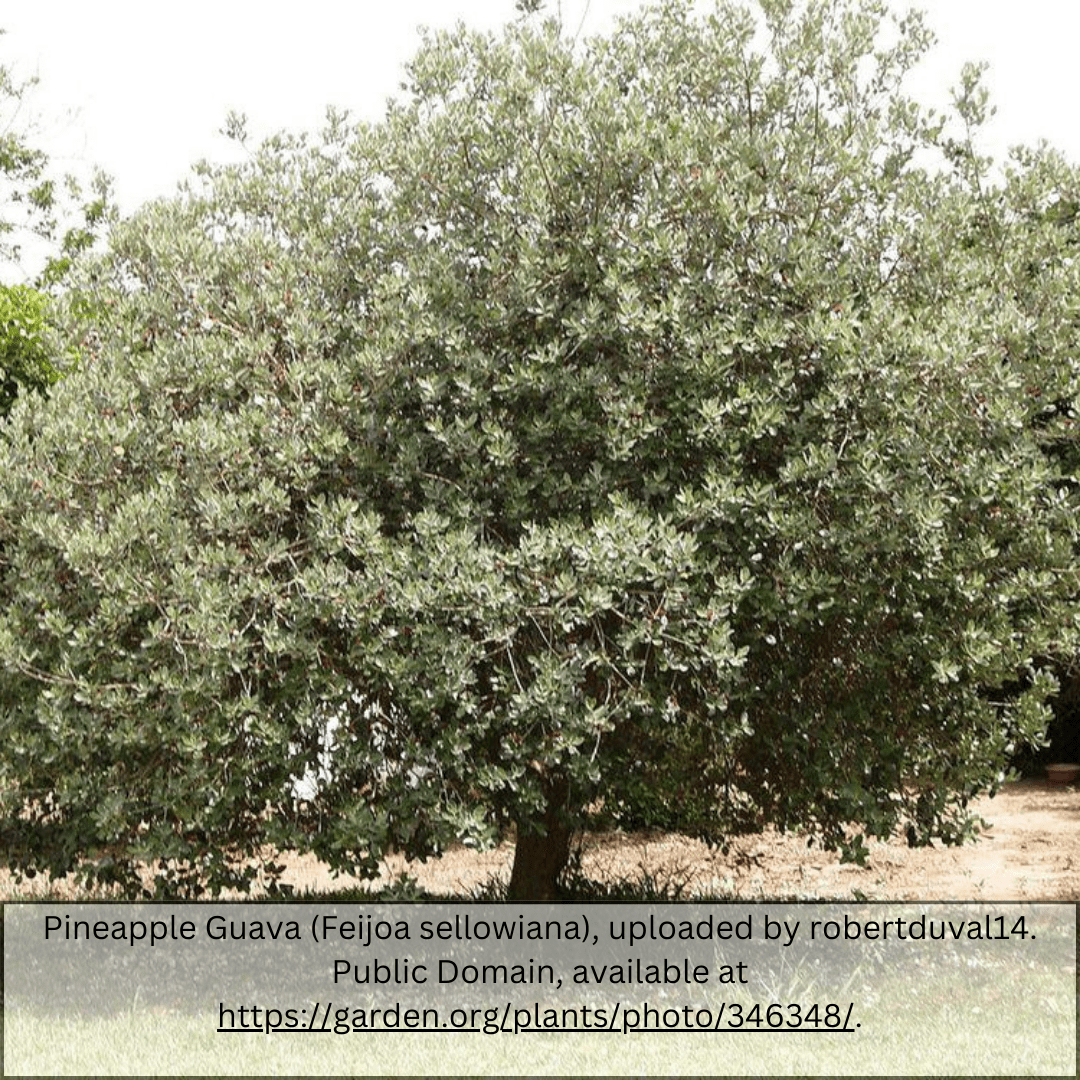

Pineapple Guava-Tree
Pineapple Guava-Tree
Couldn't load pickup availability
Pineapple Guava — The Ultimate Edible Evergreen for Phoenix Landscapes
Pineapple Guava (Acca sellowiana) is one of the most versatile landscape plants for the Phoenix Valley — equal parts ornamental showpiece and fruit-producing powerhouse. This dense evergreen tree features silvery-green foliage, stunning edible red-and-white flowers in spring, and sweet tropical fruit in fall. Extremely heat-tolerant, drought-friendly, and virtually pest-free, the Pineapple Guava thrives with minimal care. Whether you're creating an edible hedge in Scottsdale, adding a privacy screen in Mesa, or planting an ornamental fruit tree in a Chandler courtyard — Pineapple Guava does it all.
Pineapple Guava Plant Details
| Attribute | Detail |
|---|---|
| Scientific Name | Acca sellowiana (syn. Feijoa sellowiana) |
| Common Names | Pineapple Guava, Feijoa, Guavasteen |
| Mature Height | 10–15 feet |
| Mature Width | 10–15 feet |
| Growth Rate | Moderate — 1–2 feet per year in Phoenix |
| Sun | Full sun to partial shade. Handles reflected heat from walls. |
| Water | Low to moderate once established. Drought-tolerant but fruits better with regular water. |
| USDA Zones | 8–11 (Phoenix is Zone 9b–10a) |
| Soil | Well-draining. Adapts to Arizona caliche soils with proper planting. |
| Foliage | Evergreen — attractive silvery-green leaves year-round |
| Bloom | Spring — showy red-and-white edible flowers |
| Harvest | Fall — sweet tropical fruit with pineapple-mint flavor |
Pineapple Guava Uses in Phoenix Landscapes
Edible Privacy Hedge
Pineapple Guava's dense evergreen growth makes it one of the best edible hedge plants for Phoenix. Plant 5–6 feet apart for a thick privacy screen that also produces fruit every fall. A 40-foot fence line needs about 7–8 plants. The silvery foliage adds a softer, more refined texture than typical hedge plants.
Ornamental Fruit Tree
As a standalone specimen, Pineapple Guava delivers four-season interest: silvery foliage year-round, dramatic edible flowers in spring, tropical fruit in fall, and a naturally attractive shape that needs minimal pruning. Plant one near a patio, entry, or outdoor kitchen in Gilbert, Tempe, or Scottsdale.
Low-Water Landscape Anchor
Pineapple Guava pairs beautifully with other drought-tolerant plants in a modern desert landscape. Combine it with Texas Sage, Yellow Bells, and Lantana from Three Timbers for a colorful, low-water garden that includes a bonus fruit harvest. Its compact size works well in smaller residential lots.
Best Time to Plant Pineapple Guava in Phoenix
Fall (October–November) is the ideal planting window. Warm soil encourages root establishment while cooler air reduces transplant stress. The tree gets 6–8 months of root growth before its first Phoenix summer. Spring (March–April) is a solid second choice — just plan for more frequent watering through the first summer.
How to Plant Pineapple Guava
- Dig wide, not deep — 2–3x the root ball width, same depth as the container.
- Check for caliche — Break through any hardpan layer for proper drainage.
- Backfill with native soil — A light 20% compost amendment is fine but not required.
- Spacing — 5–6 ft apart for hedge; 10–12 ft for standalone specimens.
- Water basin — Build a 3–4 inch soil ring around the root zone to direct water to the roots.
- Mulch — 2–3 inches of bark or gravel mulch around the base to retain moisture.
Watering Pineapple Guava in Phoenix
First Year Watering Schedule
- Weeks 1–2: Every 1–2 days, deep and slow (20–30 minutes per session)
- Months 1–2: Every 3–4 days
- Months 3–6: Every 7–10 days (every 5–7 days during peak summer)
- After Year 1: Every 10–14 days in summer; every 3–4 weeks in winter
Drip Irrigation
Place 2–3 emitters 18–24 inches from the trunk, each delivering 2–4 GPH. Pineapple Guava is drought-tolerant once established but produces more and larger fruit with consistent deep watering during spring bloom and fall fruit development.
Does Pineapple Guava need a pollinator?
Pineapple Guava is partially self-fertile, but fruit production improves significantly when you plant two or more trees for cross-pollination. If space is limited, a single tree will still produce some fruit.
What does Pineapple Guava fruit taste like?
The fruit has a unique tropical flavor often described as a blend of pineapple, guava, and mint. The flesh is sweet and aromatic with a slightly gritty texture similar to a pear. It's delicious fresh, in smoothies, or in jams.
Is Pineapple Guava drought tolerant?
Yes. Once established, Pineapple Guava handles Phoenix drought conditions well. It will survive on minimal water but produces better fruit and foliage with moderate irrigation.
Can I eat the flowers?
Yes! Pineapple Guava flowers are edible and have a sweet, slightly spicy flavor. They make a beautiful and tasty addition to salads, desserts, and cocktails. Picking flowers won't significantly reduce fruit production.
You May Also Like
- Pomegranate — Another drought-tolerant fruit tree with stunning blooms and easy fall harvest.
- Fig Tree — A low-maintenance fruit tree that produces heavily in Phoenix heat.
- Japanese Privet Tree — A lush evergreen option for dense privacy screening.
- Bottle Brush Tree — A colorful evergreen with red flowers and low water needs.
How Many Pineapple Guava Do I Need?
With a mature width of 10 to 15 feet, Pineapple Guava works as both an edible hedge and a standalone fruit tree. For a dense, fruit-bearing privacy screen, space plants about 5 to 6 feet apart so they knit into a solid wall. As an ornamental specimen, give a single plant 10 to 12 feet of room to show its natural form.
| Hedge run length | Plants needed (5–6 ft spacing) |
|---|---|
| 20 ft | 4 |
| 40 ft | 7–8 |
| 60 ft | 11–12 |
For fruit, plant at least two for cross-pollination and a heavier harvest.
Pineapple Guava Season-by-Season in Phoenix
- Spring (Feb–Apr): Showy red-and-white edible flowers open and draw pollinators. New silvery growth flushes. A good second planting window.
- Summer (May–Sep): Handles Phoenix heat and reflected warmth well, holding its evergreen foliage. Keep water consistent through bloom and fruit set; afternoon shade in the hottest reflected-heat spots keeps foliage crisp. Monsoon humidity is welcome.
- Fall (Oct–Nov): Harvest season. Sweet pineapple-mint fruit ripens and drops. Prime planting season for new trees.
- Winter (Dec–Jan): Evergreen and reliably cold-hardy in the Valley, tolerating temperatures down to about 15°F with no special protection.
At a Glance
✔ Edible ✔ Evergreen ✔ Drought-Tolerant ✔ Heat-Loving (Reflected-Heat Tolerant) ✔ Pollinator-Friendly ✔ Low-Maintenance ✔ Cold-Hardy to 15°F
Plant It With
- Pomegranate: another heat-loving, low-water fruit tree that extends the backyard harvest into fall.
- Fig Tree: a reliable Phoenix producer that rounds out a small edible orchard.
- Japanese Privet Tree: a dense evergreen that pairs for a mixed privacy screen.
- Bottle Brush Tree: a colorful low-water evergreen that adds red bloom and pollinator value.
Is Pineapple Guava Right for Your Yard?
Pineapple Guava thrives in full sun to light afternoon shade, in well-draining or amended caliche soil, and works equally well as a clipped edible hedge or a free-form specimen with year-round silvery foliage. It is one of the most cold-hardy and trouble-free edibles for the Valley. It is not the best fit right at a pool edge, since it drops fruit in fall, or in a spot where you cannot give it steady water through bloom and fruit set if you want a full harvest.
Customer Reviews
Everything we have gotten from here has been amazing we have even used them to get plants for investment properties.
Share