

Peruvian Old Man
Peruvian Old Man
Couldn't load pickup availability
The Best Woolly Columnar Cactus for Phoenix Desert Gardens
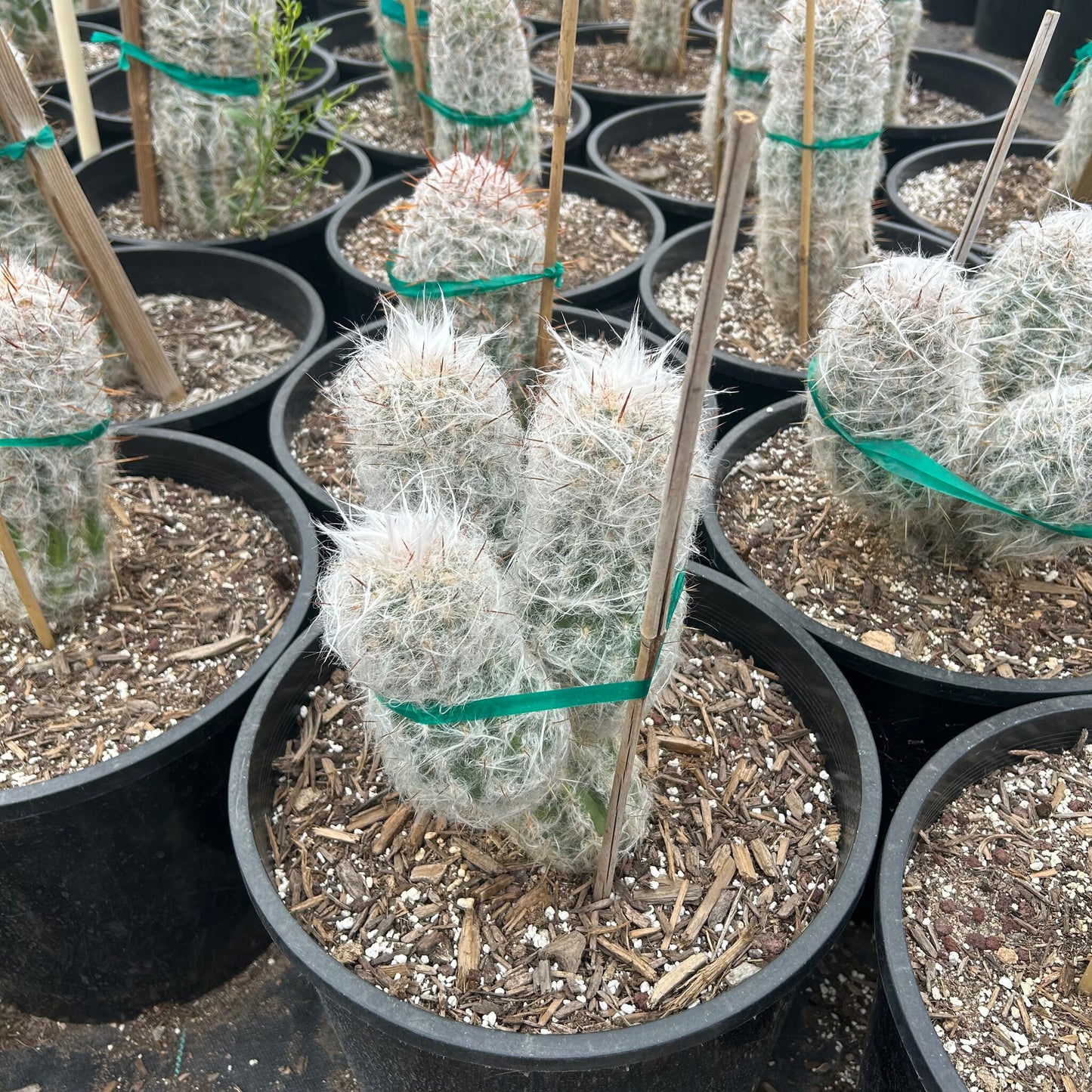
Espostoa lanata, commonly known as the Peruvian Old Man Cactus, is one of the most visually striking columnar cacti you can grow in the Phoenix Valley. Its tall, upright stems are covered in a dense coat of white, woolly hairs that protect the plant from intense sun — and give it an unmistakable silhouette in any landscape. Slow-growing but long-lived, this Andean native thrives in full sun and requires very little water once established. Whether you're building a modern desert garden in Scottsdale, adding texture to a xeriscape bed in Chandler, or creating a statement piece in a Mesa courtyard — the Peruvian Old Man Cactus delivers dramatic impact with minimal effort.
Peruvian Old Man Cactus Plant Details
| Attribute | Detail |
|---|---|
| Scientific Name | Espostoa lanata |
| Common Names | Peruvian Old Man Cactus, Peruvian Old Man, Cotton Ball Cactus |
| Mature Height | 10–15 feet |
| Mature Width | 1–3 feet per stem |
| Growth Rate | Slow — 2–4 inches per year in Phoenix |
| Sun | Full sun (6+ hrs). Handles reflected heat from walls. |
| Water | Very low once established. Highly drought-tolerant. |
| USDA Zones | 9–11 (Phoenix is Zone 9b–10a) |
| Soil | Well-draining. Adapts to Arizona caliche soils with added drainage. |
| Foliage | Evergreen — dense white woolly hairs year-round |
| Origin | High Andes of Peru and Ecuador |
Peruvian Old Man Cactus Uses in Phoenix Landscapes
Dramatic Focal Point in Desert Gardens
The dense white woolly covering makes the Peruvian Old Man Cactus an instant conversation piece. Plant a single specimen in a gravel bed or raised planter and it becomes the centerpiece of the entire yard. The white texture contrasts beautifully with dark volcanic rock or decomposed granite commonly used in Phoenix landscaping.
Modern Desert & Minimalist Design
Architects and landscape designers in Scottsdale and Paradise Valley love this cactus for its clean columnar form and unusual texture. It pairs well with smooth-skinned columnar cacti like Blue Ghost, Mexican Fence Post, or Totem Pole for a curated cactus garden with varied textures.
Rock Gardens & Xeriscape Beds
The Peruvian Old Man is perfectly at home in rock gardens alongside other low-water plants. Combine it with Golden Barrel, Desert Spoon, and Agave for a zero-lawn xeriscape that thrives in Gilbert, Tempe, or Peoria without supplemental irrigation once established.
Container & Courtyard Planting
Smaller sizes (1–5 gallon) make excellent container specimens for patios, courtyards, and pool decks. The slow growth rate means it stays proportional in a pot for years. Place in a spot with full morning sun and afternoon light for the best woolly hair development.
Best Time to Plant Peruvian Old Man Cactus in Phoenix
Fall (October–November) is ideal. The soil is still warm enough for root establishment, while cooler air temperatures reduce transplant stress. This gives the cactus 6–8 months to develop roots before its first Phoenix summer. Spring (February–April) is the second-best window. Avoid planting during peak summer heat if possible — the woolly hairs provide sun protection, but fresh transplants still need time to anchor their roots.
How to Plant Peruvian Old Man Cactus
- Dig wide, not deep — 2–3x the root ball width, same depth as the container.
- Check for caliche — break through any hardpan layer to ensure drainage. This species is especially sensitive to standing water.
- Backfill with native soil — mix in 20–30% pumice or perlite for extra drainage if your soil is heavy clay.
- Spacing — 3–4 feet apart for a grouped planting; 5+ feet for standalone specimens.
- Water basin — build a 3–4 inch ring around the base to direct water to the root zone.
- Mulch — 2–3 inches of gravel mulch (not bark — bark retains too much moisture for this species).
Watering Peruvian Old Man Cactus in Phoenix
First Year Watering Schedule
- Weeks 1–2: Every 5–6 days, deep and slow (15–20 min)
- Month 1–2: Every 7–10 days
- Month 3–6: Every 14–18 days (10–14 days in peak summer)
- After Year 1: Every 21–28 days summer; monthly or less in winter
Drip Irrigation
Place one 1–2 GPH emitter 12–18 inches from the base of the stem. Established Peruvian Old Man Cactus needs very little supplemental water — overwatering is the number one killer. In winter, reduce irrigation to once a month or stop entirely if rainfall is adequate.
How fast does the Peruvian Old Man Cactus grow in Phoenix?
Slowly — expect 2–4 inches of new height per year. A 1 gallon specimen may take 8–10 years to reach 3–4 feet. The slow pace is part of its charm and means it rarely outgrows its spot.
Is it drought tolerant once established?
Extremely. Once the root system is anchored (after the first year), this cactus can survive on rainfall alone in most Phoenix winters and only needs occasional deep watering in the hottest summer months.
Can the Peruvian Old Man Cactus handle full Phoenix summer heat?
Yes. The dense white woolly hairs act as natural sun protection, reflecting intense UV and insulating the stem. It handles reflected heat from walls and pavement without issue once established.
What's the difference between Peruvian Old Man and Old Man of Mexico?
Both are woolly cacti, but they're different species. Peruvian Old Man (Espostoa lanata) is columnar and from the Andes, growing tall and upright. Old Man of Mexico (Cephalocereus senilis) has longer, more hair-like fibers and a slightly different growth habit. Both do well in Phoenix, but Peruvian Old Man tends to be the hardier landscape choice.
Does it need frost protection?
It can tolerate brief dips to 25–28°F, which covers most Phoenix winters. In unusually cold snaps, a frost cloth draped over the plant for a night or two is sufficient protection. The woolly covering provides some natural insulation.
You May Also Like
- Old Man of Mexico — another iconic woolly cactus with flowing white hairs, perfect companion planting.
- Blue Ghost — a stunning blue-skinned columnar that contrasts beautifully with the white wool of the Peruvian Old Man.
- Totem Pole Major — smooth, spineless columnar cactus for a textural contrast in modern desert gardens.
- Senita — native Sonoran columnar with distinctive whisker-like spines at the growing tips.
- Golden Torch — bright golden-spined columnar that adds warm color next to the cool white of the Peruvian Old Man.
How Many Peruvian Old Man Cactus Do I Need?
This is a slow, narrow columnar cactus (1 to 3 ft wide per stem, 10 to 15 ft tall over many years), so it is grown as a specimen rather than a hedge. Plan around its upright form and airflow needs:
| Planting style | Spacing and count |
|---|---|
| Single focal point | 1 plant, 5-plus ft clear so the wool stays dry |
| Sculptural grouping | 3 columns spaced 3 to 4 ft apart for a clustered display |
| Mixed columnar bed | Columns 3 to 4 ft on center among other slow columnar cacti |
Odd-numbered groups of 3 or 5 look most natural. Because it gains only 2 to 4 inches a year, a larger starter plant gives instant height.
Peruvian Old Man Cactus Season-by-Season in Phoenix
- Spring (Feb–Apr): Main growth flush as soil warms; fresh white wool forms at the tips. A good secondary planting window.
- Summer (May–Sep): Loves full sun and reflected heat; the dense wool is natural sunscreen and the plant grows hardest in the heat. Keep water at the soil, not the wool, and let it dry fully between waterings so monsoon humidity does not cause rot.
- Fall (Oct–Nov): Prime planting season. Warm soil with cooling air gives this slow grower 6 to 8 months to root before summer.
- Winter (Dec–Jan): Holds its woolly form year-round and takes brief dips to about 25°F, covering most Valley winters. In a hard cold snap, drape frost cloth for a night or two and keep it dry.
At a Glance
✔ Heat-Loving (Reflected-Heat Tolerant) ✔ Drought-Tolerant ✔ Evergreen ✔ Low-Maintenance ✔ Deer & Rabbit-Resistant ✔ Cold-Hardy to 25°F
Plant It With
- Old Man of Mexico: a companion woolly cactus for a classic hairy-cactus pairing.
- Blue Ghost: a blue-skinned column whose smooth color sets off the white wool.
- Totem Pole Major: a smooth knobby column for a contrasting texture in a modern bed.
- Senita: a native Sonoran column with whiskered tips to round out a curated grouping.
Is Peruvian Old Man Cactus Right for Your Yard?
It thrives in full sun and reflected heat, fast-draining soil amended through any caliche, and an open spot with airflow so the wool stays dry. It is one of the easier woolly columns for the Valley and makes a striking modern focal point or container specimen. It is not a fit if your only spot stays damp or shaded, or sits under overhead spray: wet wool and soggy roots are what cause it to decline.
Share