

Mountain Aloe
Mountain Aloe
Couldn't load pickup availability
Phoenix's Boldest Large Succulent — The Mountain Aloe
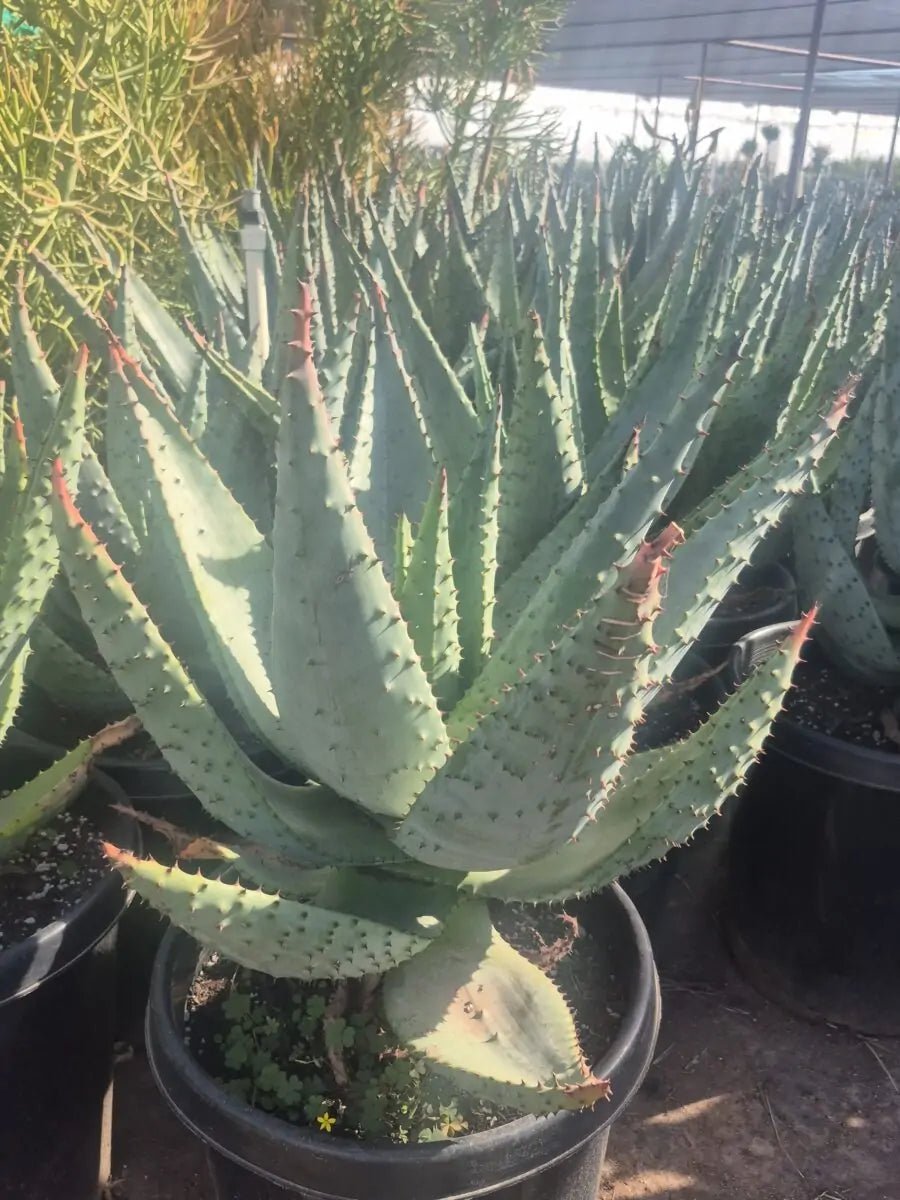
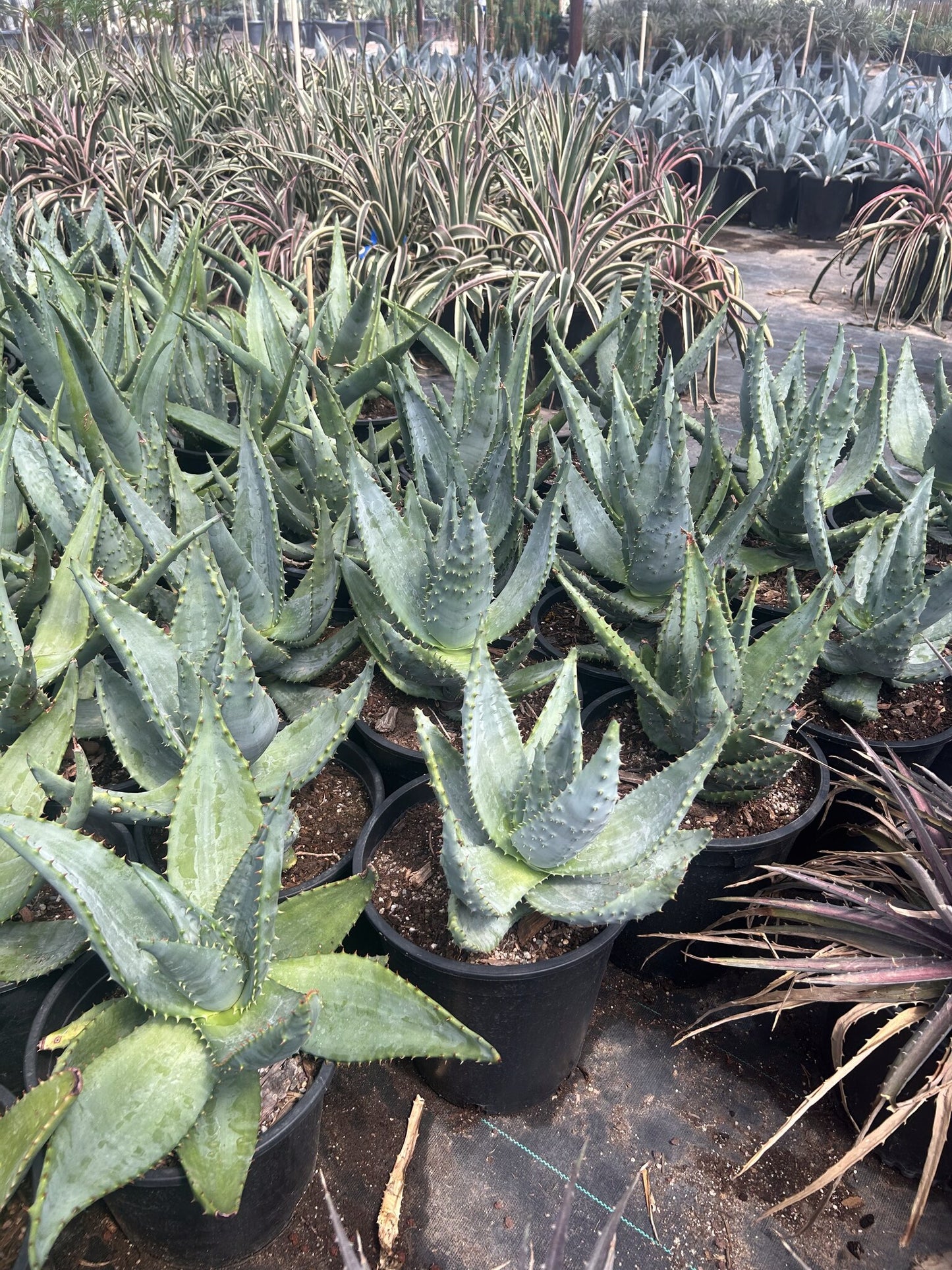
Mountain Aloe (Aloe marlothii) is one of the most dramatic and imposing aloes you can grow in the Phoenix Valley. This South African native reaches 5–8 feet tall and 4–6 feet wide, forming a massive rosette of thick, gray-green leaves armed with spiny teeth on both surfaces and edges. In winter, it sends up spectacular branching flower spikes covered in bright orange-red blooms that attract hummingbirds from across the neighborhood. It thrives in full Phoenix sun, handles reflected heat, and needs almost no supplemental water once established. Whether you need a bold sculptural anchor for a Scottsdale estate, a statement piece in a Chandler xeriscape, or a dramatic focal point in a Gilbert front yard — Mountain Aloe commands attention year-round.
Mountain Aloe Plant Details
| Attribute | Detail |
|---|---|
| Scientific Name | Aloe marlothii |
| Common Names | Mountain Aloe, Flat-Flowered Aloe |
| Mature Height | 5–8 feet |
| Mature Width | 4–6 feet |
| Growth Rate | Moderate — 6–12 inches per year in Phoenix |
| Sun | Full sun (6+ hrs). Handles reflected heat from walls. |
| Water | Low once established. Highly drought-tolerant. |
| USDA Zones | 9–11 (Phoenix is Zone 9b–10a) |
| Soil | Well-draining sandy or rocky soil. Adapts to Arizona caliche soils. |
| Foliage | Evergreen — gray-green with spiny teeth on surfaces and edges |
| Bloom Color | Bright orange-red, winter (branching candelabra-style spikes) |
| Attracts | Hummingbirds, bees, nectar-feeding birds |
Mountain Aloe Uses in Phoenix Landscapes
Statement Focal Point
At 5–8 feet tall with a massive rosette and dramatic flower spikes, Mountain Aloe is one of the most commanding single specimens you can place in a desert garden. Use it as the centerpiece of a front yard, the anchor of a large planter bed, or a standalone sculptural piece against a modern wall. Its architectural form rivals any agave or cactus for visual impact.
Xeriscape Anchor
Mountain Aloe anchors large xeriscape compositions beautifully. Plant it with lower-growing companions like Blue Elf Aloe, Desert Spoon, and Red Bird of Paradise to create dramatic height layers. Its gray-green color and spiny texture contrast perfectly with soft-textured ornamental grasses and smooth-trunked palo verde trees.
Hummingbird & Wildlife Gardens
The branching candelabra-style flower spikes produce enormous quantities of nectar, making Mountain Aloe one of the best hummingbird plants for Phoenix winters. A single mature plant can feed dozens of hummingbirds throughout the bloom season. Pair with Chuparosa and Dawe's Aloe for continuous winter nectar.
Best Time to Plant Mountain Aloe in Phoenix
Fall (October–November) is the ideal planting window. Warm soil promotes rapid root establishment, cooler air reduces transplant stress, and the plant gets 6–8 months of root growth before its first Phoenix summer. Spring (February–April) is the second-best option. Avoid planting in peak summer — especially for larger box sizes that need time to anchor their root systems.
How to Plant Mountain Aloe
- Dig wide, not deep — 2–3× the root ball width, same depth.
- Check for caliche — break through any hardpan layer for drainage. Critical for large specimens.
- Backfill with native soil — a light 20% organic blend is fine.
- Spacing — 5–6 ft from other large plants; give it room to spread its full rosette.
- Water basin — build a 4–6 inch ring to direct water to roots for larger specimens.
- Mulch — 2–3 inches of gravel mulch to retain moisture and suppress weeds.
Watering Mountain Aloe in Phoenix
First Year Watering Schedule
- Weeks 1–2: Every 2–3 days, deep and slow (30–45 min for large specimens)
- Month 1–2: Every 4–5 days
- Month 3–6: Every 7–10 days (5–7 days in peak summer)
- After Year 1: Every 10–14 days summer; every 3–4 weeks winter
Drip Irrigation
For 15-gallon and larger specimens, use two 2 GPH emitters on opposite sides, 18–24 inches from the trunk. Established plants in the ground need very little supplemental water — they're built for drought.
How fast does Mountain Aloe grow in Phoenix?
Expect 6–12 inches of new growth per year in full sun. A 1-gallon plant will take 5–7 years to reach full size. For instant impact, choose a 25-gallon or 30-inch box specimen.
Is Mountain Aloe cold hardy in Phoenix?
Yes — it handles Phoenix winter lows (mid-20s°F) without issue. Brief freezes may cause minor leaf tip damage, but the plant recovers quickly. It's one of the hardiest large aloes for the Valley.
How big do the flower spikes get?
Mature plants produce branching candelabra-style spikes that can reach 3–4 feet above the rosette. A single plant may have multiple spikes blooming simultaneously, creating an extraordinary winter display.
Does Mountain Aloe have thorns?
Yes — the leaves have spiny teeth on both flat surfaces and along the margins. Plant it away from walkways and play areas. The thorns give it a dramatic, prehistoric appearance that many gardeners love.
You May Also Like
- Cape Aloe — Another large tree-form aloe with coral-red flowers and dramatic form.
- Hercules Tree Aloe — Massive tree aloe for the ultimate specimen plant.
- Goliath Aloe — Large hybrid aloe with impressive rosettes and bold presence.
- Dawe's Aloe — Medium-sized aloe with vivid red-orange flower spikes.
- Malagasy Tree Aloe — Exotic tree-form aloe from Madagascar.
How Many Mountain Aloe Do I Need?
Mountain Aloe is a large, spiny specimen (4 to 6 ft wide), so it is planted as a focal point or in bold, well-spaced groupings rather than a tight hedge. Plan by design goal:
| Design goal | How to plant |
|---|---|
| Single focal anchor | 1 plant with 5 to 6 ft of clear space around the rosette |
| Sculptural cluster | An odd-numbered group of 3 spaced 5 to 6 ft apart so each rosette stands clear |
| Bold xeriscape mass | 5 staggered at 6 ft centers for a dramatic large-bed statement |
Because the leaves carry spiny teeth on both surfaces and edges, keep this plant at least 4 to 5 ft back from walkways, patios, pool decks, and play areas.
Mountain Aloe Season-by-Season in Phoenix
- Spring (Feb to Apr): Winter bloom finishes and the rosette pushes new gray-green leaves. Solid second planting window.
- Summer (May to Sep): Built for full Valley sun and reflected heat with very little water. Monsoon rain is fine given sharp drainage; ease off irrigation if soil stays damp.
- Fall (Oct to Nov): Best planting season, especially for large box sizes that need time to anchor before summer.
- Winter (Dec to Jan): The showstopper season. Branching candelabra spikes feed hummingbirds for weeks. One of the hardiest large aloes, taking mid-20s°F with at most minor leaf-tip nip.
At a Glance
✔ Hummingbird-Friendly ✔ Pollinator-Friendly ✔ Heat-Loving (Reflected-Heat Tolerant) ✔ Drought-Tolerant ✔ Evergreen ✔ Low-Maintenance ✔ Deer & Rabbit-Resistant ✔ Cold-Hardy to 25°F
Plant It With
- Cape Aloe: another large tree-form aloe that extends the bold winter bloom show.
- Goliath Aloe: massive hybrid rosette that matches Mountain Aloe's scale.
- Dawe's Aloe: medium red-orange bloomer for the mid-height layer in front.
- Desert Spoon: soft silvery fountain that contrasts the spiny rosette at ground level.
Is Mountain Aloe Right for Your Yard?
Mountain Aloe is ideal for a hot, full-sun spot with fast-draining, sandy or rocky soil where a big sculptural anchor and winter hummingbird magnet earns its space. It loves reflected heat, needs almost no water once established, and is one of the cold-hardiest large aloes for the Valley. It is not a fit close to walkways, pools, or play areas because the leaves are sharply toothed on both surfaces, and it will struggle in low ground or wet caliche that holds water.
Share