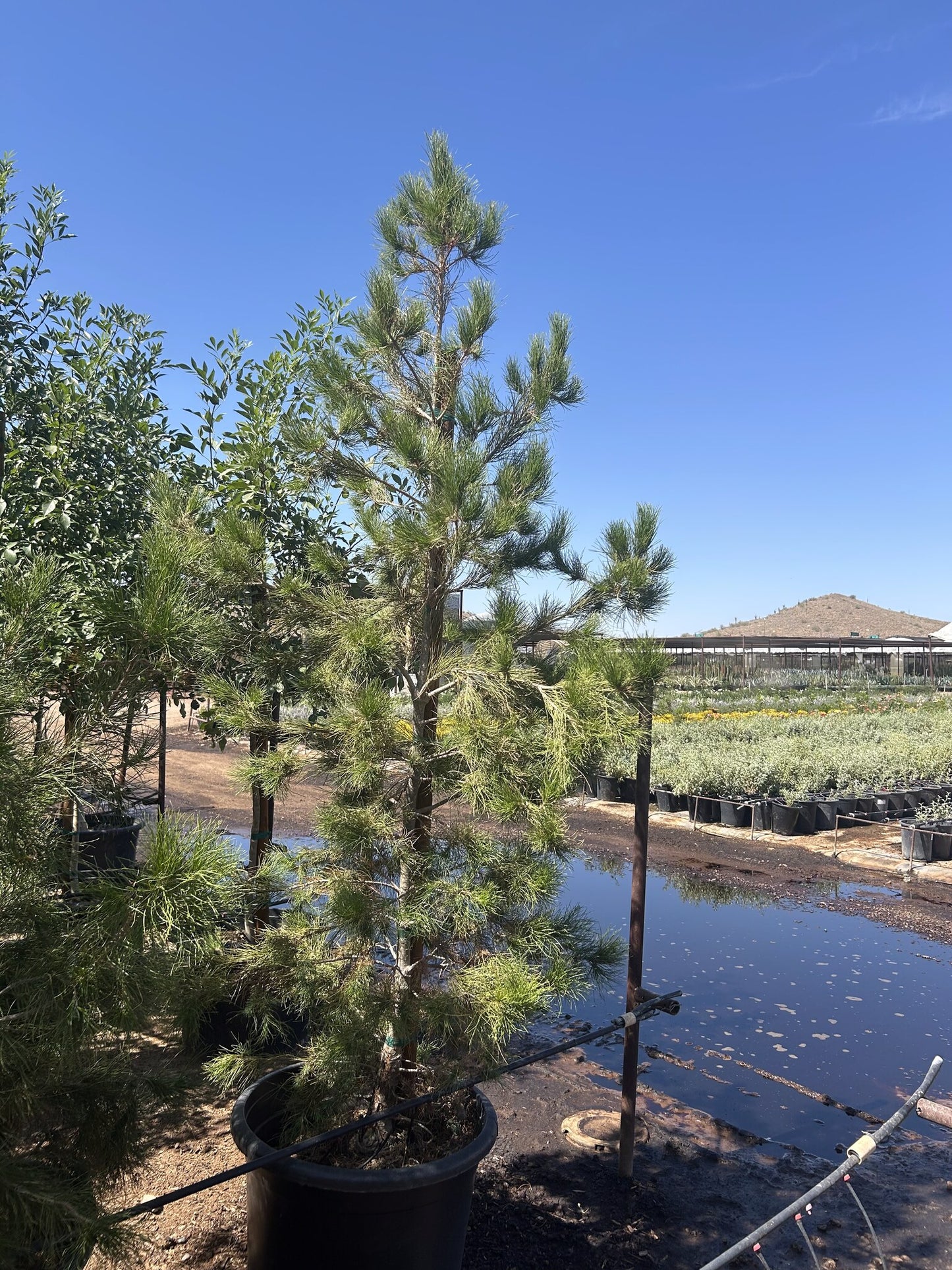


Mondale Pine
Mondale Pine
Couldn't load pickup availability
The Fastest-Growing Evergreen Pine for Phoenix Landscapes
Mondale Pine (Pinus eldarica), also known as Eldarica Pine or Afghan Pine, is the go-to evergreen tree for Phoenix Valley homeowners who want year-round privacy, wind protection, and shade — fast. This drought-adapted pine grows 3–5 feet per year and keeps its dense green needles through every season, making it one of the most reliable screening trees available in the low desert. Whether you're blocking a neighbor's view in Scottsdale, creating a windbreak along a property line in Gilbert, or adding vertical structure to a modern landscape in Chandler — Mondale Pine delivers results quickly.
Mondale Pine Plant Details
| Attribute | Detail |
|---|---|
| Scientific Name | Pinus eldarica |
| Common Names | Mondale Pine, Eldarica Pine, Afghan Pine, Mondell Pine |
| Mature Height | 30–60 feet |
| Mature Width | 20–30 feet |
| Growth Rate | Fast — 3–5 feet per year in Phoenix |
| Sun | Full sun (6+ hrs). Handles reflected heat from walls and pavement. |
| Water | Low to moderate once established. Drought-tolerant. |
| USDA Zones | 6–11 (Phoenix is Zone 9b–10a) |
| Soil | Well-draining. Adapts to Arizona caliche and alkaline soils. |
| Foliage | Evergreen — dense green needles year-round |
| Shape | Pyramidal to oval — naturally symmetrical with minimal pruning |
Mondale Pine Uses in Phoenix Landscapes
Privacy Screening and Windbreaks
Mondale Pine is one of the best privacy trees for Phoenix properties. Its dense, year-round foliage blocks sight lines from ground level to well above roofline height. Plant 10–12 feet apart for a solid privacy screen, or 8–10 feet apart for a tight windbreak along a property boundary. For a 40-foot fence line, plan on 4–5 trees. Pair with lower evergreen shrubs like Oleander or Texas Sage from Three Timbers for full coverage from ground to canopy.
Shade and Energy Savings
A mature Mondale Pine casts significant shade that can reduce cooling costs when planted on the west or south side of a home. Unlike deciduous trees, it provides shade year-round — which is exactly what Phoenix homeowners need during those 6+ months of intense sun. Plant at least 15–20 feet from structures to give the root system room and prevent branch interference.
Backyard and Property Line Planting
Mondale Pine works beautifully as a backyard specimen tree or along property lines in neighborhoods across Mesa, Tempe, Peoria, and Glendale. Its upright form takes up less lateral space than many shade trees, making it ideal for narrower lots. It pairs well with desert groundcovers and decomposed granite landscapes.
Best Time to Plant Mondale Pine in Phoenix
Fall (October–November) is the ideal planting window. Warm soil encourages strong root development while cooler air temperatures reduce transplant stress. This gives the tree 6–8 months of root establishment before its first Phoenix summer. Spring (February–April) is the second-best window. Avoid planting during the peak summer months when temperatures regularly exceed 110°F.
How to Plant Mondale Pine
- Dig wide, not deep — excavate a hole 2–3× the width of the root ball, but only as deep as the root ball height. The root flare should sit at or slightly above grade.
- Check for caliche — if you hit a white hardpan layer, break through it completely to ensure drainage. Standing water will kill Mondale Pine faster than drought.
- Backfill with native soil — Mondale Pine thrives in native desert soil. A light 20% organic amendment is fine but not required.
- Spacing — 10–12 feet apart for a privacy screen; 20–25 feet apart for individual shade trees.
- Build a water basin — create a 3–4 inch berm ring around the root zone to direct irrigation water down to the roots.
- Mulch — spread 2–3 inches of bark or gravel mulch over the root zone (not touching the trunk) to retain moisture and moderate soil temperature.
Watering Mondale Pine in Phoenix
First Year Watering Schedule
Weeks 1–2: Water every 1–2 days, deep and slow (30–45 minutes with a slow trickle). Month 1–2: Reduce to every 3–4 days. Month 3–6: Water every 7–10 days (every 5–7 days during peak summer heat). After Year 1: Water every 10–14 days in summer and every 3–4 weeks in winter. Established Mondale Pines are very drought-tolerant but perform best with regular deep watering during the hottest months.
Drip Irrigation Tips
Place emitters 18–24 inches from the trunk for new plantings, moving them outward as the canopy expands. Use 2–4 GPH emitters with 3–4 emitters per tree. By year three, position emitters at the canopy drip line for deep root encouragement.
How fast does Mondale Pine grow in Phoenix?
Mondale Pine is one of the fastest-growing pines available for Phoenix landscapes. Expect 3–5 feet of growth per year with proper watering during the first two years. Most trees reach functional screening height (15–20 feet) within 4–5 years of planting.
Is Mondale Pine drought-tolerant?
Yes. Once established (after 1–2 years), Mondale Pine handles Phoenix heat and drought remarkably well. It originates from arid regions of Central Asia and is naturally adapted to hot, dry climates with alkaline soils — very similar to the Phoenix Valley.
Does Mondale Pine drop needles?
Mondale Pine is evergreen and holds its needles year-round. There is some natural needle drop (especially older interior needles in fall), but it's minimal compared to deciduous trees. It's a relatively clean tree for pool areas and patios.
Can Mondale Pine handle full Phoenix summer heat?
Absolutely. Mondale Pine thrives in temperatures above 110°F and handles reflected heat from walls and pavement without stress. It's one of the toughest evergreen trees for the low desert.
How tall does Mondale Pine get?
In Phoenix landscapes, Mondale Pine typically reaches 30–50 feet tall with a 20–30 foot spread. In ideal conditions with deep soil, it can reach 60 feet. Its naturally pyramidal shape makes it an impressive vertical element in any landscape.
You May Also Like
Italian Cypress (Cupressus sempervirens) — A tall, narrow evergreen column perfect for formal privacy screens and Mediterranean-style landscapes.
Bottle Brush Tree (Callistemon viminalis) — An evergreen flowering tree with bright red blooms and year-round foliage, great as a smaller privacy screen or accent.
Japanese Privet (Ligustrum japonicum) — A dense evergreen tree ideal for smaller privacy screening and formal hedge applications.
Fern of the Desert (Lysiloma watsonii) — A fine-textured native shade tree for those who want a softer desert look alongside their evergreen screen.
How Many Mondale Pine Do I Need?
Mondale Pine is most often planted as a fast evergreen privacy screen or windbreak. Use the table below to estimate tree counts at typical spacings. For a single shade specimen, give it 20 to 25 feet of clear room.
| Run Length | Privacy Screen (12 ft on center) | Tight Windbreak (10 ft on center) |
|---|---|---|
| 30 ft | 3 trees | 3 to 4 trees |
| 50 ft | 4 to 5 trees | 5 to 6 trees |
| 75 ft | 6 to 7 trees | 7 to 8 trees |
| 100 ft | 8 to 9 trees | 10 to 11 trees |
Mondale Pine Season-by-Season in Phoenix
- Spring (Feb to Apr): Strong flush of new candle growth. A good second planting window with mild temperatures for establishment.
- Summer (May to Sep): Holds dense green needles through extreme heat and reflected heat off walls and pavement. Fast growth continues; monsoon storms can rock young, top-heavy trees, so stake until well-rooted.
- Fall (Oct to Nov): Prime planting season. Some natural shedding of older interior needles, which is normal and minimal.
- Winter (Dec to Jan): Stays fully evergreen for year-round screening. Very cold-hardy (to roughly 0°F), so no frost concern in the Valley.
At a Glance
✔ Heat-Loving (Reflected-Heat Tolerant) ✔ Drought-Tolerant ✔ Evergreen ✔ Pool-Friendly (Low-Litter) ✔ Shade-Providing ✔ Low-Maintenance ✔ Cold-Hardy to 0°F
Plant It With
- Italian Cypress: a narrow evergreen column that pairs with Mondale Pine for layered formal screening.
- Japanese Privet Tree: a dense evergreen for the lower tier of a screen, ground to mid-height.
- Texas Sage: an evergreen flowering shrub to fill in below the canopy for full ground-to-top coverage.
- Fern of the Desert: a fine-textured native that softens the look alongside an evergreen wall of pines.
Is Mondale Pine Right for Your Yard?
Mondale Pine thrives in full sun, tolerates reflected heat, and grows fast in well-drained caliche soil once the hardpan is broken. It is drought-tolerant once established, evergreen for year-round privacy, and cold-hardy through any Valley winter. Give a screen 10 to 12 feet between trees and keep it 15 to 20 feet off structures. It is not a fit for small or narrow lots where a 30 to 60 foot tree will outgrow the space, and standing water in poorly drained soil will kill it faster than drought.
Share