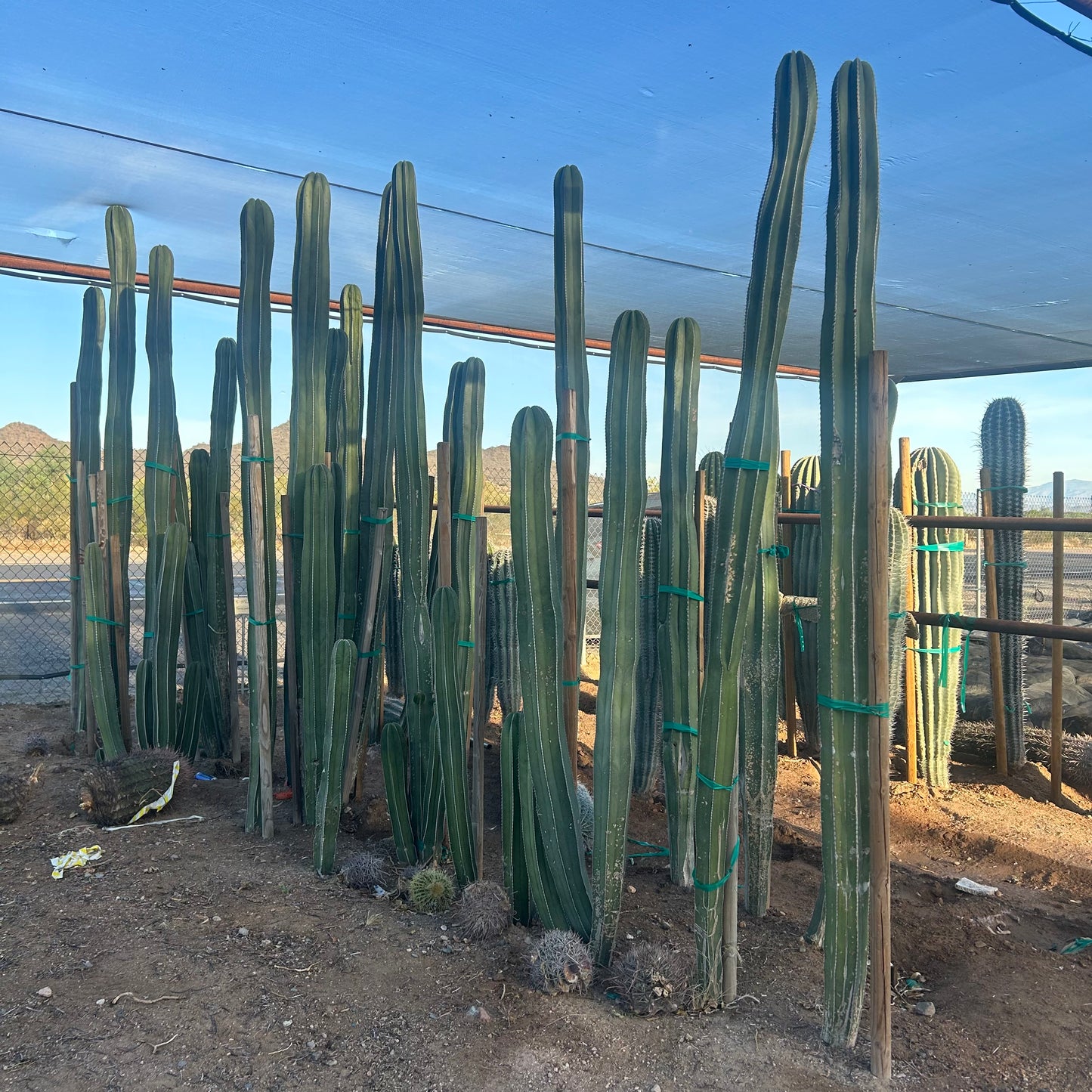


Mexican Fence Post
Mexican Fence Post
Couldn't load pickup availability
Phoenix's Most Striking Columnar Cactus for Fences, Borders & Modern Landscapes
The Mexican Fence Post (Pachycereus marginatus) is one of the most architecturally dramatic cacti you can plant in the Phoenix Valley. Its tall, ribbed columns grow in tight clusters with clean white margins along each rib — creating a living fence that looks like it was designed by an architect. Growing 12–20 feet tall at maturity and requiring almost zero maintenance, this columnar cactus is the go-to choice for homeowners in Scottsdale, Mesa, Chandler, Gilbert, and Tempe who want bold vertical structure without the hassle.
Mexican Fence Post Plant Details
| Attribute | Detail |
|---|---|
| Scientific Name | Pachycereus marginatus (syn. Stenocereus marginatus) |
| Common Names | Mexican Fence Post, Mexican Fencepost Cactus, Organ Pipe |
| Mature Height | 12–20 feet |
| Mature Width | 3–6 feet (clumping) |
| Growth Rate | Moderate — 1–2 feet per year in Phoenix |
| Sun | Full sun (6+ hrs). Handles reflected heat from walls and pavement. |
| Water | Very low once established. Extremely drought-tolerant. |
| USDA Zones | 9–11 (Phoenix is Zone 9b–10a) |
| Soil | Well-draining. Adapts to Arizona caliche soils. |
| Foliage | Evergreen — columnar green stems with white rib margins year-round |
| Bloom | White to light pink flowers in spring/summer (nocturnal) |
Mexican Fence Post Uses in Phoenix Landscapes
Living Fence & Privacy Screen
This is the cactus that earned its name. Plant Mexican Fence Posts 3–4 feet apart in a row and they'll grow into a dense, impenetrable living wall. A 20-foot property line needs roughly 5–7 plants; a 40-foot run needs 10–14. They're perfect along block walls in Scottsdale or as a dramatic replacement for a traditional fence in Mesa and Gilbert neighborhoods.
Modern Desert & Architectural Design
The clean vertical lines and white-edged ribs make Mexican Fence Post a favorite for contemporary desert landscaping. Plant a cluster of 3–5 at varying heights near an entryway, pool deck, or courtyard wall for instant sculptural impact. Pair with low-growing Desert Spoon or Golden Barrel for a layered modern look.
Streetside & Xeriscape Borders
Mexican Fence Post thrives in the hellstrip — that brutal strip between the sidewalk and street. It handles reflected heat from concrete, needs almost no water, and creates a bold vertical statement that elevates curb appeal. Plant 4–5 feet apart for a staggered border along driveways and walkways in Chandler and Tempe.
Pool-Friendly Landscaping
No leaves to shed, no messy flowers, and no invasive roots — Mexican Fence Post is one of the cleanest cacti for pool areas. Its upright form keeps walkways clear while adding dramatic height behind pool walls or spa features.
Best Time to Plant Mexican Fence Post in Phoenix
Fall (October–November) is the ideal planting window. The soil is still warm enough for root establishment, but cooler air temperatures reduce transplant stress. Your cactus gets a full 6–8 months of root growth before its first Phoenix summer. Spring (February–April) is the second-best window. Avoid planting in the peak of summer if possible — the extreme heat makes establishment harder.
How to Plant Mexican Fence Post
- Dig wide, not deep — excavate 2–3x the root ball width at the same depth as the container.
- Check for caliche — if you hit a hard layer, break through it completely so water drains freely.
- Backfill with native soil — a light 20% organic blend is fine, but this cactus does best in lean, mineral soil.
- Spacing — 3–4 feet apart for a living fence; 5–6 feet for standalone specimens.
- Water basin — build a 3–4 inch soil ring around the base to direct water to the roots.
- Mulch with gravel — 2–3 inches of decorative rock or gravel. Avoid organic bark mulch against the stem.
Watering Mexican Fence Post in Phoenix
First Year Watering Schedule
Weeks 1–2: Water every 3–5 days, deep and slow (15–20 min). Month 1–3: Every 7–10 days. Month 3–6: Every 10–14 days (every 7 days in peak summer). After Year 1: Every 2–3 weeks in summer; once a month or less in winter.
Drip Irrigation
Place one 2 GPH emitter 12–18 inches from the base. For larger specimens (25 gallon+), use two emitters on opposite sides. Once established, Mexican Fence Post is one of the most drought-tolerant cacti — overwatering is the main risk, not underwatering.
How fast does Mexican Fence Post grow in Phoenix?
Expect 1–2 feet of vertical growth per year in ideal conditions. A 5 gallon specimen will reach 6–8 feet in 3–4 years. Larger box specimens (30" or 36") give you instant 10–15 foot height on day one.
Can Mexican Fence Post handle Phoenix summer heat?
Absolutely. This cactus is native to the deserts of central Mexico and thrives in temperatures well above 110°F. It also handles reflected heat from walls, concrete, and pavement — making it perfect for tight urban spaces in Scottsdale and Tempe.
Does it spread or become invasive?
Mexican Fence Post slowly offsets from the base, creating a clumping form. It won't send runners or spread aggressively. You can easily control its footprint by removing offsets if needed.
Is Mexican Fence Post safe around kids and pets?
It has short, stiff spines along the ribs — much less aggressive than barrel cactus or cholla, but still worth keeping away from high-traffic play areas. The spines become less prominent on mature growth.
What's the difference between Mexican Fence Post and Totem Pole?
Both are columnar cacti, but Mexican Fence Post has pronounced ribs with white margins and short spines, while Totem Pole Major (Lophocereus schottii 'Monstrosus') is completely smooth and spineless. Fence Post grows taller and is better for screening; Totem Pole is more sculptural and ornamental.
You May Also Like
Totem Pole Major — A smooth, spineless columnar cactus with sculptural bumps. Perfect companion for modern desert gardens.
Golden Barrel (Bareroot) — Round, golden-spined barrel cactus that pairs beautifully at the base of tall columnar cacti.
Queen Victoria Agave — A compact, geometric agave with white markings that complements the clean lines of Mexican Fence Post.
Engleman's Prickly Pear — A native Arizona prickly pear with blue-green pads and showy yellow flowers — great for a layered desert border.
Purple Prickly Pear — Vibrant purple pads that create stunning color contrast next to the green and white of Mexican Fence Post.
How Many Mexican Fence Post Do I Need?
For a living fence or privacy screen, space the columns 3 to 4 feet on center so the clusters close into a solid wall. For a sculptural focal grouping, plant 3 to 5 at staggered heights instead.
| Run length | Spacing | Plants needed |
|---|---|---|
| 10 ft | 3.5 ft centers | 3 |
| 20 ft | 3.5 ft centers | 6 |
| 40 ft | 3.5 ft centers | 12 |
For freestanding specimens, give each plant 5 to 6 feet of clearance and keep the short rib spines a step back from pool decks and walkways.
Mexican Fence Post Season-by-Season in Phoenix
- Spring (Feb to Apr): Vertical growth resumes as soil warms. The best second window to plant new columns.
- Summer (May to Sep): Peak growth season. Thrives in full sun and reflected heat well above 110 degrees. Monsoon rain is welcome as long as the soil drains fast; back off any supplemental water after a good storm.
- Fall (Oct to Nov): Prime planting season. Warm soil plus mild air gives roots months to establish before winter.
- Winter (Dec to Jan): Holds its green columns and white rib margins year-round. It tolerates the Valley's typical winter lows, but in a hard frost pocket a frost cloth over the growing tips on the coldest nights prevents cosmetic tip damage.
At a Glance
✔ Heat-Loving (Reflected-Heat Tolerant) ✔ Drought-Tolerant ✔ Pool-Friendly (Low-Litter) ✔ Pollinator-Friendly ✔ Evergreen ✔ Low-Maintenance ✔ Deer & Rabbit-Resistant
Plant It With
- Golden Barrel: round golden globes that pool beautifully at the base of the tall columns.
- Desert Spoon: a low silver-blue rosette that softens the strict vertical lines.
- Engleman's Prickly Pear: a native blue-green prickly pear for a layered desert border.
- Red Yucca: arching coral flower spikes that add color and movement at the base.
Is Mexican Fence Post Right for Your Yard?
Yes if you want bold vertical structure, a living privacy fence, or a clean low-litter cactus near a pool, in full sun with fast-draining soil (break through caliche before planting). It shrugs off reflected heat and needs almost no water once established. Not a fit if you need height immediately on a budget (it grows 1 to 2 feet a year) or if the only open spot stays soggy, since wet feet will rot the base.
Share