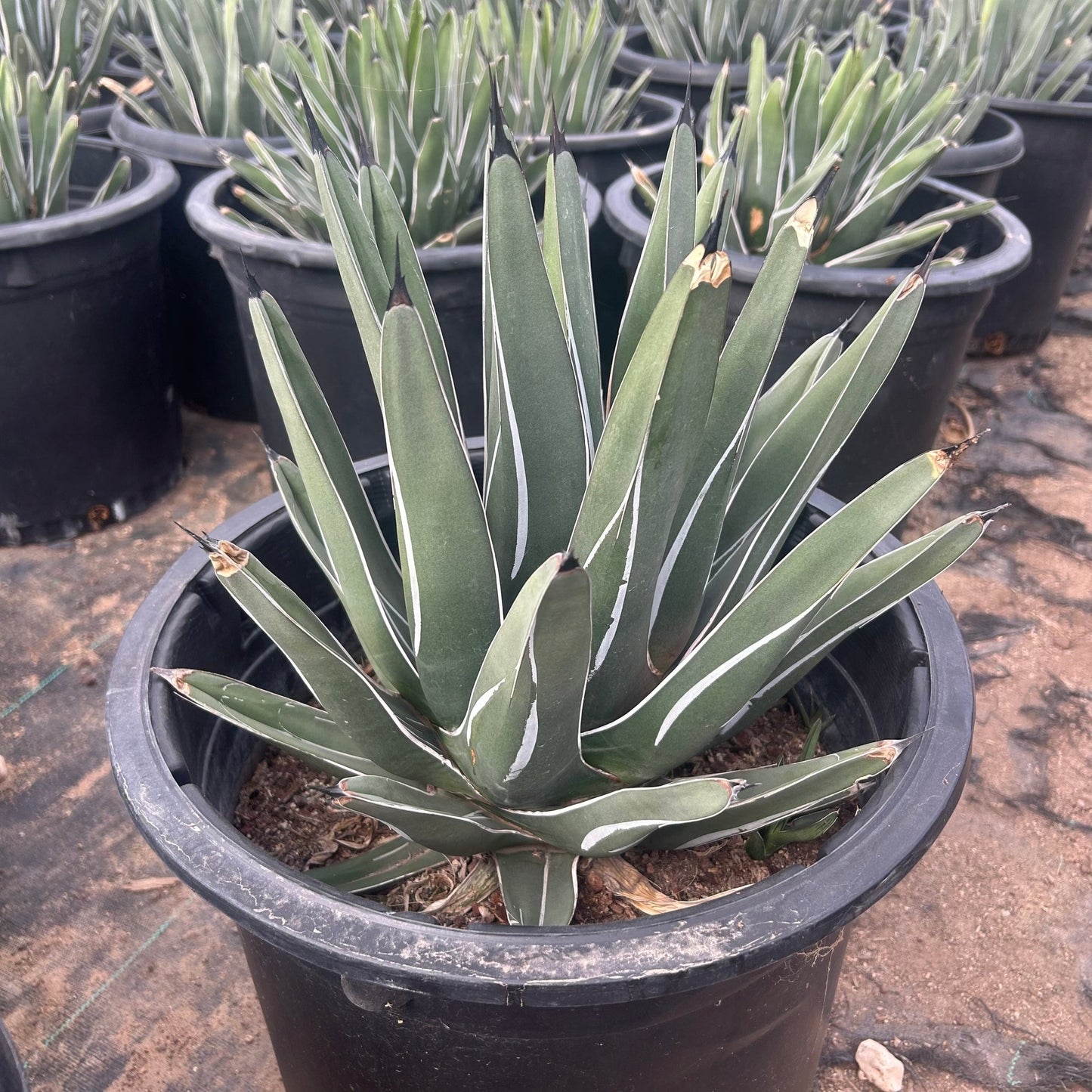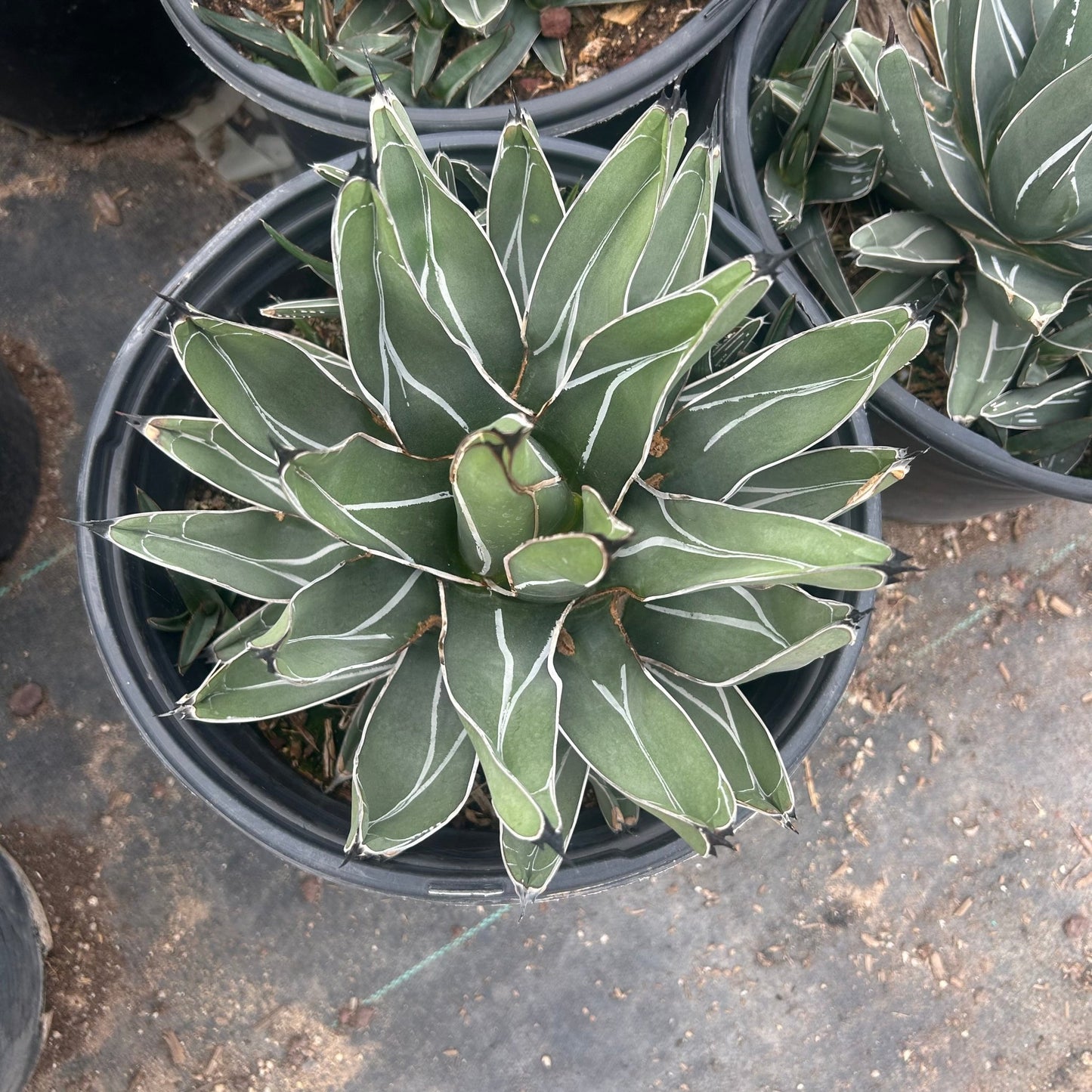


King Ferdinand Agave
King Ferdinand Agave
Couldn't load pickup availability
A Rare, Collector-Grade Agave With Perfect Geometric Symmetry
King Ferdinand Agave (Agave nickelsiae, formerly Agave ferdinandi-regis) is one of the most sought-after and visually perfect agaves in the world. Its compact, densely packed rosette features dark green leaves with bright white bud imprints and fine white margins, creating a striking geometric pattern unlike any other agave. Whether you're building a collector's garden in Scottsdale, adding a premium accent to a Paradise Valley estate, or showcasing a rare specimen in a Mesa courtyard — King Ferdinand Agave is the crown jewel of desert landscaping.
King Ferdinand Agave Plant Details
| Attribute | Detail |
|---|---|
| Scientific Name | Agave nickelsiae (syn. Agave ferdinandi-regis) |
| Common Names | King Ferdinand Agave, King of Agaves, Nickelsiae Agave |
| Mature Height | 1–2 feet |
| Mature Width | 1.5–2.5 feet |
| Growth Rate | Slow — reaches mature size in 10–15 years in Phoenix |
| Sun | Full sun to light afternoon shade. Handles reflected heat with some protection. |
| Water | Low once established. Drought-tolerant but benefits from occasional deep watering. |
| USDA Zones | 8–11 (Phoenix is Zone 9b–10a) |
| Soil | Excellent drainage required. Thrives in rocky, gritty Arizona caliche soils with added pumice. |
| Foliage | Evergreen — dark green leaves with white margins year-round |
| Rarity | Rare and highly collectible — listed as endangered in the wild |
| Bloom | Tall flower stalk at maturity (monocarpic — blooms once, produces pups before flowering) |
King Ferdinand Agave Uses in Phoenix Landscapes
Premium Specimen & Collector's Accent
King Ferdinand Agave is the ultimate collector's agave. Its perfect symmetry and striking white-on-dark-green patterning make it a living sculpture. Position it as a standalone specimen in a raised planter, decorative pot, or elevated rock garden bed where its geometric beauty can be appreciated up close. In Scottsdale and Paradise Valley, this agave is a staple of high-end desert garden design.
Container & Courtyard Showpiece
This agave's compact size (under 2 feet) makes it ideal for premium ceramic or concrete containers on patios, entryways, and pool decks throughout the Phoenix Valley. Use a fast-draining cactus mix with extra pumice, and select a pot with generous drainage. Container plantings also allow you to provide light afternoon shade protection during the most intense summer weeks.
Curated Desert Garden Groupings
Pair King Ferdinand Agave with other collector-grade succulents for a curated desert garden vignette. Excellent companions include Artichoke Agave, Mountain Agave, and variegated agave varieties. Group 3–5 different species in a raised bed with decorative boulders and decomposed granite for a gallery-quality desert garden in Chandler, Gilbert, or Tempe.
Best Time to Plant King Ferdinand Agave in Phoenix
Fall (October–November) is the ideal planting window. The soil stays warm enough for root establishment while cooler air temperatures reduce transplant stress, giving the agave 6–8 months of root growth before its first Phoenix summer. Spring (February–April) is the second-best window. Avoid planting during peak summer heat — this species appreciates a gentler transition.
How to Plant King Ferdinand Agave
- Dig wide, not deep — 2–3x the root ball width, same depth as the container.
- Check for caliche — break through any hardpan layer; this agave absolutely requires excellent drainage.
- Amend for drainage — mix 30–40% pumice or perlite into native soil for optimal drainage around the root zone.
- Spacing — 2–3 feet apart for groupings; allow room to appreciate each plant's form individually.
- Water basin — build a shallow 2–3 inch soil ring around the root zone for targeted watering.
- Mulch — 2–3 inches of decorative gravel or decomposed granite (never let organic mulch touch the crown).
Watering King Ferdinand Agave in Phoenix
First Year Watering Schedule
Weeks 1–2: Every 3–4 days, deep and slow (10–15 min). Month 1–3: Every 7–10 days. Month 3–6: Every 10–14 days (7–10 days in peak summer). After Year 1: Every 2–3 weeks in summer; monthly in winter. Avoid overwatering — root rot is the primary risk.
Drip Irrigation
Place one 1-GPH emitter 6–8 inches from the base. King Ferdinand Agave is sensitive to overwatering, so err on the dry side. In-ground plants may need no supplemental water at all during cooler months.
How fast does King Ferdinand Agave grow?
King Ferdinand Agave is a slow grower. A 1-gallon plant may take 5–8 years to reach its full 1.5–2 foot diameter in the Phoenix climate. The slow growth is part of the appeal — each new leaf unfurls with more refined patterning.
Why is King Ferdinand Agave so expensive?
This species is rare in the wild (listed as endangered in Mexico) and slow to propagate. Larger specimens represent years of careful cultivation, making them prized collector's plants. Investing in a larger gallon size gives you a more established plant with a head start.
Can King Ferdinand Agave survive Phoenix summer heat?
Yes, with some care. It handles full sun well but appreciates light afternoon shade during the most extreme summer weeks (June–July). South- and east-facing exposures work best; avoid unprotected west-facing walls where reflected heat is most intense.
Does King Ferdinand Agave produce pups?
Yes — mature plants typically produce offsets before flowering, ensuring the colony continues. Pups can be carefully separated and replanted once they've developed their own root system.
You May Also Like
Artichoke Agave — A larger rosette agave with wide, overlapping blue-green leaves and a stunning artichoke-like form.
Mountain Agave — A cold-hardy compact agave with dramatic bud imprints — great companion planting.
Variegated Octopus Agave — A rare, variegated agave with flowing leaves — another collector's favorite.
Mr Ripples Agave — A uniquely textured agave with undulating leaf margins for maximum visual interest.
Green Giant Agave — A massive agave for landscapes that need large-scale sculptural impact.
How Many King Ferdinand Agave Do I Need?
This is a slow, compact specimen agave (mature 1.5 to 2.5 ft wide), so it is planted for form rather than mass coverage. Plant single as a jewel-box focal point, or in odd-numbered groups of 3 to 5 so each symmetrical rosette stands clear.
| Planting Goal | Spacing | Plants |
|---|---|---|
| Single container or focal specimen | Standalone | 1 |
| Curated rock-garden cluster | 2 to 3 ft apart | 3 |
| Raised collector bed grouping | 2 to 3 ft apart | 5 |
Because of the stiff terminal spine, keep rosettes set back 2 to 3 ft from walkways, seating, and pool edges.
King Ferdinand Agave Season-by-Season in Phoenix
- Spring (Feb to Apr): Best secondary planting window. Slow new-leaf growth resumes as soil warms; each unfurling leaf shows crisper white bud imprints.
- Summer (May to Sep): Handles full Phoenix sun but appreciates light afternoon shade during the worst June and July weeks, especially against west-facing reflected heat. Ease back on water during monsoon humidity to avoid crown rot.
- Fall (Oct to Nov): Prime planting season. Warm soil plus mild air gives roots months to establish before next summer.
- Winter (Dec to Jan): Evergreen and structural through the cool season. Cold-hardy to roughly 10°F, so it shrugs off typical Valley frost; in an unusually hard freeze, cover young plants overnight.
At a Glance
✔ Heat-Loving (Reflected-Heat Tolerant) ✔ Drought-Tolerant ✔ Evergreen ✔ Low-Maintenance ✔ Deer & Rabbit-Resistant ✔ Cold-Hardy to 10°F
Plant It With
- Artichoke Agave: A larger blue-green rosette that anchors a collector grouping while King Ferdinand reads as the fine-detail jewel.
- Green Giant Agave: A massive sculptural agave for scale contrast behind the compact King Ferdinand.
- Desert Spoon: Soft, fountain-like blue-gray texture that offsets the rigid geometry of the rosette.
- Red Yucca: Adds airy coral bloom spikes and hummingbird traffic above the low agave.
Is King Ferdinand Agave Right for Your Yard?
Choose King Ferdinand Agave for a full-sun to lightly-shaded spot with sharp drainage, where its slow, perfect symmetry can be admired up close: raised beds, decorative pots, courtyards, and pool-deck planters (set back from the edge). Break through caliche and amend with pumice so it never sits wet. It is not a fit if you need fast coverage or a spineless, kid-and-pet-safe rosette right next to a path, since the terminal spine is sharp and growth is deliberately slow.
Share