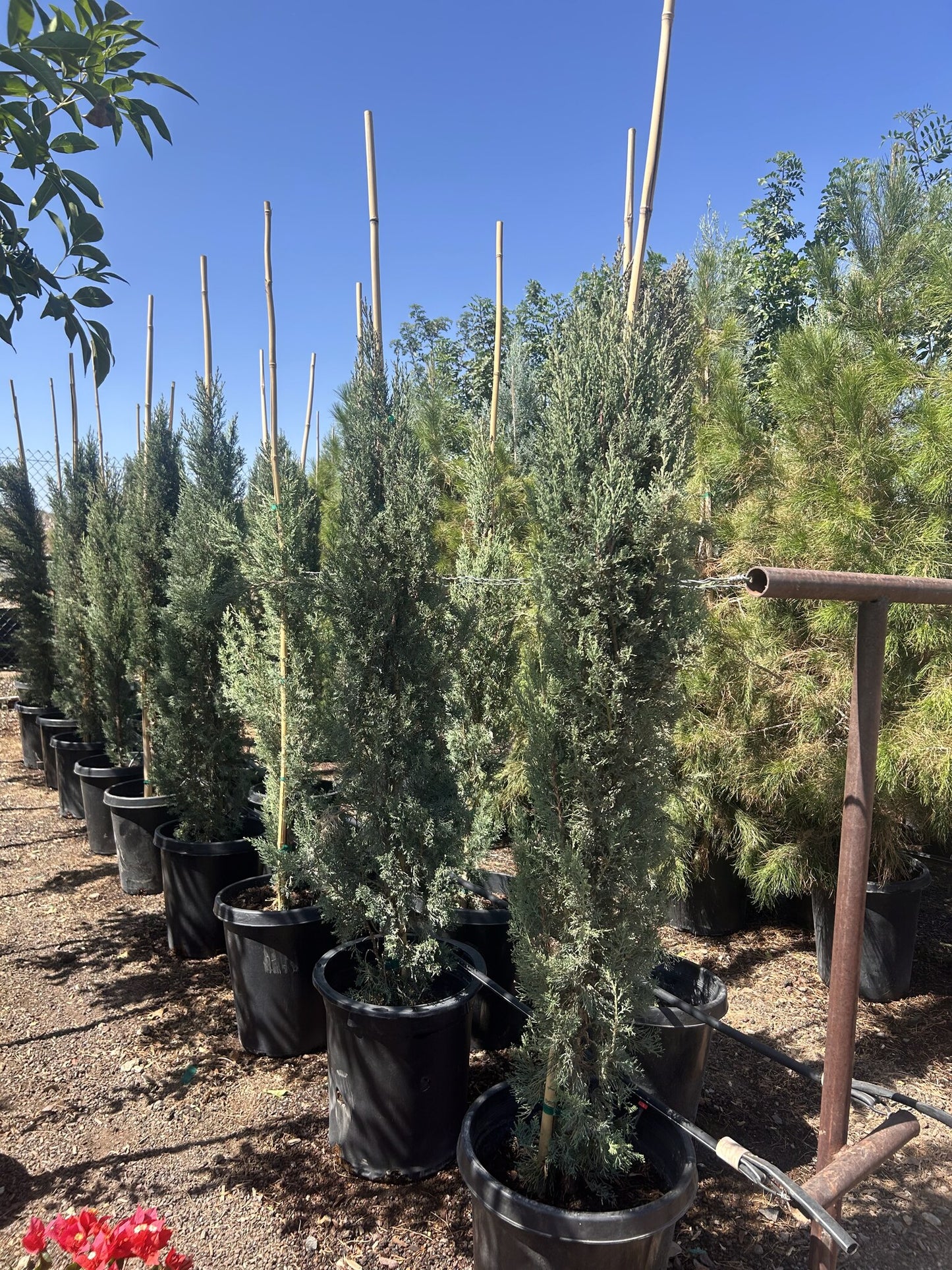


Italian Cypress
Italian Cypress
Couldn't load pickup availability
Phoenix's Most Dramatic Privacy & Screening Tree — Italian Cypress
Italian Cypress (Cupressus sempervirens) is the ultimate columnar tree for Phoenix homeowners who want fast privacy, bold vertical drama, and zero-fuss maintenance. This slender evergreen grows 2–3 feet per year in Arizona's warm climate, quickly forming a dense wall of dark green foliage that screens neighbors, fences, and unsightly views year-round. Its exceptionally narrow, pencil-like form — just 3–5 feet wide at full maturity — makes it perfect for tight spaces where other trees simply don't fit. Whether you're planting a formal privacy screen in Scottsdale, framing an entryway in Chandler, or creating a Tuscan-inspired focal row in Gilbert or Peoria — Italian Cypress is the defining choice.
Italian Cypress Plant Details
| Attribute | Detail |
|---|---|
| Scientific Name | Cupressus sempervirens |
| Common Names | Italian Cypress, Mediterranean Cypress, Pencil Pine |
| Mature Height | 35–70 feet (typically 35–40 ft in managed landscapes) |
| Mature Width | 3–5 feet — extremely narrow, columnar habit |
| Growth Rate | Fast — 2–3 feet per year in Phoenix |
| Sun | Full sun (6+ hrs). Thrives with reflected heat from walls and pavement. |
| Water | Low once established. Highly drought-tolerant. |
| USDA Zones | 7–11 (Phoenix is Zone 9b–10a) |
| Soil | Well-draining. Adapts well to Arizona caliche soils with adequate drainage. |
| Foliage | Evergreen — dense, dark green year-round |
| Form | Strictly columnar — one of the narrowest large trees available |
Italian Cypress Uses in Phoenix Landscapes
Privacy Screens and Wind Barriers
Italian Cypress is Phoenix's go-to tree for creating tall, fast privacy screens in tight linear spaces. Its columnar form means you can plant close together to quickly form a solid evergreen wall. For a 20-foot privacy screen, plant 3–4 trees spaced 4–5 feet apart; for a 40-foot screen, use 6–8 trees. Pair with Purple Hopseed Bush or Texas Sage at the base for a layered privacy planting that looks polished year-round.
Driveway and Entryway Framing
Few plants create an entryway statement like a matched pair or row of Italian Cypress flanking a driveway or front walkway. The formal, vertical silhouette adds instant elegance and Mediterranean character to any home style — from stucco Mediterranean to modern desert architecture. Plant one on each side of a gate or entry for dramatic symmetry, or create a formal allée down a long driveway in Scottsdale, Tempe, or Mesa.
Focal Points and Architectural Accents
A single Italian Cypress planted as a vertical exclamation point instantly draws the eye and adds structure to flat desert landscapes. Use one at a corner of the home, beside a pool feature wall, or to bookend a garden bed. Unlike most large trees, the pencil-thin form means it never outgrows a tight planting zone — the columnar habit stays disciplined for decades without structural pruning.
Pool-Friendly Screening
Italian Cypress is an excellent pool-area tree — it drops very little debris, has no thorns, and its vertical, tight form keeps it well away from pool surfaces. Plant a row along a back fence or side wall to create privacy and windbreak from adjacent properties without shading the pool excessively. It's tagged pool-friendly and widely used in resort-style Scottsdale and Chandler landscapes for exactly this reason.
Best Time to Plant Italian Cypress in Phoenix
Fall (October–November) is the ideal planting window. Soil stays warm enough for root establishment, while cooler air reduces transplant stress — giving trees 6–8 months to anchor before their first Phoenix summer. Spring (February–April) is your second-best window. Avoid planting in the peak of summer (June–August) unless you can commit to daily irrigation. Italian Cypress is exceptionally drought-tolerant once established but needs consistent water in its first season to root deeply.
How to Plant Italian Cypress
- Dig wide, not deep — excavate 2–3x the width of the root ball, but no deeper than the container height.
- Check for caliche — break through any hardpan layer to ensure water drains freely and roots can penetrate.
- Backfill with native soil — a light 20% organic amendment is fine; avoid heavy compost that retains too much moisture.
- Spacing for screens — plant 4–6 feet apart for a tight privacy wall; 6–10 feet apart for individual accent use.
- Stake young trees — use two stakes and soft ties for the first year to keep the columnar form upright in Phoenix wind events.
- Mulch — apply 2–3 inches of bark or gravel mulch to retain moisture and suppress weeds around the base.
Watering Italian Cypress in Phoenix
First Year Watering Schedule
- Weeks 1–2: Every 1–2 days, deep and slow (20–30 minutes per session)
- Months 1–2: Every 3–4 days
- Months 3–6: Every 7–10 days (every 5–7 days during peak summer heat)
- After Year 1: Every 10–14 days in summer; every 3–4 weeks in winter
Drip Irrigation
Place 2–4 GPH emitters 18–24 inches from the trunk on opposite sides of the tree. Larger box specimens (24" and 36") benefit from a second ring of emitters placed further out to match the root ball spread. Once established, Italian Cypress needs minimal supplemental irrigation in Phoenix — it thrives on far less water than most large trees.
How fast does Italian Cypress grow in Phoenix?
Italian Cypress grows 2–3 feet per year in Phoenix's warm climate. A 3/5 gallon tree planted in fall can reach 8–10 feet within 2–3 years. Larger 24"/25 gallon and 36" box specimens will establish faster and provide immediate visual impact.
How tall and wide will Italian Cypress get?
In Phoenix landscapes, Italian Cypress typically reaches 35–40 feet tall and just 3–5 feet wide. The extremely narrow columnar habit is its defining characteristic — it will never significantly widen with age the way most other trees do.
Is Italian Cypress drought-tolerant once established?
Yes — it's one of the most drought-adapted large trees for the Phoenix Valley. Once it has established a deep root system (typically after one full year), it survives on minimal supplemental irrigation and handles the extreme heat and reflected light of the desert environment remarkably well.
Does Italian Cypress work near pools?
Absolutely. It drops minimal debris, has no thorns or spines, and its slender form means it can be planted close to pool decks without branches hanging over the water. It's widely used in resort-style Phoenix and Scottsdale backyards for privacy screening around pool areas.
Can Italian Cypress handle Phoenix reflected heat?
Yes — it's native to the Mediterranean region and is adapted to hot, dry summers with intense sun. It thrives against south-facing walls and in situations with pavement or block fence reflected heat that would stress most ornamental trees.
You May Also Like
- Purple Hopseed Bush (Dodonaea viscosa 'Purpurea') — a fast-growing privacy shrub that pairs beautifully at the base of Italian Cypress for a layered screening combination.
- Mediterranean Fan Palm (Chamaerops humilis) — a low-water, clumping palm that complements Italian Cypress in Mediterranean and Spanish-style landscape designs.
- Chinese Pistache 'Red Push' (Pistacia chinensis) — a spectacular fall-color shade tree that contrasts beautifully with the evergreen form of Italian Cypress.
- Indian Laurel Fig (Ficus microcarpa) — another fast-growing evergreen privacy option for Phoenix landscapes requiring a broader canopy form.
How Many Italian Cypress Do I Need?
Because Italian Cypress holds a strict 3 to 5 foot wide column, you plant it tight for a solid privacy wall. For a continuous evergreen screen, set trees 4 feet on center; for a slightly more open row, use 5 feet. Use this table to estimate plant counts at 4 ft spacing:
| Run Length | Trees Needed (4 ft on center) |
|---|---|
| 16 ft | 4 trees |
| 24 ft | 6 trees |
| 40 ft | 10 trees |
| 60 ft | 15 trees |
For matched entry or driveway accents, plant single specimens or symmetrical pairs spaced 6 to 10 feet apart so each column reads as its own vertical statement.
Italian Cypress Season-by-Season in Phoenix
- Spring (Feb-Apr): Strong flush of new growth as soil warms. Best second window to plant and the time to do any light shaping or tie-in of leaders before the heat arrives.
- Summer (May-Sep): Handles extreme Valley heat and reflected heat off walls and pavement with ease once established. Keep first-year trees on deep, regular drip water through the monsoon; mature trees coast on minimal irrigation.
- Fall (Oct-Nov): Prime planting season. Warm soil plus mild air lets roots anchor before winter, giving you the strongest start for next year's growth surge.
- Winter (Dec-Jan): Stays dense, dark green, and fully evergreen through Valley winters. Cold-hardy well below freezing (USDA zone 7), so Phoenix frosts do not faze it. No cover needed.
At a Glance
✔ Heat-Loving (Reflected-Heat Tolerant) ✔ Drought-Tolerant ✔ Pool-Friendly (Low-Litter) ✔ Evergreen ✔ Low-Maintenance ✔ Cold-Hardy to 10°F
Plant It With
- Purple Hopseed Bush: fast evergreen shrub that fills in the base of a cypress row for a layered, polished screen.
- Texas Sage: low-water flowering shrub that softens the formal columns with silvery foliage and purple bloom.
- Chinese Pistache 'Red Push': broad fall-color shade tree that contrasts beautifully against the dark evergreen verticals.
- Indian Laurel Ficus Column: another upright evergreen screen option when you want a broader, denser wall in the same formal style.
Is Italian Cypress Right for Your Yard?
Italian Cypress thrives in full sun, including hot south and west exposures with reflected heat off block walls and pavement. It wants well-draining ground, so break through any caliche layer at planting and avoid spots that stay soggy. Its pencil-thin 3 to 5 foot footprint makes it ideal for tight side yards, property lines, and formal entries where a wide tree would never fit. It is not a fit if you need a spreading shade canopy or have heavy, poorly drained soil that holds water, since chronically wet roots invite root rot and cypress canker.
Customer Reviews
Ordered products over the weekend. They were delivered Monday morning and we’re beautiful. Amazing products great service will definitely use again.
Share