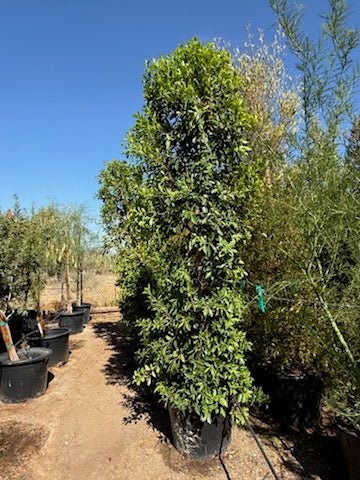


Indian Laurel Ficus Column
Indian Laurel Ficus Column
How many do I need?
Enter the length of the fence or wall you want to screen.
Ordering 5 or more? The Privacy Hedge Pack saves 15% on 5 Green Hopseed (5 or 15 gallon).
Spacing is based on each plant's mature width and is the same for every container size. Add a plant or two for corners and gaps.
Couldn't load pickup availability
114 sold through Three Timbers
28 sold in the last 90 days.
Phoenix's #1 Column Privacy Tree — Indian Laurel Fig (Ficus Nitida)
Indian Laurel Fig Column (Ficus microcarpa nitida) is the most-planted privacy column across the Phoenix Valley. It grows 2–3 feet per year, holds a lush evergreen canopy year-round, and thrives through punishing Arizona summers without flinching. Whether you're screening a block wall in Scottsdale, building a formal privacy hedge in Gilbert, or lining a driveway in Chandler — the Indian Laurel Fig gets the job done.
Indian Laurel Fig Plant Details
| Attribute | Detail |
|---|---|
| Scientific Name | Ficus microcarpa nitida |
| Common Names | Indian Laurel Fig, Ficus Nitida, Column Ficus |
| Mature Height | 25–35 feet |
| Mature Width | 8–15 feet |
| Growth Rate | Fast — 2–3 feet per year in Phoenix |
| Sun | Full sun to partial shade. Handles intense reflected heat from walls and pavement. |
| Water | Moderate first year; drought-tolerant once established. |
| USDA Zones | 9–11 (Phoenix is Zone 9b–10a) |
| Soil | Well-draining. Adapts to Arizona caliche soils. |
| Foliage | Evergreen — dense, glossy dark green leaves year-round |
| Root System | Aggressive — keep 6–10 ft from foundations, pools, and underground pipes |
Indian Laurel Fig Uses in Phoenix Landscapes
Column Privacy Walls & Hedges
The column form of Ficus nitida is the go-to privacy solution for luxury Phoenix Valley properties. Planted 4–6 feet apart, they grow together into a seamless green wall that screens neighbors, street views, and road noise. Unlike block walls, a Ficus column hedge softens hardscape with living, year-round greenery that only gets better with age.
How many plants do you need?
- 20 ft fence line: 4 to 5 plants
- 40 ft fence line: 7 to 10 plants
- 60 ft fence line: 10 to 15 plants
- 80 ft fence line: 14 to 20 plants
Formal Driveway & Entry Columns
Planted symmetrically along driveways or flanking entry gates, Indian Laurel Figs create the classic Scottsdale estate look. Their naturally upright form requires only light trimming to maintain a crisp, architectural silhouette. Pair with Desert Spoon or Agave at the base for a clean, modern finish.
Pool Area Privacy & Perimeter Screening
Indian Laurel Fig is a popular pool-side privacy tree for Mesa, Tempe, and Peoria homeowners — but it requires careful placement. Keep the tree at least 8–10 feet from the pool shell and water lines to prevent root intrusion. Planted along a back or side fence beyond that buffer, it delivers fast, dense screening without messy leaf drop into the pool. At the base, pair with Texas Sage or Ruellia for color at eye level while Ficus columns do the heavy lifting above the fence line.
Commercial & HOA Screening
Indian Laurel Fig is the most common evergreen tree used in Phoenix HOA common areas, commercial properties, and parking lot perimeters. It's fast, formal, and requires only quarterly trimming to stay sharp. Its tolerance for reflected heat off concrete and asphalt makes it ideal where other trees fail.
Best Time to Plant Indian Laurel Fig in Phoenix
Fall planting (October–November) is ideal. The soil stays warm for root development while cooler air reduces transplant stress. Fall-planted Ficus gets 6–8 months of root growth before its first Phoenix summer — dramatically improving survival and first-year establishment. Spring (February–April) is the second-best window. Avoid summer planting if possible — Indian Laurel Fig is sensitive to transplant shock in extreme heat and may defoliate if planted when temperatures exceed 105°F.
How to Plant Indian Laurel Fig
- Dig wide, not deep — 2–3x the root ball width, same depth as the root ball
- Check for caliche — break through any hardpan layer with a pick or bar to ensure drainage
- Backfill with native soil — a light 20% organic blend is fine; avoid heavy amendment
- Spacing — 4–6 ft apart for privacy hedge; 10–15 ft for individual accent trees
- Water basin — build a 3–4 inch soil ring around the root zone to direct water to roots
- Mulch — 2–3 inches of bark or gravel mulch to retain soil moisture
Watering Indian Laurel Fig in Phoenix
First Year Watering Schedule
- Weeks 1–2: Every 1–2 days, deep and slow (20–30 minutes)
- Month 1–2: Every 3–4 days
- Month 3–6: Every 7–10 days (5–7 days in peak summer heat)
- After Year 1: Every 10–14 days in summer; every 3–4 weeks in winter
Drip Irrigation
Place emitters 24–36 inches from the trunk. Use 2–3 emitters per tree at 2–4 gallons per hour. Established Indian Laurel Figs are more drought-tolerant than most people expect — consistent deep watering produces denser foliage and faster privacy coverage.
How fast does Indian Laurel Fig grow in Phoenix?
Indian Laurel Fig adds 2–3 feet per year in good conditions — one of the fastest privacy trees in the Valley. A 15-gallon column planted in fall can reach 12–15 feet within 3–4 growing seasons.
Is Indian Laurel Fig the same as Ficus nitida?
Yes. "Ficus nitida" is the trade name used in Arizona nurseries for the columnar form of Ficus microcarpa. Both names refer to the same plant. The column variety is selected for its narrow, upright growth — ideal for privacy hedges rather than the wide-spreading tree form.
Are the roots invasive?
Indian Laurel Fig has an aggressive root system. Keep it at least 6–10 feet from foundations, underground pipes, pools, and sidewalks. When planted in open landscape areas with drip irrigation, roots tend to stay in the watered zone and cause minimal disruption.
Can Indian Laurel Fig handle Phoenix summer heat?
Yes — Ficus is one of the most heat-tolerant evergreen trees available for Phoenix. It handles reflected heat from block walls, pavement, and stucco. USDA Zones 9–11 cover all of the Phoenix metro including Scottsdale, Mesa, Chandler, Gilbert, and Tempe.
How often does it need to be trimmed?
For a maintained column shape, plan on 2–4 trims per year. One in spring (March–April) and one in fall (September–October) is the minimum. For a manicured look in formal driveways or commercial settings, quarterly trimming keeps the columns crisp.
You May Also Like
- Green Hopseed Bush — Fast-growing privacy hedge with a softer, natural look. Great alternative where Ficus roots are a concern.
- Italian Cypress — Narrow, spire-like evergreen perfect for tight spaces, entries, and Mediterranean-style homes.
- Texas Sage — Low, colorful shrub that pairs beautifully at the base of Ficus columns for color and texture contrast.
- Desert Spoon — Architectural accent with striking form; complements the formal column look of Indian Laurel Fig hedges.
- Blue Palo Verde — Arizona's state tree — a flowering canopy tree that pairs well where you want height with seasonal color.
How Many Indian Laurel Fig Do I Need?
For a solid column privacy wall, space plants about 4 to 6 ft on center so the canopies fuse into one continuous green screen. Use this run-length guide:
| Fence line | Columns needed (4 to 6 ft on center) |
|---|---|
| 20 ft | 4 to 5 |
| 40 ft | 7 to 10 |
| 60 ft | 10 to 15 |
| 80 ft | 14 to 20 |
For driveway or entry accents, space single columns 10 to 15 ft apart. Whatever the layout, keep the trunks 6 to 10 ft off pools, foundations, sidewalks, and underground pipes to stay clear of the aggressive roots.
Indian Laurel Fig Season-by-Season in Phoenix
- Spring (Feb to Apr): Vigorous new flush of glossy green growth and the best first trim of the year. Strong spring planting window in warming soil.
- Summer (May to Sep): Holds dense evergreen foliage right through reflected heat off walls and pavement. One of the few screens that does not flinch at 110-plus degree days, as long as water stays steady. Avoid planting new trees in peak heat.
- Fall (Oct to Nov): Prime planting season and a good second trim. Roots establish fast in warm soil ahead of winter.
- Winter (Dec to Jan): Stays green and screening through the cool season. Frost-sensitive in a hard freeze (leaf burn or partial defoliation below about 25 degrees F), but established trees releaf in spring. Cover young plants on the coldest nights.
At a Glance
✔ Heat-Loving (Reflected-Heat Tolerant) ✔ Drought-Tolerant ✔ Evergreen
Plant It With
- Green Hopseed: softer natural-form hedge for spots where Ficus roots are a concern.
- Italian Cypress: narrow spire evergreen that pairs with the formal column look.
- Texas Sage: colorful low shrub for the base of a Ficus column hedge.
- Desert Spoon: architectural accent that finishes a clean, modern column line.
Is Indian Laurel Fig Right for Your Yard?
Indian Laurel Fig is the workhorse choice for fast, formal, evergreen privacy in full sun and reflected heat, with well-drained soil and room to keep the trunks well off hardscape. It is not a fit if you want a no-trim plant or have tight clearances near pools, foundations, or pipes, since it needs regular shaping and has aggressive roots.
Growing in yards near you
Sold to homes across the Valley, by city
Counts from Three Timbers orders by city. Updated monthly.
Customer Reviews
On time delivery of 30 trees, the trees look great/full/green, guys delivering were great and super helpful. Overall, these guys are crushing it - will continue to order from them for all future orders!
These will work well to create a hedge to protect my solar equipment and keep the wall to the wine room cooler
Share