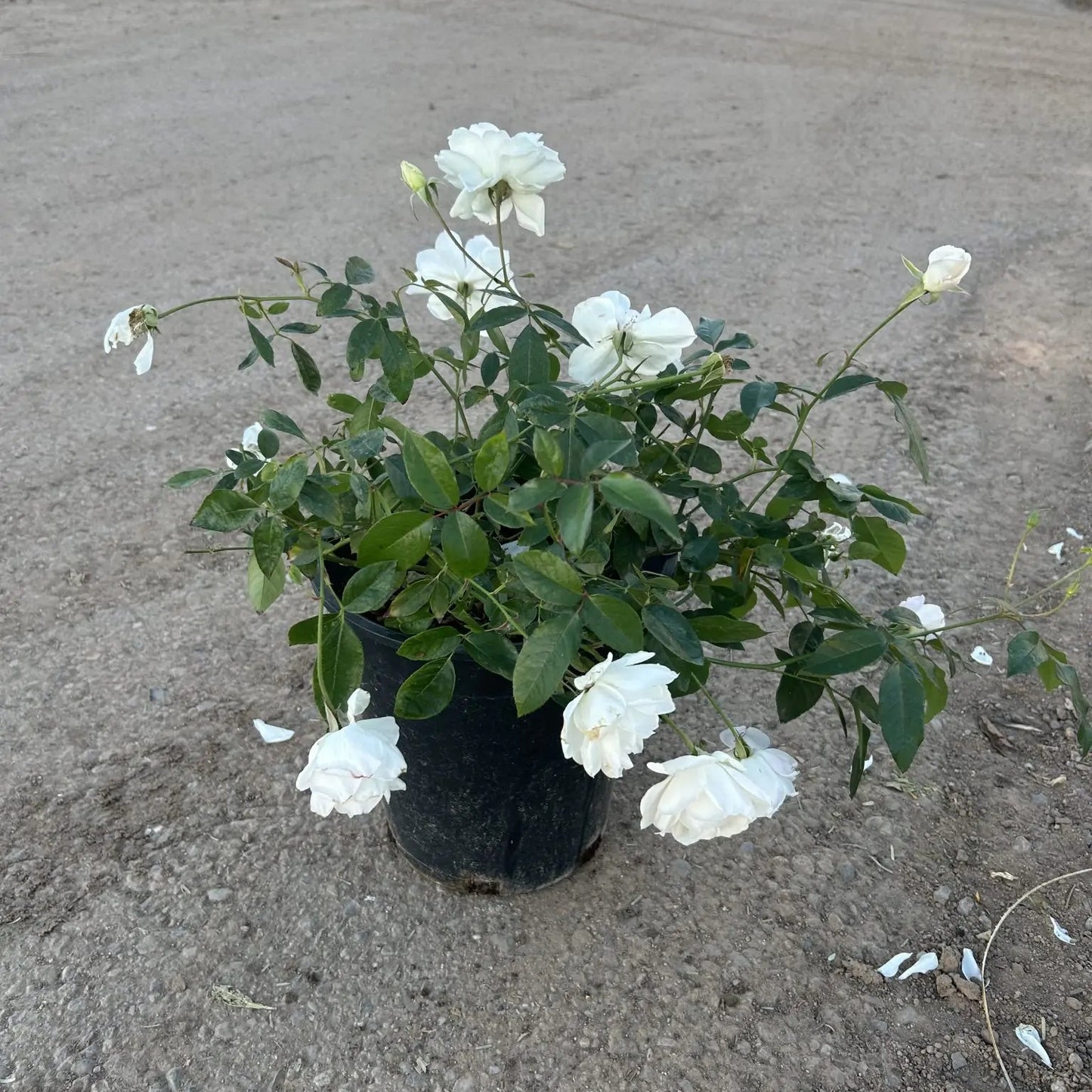


White Iceberg Rose
White Iceberg Rose
Couldn't load pickup availability
Phoenix's Most Elegant Repeat-Blooming Landscape Rose — White Iceberg Rose
White Iceberg Rose (Rosa 'Iceberg') is Phoenix's most beloved and reliable landscape rose, celebrated for its stunning pure white blooms that reappear continuously from spring through fall. This legendary floribunda rose thrives in the Phoenix Valley's intense sun and dry heat, producing clusters of lightly fragrant, semi-double white flowers on a tidy, disease-resistant shrub. Its combination of exceptional beauty, low water needs, and easy maintenance has made it a staple of Arizona landscaping for decades. Whether you're framing an entry in Scottsdale, creating a formal rose garden in Mesa, or adding elegance to a pool-facing border in Gilbert — White Iceberg Rose delivers.
White Iceberg Rose Plant Details
| Attribute | Detail |
|---|---|
| Scientific Name | Rosa 'Iceberg' (Floribunda) |
| Common Names | White Iceberg Rose, Iceberg Rose, Fee des Neiges |
| Mature Height | 3–4 feet (bush form); 8–12 feet as a climbing form |
| Mature Width | 2–3 feet |
| Growth Rate | Moderate to fast — 1–2 feet per year in Phoenix |
| Sun | Full sun (6+ hrs). Tolerates reflected heat from walls. |
| Water | Low-moderate. Drought-tolerant once established; deeper watering extends bloom season. |
| USDA Zones | 5–9 (Phoenix Zone 9b–10a — performs excellently) |
| Soil | Well-draining. Adapts to Arizona caliche soils; benefits from organic amendment at planting. |
| Foliage | Semi-evergreen — stays leafy through mild Phoenix winters |
| Bloom Color | Pure white with light fragrance |
| Bloom Season | Spring through fall; often blooms October–May in Phoenix's mild winters |
| Disease Resistance | High — one of the most disease-resistant landscape roses available |
White Iceberg Rose Uses in Phoenix Landscapes
Elegant Entry and Foundation Planting
White Iceberg Rose is a classic choice for framing home entries, flanking gates, and anchoring foundation plantings in Phoenix and Scottsdale. Its pure white blooms against desert stucco and tile create a crisp, refined look that enhances curb appeal across all home styles — from Mediterranean to modern minimalist. Space plants 3–4 feet apart for a formal hedge-like foundation planting, or use as a single accent specimen flanking a front door.
Formal Rose Garden Centerpiece
As one of the world's most recognized roses, Iceberg is a natural centerpiece for formal rose gardens in the Phoenix Valley. Its upright, tidy habit and continuous white blooms pair beautifully with other floribundas and hybrid teas. In Chandler and Tempe, formal rose beds often feature Iceberg as the white anchor surrounded by pink (Pink Iceberg Rose) and red (Dynamite Red Crape Myrtle) accent plants for a classic tri-color garden design.
Pool and Patio Border
White Iceberg Rose's thornless or lightly thorned canes, clean foliage, and moderate debris make it one of the more pool-friendly roses for Phoenix landscapes. Plant it 8–10 feet from pool coping as a blooming border that provides light fragrance near outdoor seating areas. Its white flowers look especially stunning reflected in pool water during evening entertaining in Peoria and Glendale backyards.
Low-Maintenance Color Border
For Phoenix gardeners who want rose beauty without intensive upkeep, Iceberg is the answer. It requires far less spraying, feeding, and deadheading than traditional hybrid tea roses and still produces spectacular blooms. Mass-plant it at 3-foot spacing along fence lines or driveway borders for a maintenance-friendly white flowering hedge that blooms from February through December in Phoenix's mild climate.
Best Time to Plant White Iceberg Rose in Phoenix
Fall planting (October–November) is ideal in Phoenix. Roses planted in fall establish roots during the mild winter and are ready to bloom prolifically the following spring. This also avoids the stress of summer heat during the critical establishment period. Spring planting (February–March) is also excellent — plant before temperatures push above 90°F so roots can establish before the summer heat. Iceberg is one of the most forgiving roses to establish and can even be successfully planted in late summer with consistent irrigation.
How to Plant White Iceberg Rose
- Dig wide, not deep — excavate a hole 2–3x the root ball width, same depth as the container.
- Check for caliche — break through any hardpan layer for drainage; roses do not tolerate waterlogged roots.
- Amend the backfill — mix native soil with 25–30% organic compost to support the rose's higher nutrient needs compared to native desert plants.
- Spacing — 3–4 feet apart for a hedge; 4–5 feet for individual specimen plants.
- Water basin — build a 3–4 inch soil ring around the plant to direct irrigation to roots.
- Mulch — apply 2–3 inches of bark mulch to retain moisture and moderate soil temperature; keep mulch away from the crown.
Watering White Iceberg Rose in Phoenix
First Year Watering Schedule
- Weeks 1–2: Every 1–2 days, deep and slow
- Months 1–2: Every 2–3 days
- Months 3–6: Every 5–7 days (every 3–5 days during peak summer)
- After Year 1: Every 7–10 days in summer; every 2–3 weeks in winter
Drip Irrigation
Place 2–4 GPH drip emitters 18–24 inches from the plant crown. Run for 45–60 minutes per cycle. Iceberg roses bloom most prolifically with consistent deep irrigation — drought stress causes bloom interruption. During Phoenix's cool season (November–February), reduce watering to every 2–3 weeks.
Does White Iceberg Rose survive Phoenix summers?
Yes — Iceberg is one of the most heat-tolerant roses available for the Phoenix Valley. It may slow blooming during the peak of summer (July–August) but rebounds strongly with the arrival of cooler monsoon weather. Many Phoenix gardeners find Iceberg is at its most spectacular in fall (September–November) after the summer heat breaks.
How often does White Iceberg Rose bloom in Phoenix?
In Phoenix's Zone 9b–10a climate, Iceberg Rose blooms in extended flushes rather than continuously. Expect major bloom periods in spring (March–May), a reduced flush through summer, and another spectacular display in fall (September–November). With the mild Phoenix winters, many plants continue blooming through December and January.
Does Iceberg Rose need a lot of fertilizer?
More than native desert plants, yes — roses are moderate feeders. Fertilize with a balanced rose fertilizer in February (before the spring bloom), again in September (before the fall bloom), and once mid-summer (June). Avoid heavy feeding in July–August during peak heat. Organic rose fertilizers work well in Phoenix's alkaline soils.
What's the difference between White and Pink Iceberg Rose?
Both are Rosa 'Iceberg' varieties with identical care requirements, disease resistance, and bloom habits. The White variety produces classic pure white blooms, while Pink Iceberg (a sport mutation) produces soft pink flowers. Many Phoenix gardeners plant both varieties together for a white-and-pink color combination in formal rose beds.
Do I need to deadhead White Iceberg Rose?
Deadheading (removing spent blooms) encourages faster repeat flowering, but it's not strictly required for Iceberg to keep blooming — it has good self-cleaning habits. For best performance, remove spent flower clusters when about half the blooms have faded. In Phoenix, a light shaping trim every 6–8 weeks during the growing season maintains a tidy form and encourages new flowering wood.
You May Also Like
Pink Iceberg Rose — The soft pink sport of the same legendary variety; plant alongside White Iceberg for a beautiful two-tone rose border.
Lady Banks Rose - Yellow — A vigorous, nearly thornless climbing rose with yellow blooms; great for walls and arbors in the same Phoenix landscape.
Rosemary 'Tuscan Blue' — Fragrant, drought-tolerant herb shrub with blue blooms; elegant low-water companion alongside Iceberg in formal beds.
White Cape Plumbago — Sprawling white-flowering shrub with similar bloom timing; beautiful low-water companion alongside Iceberg in Phoenix borders.
Dwarf Myrtle — Compact evergreen shrub with white summer blooms and aromatic foliage; excellent formal companion to White Iceberg Rose in structured beds.
How Many White Iceberg Rose Do I Need?
White Iceberg Rose stays a compact 2 to 3 feet wide, so set plants on 3 foot centers for a continuous flowering border or low hedge, or 4 to 5 feet apart as individual specimens. For a formal bed, group in rows or odd-numbered clusters. Use this table as a starting point at 3 foot spacing:
| Border Run | Plants Needed (3 ft spacing) |
| 20 ft | 8 plants |
| 30 ft | 11 plants |
| 40 ft | 14 plants |
White Iceberg Rose Season-by-Season in Phoenix
- Spring (Feb–Apr): The biggest bloom flush of the year as the weather warms. Feed in February before the spring show and deadhead spent clusters to keep flowers coming. Prime planting window.
- Summer (May–Sep): Tolerates full sun and reflected heat better than most roses, though bloom slows in the July and August peak. Keep deep irrigation steady, as drought stress interrupts flowering, and the plant rebounds strongly once monsoon weather cools things down.
- Fall (Oct–Nov): Often the most spectacular bloom of the year once the heat breaks. Feed again in September and enjoy heavy flushes of clean white flowers. Excellent planting season.
- Winter (Dec–Jan): Stays semi-evergreen and often keeps blooming through Phoenix's mild winters. Fully cold-hardy here (to about 5°F), so no frost protection is needed. Do a light shaping in late winter.
At a Glance
✔ Heat-Loving (Reflected-Heat Tolerant) ✔ Drought-Tolerant ✔ Pollinator-Friendly ✔ Low-Maintenance ✔ Cold-Hardy to 5°F
Plant It With
- Pink Iceberg Rose: the pink sport of the same rose, for a classic two-tone border.
- Lady Banks Rose - Yellow: a vigorous near-thornless climbing rose for a nearby wall or arbor.
- White Cape Plumbago: a low-water white-flowering shrub with matching bloom timing.
- Dwarf Myrtle: a compact evergreen for clean formal structure around the rose bed.
Is White Iceberg Rose Right for Your Yard?
White Iceberg Rose is the right pick for a full-sun bed, entry, or formal border where you want classic rose color with far less fuss than a hybrid tea. It takes Valley heat and reflected warmth, blooms for most of the year, and needs only moderate water and occasional feeding. It is not a true zero-water xeriscape plant, so skip it if you want a plant that survives on rainfall alone, and it does need richer soil and steadier irrigation than native desert shrubs to flower at its best.
Share