
Hummingbird Trumpet
Hummingbird Trumpet
Couldn't load pickup availability
Phoenix's Best Hummingbird Magnet — Hummingbird Trumpet
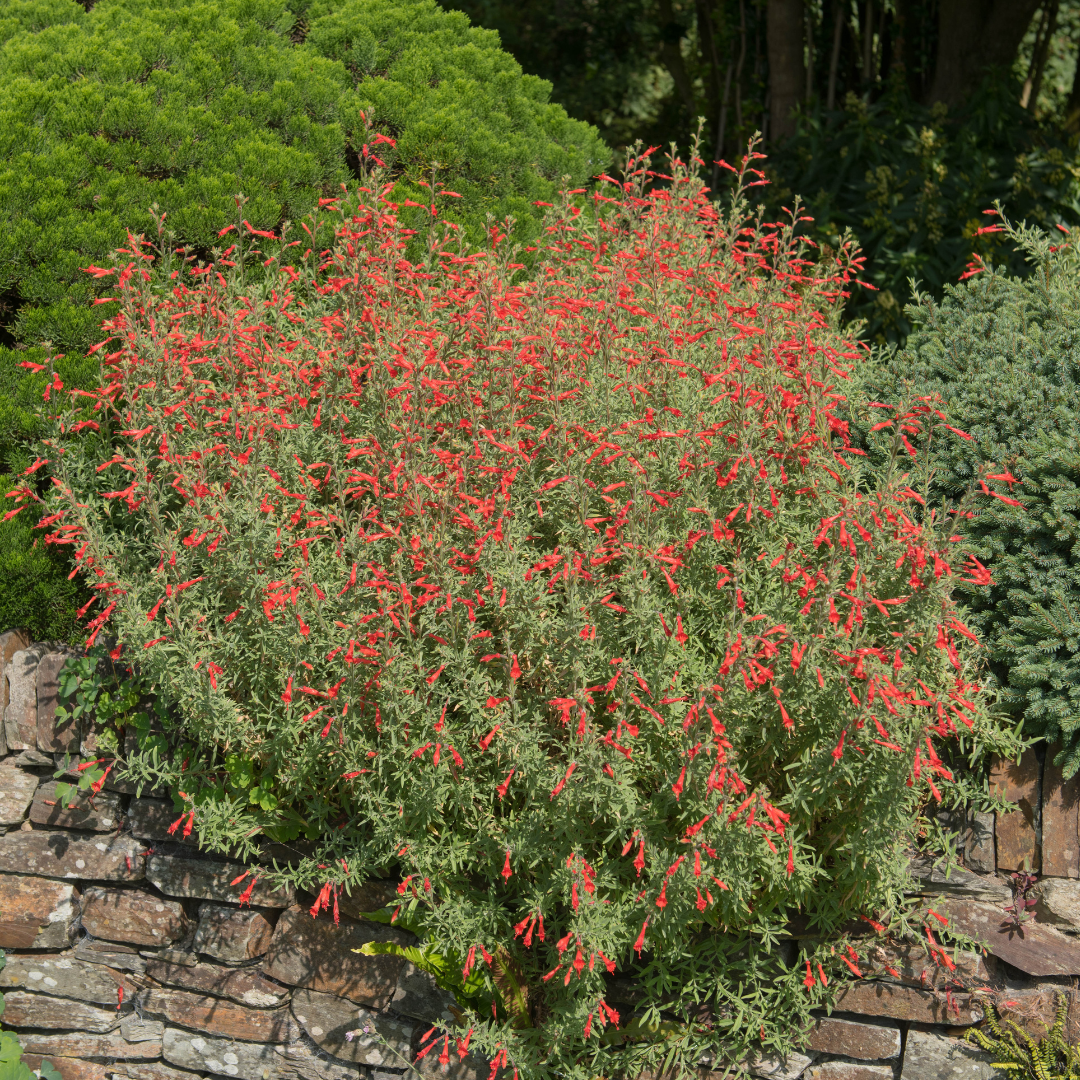
Epilobium canum (syn. Zauschneria californica), commonly known as Hummingbird Trumpet or California Fuchsia, is one of the most reliable hummingbird-attracting perennials for the Phoenix Valley. This low-growing, spreading plant erupts with tubular red-orange flowers from late summer through fall — the exact time when hummingbirds are migrating through Arizona. Whether you're creating a wildlife garden in Scottsdale, adding late-season color to a border in Chandler, or filling a dry slope in Mesa — Hummingbird Trumpet delivers fiery color when most other plants have finished blooming.
Hummingbird Trumpet Plant Details
| Attribute | Detail |
|---|---|
| Scientific Name | Epilobium canum (syn. Zauschneria californica) |
| Common Names | Hummingbird Trumpet, California Fuchsia, Zauschneria |
| Mature Height | 2–3 feet |
| Mature Width | 2–4 feet |
| Growth Rate | Fast — spreads quickly by underground runners |
| Sun | Full sun (6+ hrs). Handles reflected heat from walls. |
| Water | Very low once established. Extremely drought-tolerant. |
| USDA Zones | 5–10 (Phoenix is Zone 9b–10a) |
| Soil | Well-draining required. Thrives in Arizona caliche and rocky soils. |
| Foliage | Semi-evergreen — gray-green foliage, may go dormant in winter |
| Bloom Season | Late summer through fall (August–November in Phoenix) |
Hummingbird Trumpet Uses in Phoenix Landscapes
Hummingbird and Wildlife Garden
Hummingbird Trumpet is the #1 plant for attracting hummingbirds during fall migration through the Phoenix Valley. The tubular red-orange flowers are perfectly shaped for hummingbird beaks. Plant alongside Chuparosa, Flame Honeysuckle, and Coral Penstemon for a year-round hummingbird habitat that keeps them coming back.
Dry Slope and Hillside Cover
The spreading growth habit makes Hummingbird Trumpet excellent for stabilizing dry slopes, berms, and raised beds. It fills in quickly and requires no supplemental irrigation once established. Plant 2–3 feet apart on slopes for full coverage within one to two seasons.
Late-Season Border Color
Most desert plants bloom in spring. Hummingbird Trumpet fills the late-summer and fall color gap that many Phoenix landscapes have. Use it along borders, pathways, and garden edges where its low, spreading form creates a ribbon of fiery color from August through November.
Best Time to Plant Hummingbird Trumpet in Phoenix
Fall (October–November) is ideal for planting in the Phoenix Valley. The plant establishes roots through the cool season and is ready to bloom by late summer. Spring (February–April) is the second-best window. Avoid summer planting — the plant naturally goes semi-dormant in extreme heat before its fall bloom flush.
How to Plant Hummingbird Trumpet
- Dig wide, not deep — 2x the root ball width, same depth as the container.
- Check for caliche — break through any hardpan layer for drainage.
- Backfill with native soil — do not over-amend. Lean soil produces better blooms.
- Spacing — 2–3 feet apart for ground cover; 3–4 feet for individual accent plantings.
- Water basin — build a shallow ring for establishment watering only.
- Mulch — 2 inches of gravel or decomposed granite. Avoid heavy bark mulch.
Watering Hummingbird Trumpet in Phoenix
First Year Watering Schedule
Weeks 1–2: Every 2–3 days, deep and slow. Month 1–2: Every 5–7 days. Month 3–6: Every 10–14 days. After Year 1: Little to no supplemental water needed. Natural rainfall and monsoons sustain established plants.
Drip Irrigation
Place one 1-GPH emitter 8–12 inches from the base. Reduce watering as the plant matures. Overwatering causes leggy, weak growth and fewer flowers.
When does Hummingbird Trumpet bloom in Phoenix?
Late summer through fall — typically August through November. This late bloom window makes it invaluable for fall hummingbird migration season in Arizona.
Does Hummingbird Trumpet spread aggressively?
It can spread by underground runners, which is great for ground cover but may need occasional edging in formal garden beds. It is easy to control by pulling unwanted runners.
Does Hummingbird Trumpet go dormant in Phoenix?
It may go semi-dormant in winter, with foliage dying back. Cut back old stems in late winter (January–February) and new growth will emerge in spring.
Is Hummingbird Trumpet native to Arizona?
It is native to the western United States, including parts of Arizona. It is well-adapted to our desert climate and thrives with minimal intervention.
You May Also Like
Chuparosa — Red tubular flowers that attract hummingbirds year-round in Phoenix.
Coral Penstemon — Coral-pink spikes beloved by hummingbirds, blooming spring through summer.
Flame Honeysuckle — Compact shrub with orange-red tubular flowers for hummingbird gardens.
Desert Honeysuckle — Upright native shrub with orange flowers, a hummingbird favorite.
Share