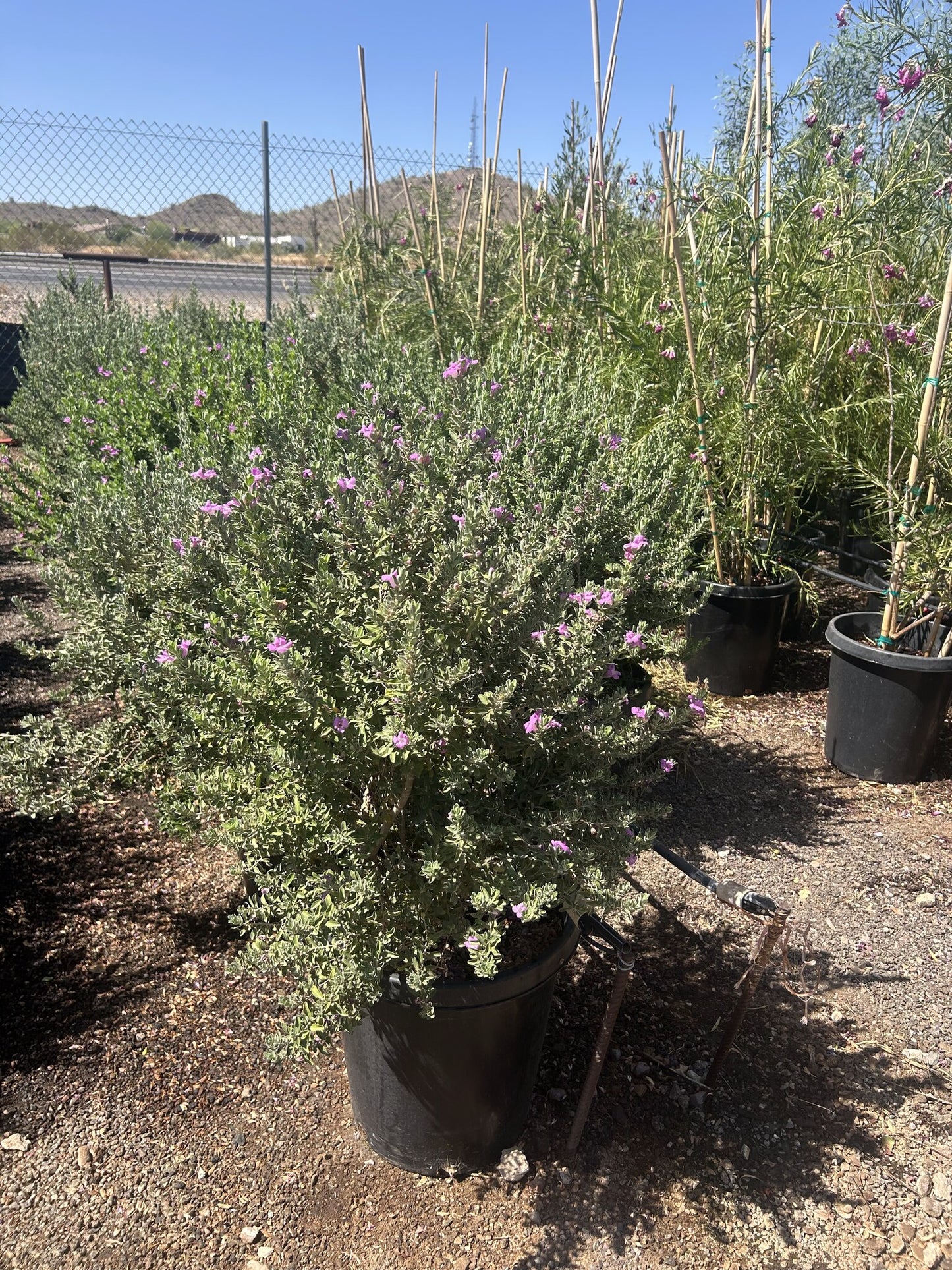


Green Cloud Sage
Green Cloud Sage
Green-leafed sage that bursts purple after rain
Couldn't load pickup availability
The Lushest Texas Sage for Phoenix & Scottsdale Landscapes
Leucophyllum frutescens 'Green Cloud' is the greenest, most lush-looking Texas Sage you can plant in the Phoenix Valley. While most Texas Sage varieties have silver-gray foliage, Green Cloud breaks the mold with rich, deep green leaves that give it a lusher, more tropical appearance — all while maintaining the bulletproof toughness Texas Sage is famous for. This evergreen shrub grows 5–7 feet tall and wide, produces waves of violet-purple flowers after summer monsoon rains, and thrives on neglect. Whether you're building a privacy hedge in Scottsdale, adding a flowering accent in Chandler, or anchoring a xeriscape border in Mesa — Green Cloud Sage delivers year-round beauty with nearly zero water or maintenance.
Green Cloud Sage Plant Details
| Attribute | Detail |
|---|---|
| Scientific Name | Leucophyllum frutescens 'Green Cloud' |
| Common Names | Green Cloud Sage, Green Cloud Texas Sage, Green Texas Ranger |
| Mature Height | 5–7 feet |
| Mature Width | 5–6 feet |
| Growth Rate | Moderate — 1–2 feet per year in Phoenix |
| Sun | Full sun (6+ hrs). Thrives in reflected heat from walls and concrete. |
| Water | Very low once established. Extremely drought-tolerant. |
| USDA Zones | 8–11 (Phoenix is Zone 9b–10a) |
| Soil | Well-draining. Adapts to Arizona caliche soils. Avoid overwatering. |
| Foliage | Evergreen — rich green leaves year-round (greener than other Texas Sage varieties) |
| Bloom Season | Summer through fall, especially after monsoon humidity |
| Bloom Color | Violet-purple bell-shaped flowers |
| Wildlife | Attracts bees and butterflies; deer resistant |
Green Cloud Sage Uses in Phoenix Landscapes
Privacy Hedge & Screen
Green Cloud Sage is one of the best evergreen hedge plants for the Phoenix Valley. Space plants 4–5 feet apart for a continuous, dense privacy screen that reaches 5–7 feet tall. The lush green foliage provides a softer, more tropical look than silver-leaved Texas Sage varieties, making it popular for Scottsdale and Paradise Valley landscapes. For a 20-foot fence line, use 4–5 plants; for 40 feet, use 8–10.
Foundation & Border Planting
The dense, rounded form makes Green Cloud Sage an excellent foundation plant along walls, fences, and property lines in Gilbert and Tempe. Its deep green foliage stays attractive year-round, and the monsoon-triggered purple blooms add seasonal drama. Pair with Flame Honeysuckle and Gold Mound Lantana for a multi-color, multi-height border.
Monsoon Color Show
One of the most magical features of Texas Sage is its response to monsoon humidity — when the humidity rises, Green Cloud erupts in waves of violet-purple flowers that can cover the entire shrub. This "barometer bush" effect is one of the signature moments of a Phoenix summer garden. Plant alongside Chihuahuan Sage and Cherry Red Sage in Peoria and Glendale for a monsoon flower show.
Best Time to Plant Green Cloud Sage in Phoenix
Fall (October–November) is the ideal planting window. Warm soil promotes root establishment while cooler air reduces transplant stress. Spring (March–April) is also excellent — the plant will establish quickly as warm weather arrives. Green Cloud Sage is tough enough to plant almost any time, but avoid mid-summer transplanting with larger specimens.
How to Plant Green Cloud Sage
- Dig wide, not deep — 2–3x the root ball width, same depth
- Check for caliche — break through any hardpan layer. Texas Sage absolutely requires fast drainage.
- Backfill with native soil — no amendments needed. Rich soil and compost actually harm Texas Sage.
- Spacing — 4–5 ft apart for a hedge; 5–6 ft for individual specimens
- Water basin — build a shallow ring for initial establishment watering only
- Mulch — 2–3 inches of gravel mulch (not bark). Gravel keeps the root crown dry.
Watering Green Cloud Sage in Phoenix
First Year Watering Schedule
- Weeks 1–2: Every 2–3 days, deep soak
- Month 1–2: Every 4–5 days
- Month 3–6: Every 7–14 days
- After Year 1: Every 14–21 days summer; minimal to no water in winter
Drip Irrigation
Place 1–2 emitters 18–24 inches from the base, each delivering 1–2 GPH. Established Green Cloud Sage is one of the most drought-tolerant shrubs in Arizona — overwatering is the number one cause of Texas Sage failure. Too much water causes root rot, leggy growth, and fewer flowers. When in doubt, keep it dry.
Why does my Green Cloud Sage bloom after rain?
Texas Sage responds to increased humidity, not the rain itself. When monsoon moisture builds in the atmosphere, the plant detects the humidity change and triggers flowering. This "barometer bush" behavior is one of the unique charms of growing Texas Sage in Phoenix.
How is Green Cloud different from other Texas Sage?
Green Cloud has distinctly greener foliage than varieties like Chihuahuan Sage or standard Texas Ranger, which have silver-gray leaves. This gives Green Cloud a lusher, more manicured look that appeals to homeowners who want the toughness of Texas Sage with a less "desert" aesthetic.
Does Green Cloud Sage need pruning?
Minimal pruning is best. Texas Sage naturally forms a rounded shape. If needed, lightly shape after flowering — never shear into formal shapes, as this ruins the natural form and reduces blooming. A light tip-pruning in early spring encourages bushier growth.
Is it really zero maintenance?
Close to it. Once established, Green Cloud Sage needs no fertilizer, minimal water, no pest treatments, and only occasional light pruning. It's one of the most truly low-maintenance shrubs available for Phoenix landscapes.
You May Also Like
- Chihuahuan Sage — silver-leaved Texas Sage with vibrant purple blooms
- Cherry Red Sage — red-flowering sage for color contrast
- Texas Sage — classic silver Texas Ranger for traditional desert landscapes
- Cape Honeysuckle — orange-flowering evergreen shrub for hedges
- Flame Honeysuckle — hummingbird-attracting shrub for mixed borders
How Many Green Cloud Sage Do I Need?
At a mature width of 5 to 6 feet, space Green Cloud Sage about 4 feet apart on center for a solid, fast-knitting privacy hedge, or 5 feet apart for a looser informal screen. Use this table to estimate plant counts for a continuous hedge at 4 ft spacing:
| Hedge Run Length | Plants Needed (4 ft spacing) |
|---|---|
| 10 ft | 3 plants |
| 20 ft | 5 plants |
| 30 ft | 8 plants |
| 40 ft | 10 plants |
| 50 ft | 13 plants |
For specimen or accent use, plant single or in odd-numbered groups of 3 spaced 5 to 6 feet apart so each shrub keeps its naturally rounded form.
Green Cloud Sage Season-by-Season in Phoenix
- Spring (Feb–Apr): Steady new growth as soil warms. An excellent second planting window. A light tip-prune now builds density before the heat arrives.
- Summer (May–Sep): Peak performance in full sun and reflected heat off walls and west exposures. The monsoon (Jul–Sep) is the show: rising humidity triggers waves of violet-purple bloom across the whole shrub. No afternoon shade needed.
- Fall (Oct–Nov): Prime planting season in the Valley and a strong repeat bloom. Cooler nights and warm soil let roots establish fast.
- Winter (Dec–Jan): Holds its rich green foliage as an evergreen anchor. Cold-hardy down to about 10°F, so it shrugs off normal Phoenix frost with no cover needed. Keep it dry through the cool months.
At a Glance
✔ Evergreen ✔ Drought-Tolerant ✔ Heat-Loving (Reflected-Heat Tolerant) ✔ Pool-Friendly (Low-Litter) ✔ Pollinator-Friendly ✔ Low-Maintenance ✔ Deer & Rabbit-Resistant ✔ Cold-Hardy to 10°F
Plant It With
- Texas Sage: the classic silver Texas Ranger pairs beautifully against Green Cloud's deeper green foliage.
- Chihuahuan Sage: another Leucophyllum with vivid purple bloom for a layered, low-water hedge.
- Cherry Red Sage: adds a hot red flower contrast at the front of the border.
- Flame Honeysuckle: brings hummingbirds and orange-red color into a mixed desert screen.
Is Green Cloud Sage Right for Your Yard?
Green Cloud Sage thrives in full sun and reflected heat, on fast-draining or caliche soil, with very little water once established. It is ideal for privacy hedges, low-water borders, and pool surrounds where you want lush green color without litter or fuss. It is not a fit if your spot stays wet or shaded: soggy roots and deep shade cause leggy growth, root rot, and far fewer flowers.
Share