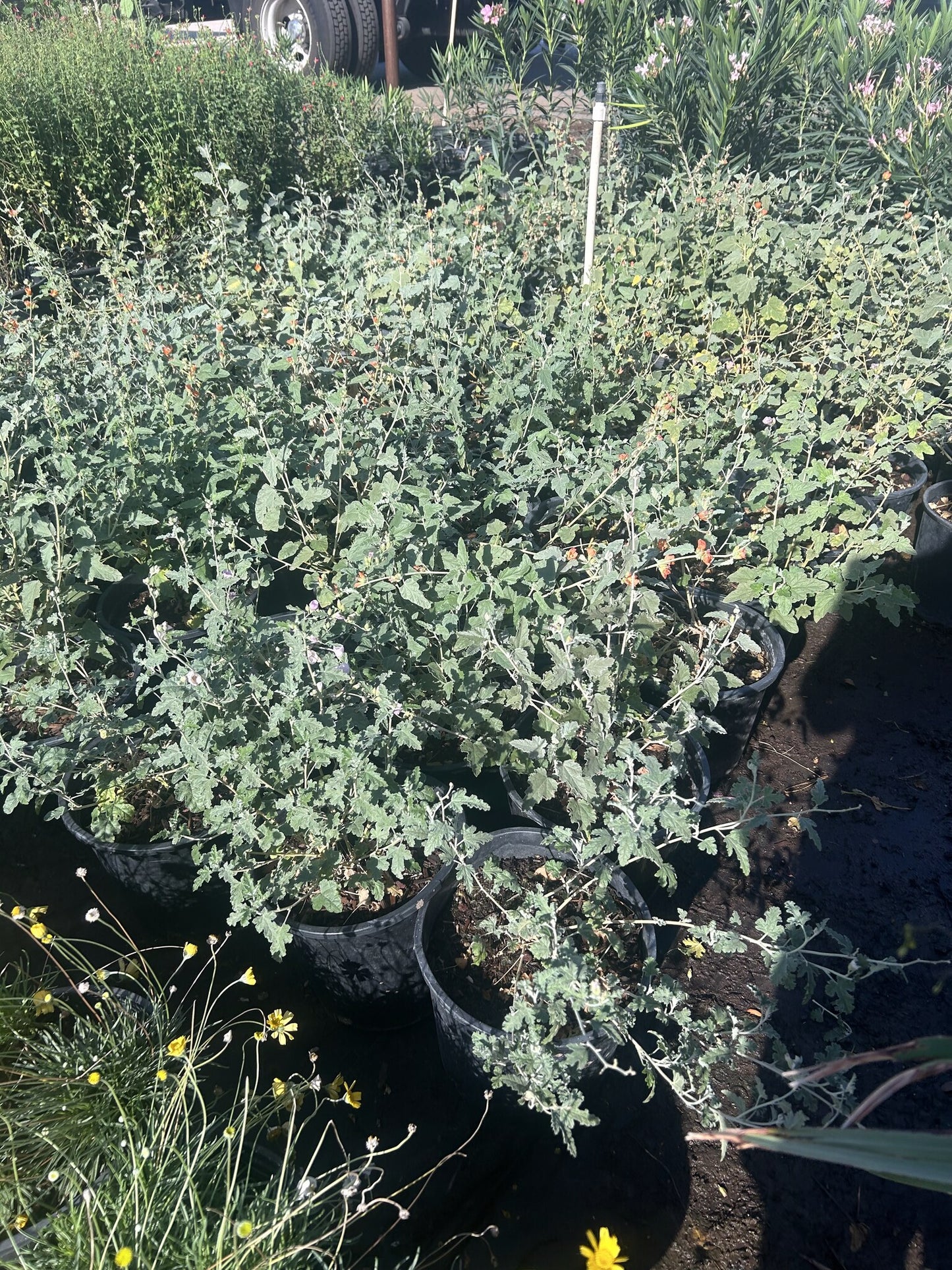


Globemallow
Globemallow
Couldn't load pickup availability
Phoenix's Toughest Native Wildflower — Globemallow
Globemallow (Sphaeralcea spp.), also called Desert Mallow, is one of Arizona's most beloved native perennials. Blooming in vivid shades of orange, red, pink, and yellow, it delivers season-long color with almost zero maintenance. Growing 1–3 feet tall, it thrives in full sun and punishing heat — making it a perfect choice whether you're adding color to a xeriscape in Scottsdale, filling a rock garden in Chandler, or lining a desert border in Mesa. Globemallow is the low-water wildflower Phoenix landscapes deserve.
Globemallow Plant Details
| Attribute | Detail |
|---|---|
| Scientific Name | Sphaeralcea spp. |
| Common Names | Globemallow, Desert Mallow, Indian Mallow, Sore Eye Poppy |
| Mature Height | 1–3 feet |
| Mature Width | 1–2 feet |
| Growth Rate | Moderate to fast — establishes quickly in Phoenix heat |
| Sun | Full sun (6+ hrs). Handles intense reflected heat from walls and gravel. |
| Water | Very low once established. One of the most drought-tolerant natives available. |
| USDA Zones | 7–11 (Phoenix is Zone 9b–10a) |
| Soil | Well-draining. Thrives in rocky, sandy, and Arizona caliche soils. |
| Foliage | Semi-evergreen — gray-green lobed leaves year-round |
| Bloom Color | Orange, red, pink, or yellow (varies by variety) |
| Bloom Season | Spring through fall, with heaviest flush after monsoon rains |
| Native | Yes — Sonoran and Mojave Deserts, native to Arizona |
Globemallow Uses in Phoenix Landscapes
Desert Wildflower Gardens
Globemallow is a staple of Arizona native wildflower gardens, producing upright spikes of cup-shaped blooms from spring through fall. Plant drifts of 3–5 plants together in Gilbert, Tempe, or Peoria yards for a colorful, naturalistic display that attracts butterflies and hummingbirds. For a 10-foot wildflower border — use 5–6 plants; for a 20-foot border — plant 10–12 plants spaced 18–24 inches apart.
Rock Gardens and Desert Slopes
With its love of rocky, fast-draining soil and full sun, Globemallow is ideal for sloped rock garden beds throughout the Phoenix Valley. Its mounding habit fills gaps between boulders naturally, and its gray-green foliage blends beautifully with granite mulch. Pair with Trailing Indigo or Desert Ruellia for layered texture at different heights.
Low-Water Border Planting
Globemallow makes an excellent front-of-border plant in xeriscape designs, providing color at eye level without overwhelming the space. It works well alongside taller plantings like Desert Bird of Paradise or Yellow Dalea and pairs naturally with Autumn Sage for extended bloom season coverage.
Pollinator Support
The cup-shaped flowers of Globemallow are a critical nectar source for native bees, butterflies, and hummingbirds throughout the warm months. A planting of just 3–5 Globemallow plants can significantly boost pollinator activity in any Phoenix yard or commercial landscape.
Best Time to Plant Globemallow in Phoenix
Fall (October–November) is the best planting window — warm soil encourages root development while cool air reduces transplant stress. Plants establish over 6–8 months before their first full Phoenix summer. Spring (February–April) also works well. Avoid planting in peak summer when young plants need intense supplemental water to survive.
How to Plant Globemallow
- Dig wide, not deep — 2–3x the root ball width, same depth as the container.
- Check for caliche — break through any hardpan layer to ensure proper drainage.
- Backfill with native soil — a light 20% organic amendment is fine; avoid heavy compost.
- Spacing — 18–24 inches apart for dense borders; 24–30 inches for natural groupings.
- Water basin — build a 3–4 inch berm around each plant to concentrate water at roots.
- Mulch — apply 2–3 inches of gravel or decomposed granite to retain soil moisture.
Watering Globemallow in Phoenix
First Year Watering Schedule
- Weeks 1–2: Every 1–2 days, deep and slow (15–20 minutes per session)
- Months 1–2: Every 3–4 days
- Months 3–6: Every 7–10 days (every 5–7 days during peak summer)
- After Year 1: Every 2–3 weeks in summer; rely on natural rainfall in cooler months
Drip Irrigation
Place emitters 12 inches from the plant crown. Use 1 GPH emitters for 1-gallon plants and 2 GPH for 5-gallon plants. Once fully established, Globemallow needs very little supplemental water beyond natural rainfall — it's one of the most self-sufficient plants available for Phoenix landscapes.
How often does Globemallow bloom?
Globemallow typically blooms from spring through fall in Phoenix, with the heaviest flowering in spring and a strong rebound after monsoon rains in late summer. Cutting plants back by one-third after the spring bloom encourages a fresh flush of flowers.
Is Globemallow truly drought tolerant in Phoenix?
Yes — once established after its first growing season, Globemallow is one of the most drought-tolerant natives available. Established plants survive on natural rainfall alone during cooler months and need only minimal supplemental irrigation during the hottest Phoenix summers.
Does Globemallow spread or reseed?
Globemallow can reseed modestly in ideal conditions, but it's not considered invasive. If you want to control reseeding, simply deadhead spent flower spikes before they go to seed. The plants themselves stay in a compact mound and don't aggressively spread by root.
What are the best Globemallow colors for Phoenix landscapes?
The most common Globemallow in Phoenix landscapes is the vivid orange Sphaeralcea ambigua, but red, pink, and yellow varieties are also widely available. Mixing colors in a single planting creates a stunning wildflower effect that closely resembles a natural desert wash.
You May Also Like
- Desert Ruellia — A tough spreading perennial with purple flowers that pairs beautifully alongside Globemallow in low-water borders.
- Autumn Sage — A compact, heat-tolerant native shrub with red or pink blooms that extends color season alongside Globemallow.
- Trailing Indigo — A spreading groundcover with purple blooms that fills space below Globemallow in xeriscape designs.
- Yellow Dalea — A compact native shrub with golden-yellow fall blooms that complements Globemallow's spring and summer color.
- Damianita — A low-growing native with bright yellow daisy-like blooms that pairs well with Globemallow in rock gardens.
How Many Globemallow Do I Need?
Globemallow reads best in drifts, not as single dots. Set plants about 20 inches on center for a full front-of-border band, or 24 to 30 inches apart for a looser, natural wildflower look. Plant in odd-numbered groups of 3 to 5 of one color, or mix colors for a desert-wash effect. Use the table below for a continuous border at roughly 20 inch spacing.
| Border length | Plants needed (about 20 in on center) |
|---|---|
| 10 ft | 6 plants |
| 15 ft | 9 plants |
| 20 ft | 12 plants |
| 30 ft | 18 plants |
Globemallow Season-by-Season in Phoenix
- Spring (Feb to Apr): Heaviest bloom flush of the year in orange, red, pink, or yellow, and a strong second planting window. Shear spent spikes by a third to push more flowers.
- Summer (May to Sep): Loves extreme and reflected heat. Blooming slows in the hottest stretch, then rebounds hard after the monsoon rains (Jul to Sep). Needs very little water once established.
- Fall (Oct to Nov): Prime planting season and a return of cooler-weather color. Deadhead to keep plants tidy and reduce reseeding if you prefer.
- Winter (Dec to Jan): The semi-evergreen gray-green mound holds through Valley winters with no frost protection needed. Cut plants back by about a third in late winter for fresh spring growth.
At a Glance
✔ Arizona Native ✔ Pollinator-Friendly ✔ Hummingbird-Friendly ✔ Heat-Loving (Reflected-Heat Tolerant) ✔ Drought-Tolerant ✔ Low-Maintenance ✔ Cold-Hardy to 10°F
Plant It With
- Desert Ruellia: tough purple-flowered perennial that layers below Globemallow in low-water borders.
- Autumn Sage Furman's Red: extends the bloom season with red flowers and matching toughness.
- Damianita: low golden-yellow daisy mounds that pair perfectly in rock gardens.
- Brittlebush: silver-leaved native with yellow daisies for a classic Sonoran wildflower mix.
Is Globemallow Right for Your Yard?
It thrives in full sun, reflected heat, and fast-draining rocky or caliche soil on very little water, staying a compact 1 to 3 feet. Not a fit if you want a tidy formal look (it is a loose, lightly reseeding wildflower) or if your spot is shady or holds wet, poorly drained soil.
Customer Reviews
Unfortunately, it did not do well. None of the plants I got from three timbers survived.
Share