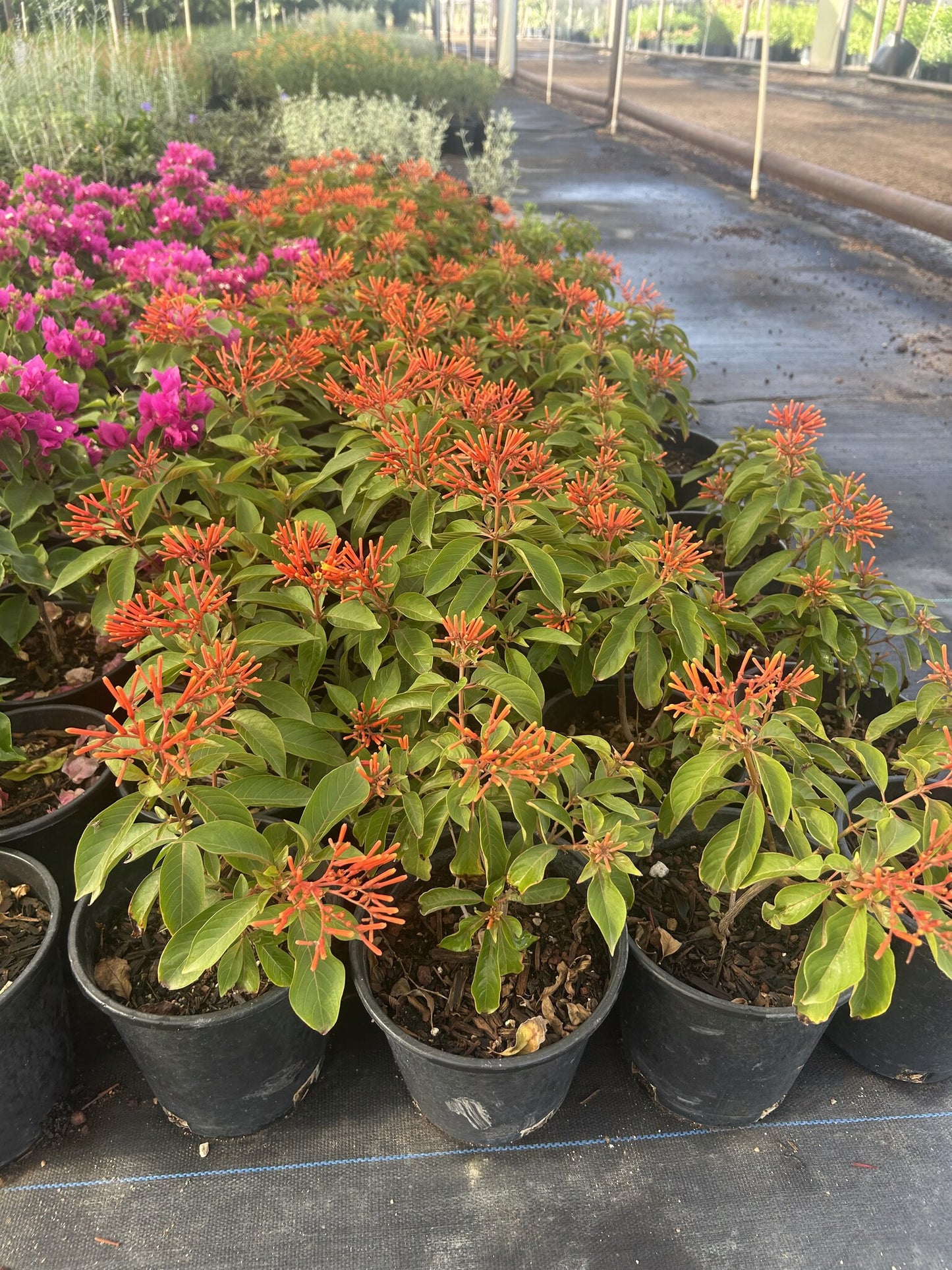


Firecracker Bush red
Firecracker Bush red
Couldn't load pickup availability
Phoenix's Best Hummingbird Shrub — Firecracker Bush
Firecracker Bush (Hamelia patens) is Phoenix's most reliable source of year-round color and wildlife activity in one easy-care shrub. With brilliant orange-to-red tubular flowers that bloom nearly every month in the Valley, this Central American native is an absolute magnet for hummingbirds, butterflies, and native bees. It grows fast, handles full desert sun, and thrives on low water once established. Whether you're adding bold color to a Scottsdale poolside, a pollinator garden in Mesa, or a layered desert border in Chandler or Gilbert — Firecracker Bush never lets you down.
Firecracker Bush Plant Details
| Attribute | Detail |
|---|---|
| Scientific Name | Hamelia patens |
| Common Names | Firecracker Bush, Firebush, Hummingbird Bush, Texas Firebush |
| Mature Height | 3–5 feet (can reach 8 feet in ideal conditions) |
| Mature Width | 3–5 feet |
| Growth Rate | Fast — 1–2 feet per year in Phoenix with regular water |
| Sun | Full sun to partial shade. Performs best with 6+ hours of direct sun. |
| Water | Low to moderate once established. More flowers with occasional deep watering. |
| USDA Zones | 9–11 (Phoenix is Zone 9b–10a) |
| Soil | Well-draining. Adaptable to Arizona caliche soils with proper drainage. |
| Foliage | Semi-evergreen in Phoenix — may drop some leaves in cold winters but rebounds quickly |
| Bloom Color | Bright orange to red tubular flowers; nearly year-round in Phoenix |
| Wildlife Value | Top-rated hummingbird and butterfly plant for Phoenix landscapes |
Firecracker Bush Uses in Phoenix Landscapes
Hummingbird and Pollinator Gardens
No plant in the Phoenix Valley draws more hummingbirds than Firecracker Bush. Its abundant orange-red tubular flowers are perfectly shaped for hummingbird feeding, and the plant produces blooms almost continuously from spring through fall and often into winter. Planted in groups of 3–5 in Scottsdale or Tempe, a mass of Firecracker Bush creates an astonishing wildlife spectacle. Pair it with Desert Milkweed and Ruellia for a full pollinator garden that supports hummingbirds, butterflies, and native bees simultaneously.
Bold Color in Low-Water Borders
If you want a flowering shrub that produces months of bold color without constant irrigation, Firecracker Bush delivers. Once established, it thrives on Phoenix's natural rainfall supplemented by occasional deep watering. The vivid orange-red flowers stand out dramatically against decomposed granite, grey stucco, and dark-colored walls common in modern Phoenix and Scottsdale landscapes. Pair it with the silvery foliage of Texas Sage or the bold texture of Desert Spoon for a high-contrast, low-water design that pops year-round.
Poolside and Patio Planting
Firecracker Bush is an excellent choice for poolside planting in the Phoenix Valley. Its upright growth keeps it tidy without requiring much pruning, and it handles the reflected heat and humidity near pools without stress. Plant 3–4 feet from pool edges to allow for spread, and enjoy the added benefit of watching hummingbirds visit your blooms while you relax. In Chandler, Peoria, and Glendale backyards, this plant is a perennial customer favorite for creating a lush, tropical feel around outdoor living spaces.
Accent and Foundation Planting
At 3–5 feet tall and wide, Firecracker Bush is perfectly sized for foundation planting, corner accents, and mixed border applications. Use it to frame entryways, fill awkward corners near walls or fences, or create a colorful mid-border layer between low groundcovers and taller canopy trees. In mesa, Gilbert, and Tempe, it's commonly used as a year-round focal point that replaces annual color plants with far less maintenance and water.
Best Time to Plant Firecracker Bush in Phoenix
Fall (October–November) is the ideal planting window. The warm soil encourages root establishment while cooler air reduces transplant stress, giving the plant 6–8 months to settle in before facing its first Phoenix summer. Spring (February–April) is the second-best option — you'll see blooms more quickly, though you'll need to water more frequently through the summer heat. Avoid planting in peak summer if possible, and if you must, provide afternoon shade for the first few weeks and water every 1–2 days until established.
How to Plant Firecracker Bush
- Dig wide, not deep — dig a hole 2–3 times the width of the root ball and the same depth to encourage lateral root spread.
- Check for caliche — break through any hardpan caliche layer. Firecracker Bush needs good drainage to thrive; standing water will cause root rot.
- Backfill with native soil — a light 20% organic amendment is fine, but don't overdo it. These plants adapt readily to lean Arizona soils.
- Spacing — plant 3–4 feet apart for a mass effect; 5 feet apart for individual specimens in a mixed border.
- Water basin — build a 3-inch raised soil ring around the outer edge of the root zone to direct irrigation water to the roots.
- Mulch — apply 2–3 inches of bark or gravel mulch to retain moisture and regulate soil temperature. Keep mulch 2 inches away from the main stem.
Watering Firecracker Bush in Phoenix
First Year Watering Schedule
Consistent watering is critical during the first year to establish strong roots:
- Weeks 1–2: Water every 1–2 days, deep and slow (20–30 minutes per session)
- Month 1–2: Reduce to every 3–4 days as roots spread
- Month 3–6: Water every 7–10 days (every 5–7 days in summer heat above 105°F)
- After Year 1: Every 10–14 days in summer; every 3–4 weeks in winter. More water equals more blooms.
Drip Irrigation
Install drip emitters 12–18 inches from the main stem using 1 GPH emitters. Run for 20–30 minutes per session. Unlike ultra-drought-tolerant cacti, Firecracker Bush blooms most profusely with regular deep watering — think of water as bloom fuel. Established plants can handle dry stretches but will reward consistent moisture with far more flowers.
How long does Firecracker Bush bloom in Phoenix?
In Phoenix's warm climate, Hamelia patens blooms nearly year-round — typically from early spring through late fall, and often into winter during mild years. In warmer microclimates in Scottsdale and Tempe, some plants flower 10–12 months a year, making Firecracker Bush one of the longest-blooming shrubs available for Valley landscapes.
Is Firecracker Bush drought tolerant once established?
Yes — once established (typically 12–18 months), Firecracker Bush handles Phoenix's dry conditions well and can get by on very little supplemental irrigation. However, it will produce significantly more flowers with regular deep watering. Think of it as low-water capable but "thirsty for blooms" — more water means more hummingbirds.
Does Firecracker Bush attract hummingbirds in Arizona?
Absolutely. Hamelia patens is consistently rated as one of the top hummingbird plants for the Sonoran Desert region. Both Anna's Hummingbirds (year-round residents) and migrating Rufous Hummingbirds are strongly attracted to its tubular orange-red flowers. Plant a mass of 3–5 plants and you'll have a dedicated hummingbird feeding station in your yard.
Will Firecracker Bush survive Phoenix winters?
Firecracker Bush is cold-hardy to Zone 9 and handles Phoenix winters well. In the coldest years, it may die back to the ground but will resprout vigorously in spring from established roots. In most Phoenix winters, it retains most of its foliage and continues to flower on warm days. A light protective mulch around the root zone during cold snaps helps ensure survival.
How do I prune Firecracker Bush?
Prune lightly in late winter (February) before new growth emerges — cut back by one-third to encourage bushy, compact growth and maximize summer flower production. You can deadhead spent blooms throughout the season to encourage continuous flowering, though the plant will bloom readily with minimal pruning. Avoid heavy pruning in fall, as this removes flower buds.
You May Also Like
Texas Sage (Leucophyllum frutescens) — A native-adapted silvery-foliage shrub with purple blooms that pairs beautifully with the bold color of Firecracker Bush in mixed borders.
Ruellia (Mexican Petunia) — A low-growing, prolific purple bloomer that fills in beautifully at the base of Firecracker Bush for a colorful layered planting.
Desert Spoon (Dasylirion) — A bold architectural accent plant that provides striking texture contrast next to Firecracker Bush's soft, flowering form.
Tropical Bird of Paradise (Strelitzia reginae) — Another hummingbird favorite with dramatic orange flowers that pairs well in a tropical-inspired Phoenix planting.
Bower Vine (Pandorea jasminoides) — A climbing vine with soft pink blooms that can be used on a nearby fence or trellis to complement Firecracker Bush's vibrant tones.
How Many Firecracker Bush Do I Need?
At a mature 3 to 5 foot width, space plants about 4 feet on center for a flowering mass, or 5 feet for individual accents in a mixed border.
| Border run length | Plants needed (4 ft spacing) |
|---|---|
| 12 ft | 3 plants |
| 20 ft | 5 plants |
| 32 ft | 8 plants |
| 40 ft | 10 plants |
For a hummingbird hotspot, group 3 to 5 plants about 4 feet apart so the orange-red bloom reads as one block of color.
Firecracker Bush Season-by-Season in Phoenix
- Spring (Feb–Apr): Strong regrowth flush and the start of heavy bloom. Cut back by a third in February to shape it. Best second planting window.
- Summer (May–Sep): Peak bloom right through extreme and reflected heat, drawing hummingbirds daily. Flowers hardest with occasional deep water, and the monsoon often triggers a flush.
- Fall (Oct–Nov): Prime planting season and continued bloom. Color often runs into early winter in warm microclimates.
- Winter (Dec–Jan): Semi-evergreen. Holds leaves and flowers on warm Valley days, but a hard frost below about 28 to 30°F can burn it back. It resprouts vigorously from the roots in spring, so leave the dieback and a little mulch over the root zone on cold nights.
At a Glance
✔ Hummingbird-Friendly ✔ Pollinator-Friendly ✔ Heat-Loving (Reflected-Heat Tolerant) ✔ Drought-Tolerant ✔ Pool-Friendly (Low-Litter) ✔ Low-Maintenance
Plant It With
- Texas Sage: silver foliage and purple bloom for high-contrast color beside the orange-red flowers.
- Desert Ruellia: low purple bloomer that fills in at the base of the bush.
- Desert Milkweed: rounds out a pollinator bed for butterflies alongside the hummingbirds.
- Bower Vine: soft pink trellis bloom on a nearby wall to echo the tropical feel.
Is Firecracker Bush Right for Your Yard?
It thrives in full sun to light shade, takes reflected heat and poolside conditions, and adapts to caliche as long as drainage is good, blooming nearly year-round for hummingbirds. Give it occasional deep water for the heaviest flowering. The one caveat is frost: a hard Valley freeze can burn it back, though it returns from the roots each spring, so plan for a winter cut-back rather than a tidy evergreen.
Share