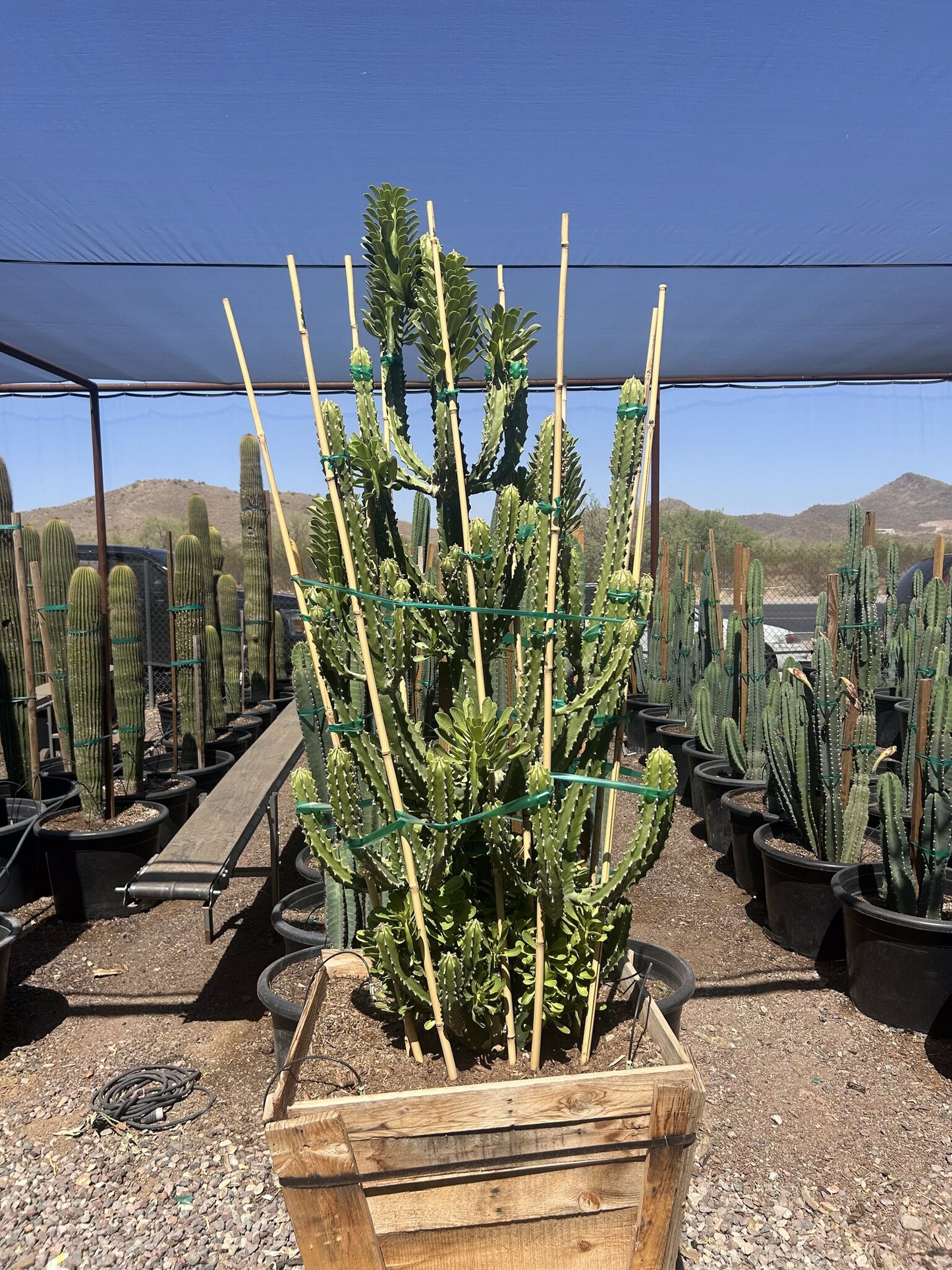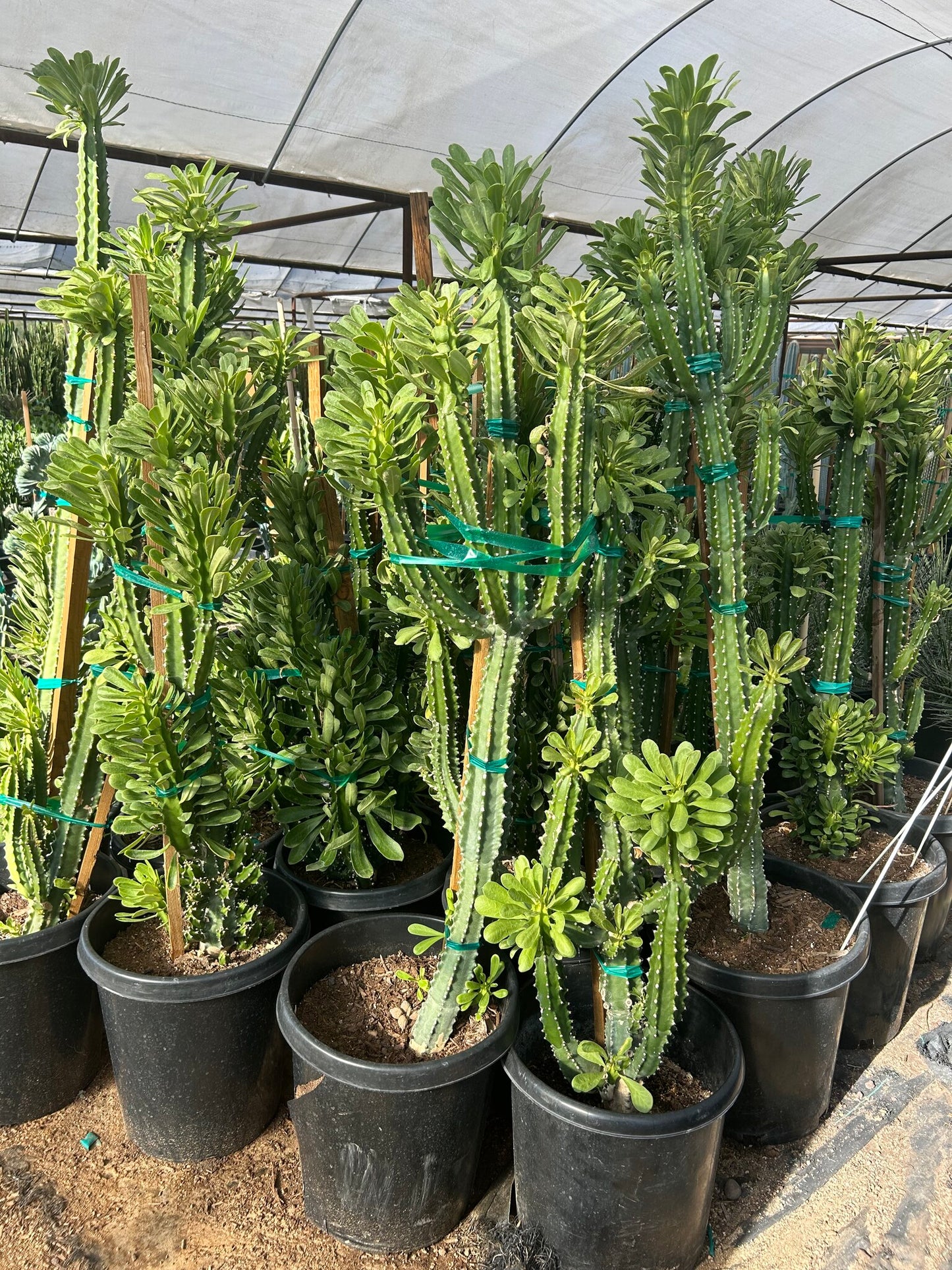


Euphorbia royleana
Euphorbia royleana
Couldn't load pickup availability
A Dramatic Tree-Like Succulent for Phoenix Desert Landscapes
Euphorbia royleana (Royle's Spurge) is one of the most architecturally striking succulents you can grow in Phoenix. This tree-like euphorbia rises 6–15 feet tall on thick, angular, columnar stems that branch into a candelabra silhouette — creating an unforgettable sculptural presence in any landscape. Native to the Himalayan foothills, it's perfectly adapted to Phoenix's hot, dry conditions and requires almost no water once established. Whether you're creating a modern desert garden in Scottsdale, adding vertical drama to a succulent collection in Chandler, or planting a statement specimen in Mesa — Euphorbia royleana commands attention year-round.
Euphorbia royleana Plant Details
| Attribute | Detail |
|---|---|
| Scientific Name | Euphorbia royleana |
| Common Names | Royle's Spurge, Sullu Spurge |
| Mature Height | 6–15 feet |
| Mature Width | 2–6 feet |
| Growth Rate | Moderate — 1–2 feet per year in Phoenix |
| Sun | Full sun to partial shade. Handles reflected heat from walls. |
| Water | Very low once established. Extremely drought-tolerant. |
| USDA Zones | 9b–11 (Phoenix is Zone 9b–10a) |
| Soil | Well-draining essential. Thrives in rocky Arizona caliche soils. |
| Foliage | Semi-deciduous — leaves appear on stem tips in warm months, drop in winter |
| Bloom Color | Greenish-yellow cyathia (small flower clusters) |
| Caution | Milky sap is irritating — wear gloves when handling |
Euphorbia royleana Uses in Phoenix Landscapes
Architectural Specimen
The candelabra branching pattern and tall columnar form make Euphorbia royleana a living sculpture. Plant it as a standalone focal point in a gravel bed, courtyard, or modern desert garden. The angular stems catch dramatic shadow patterns throughout the day, especially against stucco or concrete walls.
Succulent & Cactus Garden Anchor
Use Euphorbia royleana as a towering backdrop in mixed succulent gardens. It pairs beautifully with Agave americana, Cow's Horn Euphorbia, Barrel Cactus, and Desert Spoon — providing the vertical element that grounds the composition. Space 4–6 feet from neighboring plants.
Low-Water Privacy Screen
Planted 4–5 feet apart, mature Euphorbia royleana creates an imposing, thorny privacy barrier that uses almost no water. The thick stems and spiny ridges naturally deter foot traffic. For a 20-foot screen, you'll need about 4–5 plants.
Best Time to Plant Euphorbia royleana in Phoenix
Spring (March–May) is ideal for euphorbias — warm soil and rising temperatures encourage fast root establishment and active growth. Fall (October–November) is the second-best window. Avoid planting in winter when cool temperatures slow growth and increase rot risk.
How to Plant Euphorbia royleana
- Dig wide, not deep — 2x the root ball width, same depth as the container.
- Check for caliche — break through any hardpan. Euphorbias cannot tolerate waterlogged roots.
- Backfill with native soil — no amendments needed. Fast drainage is critical.
- Spacing — 4–6 ft apart for a grouping; 5+ ft for individual specimens.
- No water basin — euphorbias prefer water to drain away quickly. Skip the basin.
- Gravel mulch — 2–3 inches of decomposed granite or rock (never bark mulch).
Watering Euphorbia royleana in Phoenix
First Year Watering Schedule
- Weeks 1–2: Every 5–7 days, light watering
- Month 1–3: Every 10–14 days
- Month 3–12: Every 2–3 weeks
- After Year 1: Monthly in summer; little to no water in winter
Drip Irrigation
Place one 0.5–1 GPH emitter 12–18 inches from the base. Established plants are extremely drought-tolerant. Overwatering causes stem rot — when in doubt, don't water.
How tall does Euphorbia royleana get in Phoenix?
6–15 feet depending on age and growing conditions. Most specimens reach 8–10 feet within 5–7 years from a 5-gallon start. Larger boxed specimens provide instant height.
Is the sap dangerous?
The milky white latex sap is a skin and eye irritant. Always wear gloves when pruning or handling. Keep away from eyes and wash hands thoroughly after contact. The sap is a natural defense mechanism shared by all euphorbias.
Is it frost tolerant?
Euphorbia royleana handles light frost to about 28°F. In most Phoenix Valley locations it overwinters without protection. Cover during rare hard freeze events below 25°F.
What's the difference between Euphorbia royleana and a cactus?
Despite looking like a cactus, euphorbias are in a completely different plant family. Key differences: euphorbias have milky sap (cacti don't), paired spines (cacti have clustered spines from areoles), and small leaf growth on stem tips during warm months.
You May Also Like
- Euphorbia trigona — another columnar euphorbia with a more compact form
- Cow's Horn Euphorbia — dramatic zigzag stems with horn-like spines
- Desert Spoon — silvery-blue rosette that pairs beautifully with tall euphorbias
- Totem Pole Cactus — smooth columnar cactus for a similar vertical effect
How Many Euphorbia royleana Do I Need?
This is a tall, tree-like specimen at 2 to 6 feet wide, so it is planted for vertical drama rather than massed. Use one as a standalone focal point in a gravel bed or courtyard, or set an odd-numbered group of 3 to 5 spaced 4 to 6 feet apart so each candelabra silhouette stands clear. For an imposing low-water privacy screen, run a line 4 to 5 feet apart (about 4 to 5 plants per 20 feet). Keep mature plants at least 4 to 6 feet back from walkways, seating, and pool edges so the spiny ridges and milky sap stay out of reach.
Euphorbia royleana Season-by-Season in Phoenix
- Spring (Mar to May): Best planting window. Warm soil drives fast root establishment, fresh leaves flush on the stem tips, and small greenish-yellow cyathia appear.
- Summer (May to Sep): Loves extreme heat and reflected warmth from walls, putting on its strongest vertical growth. Keep water minimal through monsoon humidity, since soggy soil causes stem rot.
- Fall (Oct to Nov): Good second planting window. Growth slows as nights cool and the tip leaves begin to drop.
- Winter (Dec to Jan): Largely leafless and dormant. Hardy to about 28°F and fine through most Valley winters, but cover with frost cloth on rare hard-freeze nights below 25°F.
At a Glance
✔ Heat-Loving (Reflected-Heat Tolerant) ✔ Drought-Tolerant ✔ Low-Maintenance
Plant It With
- Euphorbia trigona-Green: a more compact columnar euphorbia that echoes the form at lower height.
- Cow's Horn Euphorbia: zigzag horned stems for textural contrast in a euphorbia grouping.
- Desert Spoon: a silvery-blue rosette that grounds the base of the tall columns.
- Big Horn Euphorbia: bold ribbed columns that build a layered architectural composition.
Is Euphorbia royleana Right for Your Yard?
It thrives in full sun and reflected heat, fast-draining rocky or caliche soil, and very little water, making it a commanding vertical accent for modern desert gardens and succulent collections across the Valley. It is not a fit if your only spot stays wet or shaded, or if children and pets share the space without a barrier: the milky latex sap is caustic to skin and eyes and the angular stems carry paired spines, so keep it back from high-traffic paths.
Share