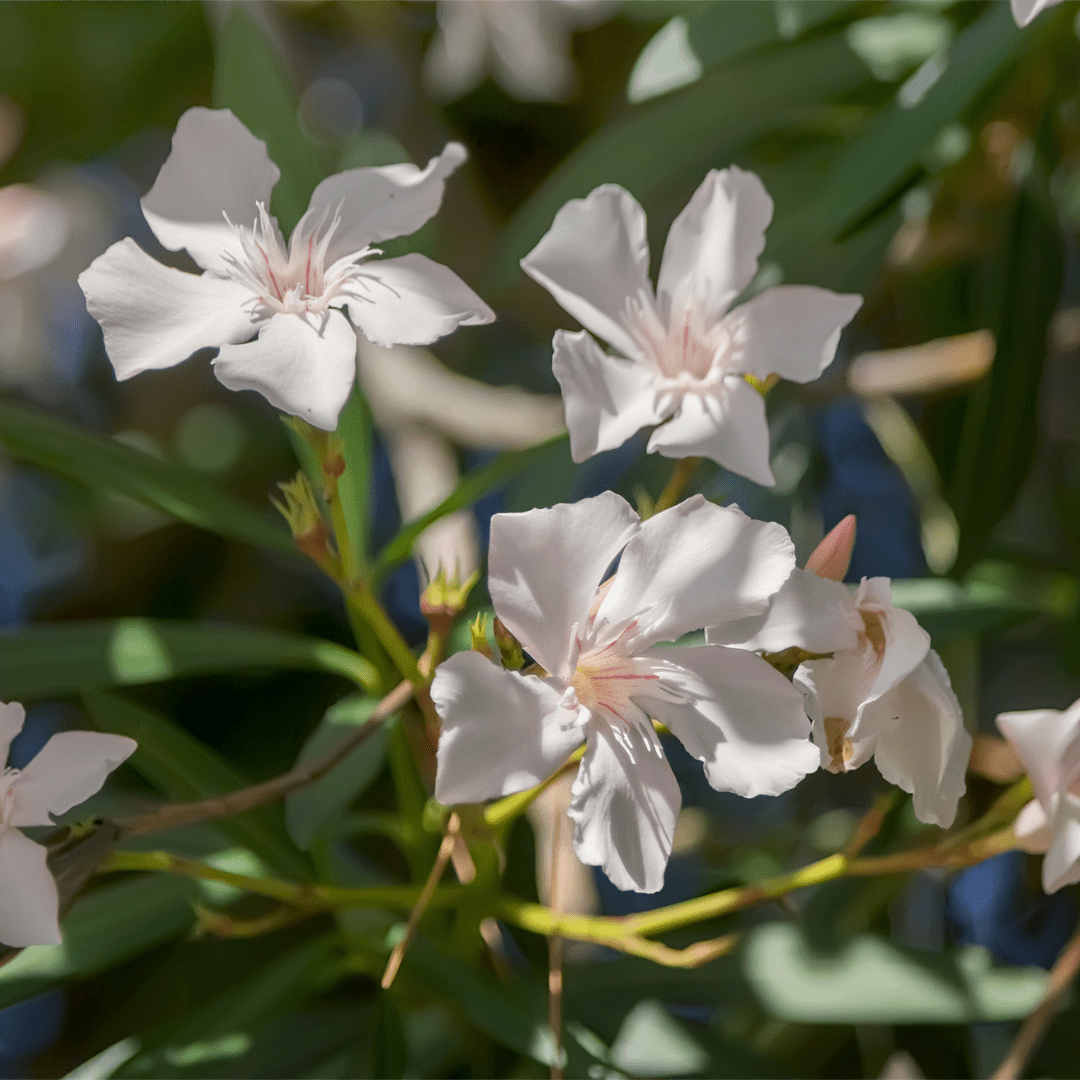


Dwarf White Oleander
Dwarf White Oleander
Couldn't load pickup availability
Dwarf White Oleander – Compact Flowering Privacy Shrub for Phoenix, Glendale & Surprise
Add brilliant, season-long white blooms and dense evergreen structure with Dwarf White Oleander (Nerium oleander 'Dwarf White'), the compact version of Phoenix's toughest flowering shrub. Cherished by homeowners across Phoenix, Glendale, and Surprise for its pure white blooms that appear from spring through fall, Dwarf White Oleander delivers striking floral color in a manageable, lower-growing form that fits easily into borders, foundation plantings, median strips, and low privacy hedges. It thrives in Zone 9b–10a's extreme summer heat with minimal water once established, and holds its glossy evergreen foliage year-round. Available in 1 Gallon and 3/5 Gallon sizes.
Plant Details
| Scientific Name | Nerium oleander 'Dwarf White' |
|---|---|
| Plant Type | Compact evergreen shrub |
| Mature Height | 3–5 ft |
| Spread | 3–5 ft |
| Growth Rate | Moderate |
| Sun Exposure | Full sun |
| Flower Color | Pure white; blooms spring through fall |
| Foliage | Narrow, dark green, evergreen |
| Hardiness Zone | Zone 9b–10a (ideal for greater Phoenix Valley) |
| Water Needs | Very low once established |
| Soil Tolerance | Excellent; handles caliche, alkaline, and poor soils |
| Note | All parts toxic if ingested; keep away from children and pets |
| Available Sizes | 1 Gallon, 3/5 Gallon |
Why Phoenix Homeowners Choose Dwarf White Oleander
Season-Long White Blooms in the Desert Heat
While many flowering shrubs fade or stop blooming in Phoenix's triple-digit summers, Dwarf White Oleander keeps producing its crisp, pure white blooms from spring all the way through fall. The continuous floral display makes it one of the longest-blooming shrubs available for Zone 9b–10a landscapes, providing reliable color through the hottest months when most other plants retreat. The white blooms complement virtually every landscape color palette and architecture style.
Compact Size — Half the Height of Standard Oleander
Standard Oleander can reach 8–12 feet and requires constant pruning to keep it manageable. Dwarf White Oleander tops out at 3–5 feet in a naturally rounded, compact form, making it ideal for borders, foundation plantings, low dividing hedges, and spots where the full-size variety would quickly overwhelm the space. Less pruning, same heat-tough performance, more manageable scale for residential landscapes throughout the Phoenix Valley.
Extreme Heat & Drought Tolerance
No Phoenix landscape shrub beats oleander for sheer heat and drought resilience. Once established in Zone 9b–10a, Dwarf White Oleander thrives on very infrequent deep watering—even through Phoenix's harshest summers. It performs well in the alkaline, caliche-heavy soils common across the metro area and tolerates reflected heat from walls, pavement, and rock mulch that would stress most other plants. This makes it especially valuable for south- and west-facing exposures, median strips, and areas with challenging conditions.
Low Borders, Foundation Plantings & Privacy Hedges
At 3–5 feet tall and wide, Dwarf White Oleander creates an effective low privacy screen when planted in a row. Space 3–4 feet apart for a continuous hedge that provides partial screening and consistent floral color. It works equally well as a standalone accent plant in rocky desert landscapes, massed in sweeps across large areas for unified color and texture, or as a border shrub framing larger trees and structures.
Year-Round Evergreen Structure
The narrow, dark green evergreen leaves of Dwarf White Oleander maintain attractive appearance even between bloom cycles, ensuring the plant looks polished and structural rather than bare in the off-season. This year-round presence makes it a reliable backbone plant for low-maintenance Phoenix landscapes that need consistent greenery without ongoing care.
Best Time to Plant Dwarf White Oleander in Phoenix
Plant during late February through April or September through November for the smoothest establishment. Spring planting takes advantage of mild temperatures and gives the plant a full growing season before its first summer; fall planting lets roots anchor in cooling soil before winter. Oleander is one of the more heat-tolerant plants at planting time—it can be transplanted in summer with adequate watering, though spring and fall remain optimal.
How to Plant Dwarf White Oleander — 6 Steps
- Choose Your Location: Select a spot with full sun — 6 or more hours per day. Dwarf White Oleander blooms best and grows most compactly in full sun; partial shade reduces flowering and increases growth laxness.
- Prepare the Soil: Dig a hole 2× wider than the container and equal in depth. Oleander tolerates poor, alkaline, and caliche soils better than almost any other landscape shrub. Lightly amend with compost if desired, but heavy amendment is not required.
- Set the Plant: Place the plant with the crown at or slightly above surrounding soil grade. Backfill with native or lightly amended soil and firm gently around the root ball.
- Water Thoroughly: Soak the root zone deeply immediately after planting to initiate root-to-soil contact and settle the backfill soil.
- Mulch Lightly: Apply 2 inches of rock or organic mulch around the base (keeping 2 inches clear of the stem). Rock mulch is well-suited to oleander's heat-loving nature and low-water requirements.
- Prune for Shape (Optional): No immediate pruning required. If a more compact or shaped form is desired, prune lightly after the first bloom flush. Avoid pruning in fall to prevent stimulating tender new growth before winter.
Watering Schedule for Dwarf White Oleander
Oleander is among the most drought-tolerant flowering shrubs for Phoenix landscapes. The key is establishing a deep root system in the first few months.
After Planting
- Weeks 1–2: Water every 3–4 days, soaking the root zone 8–10 inches deep each session.
- Weeks 3–8: Reduce to every 5–7 days as roots anchor into surrounding soil.
- Months 2–4: Transition to deep watering every 7–10 days; let the top 3 inches of soil dry between cycles.
Once Established (3–4 Months)
- Summer (May–Sept): Deep water every 2–3 weeks; even in extreme heat, established oleander rarely needs more than bi-weekly irrigation.
- Winter (Oct–Apr): Water monthly or less; oleander is remarkably drought-tolerant in cool weather and can often subsist on seasonal rainfall alone.
Drip Irrigation Setup
- Emitter Placement: 1 emitter positioned 12–15 inches from the base per plant.
- Flow Rate: 1–2 gallons per hour.
- Run Time (Summer): 1–2 hours per cycle; oleander needs less frequent watering than most landscape shrubs.
- Seasonal Adjustment: Significantly reduce run time and frequency in fall and winter; over-watering in cool months is the most common mistake with established oleander.
Frequently Asked Questions
Is Dwarf White Oleander toxic?
Yes — all parts of oleander are toxic if ingested by humans, pets, or livestock. It should not be planted in areas where children or pets may chew on the foliage or stems. Wear gloves when pruning and wash hands thoroughly afterward.
How big does Dwarf White Oleander get?
Mature size in Phoenix is typically 3–5 feet tall and 3–5 feet wide. It's significantly smaller than standard oleander varieties and requires much less pruning to remain compact.
How often does it bloom?
Continuously from spring through fall in the Phoenix Valley — one of the longest bloom seasons of any desert-adapted shrub. Removing spent flower clusters encourages additional blooms.
Can it handle full western sun exposure?
Absolutely. Dwarf White Oleander is one of the best plants available for hot west- and south-facing exposures in Phoenix, including areas with reflected heat from walls and pavement.
How far apart should I plant for a low hedge?
Space plants 3–4 feet apart for a continuous low screen. At 3/5 Gallon size they'll fill in and create a cohesive hedge within one to two growing seasons.
Does it need fertilizer?
Rarely. Oleander is a light feeder. If desired, apply a slow-release balanced fertilizer once in spring. Over-fertilizing with nitrogen produces excessive leafy growth at the expense of blooms.
You May Also Like
- Dwarf Red Oleander – Same compact heat-tough form with vibrant red blooms
- Petite Pink Oleander – Dwarf oleander with soft pink flowers for Phoenix borders
- White Oleander – Full-size white oleander for taller privacy screens and windbreaks
How Many Dwarf White Oleander Do I Need?
Dwarf White Oleander matures around 3 to 5 feet wide, so space plants about 4 feet apart center to center for a continuous low hedge or screen. Use this table to estimate counts:
| Hedge Run Length | Plants Needed (4 ft spacing) |
|---|---|
| 10 ft | 3 plants |
| 20 ft | 5 plants |
| 30 ft | 8 plants |
| 40 ft | 10 plants |
| 50 ft | 13 plants |
For tighter, faster screening, drop to 3 feet apart. As stand-alone accents or pool-surround color, give each plant about 5 feet of clearance.
Dwarf White Oleander Season-by-Season in Phoenix
- Spring (Feb–Apr): New growth flushes and the first crisp white blooms open. This is a top planting window and the start of a long flowering run.
- Summer (May–Sep): Peak bloom straight through triple-digit heat and reflected heat off walls and pavement, on very little water. It keeps flowering through the monsoon while many shrubs pause.
- Fall (Oct–Nov): Prime planting season, with continued white color and strong root establishment in warm soil. Avoid pruning now so no tender growth is pushed before winter.
- Winter (Dec–Jan): Stays evergreen for year-round structure. Hardy to roughly 15°F, so typical Valley frosts cause little or no damage; a hard freeze may nip leaf tips on exposed plants.
At a Glance
✔ Evergreen ✔ Drought-Tolerant ✔ Heat-Loving (Reflected-Heat Tolerant) ✔ Pool-Friendly (Low-Litter) ✔ Low-Maintenance ✔ Pollinator-Friendly ✔ Deer & Rabbit-Resistant ✔ Cold-Hardy to 15°F
Plant It With
- Dwarf Red Oleander: the matching compact form in vivid red for a bold red-and-white border.
- Texas Sage: silvery foliage and purple bloom that sets off the pure white flowers.
- Purple Hopseed Bush: a fast bronze-purple backdrop that frames a white oleander screen.
- Desert Spoon: a spiky silver-green rosette for architectural contrast in pool surrounds.
Is Dwarf White Oleander Right for Your Yard?
Dwarf White Oleander thrives in full sun and reflected heat, shrugs off caliche and alkaline soils, and blooms for months on very little water, making it one of the toughest compact color shrubs for Phoenix borders, screens, and hot west-facing exposures. It is not the right choice for homes where children or pets graze on plants, since all parts of oleander are toxic if eaten: in those yards, choose a non-toxic shrub like Texas Sage instead.
Share