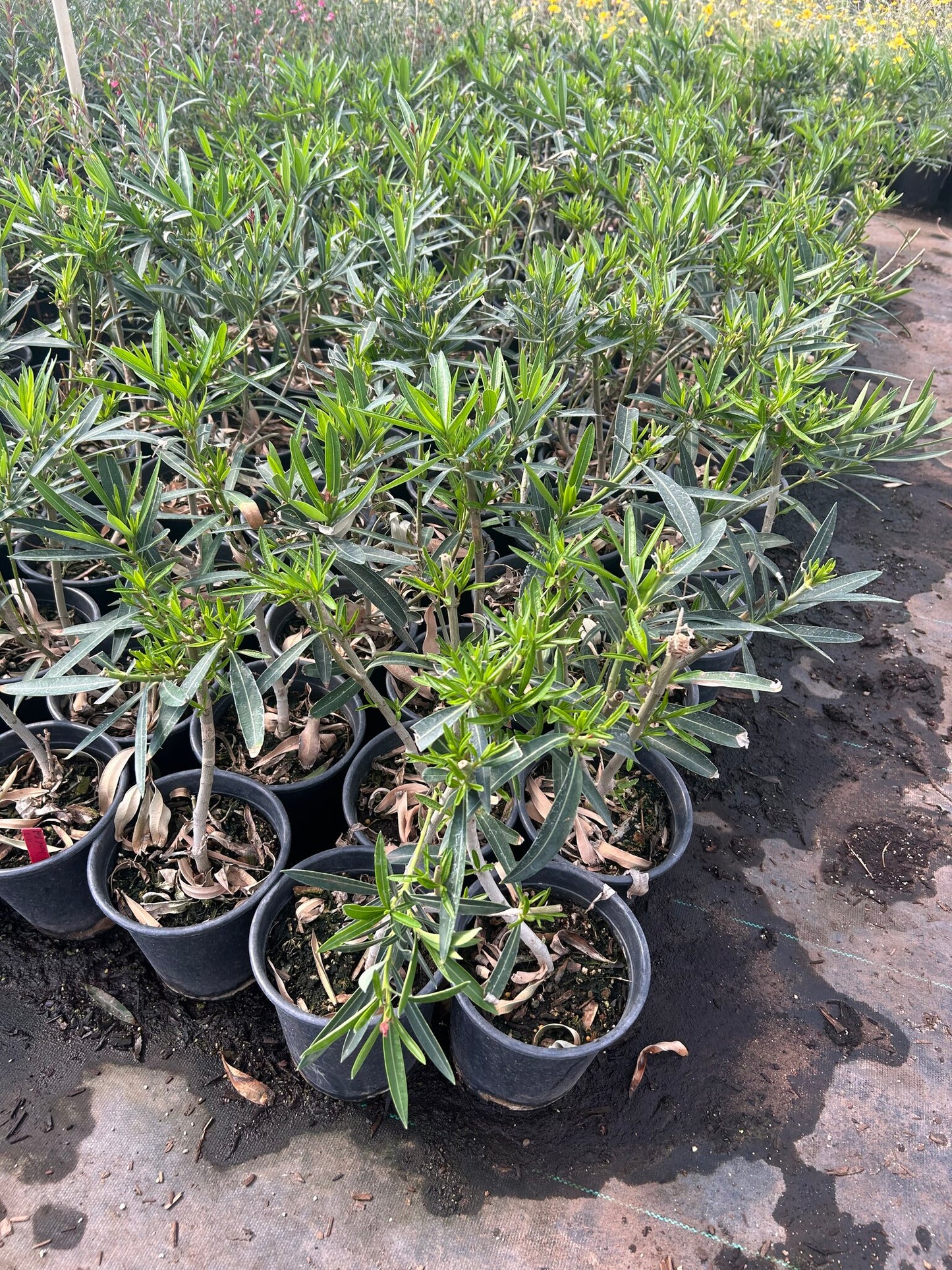


Dwarf Red Oleander
Dwarf Red Oleander
Couldn't load pickup availability
Phoenix's Boldest Compact Blooming Shrub — Dwarf Red Oleander
Dwarf Red Oleander (Nerium oleander 'Petite Red') is the compact oleander that stops traffic. Growing just 3–5 feet tall and wide, it delivers vivid fire-engine red blooms from spring through fall — one of the longest bloom windows of any low-water shrub in the Phoenix Valley. Unlike full-size oleanders that can overwhelm a space, the dwarf red variety stays tidy and proportional in borders, pool surrounds, and front yard beds. Whether you're adding bold color to a Scottsdale entryway, planting a low hedge in Chandler, or brightening up a Mesa courtyard — Dwarf Red Oleander delivers maximum impact with minimal water and care.
Dwarf Red Oleander Plant Details
| Attribute | Detail |
|---|---|
| Scientific Name | Nerium oleander 'Petite Red' |
| Common Names | Dwarf Red Oleander, Petite Red Oleander, Compact Red Oleander |
| Mature Height | 3–5 feet |
| Mature Width | 3–5 feet |
| Growth Rate | Moderate — 1–2 feet per year in Phoenix |
| Sun | Full sun (6+ hrs). Handles reflected heat from walls and pavement. |
| Water | Low once established. Highly drought-tolerant. |
| USDA Zones | 8–11 (Phoenix is Zone 9b–10a) |
| Soil | Well-draining. Adapts to Arizona caliche soils. |
| Foliage | Evergreen — stays green year-round |
| Bloom Color | Vivid red; blooms spring through fall |
Dwarf Red Oleander Uses in Phoenix Landscapes
Bold Low-Water Borders
Dwarf Red Oleander thrives as a border plant along fences, driveways, and property lines throughout the Phoenix Valley. Its vivid red blooms create a dramatic ribbon of color from late spring through fall — months when most flowering plants stop performing. Plant 4 feet apart for a dense border — a 20-foot fence needs 5 plants, a 40-foot fence needs 10 plants. Pair with Petite Pink Oleander to create an alternating red-and-pink color-block border.
Pool-Friendly Color Accent
The compact 'Petite Red' variety produces far less flower and leaf debris than full-size oleanders, making it a practical choice around pool decks and water features. Its bold red blooms complement both modern desert and tropical poolscapes. Pair with Blue Yucca, Desert Spoon, or White Oleander for striking contrast in Scottsdale and Gilbert pool surrounds.
HOA Front Yards and Entry Plantings
Dwarf Red Oleander's manageable compact size — rarely exceeding 5 feet — makes it ideal for HOA communities in Chandler, Peoria, and Tempe. It stays full and tidy with minimal pruning, adds vivid seasonal color when neighbors' yards go quiet, and fits cleanly beneath utility lines. Pair with Texas Sage for purple-and-red color contrast in entry beds.
Mass Plantings for Visual Impact
Few plants create a more dramatic mass-planting effect in Phoenix than Dwarf Red Oleander. Planted in drifts of 5–10 plants, it creates a bold red statement that carries through the hottest summer months. Mass plantings work especially well along walls, slopes, and medians where traditional landscaping is difficult to maintain.
Best Time to Plant Dwarf Red Oleander in Phoenix
Fall (October–November) is the ideal planting window. Warm soil encourages root development while cooler air reduces transplant stress. Plants establish well over the 6–8 months before their first Phoenix summer. Spring (February–April) works well too — water more frequently as temperatures climb. Avoid summer planting when possible; if you must plant during summer heat, use temporary shade cloth and water every 1–2 days until established.
How to Plant Dwarf Red Oleander
- Dig wide, not deep — 2–3x the root ball width, same depth to encourage lateral root spread in Phoenix's hard soils.
- Check for caliche — break through any hardpan layer beneath the hole to ensure proper drainage.
- Backfill with native soil — a light 20% organic amendment blend is fine; avoid over-amending in caliche areas.
- Spacing — 4 feet apart for borders and hedges; 5 feet apart for individual accent plants and pool surrounds.
- Water basin — build a 3–4 inch soil ring around the plant to channel irrigation to the root zone.
- Mulch — apply 2–3 inches of bark or gravel mulch to retain moisture and regulate root temperature.
Watering Dwarf Red Oleander in Phoenix
First Year Watering Schedule
Weeks 1–2: Water every 1–2 days, deep and slow (20–30 minutes). Month 1–2: Reduce to every 3–4 days. Month 3–6: Water every 7–10 days (every 5–7 days during peak summer heat). After Year 1: Every 10–14 days in summer; every 3–4 weeks in winter. Once established, Dwarf Red Oleander is one of the most heat-resistant and drought-tolerant compact shrubs available for Phoenix landscapes.
Drip Irrigation
Place one or two drip emitters (1–2 GPH) 12–18 inches from the base of the plant. Run for 30–45 minutes per session to soak the full root zone. Established plants in Phoenix require very little supplemental water after the first summer, particularly with good mulching.
How fast does Dwarf Red Oleander grow in Phoenix?
Expect 1–2 feet of growth per year in Phoenix. Plants typically reach their mature 3–5 foot height within 2–3 years from a 1-gallon start, or faster when planted in the 10/15-gallon size.
Is Dwarf Red Oleander drought tolerant once established?
Yes — once established after 1 full growing season, Dwarf Red Oleander is highly drought tolerant. It's one of the most reliable low-water flowering shrubs for Phoenix's extreme climate, continuing to bloom even during monsoon season gaps and dry winters.
What's the difference between Dwarf Red Oleander and full-size Red Oleander?
Standard red oleanders can reach 8–12 feet tall and wide, becoming large hedge plants or small trees. Dwarf Red stays compact at 3–5 feet, making it ideal for borders, pool areas, and smaller spaces where a full-size oleander would be too large to maintain easily.
Can Dwarf Red Oleander handle Phoenix summer heat?
Absolutely. Oleanders are among the toughest plants in the Phoenix Valley, thriving in full sun, tolerating south and west-facing exposures with heat-radiating walls, and blooming continuously through 115°F summer days with minimal care.
Is Dwarf Red Oleander safe for pets?
All oleanders are toxic to dogs, cats, and horses if ingested. If you have pets that graze on plants, consider pet-safe alternatives like Texas Sage or Desert Marigold for your border plantings instead.
You May Also Like
Petite Pink Oleander — The soft pink sister variety — same compact size and toughness, with gentler blush-pink blooms perfect for pairing with the bold red.
White Oleander — Crisp white blooms on a slightly larger shrub — a classic pairing with Dwarf Red for bold color contrast in Phoenix landscapes.
Texas Sage (Leucophyllum frutescens) — A silvery-leafed desert native that flushes purple after monsoon rains — stunning alongside red oleander in low-water borders.
Purple Hopseed Bush — A fast-growing bronze-purple privacy plant that provides vertical backdrop and color contrast behind a red oleander border.
Yellow Oleander (Thevetia) — A cheerful yellow-flowering compact tree that complements red oleander perfectly for a bold, high-impact desert landscape.
How Many Dwarf Red Oleander Do I Need?
Dwarf Red Oleander matures around 3 to 5 feet wide, so space plants about 4 feet apart center to center for a dense color border or low hedge. Use this table to estimate counts:
| Hedge Run Length | Plants Needed (4 ft spacing) |
|---|---|
| 10 ft | 3 plants |
| 20 ft | 5 plants |
| 30 ft | 8 plants |
| 40 ft | 10 plants |
| 50 ft | 13 plants |
For a bold mass planting, group 5 to 10 plants in a drift. As pool-surround accents, give each plant about 5 feet of clearance.
Dwarf Red Oleander Season-by-Season in Phoenix
- Spring (Feb–Apr): New growth flushes and the first vivid red blooms open. This is a strong second planting window and the start of a long flowering run.
- Summer (May–Sep): Peak bloom right through 115°F heat and reflected heat off walls and pavement, with very little water needed. It keeps flowering through the monsoon while many shrubs pause.
- Fall (Oct–Nov): Prime planting season, with continued color and strong root establishment in warm soil before winter.
- Winter (Dec–Jan): Stays evergreen for year-round structure. Hardy to roughly 15°F, so typical Valley frosts cause little or no damage; a hard cold snap may nip leaf tips on exposed plants.
At a Glance
✔ Evergreen ✔ Drought-Tolerant ✔ Heat-Loving (Reflected-Heat Tolerant) ✔ Pool-Friendly (Low-Litter) ✔ Low-Maintenance ✔ Pollinator-Friendly ✔ Deer & Rabbit-Resistant ✔ Cold-Hardy to 15°F
Plant It With
- Dwarf White Oleander: the crisp white sister variety for a bold red-and-white color-block border.
- Texas Sage: silvery foliage and purple bloom for cool contrast against the red flowers.
- Purple Hopseed Bush: a fast bronze-purple backdrop that frames a red oleander border.
- Desert Spoon: a spiky silver-green rosette for architectural contrast in pool surrounds.
Is Dwarf Red Oleander Right for Your Yard?
Dwarf Red Oleander thrives in full sun and reflected heat, adapts to caliche soils with decent drainage, and blooms for months on very little water, making it one of the toughest compact color shrubs for Phoenix borders, pool surrounds, and HOA front yards. It is not the right choice for homes where pets or livestock graze on plants, since all parts of oleander are toxic if eaten: in those yards, choose a pet-safe shrub like Texas Sage instead.
Share