
Dichotomous Tree Aloe
Dichotomous Tree Aloe
Couldn't load pickup availability
Phoenix's Most Architectural Tree Succulent — The Quiver Tree
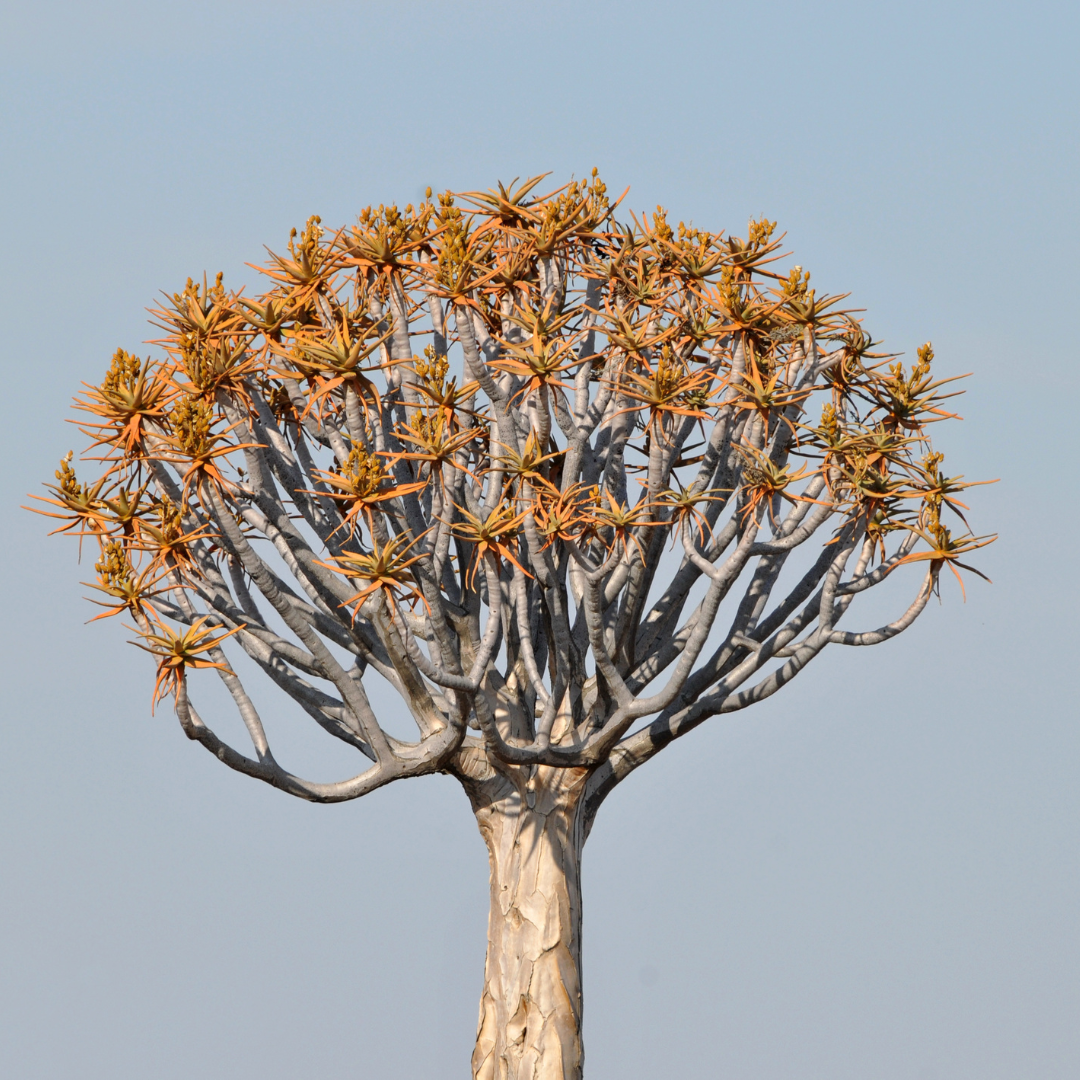
Dichotomous Tree Aloe (Aloe dichotoma), also known as the Quiver Tree, is one of the most visually spectacular and architecturally unique plants you can grow in the Phoenix Valley. This tree-form aloe reaches 15–20 feet tall and 10–15 feet wide, developing a thick, smooth trunk that branches dichotomously (splitting into two equal forks at each division) to create an instantly recognizable candelabra silhouette. In winter, clusters of bright yellow flowers appear at the branch tips, glowing against the silvery bark. It thrives in full Phoenix sun, handles extreme heat, and needs almost no supplemental water once established. Whether you're creating a museum-worthy specimen garden in Paradise Valley, anchoring a modern Scottsdale estate entrance, or designing an otherworldly xeriscape in Mesa — the Quiver Tree is the ultimate conversation starter.
Dichotomous Tree Aloe Plant Details
| Attribute | Detail |
|---|---|
| Scientific Name | Aloe dichotoma (syn. Aloidendron dichotomum) |
| Common Names | Dichotomous Tree Aloe, Quiver Tree, Kokerboom |
| Mature Height | 15–20 feet |
| Mature Width | 10–15 feet |
| Growth Rate | Slow to moderate — 6–12 inches per year in Phoenix |
| Sun | Full sun (6+ hrs). Handles reflected heat from walls. |
| Water | Very low once established. Extremely drought-tolerant. |
| USDA Zones | 9–11 (Phoenix is Zone 9b–10a) |
| Soil | Well-draining sandy or rocky soil. Adapts to Arizona caliche soils. |
| Foliage | Evergreen — blue-green rosettes at branch tips, silvery bark |
| Bloom Color | Bright yellow, winter |
| Trunk | Thick, smooth, dichotomously branching — iconic candelabra form |
Dichotomous Tree Aloe Uses in Phoenix Landscapes
Museum-Quality Specimen Plant
The Quiver Tree's otherworldly branching form is unlike anything else in the plant kingdom. A single mature specimen creates an instant focal point that rivals public botanical garden displays. Place it where it can be viewed from multiple angles — its silhouette is equally dramatic at dawn, midday, and sunset.
Modern Architectural Design
The clean geometric branching and smooth silvery trunk make Dichotomous Tree Aloe a natural fit for contemporary desert architecture. Use it against a modern stucco wall, in a minimalist courtyard, or alongside geometric hardscape. The branching pattern creates living sculpture that complements clean architectural lines.
Estate & Property Entrance
Plant a pair of Quiver Trees flanking a driveway entrance or front gate for a dramatic, unforgettable arrival experience. At 15–20 feet tall, they create a canopy-like presence without the water demands of traditional shade trees. The silvery bark and branching form are especially stunning when lit at night.
Best Time to Plant Dichotomous Tree Aloe in Phoenix
Fall (October–November) is the ideal planting window. Warm soil promotes root establishment, cooler air reduces transplant stress, and the plant gets 6–8 months of root growth before its first Phoenix summer. For the large 25-gallon and 36-inch box sizes this product comes in, fall planting is critical — these specimens need time to anchor their root systems before summer winds and heat.
How to Plant Dichotomous Tree Aloe
- Dig wide, not deep — 3× the root ball width, same depth.
- Check for caliche — break through any hardpan layer. Drainage is critical for this species.
- Backfill with native soil — avoid heavy amendments. Native sandy soil is ideal.
- Spacing — 10–15 ft from other large plants or structures to accommodate the full canopy.
- Staking — large specimens may need temporary staking until the root system anchors (6–12 months).
- Mulch — 2–3 inches of gravel mulch. Keep mulch away from the trunk to prevent rot.
Watering Dichotomous Tree Aloe in Phoenix
First Year Watering Schedule
- Weeks 1–2: Every 3–4 days, deep and slow (45–60 min for large specimens)
- Month 1–3: Every 5–7 days
- Month 3–6: Every 10–14 days
- After Year 1: Every 2–3 weeks summer; monthly or less in winter
Drip Irrigation
Use two 2 GPH emitters on opposite sides, 24–36 inches from the trunk for large specimens. Established Quiver Trees are among the most drought-tolerant tree-form plants available — they can survive on rainfall alone in most Phoenix winters.
How fast does Dichotomous Tree Aloe grow in Phoenix?
Expect 6–12 inches of new growth per year. It's a slow to moderate grower, but the larger sizes we carry (25-gallon and 36-inch box) already have significant trunk development and branching, giving you instant architectural impact.
Why is it called the Quiver Tree?
Indigenous San people of southern Africa traditionally hollowed out the branches to make quivers for their arrows, giving it the common name "Quiver Tree" or "Kokerboom" in Afrikaans.
Is the Dichotomous Tree Aloe cold hardy in Phoenix?
Yes — it handles typical Phoenix winter lows (mid-20s°F) without issue. Established specimens are quite cold-hardy. Protect young plants during unusually cold snaps below 25°F.
Does the branching really split into perfect forks?
Yes — dichotomous branching means each branch divides into exactly two equal forks, creating the distinctive candelabra silhouette. It's one of the most geometrically satisfying growth patterns in the plant world.
You May Also Like
- Hercules Tree Aloe — Another massive tree aloe for large landscapes.
- Goliath Aloe — Towering hybrid tree aloe reaching 8–12 feet.
- Mountain Aloe — Large rosette aloe with spectacular branching flower spikes.
- Cape Aloe — Dramatic tree-form aloe with coral-red flowers.
- Boojum Tree — Another architecturally bizarre desert tree for collectors.
Share