

Devil's Tongue
Devil's Tongue
Couldn't load pickup availability
A Compact Desert Gem — Bold Flat Spines & Easy Care
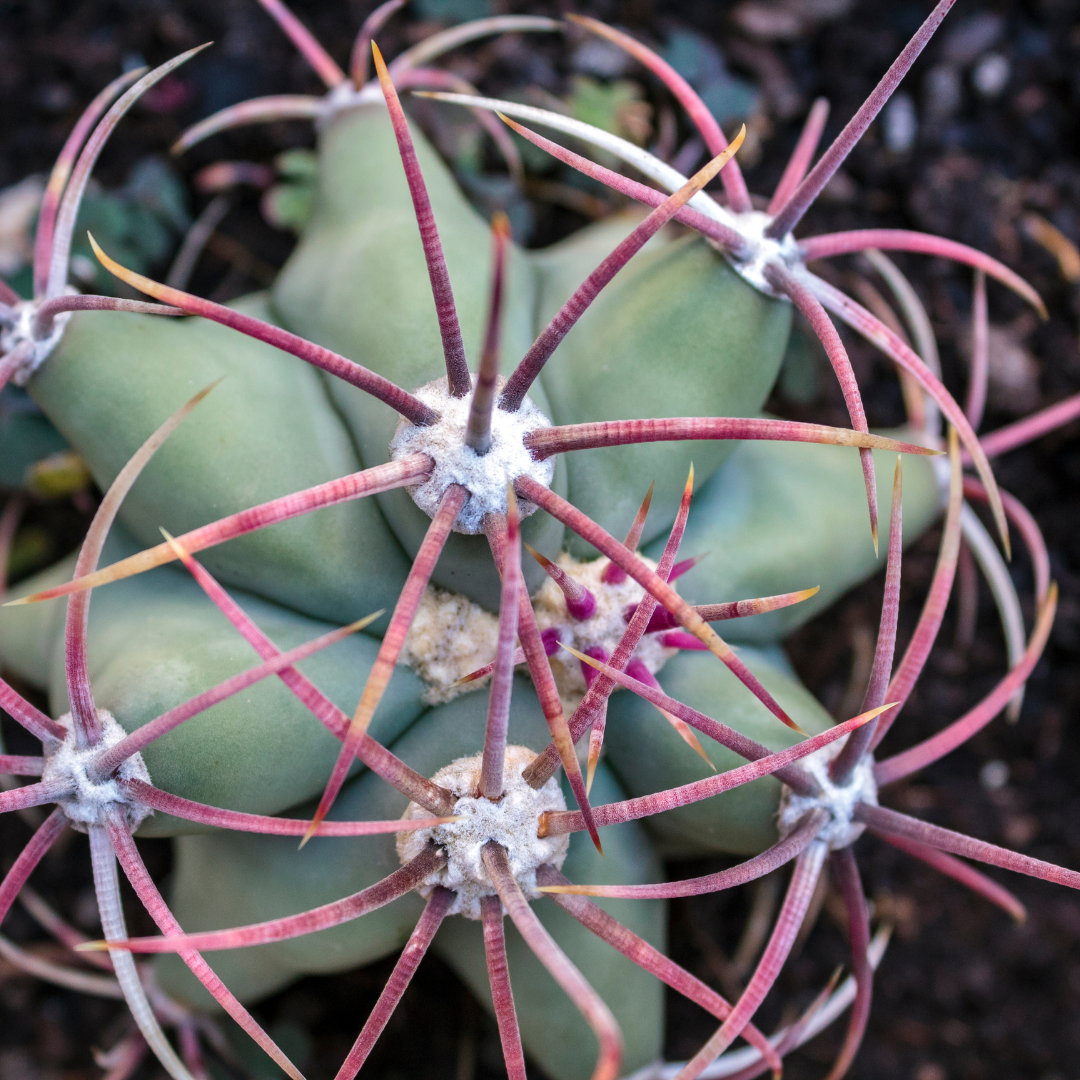
Devil's Tongue Cactus (Ferocactus latispinus) is one of the most visually striking compact barrel cacti you can grow in the Phoenix Valley. Named for its distinctive wide, flat, hook-tipped central spine that resembles a tongue, this Mexican native packs serious visual punch in a small package. Reaching just 1–2 feet tall and wide, it's the perfect barrel cactus for smaller spaces — containers, rock garden pockets, and courtyard accents. It handles Phoenix heat like a champ and rewards patient growers with showy yellow or purple flowers. Whether you're building a collector's garden in Scottsdale, adding desert character to a Chandler patio, or filling a rock garden niche in Mesa — Devil's Tongue delivers bold style with almost zero maintenance.
Devil's Tongue Cactus Plant Details
| Attribute | Detail |
|---|---|
| Scientific Name | Ferocactus latispinus |
| Common Names | Devil's Tongue, Devil's Tongue Barrel, Wide-Spine Barrel, Crow's Claw Cactus |
| Mature Height | 1–2 feet |
| Mature Width | 1–2 feet |
| Growth Rate | Slow — 1–2 inches per year in Phoenix |
| Sun | Full sun to partial shade (6+ hrs ideal). Handles reflected heat. |
| Water | Very low once established. Highly drought-tolerant. |
| USDA Zones | 9–11 (Phoenix is Zone 9b–10a) |
| Soil | Well-draining. Adapts to Arizona caliche and rocky native soils. |
| Foliage | Evergreen — blue-green ribbed body with broad, flat red-pink spines |
| Bloom Color | Yellow or purple flowers in fall and winter |
| Signature Feature | Wide, flat, hooked central spine — the "devil's tongue" |
Devil's Tongue Cactus Uses in Phoenix Landscapes
Rock Garden Accent
Devil's Tongue's compact size and bold spine pattern make it an ideal accent plant for rock gardens. Tuck it between boulders or nestle it in a gravel pocket where its distinctive flat spines can be appreciated up close. The blue-green body provides a cool contrast against warm desert tones. Pair with Golden Ball cactus and Agave for a textural trio that looks like a curated desert gallery.
Container & Patio Specimen
At just 1–2 feet, Devil's Tongue is perfectly sized for containers. Plant it in a wide, shallow ceramic or terracotta pot with fast-draining cactus mix and place it on a south-facing patio in Tempe, Gilbert, or Scottsdale. It makes an exceptional conversation piece — guests always ask about the unusual flat spines. Container-grown specimens bloom just as readily as in-ground plants.
Cactus Collections & Display Gardens
No serious Ferocactus collection is complete without Devil's Tongue. Its unique spine morphology — wide, flat, and hooked — sets it apart from every other barrel cactus in your garden. Plant it alongside Fishhook Barrel, Mexican Fire Barrel, and Golden Barrel for a world-class barrel display that showcases the incredible diversity within the genus.
Small-Space Desert Landscaping
Devil's Tongue is perfect for tight spaces where larger barrels won't fit — narrow side yards, small front planting beds, courtyards, and apartment balconies. Space them 2 feet apart for a compact border or use individual specimens as focal points in small desert vignettes throughout a Peoria or Glendale yard.
Best Time to Plant Devil's Tongue Cactus in Phoenix
Fall (October–November) is ideal — warm soil promotes root establishment while cooler air reduces transplant stress. Your Devil's Tongue will have 6–8 months to settle in before its first Phoenix summer. Spring (February–April) is the second-best window. Avoid summer planting when ground temperatures can stress newly placed roots.
How to Plant Devil's Tongue Cactus
- Dig wide, not deep — 2–3× the root ball width, same depth. This compact barrel has a shallow root system.
- Check for caliche — break through any hardpan layer to ensure drainage. Standing water is the #1 killer.
- Backfill with native soil — no amendments needed. A handful of coarse sand is fine for heavy clay.
- Spacing — 2 feet apart for grouped plantings; 3 feet for individual specimens.
- Water basin — build a 2–3 inch ring to direct water to the root zone during establishment.
- Top dress — 1–2 inches of gravel mulch around the base to keep the crown dry and prevent rot.
Watering Devil's Tongue Cactus in Phoenix
First Year Watering Schedule
- Weeks 1–2: Every 5–7 days, slow and deep (10–15 min drip)
- Month 1–3: Every 10–14 days
- Month 3–6: Every 2–3 weeks (every 10 days in peak summer)
- After Year 1: Monthly in summer; no supplemental water needed in winter
Drip Irrigation
Place a single 0.5–1 GPH emitter 6–8 inches from the base. Run for 15–20 minutes per session during establishment. Once established, Devil's Tongue can survive on rainfall alone in most Phoenix-area landscapes. A monthly deep soak in peak summer keeps it plump and promotes fall blooming.
How fast does Devil's Tongue grow in Phoenix?
Slowly — expect 1–2 inches per year. A 1-gallon plant will take several years to fill out, so buying a larger specimen (5 or 15 gallon) gives you instant character. The good news: Devil's Tongue stays compact, so it never outgrows its space.
Why is it called Devil's Tongue?
The name comes from the distinctive wide, flat, hooked central spine that protrudes from each areole like a curved tongue. This spine is broader and flatter than any other common barrel cactus — it's the plant's signature feature and makes it instantly recognizable.
Does Devil's Tongue bloom?
Yes — and it's one of the few barrel cacti that blooms in fall and winter rather than summer. Mature specimens produce showy yellow or purple flowers from the crown, typically November through February in Phoenix. The off-season blooms make it especially valuable in a garden that might otherwise lack color in winter.
Can Devil's Tongue handle full Phoenix summer sun?
Yes, though it also tolerates partial shade — making it more versatile than most barrel cacti. In full reflected heat off a west-facing wall, it may appreciate a bit of afternoon shade during the most extreme weeks of July and August. In most locations, full sun is perfect.
Is Devil's Tongue safe around pets?
The flat hooked spines are sharp — plant it away from walkways and areas where pets run. Its compact size makes it easy to position in raised beds or behind a border of lower-growing plants for safety.
You May Also Like
- Fishhook Barrel Cactus — Arizona native barrel with curved fishhook spines. A great companion in any barrel collection.
- Mexican Fire Barrel — Bold red spines on a larger barrel. Dramatic warm-tone contrast.
- Golden Barrel Cactus — The iconic golden globe. Classic companion for any desert garden.
- Monk's Hood Cactus — Another compact, collectible cactus with bold geometric patterns.
- Mammillaria melanocentra — Compact, sculptural mammillaria with dark central spines. Great small-space companion.
How Many Devil's Tongue Do I Need?
Devil's Tongue is a compact specimen barrel, not a hedge plant. Use it as a single accent tucked into a rock pocket, or stage an odd-numbered group of 3 to 5 to build a small barrel display. Space plants about 2 feet apart for a grouped planting and 3 feet for standalone specimens, measured to the mature 1 to 2 foot width. Because the flat hooked spines are sharp, keep plants at least 2 to 3 feet back from walkways, pool decks, and pet paths.
| Planting Goal | Spacing | Plants |
|---|---|---|
| Single rock-pocket accent | standalone | 1 |
| Small barrel grouping | 2 ft apart | 3 |
| Featured barrel cluster | 2 ft apart | 5 |
Devil's Tongue Season-by-Season in Phoenix
- Spring (Feb to Apr): Growth slowly resumes as soil warms. A good secondary planting window and the time to give the first light deep soak of the season.
- Summer (May to Sep): Thrives in heat and full sun, though a barrel against a west wall may appreciate light afternoon shade during the worst weeks of July and August. A monthly deep soak through the monsoon keeps the body plump and sets up fall flowering. Avoid frequent watering.
- Fall (Oct to Nov): Prime planting season and the start of bloom. This is one of the few barrels that flowers in fall and winter, opening yellow or purple from the crown.
- Winter (Dec to Jan): Bloom can continue into midwinter. Stop supplemental water. Devil's Tongue takes most Valley winters in stride but is best protected with frost cloth on the rare nights that drop into the mid-20s.
At a Glance
✔ Heat-Loving (Reflected-Heat Tolerant) ✔ Drought-Tolerant ✔ Pollinator-Friendly ✔ Evergreen ✔ Low-Maintenance ✔ Deer & Rabbit-Resistant
Plant It With
- Fishhook Barrel: an Arizona native barrel that builds a coordinated Ferocactus display beside the flat-spined Devil's Tongue.
- Mexican Fire Barrel: bold red spines on a larger barrel for warm-tone contrast.
- Golden Barrel: the iconic golden globe that anchors any barrel grouping.
- Monk's Hood: a compact geometric cactus that adds another collectible form to the vignette.
Is Devil's Tongue Right for Your Yard?
Devil's Tongue thrives in full sun to part shade, in fast-draining cactus soil or gritty native ground where caliche has been opened up for drainage, and in tight spots where a full-size barrel will not fit. It is ideal for rock gardens, containers, and collector beds, and it rewards you with off-season fall and winter color. It is not a fit right beside a walkway or pool deck, where the sharp flat hooked spines are a hazard, or in any spot that stays wet, since standing water rots the base.
Share