

Dawe's Aloe
Dawe's Aloe
Couldn't load pickup availability
Phoenix's Boldest Red-Flowering Succulent for Desert Gardens
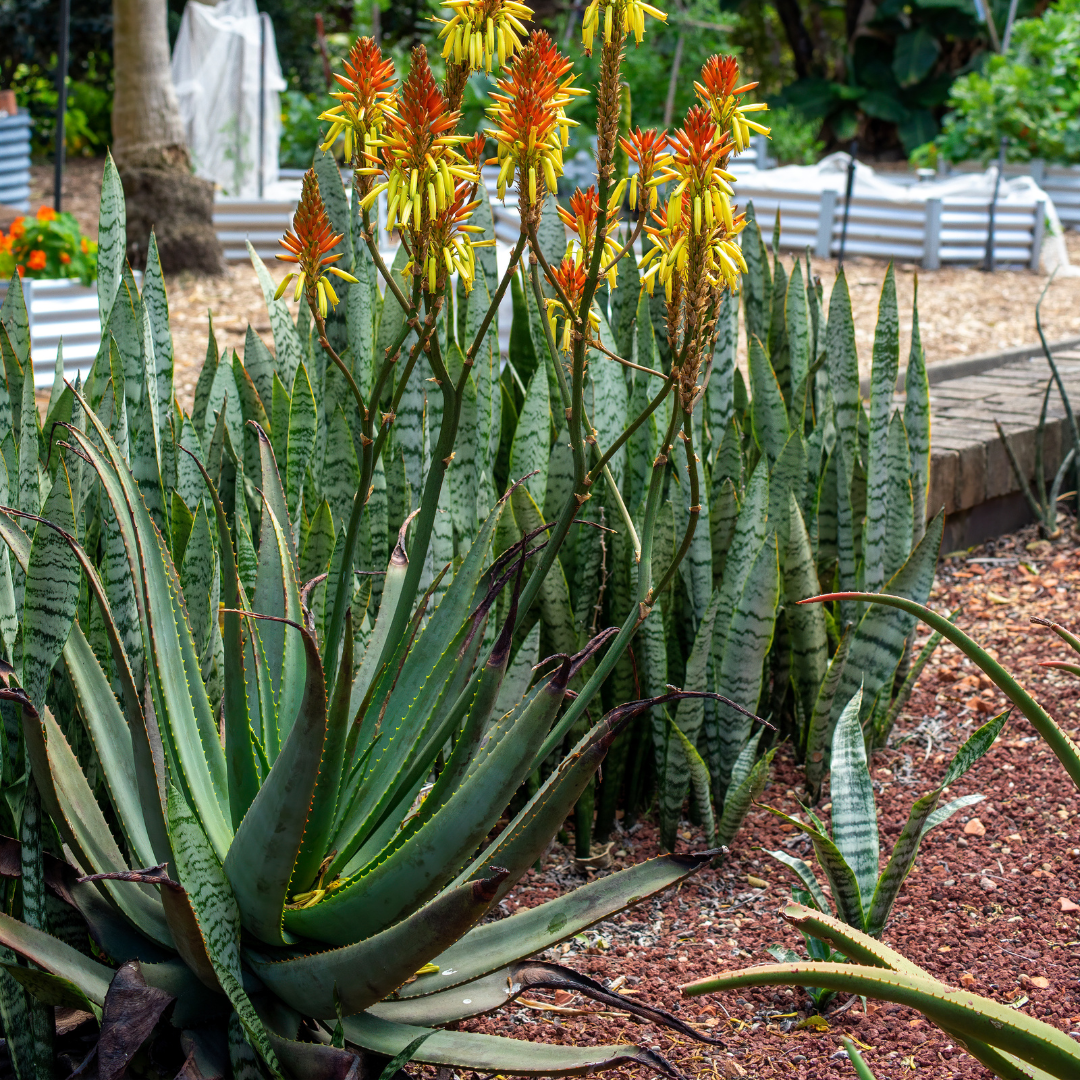
Dawe's Aloe (Aloe dawei) is one of the most striking medium-sized aloes you can grow in the Phoenix Valley. Reaching 2–4 feet tall and 2–5 feet wide, this East African native forms lush green rosettes crowned by tall spikes of bright red-orange flowers from winter through spring. It thrives in full sun, laughs at triple-digit heat, and needs almost no supplemental water once established. Whether you're building a hummingbird garden in Scottsdale, adding sculptural interest to a Chandler xeriscape, or creating a low-water border in Mesa — Dawe's Aloe delivers bold color with minimal effort.
Dawe's Aloe Plant Details
| Attribute | Detail |
|---|---|
| Scientific Name | Aloe dawei |
| Common Names | Dawe's Aloe |
| Mature Height | 2–4 feet |
| Mature Width | 2–5 feet |
| Growth Rate | Moderate — 6–12 inches per year in Phoenix |
| Sun | Full sun (6+ hrs). Handles reflected heat from walls. |
| Water | Low once established. Highly drought-tolerant. |
| USDA Zones | 9–11 (Phoenix is Zone 9b–10a) |
| Soil | Well-draining. Adapts to Arizona caliche soils. |
| Foliage | Evergreen — stays green year-round |
| Bloom Color | Bright red-orange, winter to spring |
| Attracts | Hummingbirds, bees, butterflies |
Dawe's Aloe Uses in Phoenix Landscapes
Hummingbird & Pollinator Gardens
The tall red-orange flower spikes are a beacon for hummingbirds throughout winter and spring — the exact months when desert nectar sources are scarce. Plant in groups of 3–5 for maximum pollinator impact. Pair with Red Bird of Paradise and Chuparosa for year-round hummingbird activity.
Xeriscape Focal Points
Dawe's Aloe's dense, symmetrical rosettes create strong architectural form even when not in bloom. Use a single specimen as a centerpiece in a gravel courtyard or mass-plant along a low wall for a dramatic succulent border. Pairs well with Desert Spoon and Blue Elf Aloe for layered texture.
Pool-Friendly Landscapes
No messy leaf drop, no invasive roots, and thornless enough for poolside planting. The evergreen rosettes look clean and tropical year-round, and the winter blooms add a splash of warm color when most poolside plants are dormant.
Best Time to Plant Dawe's Aloe in Phoenix
Fall (October–November) is the ideal planting window. Soil is still warm enough for rapid root establishment, cooler air reduces transplant stress, and the plant gets 6–8 months of root growth before its first Phoenix summer. Spring (February–April) is the second-best option. Avoid planting in peak summer if possible.
How to Plant Dawe's Aloe
- Dig wide, not deep — 2–3× the root ball width, same depth.
- Check for caliche — break through any hardpan layer for drainage.
- Backfill with native soil — a light 20% organic blend is fine.
- Spacing — 3 ft apart for mass planting; 4–5 ft for individual specimens.
- Water basin — build a 3–4 inch ring to direct water to roots.
- Mulch — 2–3 inches of gravel mulch to retain moisture and suppress weeds.
Watering Dawe's Aloe in Phoenix
First Year Watering Schedule
- Weeks 1–2: Every 1–2 days, deep and slow (20–30 min)
- Month 1–2: Every 3–4 days
- Month 3–6: Every 7–10 days (5–7 days in peak summer)
- After Year 1: Every 10–14 days summer; every 3–4 weeks winter
Drip Irrigation
Place one 2 GPH emitter 12–18 inches from the trunk. For 15-gallon specimens, use two emitters on opposite sides. Established plants in the ground may survive on rainfall alone in mild winters.
How fast does Dawe's Aloe grow in Phoenix?
Expect 6–12 inches of new growth per year in full sun with regular water. A 1-gallon plant can reach full 3–4 ft size in about 3–4 years.
Is Dawe's Aloe drought tolerant once established?
Yes. Once the root system is developed (typically after one full year), Dawe's Aloe needs very little supplemental water — every 10–14 days in summer and almost nothing in winter.
Can Dawe's Aloe handle Phoenix summer heat?
Absolutely. It thrives in full sun and tolerates reflected heat from walls and concrete. Some afternoon shade in the hottest inland areas (Buckeye, Goodyear) can keep leaf color at its best.
Does Dawe's Aloe attract hummingbirds?
Yes — the bright red-orange blooms are highly attractive to hummingbirds, especially from December through March when other nectar sources are limited.
You May Also Like
- Blue Elf Aloe — Compact blue rosettes with orange blooms, perfect for smaller spaces.
- Cape Aloe — Dramatic tree-form aloe reaching 6–10 feet with coral-red flowers.
- Ghost Aloe — Silvery-blue rosettes with striking orange blooms, loves full sun.
- Gold Tooth Aloe — Compact, fast-growing aloe with golden-toothed leaf margins.
- Popcorn Aloe — Unique bumpy-textured leaves with tall orange flower spikes.
How Many Dawe's Aloe Do I Need?
Dawe's Aloe is a clumping medium aloe (2 to 5 ft wide) that reads best in odd-numbered groups of 3 to 5 for a pollinator drift, or as a single rosette accent. For a low succulent border along a wall or path, set plants about 3 ft on center. Use the spacing guide below to estimate counts.
| Run Length | Plants Needed (at 3 ft spacing) |
|---|---|
| 9 ft | 3 plants |
| 15 ft | 5 plants |
| 30 ft | 10 plants |
| 45 ft | 15 plants |
Dawe's Aloe Season-by-Season in Phoenix
- Spring (Feb to Apr): Peak of the red-orange bloom, alive with hummingbirds, bees, and butterflies. New rosette growth and offsets fill in. A strong second planting window once frost risk passes.
- Summer (May to Sep): Loves the heat and reflected warmth off walls. In the hottest inland west-facing spots, a little afternoon shade keeps leaf color at its best. Monsoon rain is welcome with fast drainage. Water every 10 to 14 days.
- Fall (Oct to Nov): The ideal planting window. Warm soil drives root growth before winter, and bloom spikes begin to rise late in the season.
- Winter (Dec to Jan): Main bloom season and a key winter nectar source. Evergreen rosettes stay green, but this East African aloe is frost-tender: leaves can scorch below about 30°F, so cover plants on hard-freeze nights or site them under eaves or near a warm south wall.
At a Glance
✔ Hummingbird-Friendly ✔ Pollinator-Friendly ✔ Heat-Loving (Reflected-Heat Tolerant) ✔ Drought-Tolerant ✔ Pool-Friendly (Low-Litter) ✔ Evergreen ✔ Low-Maintenance ✔ Deer & Rabbit-Resistant
Plant It With
- Blue Elf Aloe: compact blue rosettes with orange blooms that layer in front of Dawe's Aloe.
- Cape Aloe: a tall tree-form aloe that adds vertical drama behind a Dawe's grouping.
- Ghost Aloe: silvery-blue rosettes with orange blooms for cool-toned contrast.
- Popcorn Aloe: bumpy-textured leaves and tall orange spikes that extend the bloom show.
Is Dawe's Aloe Right for Your Yard?
Dawe's Aloe thrives in full sun (with light afternoon shade in the hottest inland yards), in fast-draining or amended caliche soil, where you want a clean poolside-safe rosette and a winter-to-spring hummingbird magnet. It is one of the best mid-size bloom aloes for the Valley. It is not a fit if your site sees regular hard freezes below 30°F without protection: this East African aloe is frost-tender and will scorch in an unprotected cold snap.
Share