

Coral Fountain Grass
Coral Fountain Grass
Couldn't load pickup availability
Phoenix's Most Striking Fountain Plant — Coral Fountain Grass
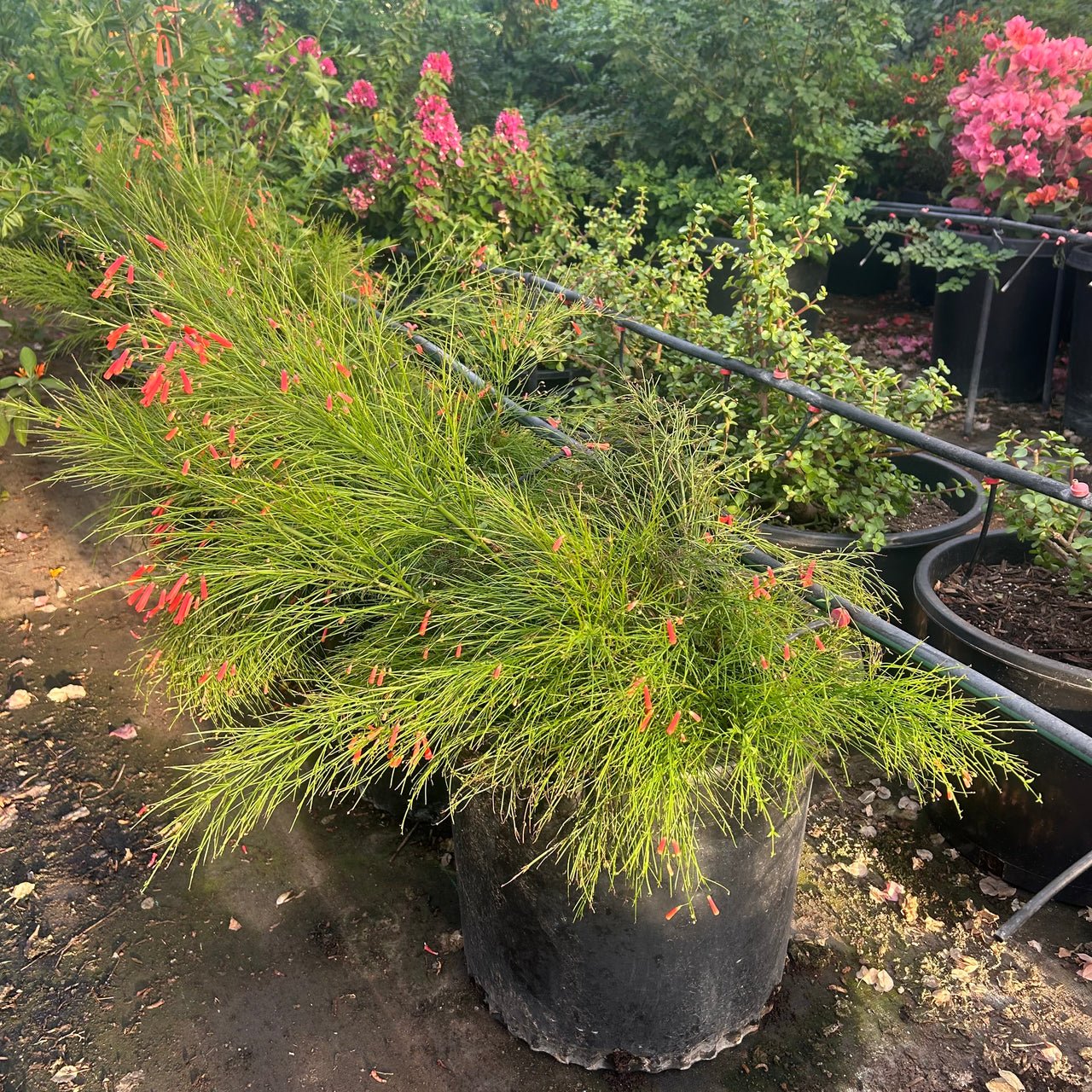
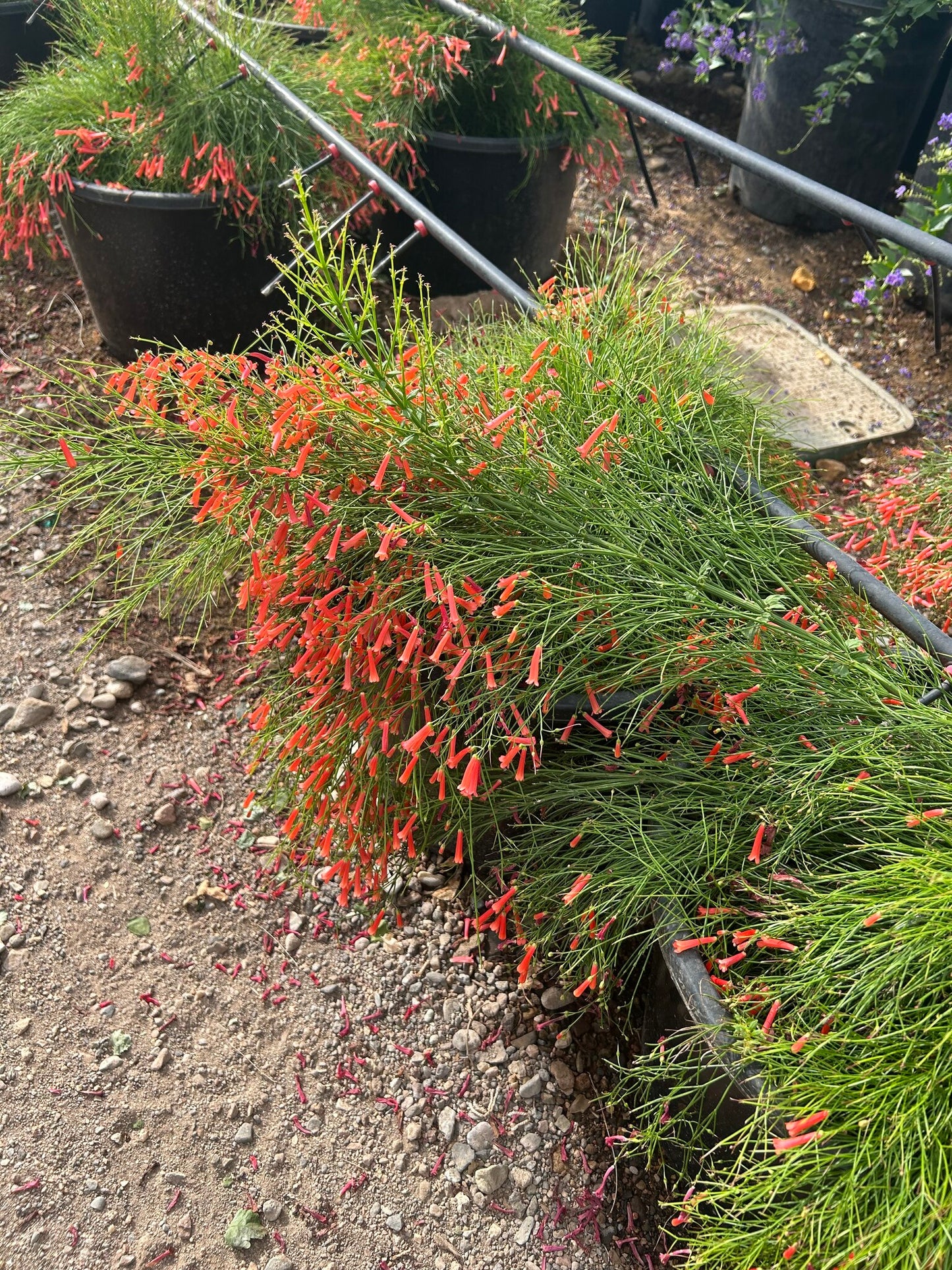
Coral Fountain Grass (Russelia equisetiformis) is one of the most eye-catching and versatile accent plants available for Phoenix Valley landscapes. Despite its common name, this plant is technically a flowering shrub — one that earns its "fountain grass" nickname from its dramatic cascading stems that arch and spill in all directions like a flowing fountain. From spring through fall, those arching stems erupt in hundreds of bright coral-red tubular flowers that attract hummingbirds and butterflies all season long. Whether you're adding a bold focal point to a desert border in Scottsdale, cascading it over a retaining wall in Chandler, or planting it poolside in Gilbert — Coral Fountain Grass delivers non-stop tropical color in an effortlessly graceful form.
Coral Fountain Grass Plant Details
| Attribute | Detail |
|---|---|
| Scientific Name | Russelia equisetiformis |
| Common Names | Coral Fountain Grass, Firecracker Plant, Coral Plant, Fountain Plant |
| Mature Height | 3–4 feet |
| Mature Width | 3–5 feet spread |
| Growth Rate | Moderate to fast — 1–2 feet per year in Phoenix |
| Sun | Full sun to partial shade. Handles reflected heat from walls well. |
| Water | Low to moderate once established. Drought-tolerant when mature. |
| USDA Zones | 9–11 (Phoenix is Zone 9b–10a) |
| Soil | Well-draining. Adapts to Arizona caliche soils. |
| Foliage | Semi-evergreen — stays green year-round in mild Phoenix winters |
| Flower Color | Bright coral-red tubular blooms — spring through fall |
| Wildlife | Strong hummingbird and butterfly magnet |
Coral Fountain Grass Uses in Phoenix Landscapes
Bold Focal Point in Desert Borders
Coral Fountain Grass earns its place as a showstopper accent plant in Phoenix desert borders. The fountain-like cascading form and vivid coral-red blooms create a natural focal point wherever it's placed — drawing the eye and adding tropical color that lasts months. Plant it as a single specimen among boulders and agaves in a Scottsdale or Peoria xeriscape for a dramatic focal contrast, or mass-plant 3–5 together for a sweeping coral color wave through a wide landscape bed.
Cascading Over Walls and Raised Planters
One of Coral Fountain Grass's best uses in Phoenix is cascading over a low block wall, retaining wall, or raised planter edge. Its naturally arching stems grow outward and downward, creating a lush spilling effect that softens hard wall edges. A single plant can cascade 3–4 feet over a wall — two or three plants spaced 3 feet apart along a 10-foot wall creates continuous coverage with brilliant seasonal blooms. The coral flowers against tan block walls or terracotta planters are a striking combination popular in Mesa and Tempe landscapes.
Pool-Friendly Accent Planting
Coral Fountain Grass is an ideal pool-area accent in Phoenix — it produces no significant litter, no messy fruit, and its soft fountain form won't scratch swimmers or create sharp hazards like cactus. Its hummingbird-attracting blooms create natural movement around pool decking in Chandler, Gilbert, and Scottsdale. Plant in the ground or in a large decorative container near the pool coping for a tropical resort feel without the maintenance of heavier water features.
Container and Patio Specimen
In large containers, Coral Fountain Grass becomes a living sculpture on Phoenix patios and courtyard spaces. A single 15-gallon specimen in a large terracotta or concrete planter creates year-round visual interest — green fountain form in winter, brilliant coral blooms from spring through fall. Its forgiving drought tolerance means it handles the occasional missed watering that's inevitable on busy Phoenix patios. Pair with purple Lantana or blue Agapanthus in adjacent containers for a vibrant complementary color combination.
Best Time to Plant Coral Fountain Grass in Phoenix
Fall (October–November) is the ideal planting window for Coral Fountain Grass in Phoenix. Cooler air reduces transplant stress while warm soil temperatures allow roots to establish before summer. A fall-planted specimen gets 6–8 months of root development before facing its first Phoenix summer, resulting in significantly better heat resilience and bloom production. Spring planting (February–April) is a solid second option — just plan on more frequent irrigation as temperatures climb through May and June. Avoid summer installation if possible, as newly planted specimens need intensive watering to establish in 110°F heat.
How to Plant Coral Fountain Grass
- Dig wide, not deep — dig a hole 2–3 times the width of the root ball but only as deep as the container height.
- Check for caliche — break through any hardpan caliche layer beneath the planting hole to ensure proper drainage and root penetration.
- Backfill with native soil — a light 20% organic amendment blend improves establishment without over-amending.
- Spacing — plant 3–4 feet apart for mass planting; 4–5 feet for individual specimens with full cascading spread.
- Water basin — build a 3–4 inch earthen ring around the root zone to direct irrigation water to the roots.
- Mulch — apply 2–3 inches of bark or gravel mulch to retain soil moisture and regulate root temperature.
Watering Coral Fountain Grass in Phoenix
First Year Watering Schedule
- Weeks 1–2: Every 1–2 days, deep and slow (20–30 minutes)
- Month 1–2: Every 3–4 days
- Month 3–6: Every 7–10 days (every 5–7 days in peak summer heat)
- After Year 1: Every 10–14 days in summer; every 3–4 weeks in winter
Drip Irrigation
Place a 1–2 GPH drip emitter 12–18 inches from the base of the plant. As the plant matures and spreads, add a second emitter on the opposite side of the root zone. Established Coral Fountain Grass is quite drought-tolerant and can go 2–3 weeks between deep waterings outside of peak Phoenix summer months.
How fast does Coral Fountain Grass grow in Phoenix?
In Phoenix's warm climate, Coral Fountain Grass grows at a moderate to fast rate — expect 1–2 feet of new growth per year under good conditions. A 1-gallon plant typically reaches 2–3 feet within its first 2 seasons; a 5-gallon plant may reach full size (3–4 feet) within one growing season with regular watering.
Is Coral Fountain Grass drought tolerant once established?
Yes. After its first year in the ground, Coral Fountain Grass becomes quite drought tolerant and can survive on deep waterings every 10–14 days during Phoenix summers. It performs best with consistent but infrequent deep watering rather than frequent light watering. Prolonged drought causes flower production to slow, but the plant itself rarely dies from underwatering once established.
Does Coral Fountain Grass attract hummingbirds?
Absolutely — it's one of the top hummingbird plants you can grow in the Phoenix Valley. The long, tubular coral-red flowers are perfectly shaped for hummingbird feeding, and the continuous bloom cycle from spring through fall means hummingbirds visit regularly throughout the season. Anna's Hummingbirds, which are year-round Phoenix Valley residents, are especially common visitors.
Can Coral Fountain Grass handle full Phoenix summer heat?
Yes, with adequate irrigation. It's rated for Zone 9–11 and performs well in Phoenix's intense summer heat. The key is ensuring the root zone stays hydrated during the July–August peak heat. Once established, it handles reflected heat from walls and paving better than most ornamental plants of similar size and will bloom prolifically right through Phoenix summers.
You May Also Like
- Purple Fountain Grass (Pennisetum setaceum 'Rubrum') — a classic fountain-form ornamental grass with deep burgundy foliage and arching plumes, perfect companion planting with Coral Fountain Grass in Phoenix borders.
- Pink Parade Hesperaloe (Hesperaloe parviflora 'Pink Parade') — a low-water hummingbird-attracting accent plant with coral-pink blooms that pairs naturally with Coral Fountain Grass in Scottsdale desert gardens.
- Regal Mist (Muhlenbergia capillaris) — a billowing pink muhly grass that creates a striking seasonal contrast alongside Coral Fountain Grass in Phoenix Valley landscapes.
- Bicolor Iris (Dietes bicolor) — an easy-care, long-blooming accent iris that complements Coral Fountain Grass in mixed ornamental borders in Chandler and Mesa.
- Giant Hesperaloe (Hesperaloe funifera) — a bold architectural accent plant that provides height contrast behind Coral Fountain Grass in Phoenix desert landscape compositions.
How Many Coral Fountain Grass Do I Need?
Coral Fountain Grass spreads 3 to 5 feet wide and grows as a soft cascading mound, so space it for the fountain form to show rather than packing it into a hedge. Use these groupings:
- Single specimen: Plant one as a focal accent among boulders, agaves, or at the base of a wall. Allow 4 to 5 feet of clear space all around so the arching stems can spill freely.
- Drift or mass: For a sweeping coral color wave, plant in odd-numbered groups of 3, 5, or 7 spaced 3 to 4 feet apart center to center.
- Cascading a wall: Along a low block or retaining wall, set plants 3 feet apart so the stems spill over and knit together. A 10 foot wall takes about 3 to 4 plants; a 20 foot wall about 7.
Coral Fountain Grass Season-by-Season in Phoenix
- Spring (Feb-Apr): Growth flushes as nights warm and the first heavy round of coral-red tubular blooms opens, pulling in returning hummingbirds. Strong second planting window.
- Summer (May-Sep): Peak performance. It blooms straight through the heat and shrugs off reflected warmth from walls and paving as long as the root zone stays watered. Monsoon humidity often triggers an even heavier flush.
- Fall (Oct-Nov): Prime planting season and a long final bloom push before cooler weather. The best time to set new plants for next year.
- Winter (Dec-Jan): Stays green and fountain-shaped through mild Valley winters. It is frost-tender: a hard freeze below about 28F can burn the stems back, but established plants resprout from the base in spring. Cover or plant against a warm south wall in frost-prone low spots.
At a Glance
✔ Hummingbird-Friendly ✔ Pollinator-Friendly ✔ Heat-Loving (Reflected-Heat Tolerant) ✔ Drought-Tolerant ✔ Pool-Friendly (Low-Litter) ✔ Low-Maintenance ✔ Evergreen
Plant It With
- Purple Fountain Grass: burgundy fountain foliage echoes the cascading form with a deep color contrast.
- Red Yucca: coral-red flower spikes repeat the hummingbird color theme on a tough architectural plant.
- Regal Mist (Pink Muhly Grass): billowing pink fall plumes play off the coral blooms in a soft seasonal pairing.
- Baja Fairy Duster: another nonstop red-flowered hummingbird magnet that loves the same heat and low water.
Is Coral Fountain Grass Right for Your Yard?
It thrives in full sun to light afternoon shade, takes reflected heat off walls and pavement, and asks only for well-draining soil once the caliche is broken through and infrequent deep water after its first year. Give it 4 to 5 feet of room to cascade and a warm spot if your yard gets hard frosts. It is not the right pick if you need a tidy, compact, formal shrub or a plant that holds an exact clipped shape: its beauty is in the loose, spilling fountain habit.
Share