
Chuparosa-Orange
Chuparosa-Orange
Couldn't load pickup availability
Phoenix's #1 Hummingbird Magnet for Desert Gardens
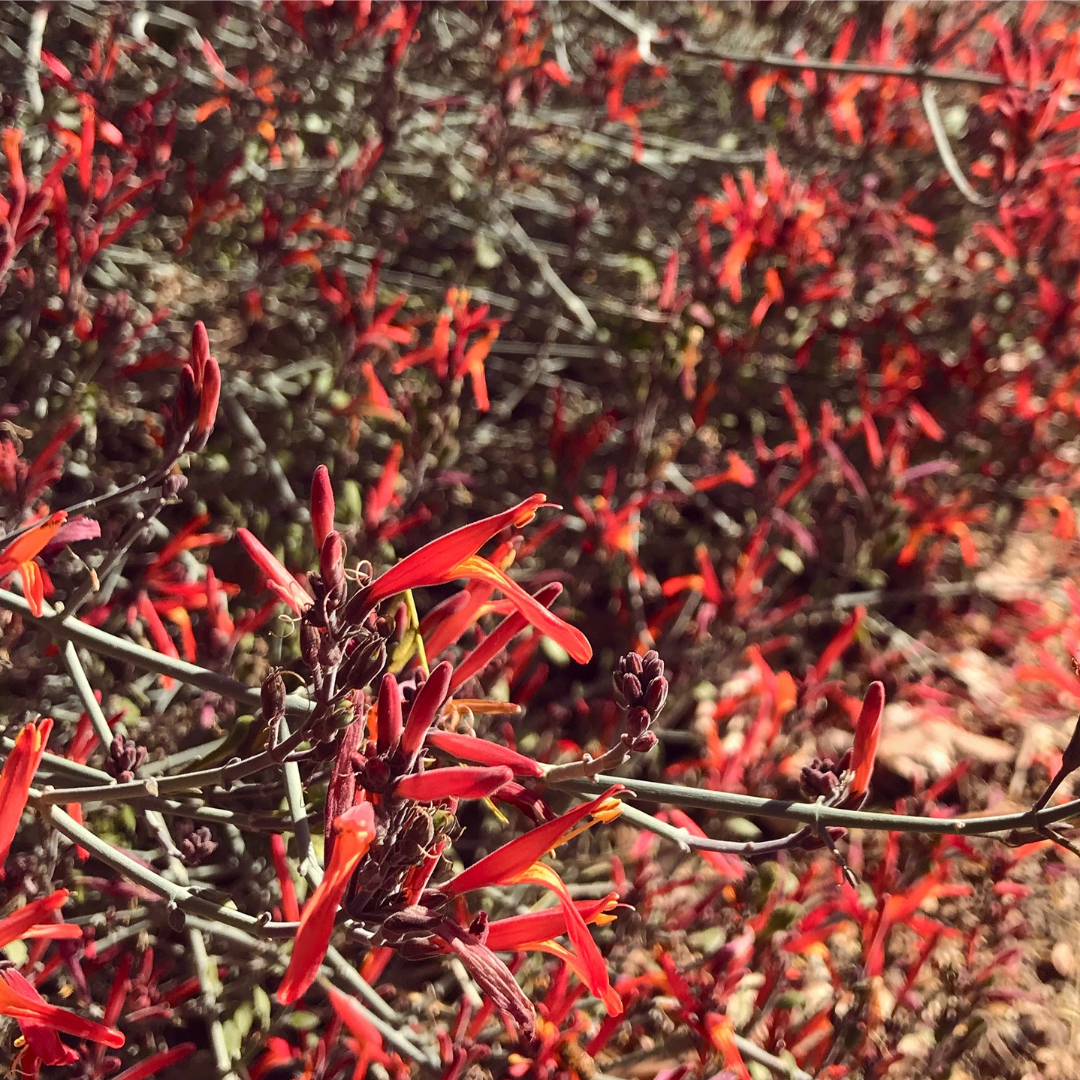
Chuparosa Orange (Justicia californica) is the most effective hummingbird-attracting native shrub you can grow in the Phoenix Valley. Its tubular bright orange flowers bloom prolifically from late winter through spring — exactly when migrating hummingbirds are hungriest. This tough Sonoran Desert native thrives in extreme heat on almost no supplemental water once established. Whether you're creating a Scottsdale wildlife garden, adding year-round color to a Gilbert courtyard, or planting a drought-proof border in Mesa — Chuparosa Orange delivers stunning blooms and constant hummingbird activity.
Chuparosa Orange Plant Details
| Attribute | Detail |
|---|---|
| Scientific Name | Justicia californica |
| Common Names | Chuparosa, Hummingbird Bush, Beloperone |
| Mature Height | 3–4 feet |
| Mature Width | 4–5 feet |
| Growth Rate | Moderate — 1–2 feet per year in Phoenix |
| Sun | Full sun to partial shade. Handles reflected heat. |
| Water | Very low once established. Extremely drought-tolerant. |
| USDA Zones | 9–11 (Phoenix is Zone 9b–10a) |
| Soil | Well-draining. Thrives in Arizona caliche and rocky desert soils. |
| Foliage | Semi-evergreen — may drop leaves during extreme drought, refoliates with water |
| Bloom Season | Late winter through spring — bright orange tubular flowers |
| Native Status | Native to the Sonoran Desert |
Chuparosa Orange Uses in Phoenix Landscapes
Hummingbird & Pollinator Gardens
Chuparosa is the single best plant for attracting hummingbirds to Phoenix-area gardens. Its tubular orange flowers are perfectly shaped for hummingbird beaks, and the long bloom period from February through May coincides with peak migration. Plant alongside Mexican Honeysuckle, Autumn Sage, and Desert Milkweed for a year-round hummingbird buffet. Position near a patio window in Scottsdale or Chandler for front-row viewing.
Low-Water Foundation & Border Planting
Chuparosa's compact 3–4 foot size makes it perfect for foundation beds alongside homes and buildings. Its mounding habit stays tidy without heavy pruning, and it thrives in the reflected heat zones that kill less-adapted shrubs. Plant 3–4 feet apart for a continuous border along walkways and driveways in Tempe, Peoria, and Glendale.
Desert Restoration & Naturalistic Design
As a Sonoran Desert native, Chuparosa blends seamlessly into natural desert landscapes. Use it in revegetation projects, HOA common areas, and commercial medians where irrigation is minimal. Its wispy, airy form pairs beautifully with Desert Spoon, Palo Verde trees, and Brittlebush for an authentic Arizona look that requires almost no maintenance once established.
Container & Courtyard Accent
Chuparosa thrives in large containers on Phoenix patios and courtyards. Use a well-draining cactus mix and a pot with drainage holes. Its bright orange blooms add a pop of desert color to pool decks, entryways, and outdoor dining areas in Gilbert and Mesa. Container plants bloom just as heavily as in-ground specimens.
Best Time to Plant Chuparosa Orange in Phoenix
Fall (October–November) is ideal. Warm soil temperatures encourage rapid root growth while cooler air reduces transplant stress. Chuparosa planted in fall will be well-established by late winter and bloom heavily in its first spring. Spring (February–April) is the second-best window. Avoid planting in peak summer — the heat stresses newly transplanted shrubs.
How to Plant Chuparosa Orange
- Dig wide, not deep — 2–3× the root ball width, same depth as the container.
- Check for caliche — break through any hardpan layer for drainage. Chuparosa is desert-adapted but still needs water to drain.
- Backfill with native soil — no amendments needed. Chuparosa prefers lean desert soil.
- Spacing — 3–4 feet apart for a border or mass planting; 5 feet for standalone accent.
- Water basin — build a 3-inch ring around the plant to direct water to the root zone.
- Mulch — 2–3 inches of gravel or decomposed granite. Avoid organic mulch against the stem.
Watering Chuparosa Orange in Phoenix
First Year Watering Schedule
- Weeks 1–2: Every 2–3 days, deep soak for 20 minutes
- Month 1–2: Every 4–5 days
- Month 3–6: Every 7–10 days (every 5–7 days in peak summer)
- After Year 1: Every 2–3 weeks in summer; monthly or less in winter
Drip Irrigation
Place one 1-GPH emitter 12–18 inches from the base. Established Chuparosa needs very little supplemental water — it's one of the most drought-tolerant shrubs available. Overwatering actually reduces bloom production. In winter, turn drip off entirely unless there's been no rain for 4+ weeks.
How fast does Chuparosa grow in Phoenix?
Moderate. Chuparosa grows 1–2 feet per year and reaches its full 3–4 foot height within 2–3 years. It's not a fast-growing hedge plant, but it fills in steadily and requires very little pruning to maintain its natural mounding shape.
Is Chuparosa drought tolerant once established?
Extremely. Chuparosa is native to the Sonoran Desert and has evolved to survive extended drought. Once established (6–12 months), it can survive on rainfall alone in most Phoenix neighborhoods. Occasional deep watering during summer heat waves will keep it looking its best.
When does Chuparosa bloom?
Chuparosa blooms primarily from late winter (February) through spring (May), which is peak hummingbird migration season. With occasional supplemental water, it can produce spot blooms into summer and fall as well.
What's the difference between Chuparosa Orange and Red Chuparosa?
Both are Justicia californica. The orange form has bright orange tubular flowers, while the red form has deeper red blooms. Both attract hummingbirds equally well and have identical care requirements. Many gardeners plant both colors together for a warm-toned display.
You May Also Like
- Mexican Honeysuckle — Compact evergreen shrub with tubular orange flowers — another top hummingbird plant for Phoenix.
- Autumn Sage - Red — Low red-flowering sage that blooms fall through spring, complementing Chuparosa's bloom window.
- Desert Milkweed — Native milkweed with fragrant pink flowers that attracts butterflies and hummingbirds.
- Yellow Bells — Fast-growing shrub with bright yellow trumpet flowers for a warm color pairing with Chuparosa.
- Blackfoot Daisy — Low white-flowering groundcover that looks stunning planted at the base of Chuparosa.
How Many Chuparosa Orange Do I Need?
Chuparosa Orange matures to 4–5 ft wide with a compact mounding habit. For a low border or informal mass, space plants about 4 ft on center. Use this table to estimate counts by run length:
| Border Run Length | Plants Needed (4 ft spacing) |
|---|---|
| 10 ft | 3 plants |
| 20 ft | 6 plants |
| 30 ft | 8 plants |
| 40 ft | 11 plants |
For tighter, faster fill along a walkway, drop to 3 ft on center. In a hummingbird or wildlife garden, plant in odd-numbered groups of 3–5 about 5 ft apart near a patio or window.
Chuparosa Orange Season-by-Season in Phoenix
- Spring (Feb–Apr): Peak bloom; bright orange tubular flowers cover the plant during peak hummingbird migration. Strong second planting window.
- Summer (May–Sep): Handles extreme and reflected heat with ease; bloom slows in peak heat and can flush again with monsoon rains (Jul–Sep). Needs very little supplemental water.
- Fall (Oct–Nov): Prime planting season, with scattered repeat blooms as temperatures ease.
- Winter (Dec–Jan): Semi-evergreen; may thin in cold or drought and refoliate with warmth. Cold-hardy to about 20°F, so no frost protection is needed in the Valley, and bloom often begins by late winter.
At a Glance
✔ Arizona Native ✔ Pollinator-Friendly ✔ Hummingbird-Friendly ✔ Heat-Loving (Reflected-Heat Tolerant) ✔ Drought-Tolerant ✔ Pool-Friendly (Low-Litter) ✔ Low-Maintenance ✔ Cold-Hardy to 20°F
Plant It With
- Chuparosa - Red: the red form for a warm-toned, multi-color hummingbird planting.
- Mexican Honeysuckle: another top orange-flowered hummingbird shrub for layered nectar.
- Desert Milkweed: a native that adds butterfly value and airy vertical texture.
- Autumn Sage - Red: a low red bloomer that extends the bloom window fall through spring.
Is Chuparosa Orange Right for Your Yard?
Chuparosa Orange thrives in full sun and reflected heat, in lean, fast-draining caliche or rocky soil, with very little water once established. It is ideal for wildlife gardens, low-water borders, courtyards, and naturalistic desert designs, and it grows happily in large well-drained containers. Not a fit if your soil stays wet or heavily amended: rich, soggy conditions reduce bloom and the plant's natural drought-tough character.
Share