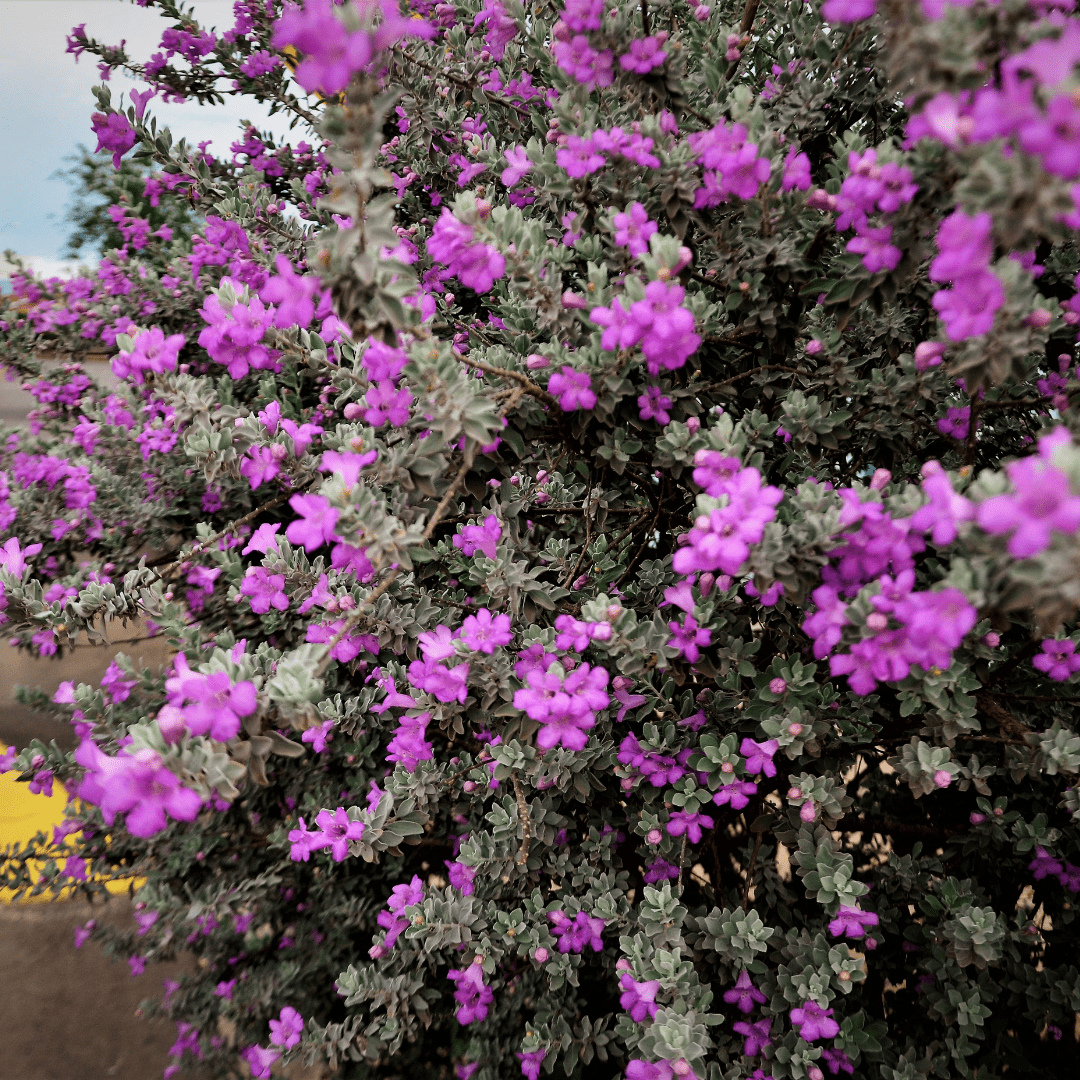


Chihuahuan Sage
Chihuahuan Sage
Couldn't load pickup availability
The Most Carefree Desert Shrub for Phoenix Landscapes
Chihuahuan Sage (Leucophyllum zygophyllum) is the compact, zero-maintenance Texas Sage relative that thrives on pure neglect in the Phoenix Valley. This evergreen shrub features silvery blue-green foliage year-round and erupts with lavender-purple flowers after summer monsoon rains — no supplemental watering needed to trigger the show. Whether you're filling a xeriscape bed in Scottsdale, lining a walkway in Chandler, or anchoring a low-water front yard in Mesa — Chihuahuan Sage is the set-it-and-forget-it shrub that delivers.
Chihuahuan Sage Plant Details
| Attribute | Detail |
|---|---|
| Scientific Name | Leucophyllum zygophyllum |
| Common Names | Chihuahuan Sage, Blue Ranger, Cimarron Sage |
| Mature Height | 4–5 feet |
| Mature Width | 4–5 feet |
| Growth Rate | Slow to moderate — 1–2 feet per year in Phoenix |
| Sun | Full sun (6+ hrs). Thrives in reflected heat from walls. |
| Water | Very low once established. Extremely drought-tolerant. |
| USDA Zones | 8–10 (Phoenix is Zone 9b–10a) |
| Soil | Well-draining. Thrives in rocky, alkaline, and caliche soils. |
| Foliage | Evergreen — silvery blue-green leaves year-round |
| Bloom Color | Lavender to purple |
| Bloom Season | After summer monsoon rains (July–September in Phoenix) |
Chihuahuan Sage Uses in Phoenix Landscapes
Xeriscape Foundation Plantings
At 4–5 feet tall and wide, Chihuahuan Sage is the perfect mid-height foundation shrub for xeriscape designs. Its dense, rounded form and silvery foliage create year-round structure and contrast against desert-toned walls and gravel. Plant 4–5 feet apart for a continuous hedge or use as standalone specimens flanking an entryway.
Low-Water Hedge & Border
Chihuahuan Sage makes a beautiful informal hedge that never needs shearing. Space 3–4 feet apart for a privacy border along property lines or walkways. The silver foliage pairs perfectly with the green of Desert Spoon, Red Yucca, or Angelita Daisy for a textured, layered look popular in Scottsdale, Tempe, and Gilbert.
Rain Garden & Monsoon Display
The signature trait of all Leucophyllum species is blooming in response to humidity and rain. After Phoenix monsoon storms, Chihuahuan Sage covers itself in lavender-purple flowers for days. Plant several together for a dramatic monsoon display that requires zero effort on your part.
Best Time to Plant Chihuahuan Sage in Phoenix
Fall (October–November) is ideal: warm soil promotes root growth while cooler air reduces transplant stress. Your sage gets 6–8 months of root establishment before its first Phoenix summer. Spring (February–April) is the second-best window. Avoid summer planting if possible.
How to Plant Chihuahuan Sage
- Dig wide, not deep — 2–3× the root ball width, same depth.
- Check for caliche — break through any hardpan layer for drainage. Chihuahuan Sage actually tolerates caliche better than most plants.
- Backfill with native soil only — do NOT amend with compost or rich soil. Leucophyllum prefers lean, alkaline soil.
- Spacing — 4–5 ft apart for hedge; 5–6 ft for standalone specimens.
- Water basin — build a 3–4 inch ring around the plant to direct water to roots during establishment.
- Mulch — 2–3 inches of gravel mulch (avoid bark mulch which retains too much moisture).
Watering Chihuahuan Sage in Phoenix
First Year Watering Schedule
- Weeks 1–2: Every 3–4 days, deep and slow (15–20 min)
- Months 1–2: Every 5–7 days
- Months 3–6: Every 10–14 days
- After Year 1: Every 3–4 weeks summer; little to no water in winter
Drip Irrigation
Place one 1 GPH emitter 18 inches from the base. Chihuahuan Sage is extremely drought-tolerant — overwatering is the #1 killer. Let the soil dry completely between waterings. Established plants often survive on rainfall alone.
How fast does Chihuahuan Sage grow in Phoenix?
Chihuahuan Sage grows 1–2 feet per year and reaches its full 4–5 foot size in 3–4 years. It's slower than Texas Sage but more compact, requiring less pruning to maintain its shape.
What's the difference between Chihuahuan Sage and Texas Sage?
Both are Leucophyllum species that bloom after rain. Chihuahuan Sage (L. zygophyllum) is more compact at 4–5 feet vs. Texas Sage (L. frutescens) at 6–8 feet. Chihuahuan Sage has smaller, rounder leaves and a tidier growth habit, making it better for tight spaces and formal borders.
Does Chihuahuan Sage need pruning?
Rarely. Its naturally rounded form stays tidy without shearing. If needed, light tip-pruning in early spring keeps it compact. Never shear into geometric shapes — this damages the natural bloom pattern.
Is Chihuahuan Sage deer and rabbit resistant?
Yes. The aromatic foliage deters deer and rabbits, making it an excellent choice for landscapes in outlying Phoenix areas near desert preserves.
You May Also Like
- Texas Sage — the larger cousin with silvery foliage and purple monsoon blooms, great for background hedges.
- Cherry Red Sage — a Salvia greggii with vivid red flowers that pairs well in front of Chihuahuan Sage.
- Red Yucca — coral flower spikes that complement the purple blooms and silver foliage of Chihuahuan Sage.
- Angelita Daisy — a low-growing yellow daisy ground cover that contrasts beautifully with silver sage foliage.
How Many Chihuahuan Sage Do I Need?
Chihuahuan Sage matures to 4–5 ft wide. For an informal low hedge or screen, space plants about 4 ft on center. Use this table to estimate counts by run length:
| Hedge Run Length | Plants Needed (4 ft spacing) |
|---|---|
| 10 ft | 3 plants |
| 20 ft | 6 plants |
| 30 ft | 8 plants |
| 40 ft | 11 plants |
For a fuller, faster-filling screen, tighten to 3 ft on center. As standalone specimens, give each plant 5–6 ft so the rounded silver form stands clear.
Chihuahuan Sage Season-by-Season in Phoenix
- Spring (Feb–Apr): Silver foliage flushes with new growth; scattered lavender blooms appear. Prime second planting window before summer heat.
- Summer (May–Sep): Unfazed by extreme and reflected heat. Monsoon humidity (Jul–Sep) triggers the signature flush of lavender-purple flowers, often within a day or two of a storm. No extra water needed.
- Fall (Oct–Nov): Best planting season in the Valley, plus a final round of bloom as nights cool.
- Winter (Dec–Jan): Holds its silvery evergreen structure. Cold-hardy to roughly 10°F, so no frost protection is needed in the Phoenix area.
At a Glance
✔ Pollinator-Friendly ✔ Heat-Loving (Reflected-Heat Tolerant) ✔ Drought-Tolerant ✔ Pool-Friendly (Low-Litter) ✔ Evergreen ✔ Low-Maintenance ✔ Deer & Rabbit-Resistant ✔ Cold-Hardy to 10°F
Plant It With
- Texas Sage: the larger Leucophyllum cousin for layered silver-foliage screens.
- Cherry Red Sage: vivid red Salvia that pops in front of the silver-and-purple sage.
- Red Yucca: coral flower spikes that echo the bloom color and add bold texture.
- Desert Spoon: an architectural rosette that contrasts the soft rounded sage form.
Is Chihuahuan Sage Right for Your Yard?
Chihuahuan Sage thrives in full sun and reflected heat, in lean, fast-draining caliche or rocky soil, with very little water once established. It is ideal for compact xeriscape beds, low hedges, and low-effort front yards across the Valley. Not a fit if your spot stays wet or shady: soggy, poorly drained soil causes root rot, and too much shade reduces both bloom and the silvery foliage color.
Share