

Cat Claw Vine
Cat Claw Vine
Couldn't load pickup availability
Phoenix's Fastest Privacy Vine — Cat Claw Vine Covers Walls & Fences Fast
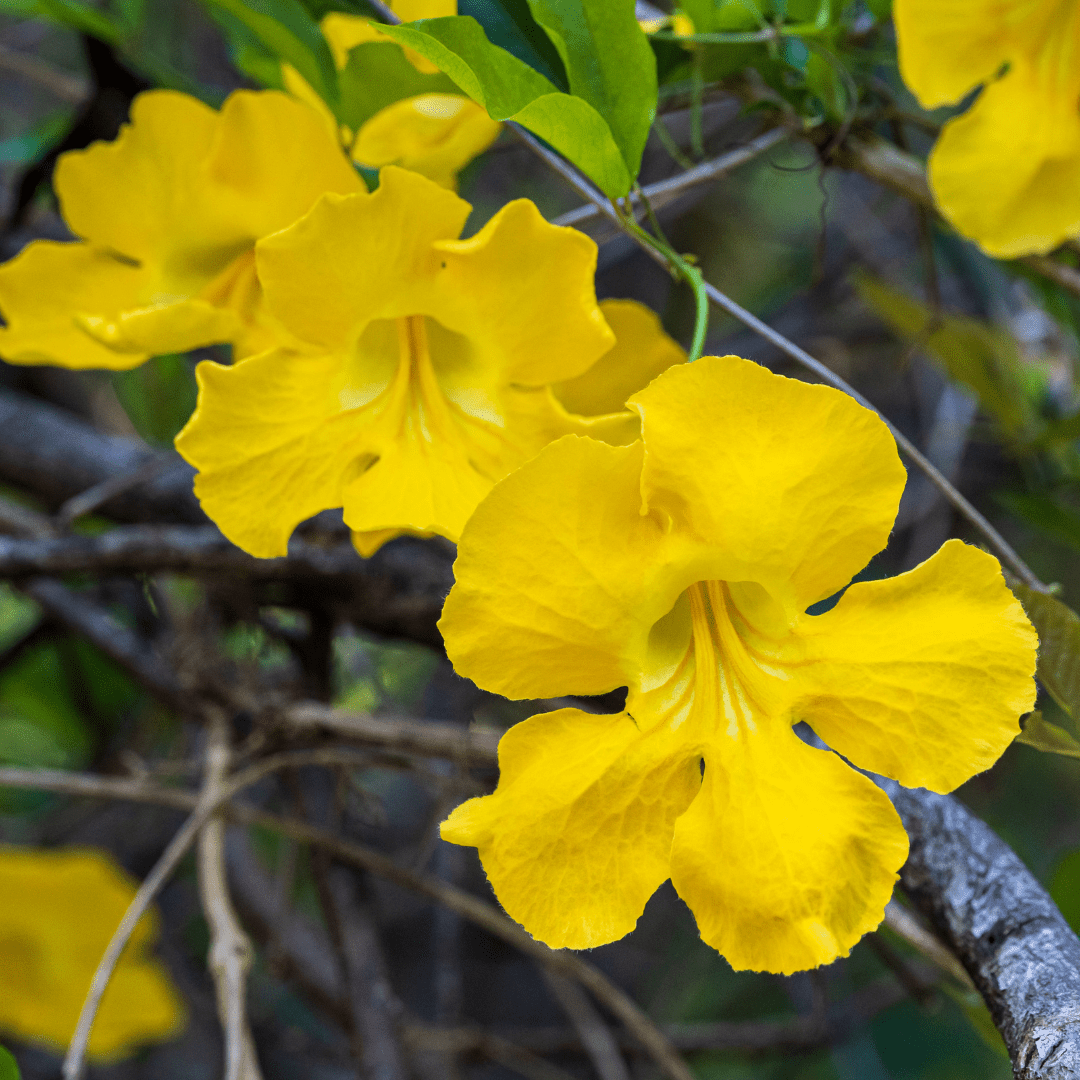
Cat Claw Vine (Macfadyena unguis-cati) is one of the fastest-growing screening vines in the Phoenix Valley. Its tiny claw-like tendrils grip block walls, brick, wood fencing, and chain link without any additional support — providing dense, green coverage in a single season. Explosive yellow trumpet blooms erupt each spring, then give way to lush green foliage all summer. Whether you're concealing a block wall in Scottsdale, creating a privacy barrier along a fence in Chandler, or covering an eyesore structure in Mesa — Cat Claw Vine delivers rapid results with minimal effort.
Cat Claw Vine Plant Details
| Attribute | Detail |
| Scientific Name | Macfadyena unguis-cati |
| Common Names | Cat Claw Vine, Yellow Trumpet Vine, Funnel Creeper |
| Mature Height | 30–50 feet |
| Mature Width | Spreads vigorously — 20–40 feet wide |
| Growth Rate | Very Fast — 15–25 feet per year in Phoenix |
| Sun | Full sun to partial shade. Handles reflected heat from block walls. |
| Water | Low once established. Very drought-tolerant after year one. |
| USDA Zones | 9–11 (Phoenix is Zone 9b–10a) |
| Soil | Well-draining. Adapts readily to Arizona caliche soils. |
| Foliage | Semi-evergreen — may drop leaves in hard frost, returns vigorously in spring |
| Bloom Color | Bright yellow trumpet-shaped flowers (spring) |
Cat Claw Vine Uses in Phoenix Landscapes
Block Wall Coverage
No plant colonizes a Phoenix block wall faster than Cat Claw Vine. The tiny claw-like tendrils on each leaf tip grip masonry without fasteners or wire. Within 1–2 seasons, a single vine can cover a 15–20 foot span. Plant one vine every 15–20 feet for full coverage along a wall: 30 ft wall — 2 plants / 60 ft wall — 4 plants. Pair with Desert Spoon or Blue Elf Aloe at the base for a layered, finished look.
Fast Privacy Screening on Fences
Cat Claw Vine wraps chain link, wood slat, and wrought iron fences quickly and densely. It's one of the go-to solutions in Tempe, Gilbert, and Peoria neighborhoods for blocking views from neighboring properties or busy streets. Train it with a few initial ties and it takes over from there. Space plants 12–15 feet apart for fence screening applications.
Pergola & Shade Structure Coverage
Trained over a pergola or ramada, Cat Claw Vine creates a natural canopy that filters harsh afternoon sun. The spring yellow bloom display over an arbor structure is one of the most striking features you can add to a Phoenix outdoor space. It pairs beautifully with climbing Bougainvillea as a companion vine on adjacent structures.
Low-Maintenance Erosion Control
Along slopes and embankments, Cat Claw Vine spreads laterally and anchors soil. Its deep tuberous roots make it exceptionally drought-tolerant and heat-resistant. Once planted and established, it needs almost no care — making it ideal for utility areas, back slopes, and HOA borders in Glendale and Peoria.
Best Time to Plant Cat Claw Vine in Phoenix
Fall (October–November) is the ideal planting window. Soil temperatures stay warm enough for root development, but air temperatures drop — reducing transplant stress. The vine gets 6–8 months to establish its root system before facing its first Phoenix summer. Spring (February–April) is the second-best option. Avoid planting in June–August when temperatures regularly exceed 110°F — new transplants struggle to root under extreme heat without intensive irrigation.
How to Plant Cat Claw Vine
- Dig wide, not deep — excavate a hole 2–3x the root ball width and the same depth. Cat Claw Vine's roots want to spread laterally.
- Check for caliche — break through any hardpan layer with a breaker bar. Caliche prevents drainage and can drown roots.
- Backfill with native soil — add up to 20% organic compost to help new roots get established. Avoid heavy amendments.
- Spacing — 12–15 feet apart for fence screening; 15–20 feet for block wall coverage; 20–25 feet for pergola coverage.
- Water basin — build a 3–4 inch soil ring around the planting hole to direct water to the root zone.
- Mulch — apply 2–3 inches of bark mulch or decomposed granite to retain moisture and regulate soil temperature.
Watering Cat Claw Vine in Phoenix
First Year Watering Schedule
Cat Claw Vine needs consistent moisture while it establishes its root system and the large tubers it uses for storage.
- Weeks 1–2: Every 1–2 days, deep and slow (20–30 min)
- Month 1–2: Every 3–4 days, deep watering sessions
- Month 3–6: Every 7–10 days (water more frequently — every 5 days — during July–September peak heat)
- After Year 1: Every 14–21 days in summer; every 4–6 weeks in winter. Often zero irrigation needed once fully established.
Drip Irrigation
Place one or two 2 GPH emitters 18–24 inches from the base of the vine. Run for 45–60 minutes per cycle during the first year. Established Cat Claw Vine is extremely drought-tolerant — reduce irrigation frequency significantly after year two. Many established specimens in Phoenix survive on rainfall alone.
How fast does Cat Claw Vine grow in Phoenix?
Extremely fast. In Phoenix's warm climate with full sun, Cat Claw Vine can grow 15–25 feet per year. A 1-gallon plant can reach 30+ feet in 2–3 seasons, making it one of the fastest wall-covering plants available.
Is Cat Claw Vine drought tolerant once established?
Yes. Cat Claw Vine stores water and energy in large underground tubers, making it highly drought-resistant after its first year. Many established Phoenix specimens require no supplemental irrigation at all once the root system matures.
Will Cat Claw Vine damage my block wall?
The claw-like tendrils grip the surface of walls but generally don't penetrate or damage solid masonry. On aging or crumbling mortar joints, removal of mature vines can cause some surface damage. For new block walls in good condition, it's considered safe for long-term use.
Does Cat Claw Vine stay green year-round in Phoenix?
It's semi-evergreen. In Zone 9b–10a (most of metro Phoenix), it keeps most of its leaves year-round. It may drop leaves briefly after a hard frost but regrows rapidly in spring — often coming back more vigorously than before.
Can I control the spread of Cat Claw Vine?
Yes — but plan on regular pruning. Cat Claw Vine is vigorous and will spread aggressively. Trim it back hard in late winter before new growth emerges. Without annual pruning it can spread into unintended areas. It's best suited for large walls, fences, and structures where robust coverage is the goal.
You May Also Like
Purple Hopseed Bush — Another vigorous privacy screening plant for Phoenix walls and fences; bronze-purple foliage adds color contrast.
Green Hopseed Bush — The classic fast-growing hedge plant for Phoenix privacy screens and windbreaks.
Hacienda Creeper — A stunning flowering vine for covering walls and fences in Phoenix with minimal water needs.
Creeping Fig (Staked) — Fine-textured, dense climbing coverage for walls and structures — a more controlled alternative to Cat Claw Vine.
Bower Vine — A fast-growing flowering vine with pink to white blooms, ideal for fence and trellis coverage in Scottsdale and Phoenix.
How Many Cat Claw Vine Do I Need?
Cat Claw Vine is a very fast, very wide spreader (a single plant covers a 15 to 20 foot span), so you need far fewer plants than a typical vine. Use its real coverage to plan a wall or fence:
| Wall / fence length | Plants needed (at 15 ft on center) |
|---|---|
| 30 feet | 2 plants |
| 45 feet | 3 plants |
| 60 feet | 4 plants |
| 90 feet | 6 plants |
Tighten to 12 to 15 feet on center for fast, dense fence screening, or stretch to 20 to 25 feet for pergola coverage. Because it self-clings and spreads hard, do not crowd it: fewer plants, more room.
Cat Claw Vine Season-by-Season in Phoenix
- Spring (Feb–Apr): the explosive yellow trumpet bloom, followed by the year's fastest growth surge. A good second planting window, and the time to do hard renewal pruning just before growth starts.
- Summer (May–Sep): vigorous leafy growth that fills walls and fences quickly. Thrives in full sun and wall-reflected heat with little water once established; monsoon rain accelerates coverage.
- Fall (Oct–Nov): the prime planting window, giving the tuberous roots months to establish before summer.
- Winter (Dec–Jan): semi-evergreen: holds most leaves in mild Phoenix winters, may briefly drop foliage after a hard frost, then returns vigorously in spring. No special frost protection needed.
At a Glance
✔ Pollinator-Friendly ✔ Hummingbird-Friendly ✔ Heat-Loving (Reflected-Heat Tolerant) ✔ Drought-Tolerant ✔ Low-Maintenance
Plant It With
- Purple Hopseed Bush: a vigorous bronze-purple screening shrub to layer color at the base of the wall.
- Green Hopseed Bush: the classic fast hedge plant to ground a privacy screen.
- Hacienda Creeper: another vigorous wall-covering vine for adjacent structures.
- Creeping Fig Staked: a finer-textured, more controlled self-clinging vine for nearby walls.
Is Cat Claw Vine Right for Your Yard?
Cat Claw Vine thrives in full sun, on large block walls, fences, and pergolas it can self-cling and cover fast, in any well-drained soil with almost no water once established. It is ideal where rapid, robust coverage of a big structure is the goal. It is not a fit for small or tidy spaces, delicate trellises, or old crumbling masonry: it is aggressive, needs hard annual pruning to stay in bounds, and removing a mature vine can scar aging mortar, so give it room and plan to keep it cut back.
Customer Reviews
Great prices. Delivery to my house is a bonus.
Share