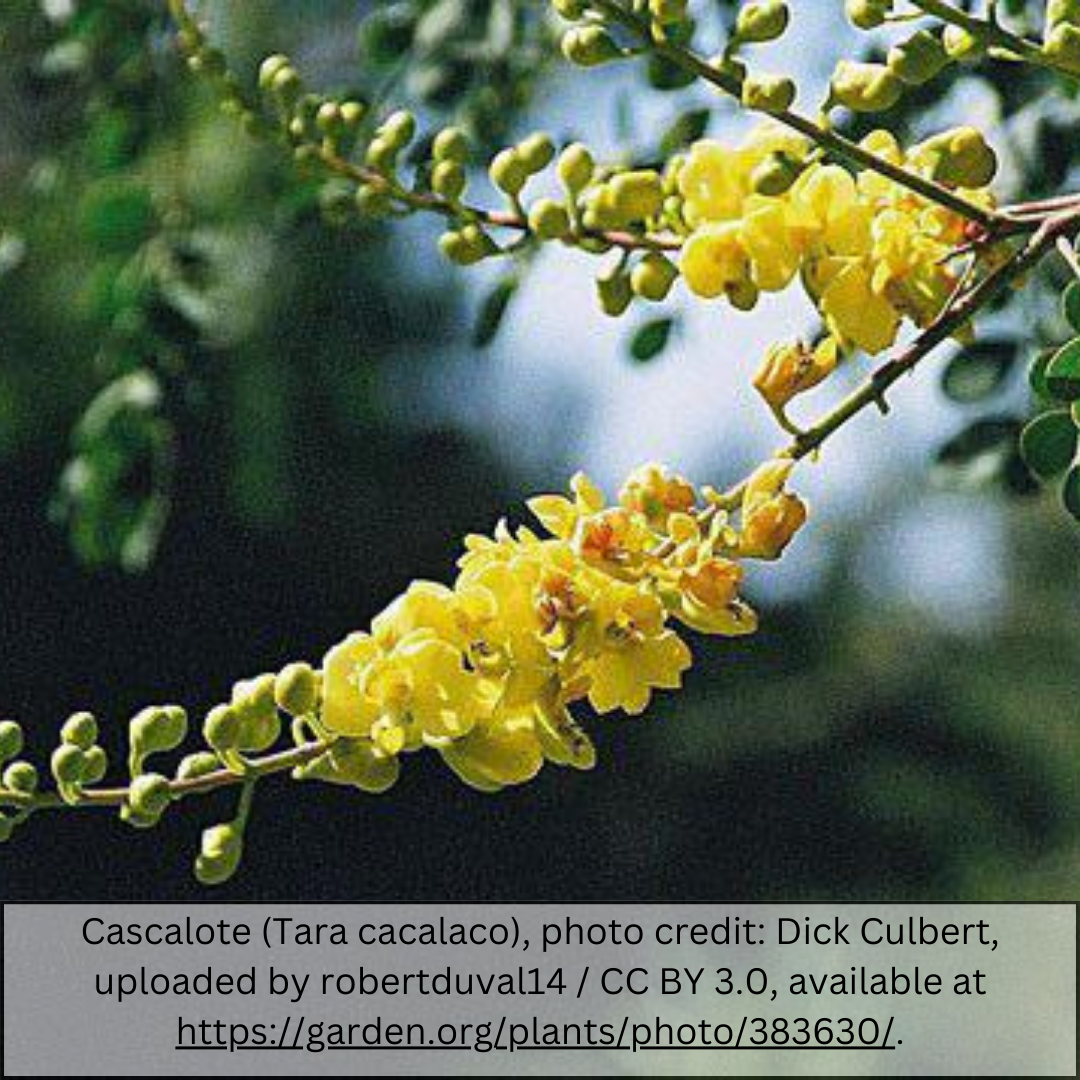


Cascalote Tree
Cascalote Tree
Couldn't load pickup availability
Phoenix's Most Spectacular Winter-Blooming Tree — Cascalote
Cascalote (Vachellia cacalaco) is Arizona's premier winter-blooming tree, erupting in vivid golden-yellow flower spikes just as the desert cools each November. While most trees go quiet in fall, Cascalote steals the show — dense clusters of bright yellow blooms light up the branches from late fall through January, attracting hummingbirds and pollinators when little else is flowering. Drought-tolerant, fast-growing, and built for Phoenix heat, this Mexican native thrives in the toughest Valley conditions. Whether you're transforming a yard in Scottsdale, Chandler, Mesa, or Peoria — Cascalote Tree delivers year-round structure with an unforgettable winter spectacle.
Cascalote Tree Plant Details
| Attribute | Detail |
|---|---|
| Scientific Name | Vachellia cacalaco (syn. Caesalpinia cacalaco) |
| Common Names | Cascalote, Mexican Cascalote, Cascalote Tree |
| Mature Height | 15–20 feet |
| Mature Width | 15–20 feet |
| Growth Rate | Moderate — 1–3 feet per year in Phoenix |
| Sun | Full sun (6+ hrs). Handles intense reflected heat from walls and pavement. |
| Water | Very low once established. One of Phoenix's most drought-tolerant flowering trees. |
| USDA Zones | 9–11 (Phoenix is Zone 9b–10a) |
| Soil | Well-draining. Adapts well to Arizona caliche soils — breaks through hardpan with a proper planting hole. |
| Foliage | Semi-evergreen — holds leaves through most of the year, may briefly drop in cold winters |
| Bloom Color | Bright golden-yellow |
| Bloom Season | Late fall through winter (November–January) — blooms when most plants don't |
| Native Status | Native to Mexico; thrives in Sonoran Desert climates |
Cascalote Tree Uses in Phoenix Landscapes
Winter Color Anchor
Cascalote is the go-to choice for Phoenix homeowners who want color through the fall and winter months. Its golden-yellow flower spikes appear just as summer annuals fade, creating a stunning focal point from November through January. Pair it with Desert Marigold or Brittlebush at its base for a year-round color sequence that never leaves your yard looking bare.
Specimen and Focal Point Tree
With a naturally rounded canopy and striking bloom display, Cascalote works beautifully as a standalone specimen tree in front yards, courtyard entries, or open desert landscape beds. Plant it where it has room to reach its full 15–20 foot spread, and underplant with low-growing desert groundcovers like Trailing Lantana or Blackfoot Daisy for a layered look.
Privacy Screening and Border Plantings
Cascalote's dense, slightly thorny branching structure makes it an excellent choice for natural privacy screens and property borders. Plant trees 10–12 feet apart for a loose hedge that provides privacy while allowing air circulation. For a 40-foot fence line, plan for 4 trees; for a 60-foot border, 6 trees will create a full screen within 3–4 years.
Xeriscape and Low-Water Desert Landscapes
Once established, Cascalote survives on Phoenix's natural rainfall alone — making it a top performer in xeriscape designs. It pairs perfectly with other low-water trees and shrubs like Texas Sage, Desert Spoon, and Saguaro for an authentic Sonoran Desert aesthetic that requires almost no supplemental irrigation after year two.
Best Time to Plant Cascalote Tree in Phoenix
Fall planting (October–November) is ideal for Cascalote in Phoenix. The soil stays warm enough to encourage root development while cooling air temperatures reduce transplant stress. A fall-planted Cascalote gets 5–6 months of establishment before facing its first Phoenix summer. Spring (February–April) is the second-best planting window — roots establish quickly in warming soil, though you'll need to water more frequently heading into summer. Avoid planting in June, July, or August if possible, as the combination of heat stress and transplant shock can slow establishment significantly.
How to Plant Cascalote Tree
- Dig wide, not deep — excavate a hole 2–3 times the width of the root ball but no deeper than the root ball itself
- Check for caliche — if you hit a hardpan layer, break through it with a pick or rebar to ensure drainage
- Backfill with native soil — a light 20% organic amendment blend helps in heavy clay, but straight native soil is fine in most Phoenix Valley soils
- Spacing — plant 12–15 feet apart for privacy screening; 20+ feet apart for individual specimen trees
- Build a water basin — create a 3–4 inch earthen ring around the drip line to direct irrigation water to the root zone
- Mulch — apply 2–3 inches of bark or gravel mulch over the root zone to retain moisture and moderate soil temperature
Watering Cascalote Tree in Phoenix
First Year Watering Schedule
Deep, infrequent watering is key to developing a strong root system:
- Weeks 1–2: Water every 1–2 days, slowly and deeply (20–30 minutes per session)
- Months 1–2: Reduce to every 3–4 days as roots begin anchoring
- Months 3–6: Water every 7–10 days (every 5–7 days during peak summer heat)
- After Year 1: Every 10–14 days in summer; every 3–4 weeks in winter — or rely on natural rainfall
Drip Irrigation
Place 2–4 drip emitters (2 GPH each) 18–24 inches from the trunk, within the drip line. As the tree grows, move emitters outward to keep pace with the expanding root zone. After year two, most established Cascalote trees in Phoenix need little to no supplemental irrigation outside of summer's peak heat months.
How fast does Cascalote grow in Phoenix?
Cascalote grows at a moderate rate of 1–3 feet per year under good conditions in Phoenix. With regular watering during the first year and full sun, you can expect a young tree to reach 6–8 feet within 3 years.
Is Cascalote drought-tolerant once established?
Yes — Cascalote is one of the most drought-tolerant flowering trees available for Phoenix landscapes. After the first 1–2 years of establishment watering, it can survive entirely on Phoenix's natural rainfall, though a deep summer watering every 2–3 weeks will keep it looking its best.
When does Cascalote bloom in Phoenix?
Cascalote blooms from late November through January — making it one of the only trees in Phoenix that flowers in winter. This is its biggest selling point: brilliant golden-yellow spikes when the rest of the landscape is quiet and dormant-looking.
Does Cascalote have thorns?
Yes, Cascalote has short thorns along its branches, which makes it an effective natural barrier but means it should be planted away from high-traffic pathways and play areas. Gloves are recommended when pruning.
Can Cascalote survive Phoenix summer heat?
Absolutely. Cascalote is native to northern Mexico's hot, arid regions and handles Phoenix's extreme summer temperatures with ease. It actually thrives in reflected heat from walls and pavement — making it a great choice for south-facing exposures and streetscapes.
You May Also Like
Desert Willow (Chilopsis linearis) — Another Arizona native flowering tree with trumpet-shaped blooms in pink and lavender from spring through fall; pairs beautifully with Cascalote for year-round color coverage.
Texas Mountain Laurel (Sophora secundiflora) — Fragrant purple blooms in late winter/early spring, just as Cascalote's winter bloom season ends — ideal for a seamless flowering sequence.
Hong Kong Orchid Tree (Bauhinia blakeana) — Stunning magenta orchid-like blooms in fall and winter, complementing Cascalote's yellow flowers for a vivid cool-season color palette.
Sweet Bubba Desert Willow (Chilopsis linearis 'Sweet Bubba') — Compact native tree with deep burgundy blooms spring through fall; excellent companion plant for creating multi-season interest alongside Cascalote.
Mexican Bird of Paradise (Caesalpinia mexicana) — Bright yellow summer blooms that pick up where Cascalote's winter display leaves off, ensuring golden color from summer through the following winter.
How Many Cascalote Trees Do I Need?
Cascalote matures 15 to 20 feet wide. As a winter-color focal point, plant it single in a front-yard or courtyard bed, or in an odd-numbered group of 3 spaced about 18 feet apart so each rounded canopy stands clear. For a loose, slightly thorny privacy screen, plant 10 to 12 feet on center. Keep it back from walkways, pools, and play areas because of the branch thorns.
| Run Length | Privacy Screen (11 ft spacing) |
|---|---|
| 22 ft | 3 trees |
| 33 ft | 4 trees |
| 44 ft | 5 trees |
| 55 ft | 6 trees |
Cascalote Season-by-Season in Phoenix
- Spring (Feb to Apr): New growth flush as the desert warms, and a strong second planting window. Foliage fills back in after any brief winter leaf drop.
- Summer (May to Sep): Holds dense green through the worst heat and reflected heat without scorch. Monsoon rains support steady growth. Very low water once established.
- Fall (Oct to Nov): Prime planting season, and the golden flower spikes begin opening late in the season.
- Winter (Dec to Jan): The main event: brilliant golden-yellow blooms when little else flowers, feeding overwintering hummingbirds. Hardy in the Valley to about 20F; a hard freeze may cause a brief leaf drop with no lasting harm.
At a Glance
✔ Pollinator-Friendly ✔ Hummingbird-Friendly ✔ Heat-Loving (Reflected-Heat Tolerant) ✔ Drought-Tolerant ✔ Low-Maintenance ✔ Cold-Hardy to 20°F
Plant It With
- Desert Willow: native flowering tree whose spring-to-fall blooms cover the seasons Cascalote rests.
- Hong Kong Orchid Tree: magenta cool-season blooms for a vivid winter color pairing.
- Bubbalicious Desert Willow: deep rose and burgundy summer flowers that complement the winter gold.
- Brittlebush: low Sonoran native for a sunny, year-round color base beneath the canopy.
Is Cascalote Right for Your Yard?
Cascalote thrives in full sun and reflected heat, takes caliche and alkaline soil with a properly dug hole, and runs on very little water once established. It is an outstanding low-water winter-color tree. Not a fit right next to walkways, patios, or pools: the branch thorns and seed-pod drop make it better suited to open beds and borders where people will not brush against it.
Share