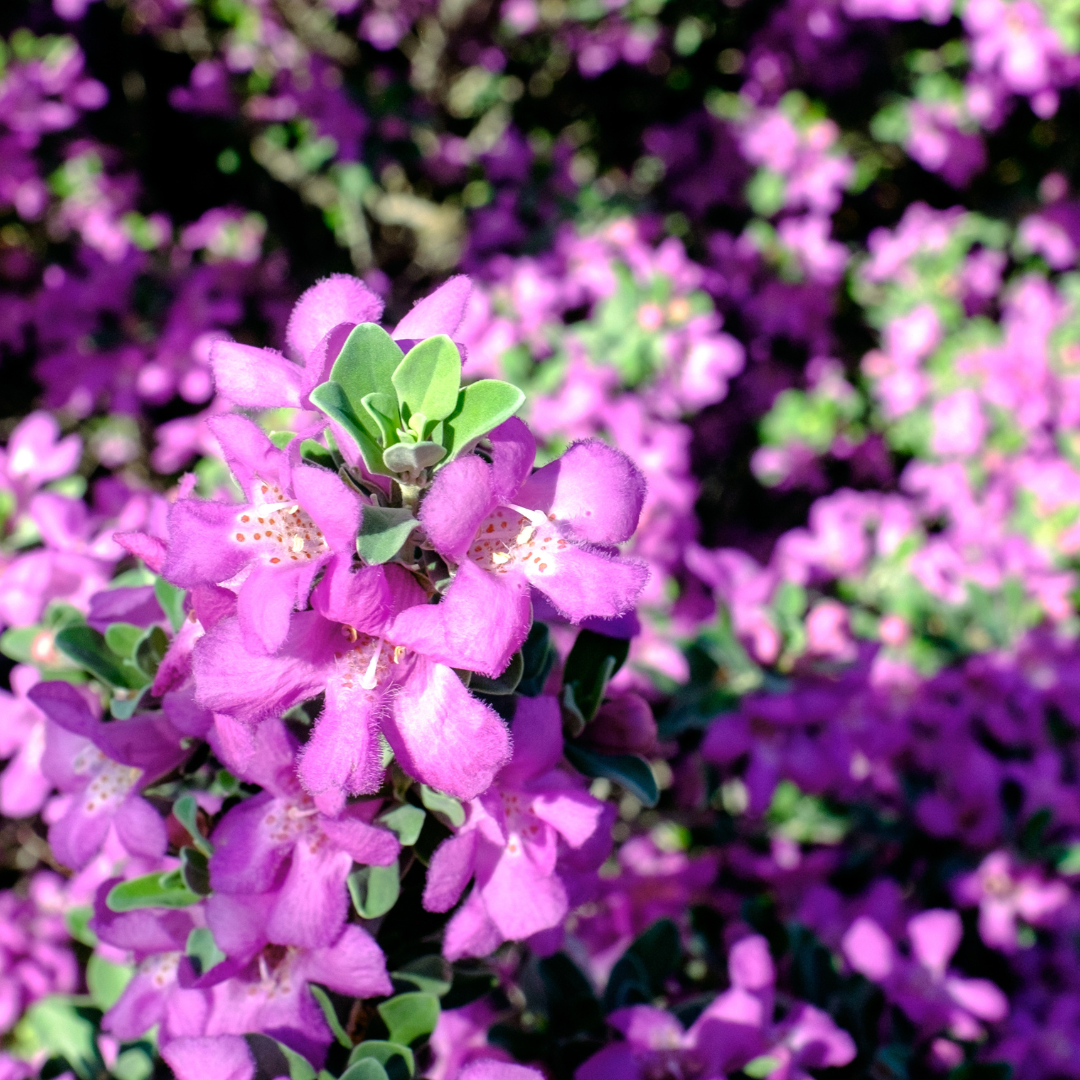


Rio Bravo Sage
Rio Bravo Sage
Couldn't load pickup availability
The Perfect Low-Water Flowering Hedge for Phoenix — Rio Bravo Sage
Rio Bravo™ Sage (Leucophyllum langmaniae) is one of the most popular and reliable evergreen shrubs for the Phoenix Valley. Growing 4–6 feet tall and wide, this lush Texas Sage variety produces waves of lavender-purple flowers after summer monsoon rains and humidity spikes — transforming your landscape into a purple paradise seemingly overnight. Extremely drought-tolerant and heat-loving, Rio Bravo Sage is a staple in Scottsdale, Chandler, Mesa, Gilbert, Tempe, and Peoria landscapes where water-wise beauty is essential.
Rio Bravo Sage Plant Details
| Attribute | Detail |
|---|---|
| Scientific Name | Leucophyllum langmaniae ‘Rio Bravo’ |
| Common Names | Rio Bravo Sage, Rio Bravo Texas Sage, Langman’s Sage |
| Mature Height | 4–6 feet |
| Mature Width | 4–6 feet |
| Growth Rate | Moderate — fills in nicely within 2–3 seasons |
| Sun | Full sun (6+ hrs). Thrives in reflected heat from walls and pavement. |
| Water | Very low once established. Highly drought-tolerant. |
| USDA Zones | 8–11 (Phoenix is Zone 9b–10a) |
| Soil | Well-draining. Thrives in Arizona caliche and rocky native soils. |
| Flower Color | Lavender to light purple |
| Bloom Season | Summer through fall (triggered by humidity and monsoon rains) |
Why Rio Bravo Sage Thrives in Phoenix Landscapes
Leucophyllum species are native to the Chihuahuan Desert of Texas and northern Mexico, making them perfectly adapted to the hot, dry conditions of central Arizona. Rio Bravo Sage is distinguished from other Texas Sage varieties by its bright green foliage (rather than silver-gray) and its exceptionally heavy bloom cycles triggered by rising humidity. When monsoon moisture arrives, the entire shrub erupts in lavender flowers — a phenomenon locals call the “barometer bush” effect because blooming predicts rain.
Perfect Uses for Rio Bravo Sage
Rio Bravo Sage is ideal as a natural privacy hedge or screening plant along property lines and fences. Space plants 3–4 feet apart for a dense, continuous hedge that requires no formal shearing. It works beautifully as a foundation planting against stucco walls where reflected heat is intense. Mass plantings on slopes provide excellent erosion control in Scottsdale foothill properties. Use as a standalone specimen plant or mix with other Texas Sage varieties for a multi-textured, multi-colored display. It also performs well in commercial landscapes, medians, and HOA common areas.
How to Plant Rio Bravo Sage in Arizona
Plant in full sun with well-draining soil — this is critical, as Texas Sage will decline in heavy, poorly drained soil. Dig a hole twice the width of the root ball and the same depth. Backfill with native soil only — do not add compost or amendments, which can retain too much moisture. Space plants 3–5 feet apart depending on desired density. Water deeply after planting and apply rock or gravel mulch around the base. Fall and spring are ideal planting times, though Rio Bravo can be planted year-round in Phoenix.
How to Water Rio Bravo Sage in Phoenix
During establishment (first 4–6 weeks), water every 3–4 days. Once established, water deeply every 10–14 days in summer and monthly or less in winter. Mature Rio Bravo Sage is one of the most drought-tolerant landscape shrubs available and can survive extended periods without supplemental irrigation. Overwatering is the number one killer of Texas Sage — soggy soil leads to root rot and decline. If your plant looks yellow or wilted, check drainage before adding more water.
Frequently Asked Questions
Why does my Rio Bravo Sage bloom after rain?
Texas Sage species bloom in response to rising humidity in the air, not soil moisture. When monsoon humidity builds before a storm, it triggers the plant to produce a flush of flowers. This is why locals call it the “barometer bush” — blooming often predicts incoming rain within 24–48 hours.
How do I prune Rio Bravo Sage?
Rio Bravo Sage has a naturally rounded shape and rarely needs pruning. If desired, lightly shape in late winter by removing no more than one-third of the growth. Never shear into a formal box shape, as this destroys the natural form and reduces flowering. Remove any dead or frost-damaged branches in early spring.
Is Rio Bravo Sage deer-resistant?
Yes, deer typically avoid all Leucophyllum species due to their aromatic foliage. Rio Bravo Sage is an excellent choice for properties near desert preserves in Scottsdale, Fountain Hills, Cave Creek, and north Phoenix where deer browsing is common.
What’s the difference between Rio Bravo and other Texas Sage varieties?
Rio Bravo Sage features bright green foliage (not silver-gray like many Texas Sage varieties) and tends to bloom more prolifically. It also has a slightly more open, airy growth habit compared to compact varieties like Green Cloud or Thundercloud. All share the same love of heat, sun, and dry conditions.
You May Also Like
Green Cloud Sage · Thundercloud Sage · Violet Silverleaf Sage · Autumn Sage · Ruellia
How Many Rio Bravo Sage Do I Need?
For a dense, no-shear privacy hedge, space Rio Bravo Sage about 4 feet apart (its mature spread is 4 to 6 feet). For a looser informal screen or specimen grouping, give each plant 5 feet. Use this table to size a hedge run:
| Run Length | Plants Needed (4 ft spacing) |
|---|---|
| 10 ft | 3 plants |
| 20 ft | 5 plants |
| 30 ft | 8 plants |
| 40 ft | 10 plants |
| 50 ft | 13 plants |
Rio Bravo Sage Season-by-Season in Phoenix
- Spring (Feb-Apr): Fresh green growth and scattered early bloom flushes. A good planting window before the heat builds.
- Summer (May-Sep): Its star season. Monsoon humidity (Jul-Sep) triggers heavy lavender bloom waves, the famous barometer-bush effect. It thrives on reflected heat and needs very little water. Resist the urge to overwater.
- Fall (Oct-Nov): More bloom flushes follow passing storms as the heat eases. Prime planting season for root establishment.
- Winter (Dec-Jan): Holds its green structure year-round. Hardy to about 10°F; a hard freeze may nip the tips but it recovers in spring.
At a Glance
✔ Evergreen ✔ Drought-Tolerant ✔ Heat-Loving (Reflected-Heat Tolerant) ✔ Pool-Friendly (Low-Litter) ✔ Low-Maintenance ✔ Pollinator-Friendly ✔ Deer & Rabbit-Resistant ✔ Cold-Hardy to 10°F
Plant It With
- Green Cloud Sage: A silver-leafed Leucophyllum for contrasting foliage in a mixed sage hedge.
- Thunder Cloud Sage: A compact deep-purple bloomer for the front of a layered sage planting.
- Texas Sage: The classic silver-gray Leucophyllum that pairs naturally with Rio Bravo's bright green.
- Desert Ruellia: The Ruellia from the pairing list, adding lower purple bloom and tough desert structure.
Is Rio Bravo Sage Right for Your Yard?
Rio Bravo Sage is ideal for full-sun, reflected-heat spots in fast-draining native or rocky soil on very little water, including stucco-wall foundations and HOA screens. It is not a fit in heavy, poorly drained soil or on a lawn-style irrigation schedule, since steady overwatering causes root rot and decline.
Share