

Bougainvillea 'Rosenka'-Staked
Bougainvillea 'Rosenka'-Staked
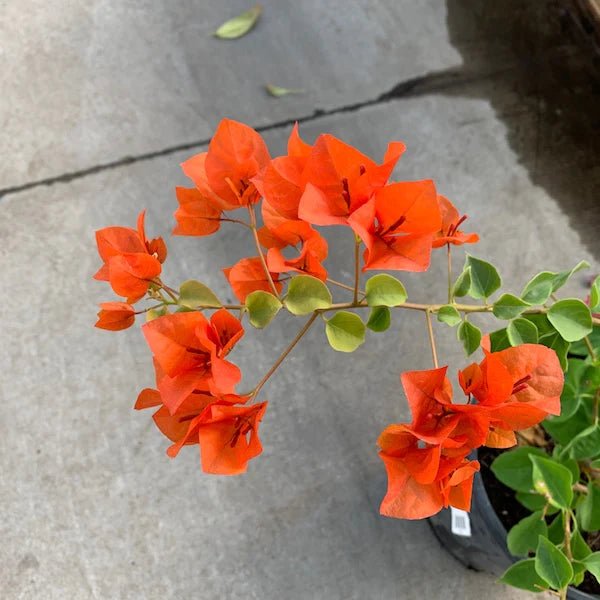
Staked bougainvillea in glowing gold-and-pink color
Couldn't load pickup availability
Color-Changing Bougainvillea Vine for Phoenix Walls & Trellises
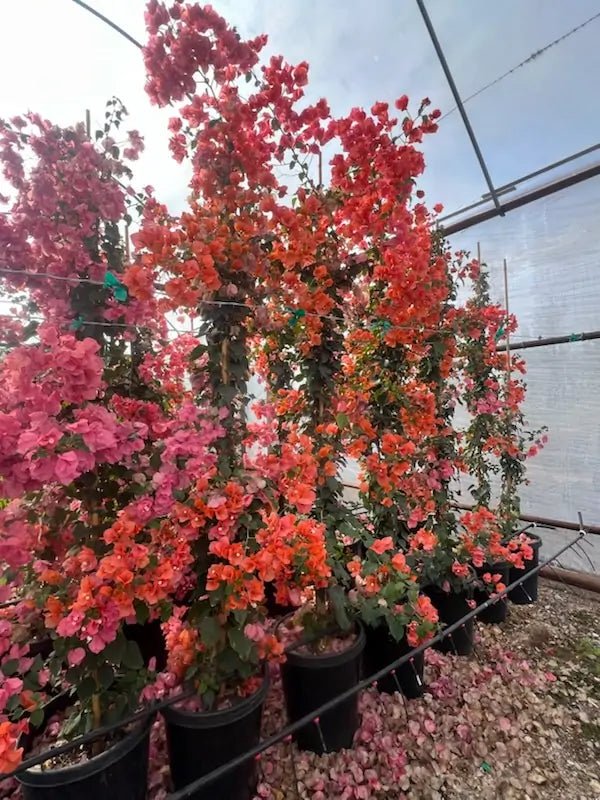
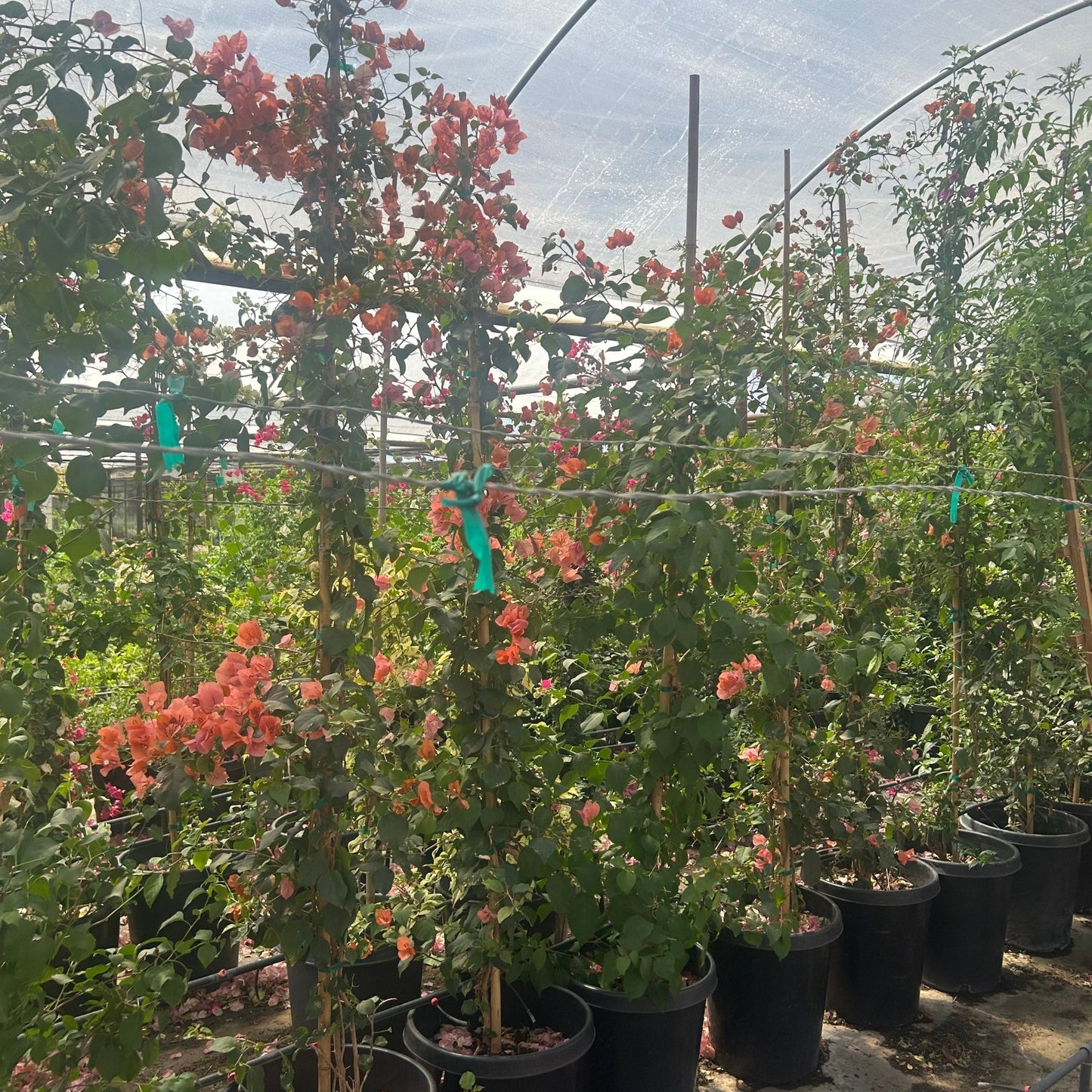
Bougainvillea 'Rosenka' Staked (Bougainvillea 'Rosenka') is one of the most unique and captivating bougainvillea varieties you can grow in the Phoenix Valley. What makes Rosenka special is its color-shifting bracts — they open golden-orange and gradually fade to salmon-pink as they mature, giving you multiple colors on one plant at the same time. This staked form comes trained upright for easy planting against walls, trellises, and fences. It handles full Arizona sun, thrives in reflected heat, and blooms heaviest when other plants are wilting. Whether you're adding color to a Scottsdale patio wall, covering an arbor in Mesa, or creating a showpiece entry in Chandler — Rosenka Bougainvillea delivers nonstop, multi-toned blooms with minimal care.
Bougainvillea 'Rosenka' Staked Plant Details
| Attribute | Detail |
|---|---|
| Scientific Name | Bougainvillea 'Rosenka' |
| Common Names | Rosenka Bougainvillea, Color-Changing Bougainvillea |
| Mature Height | 15–20 feet (as a vine); 4–6 feet (pruned as a shrub) |
| Mature Width | 6–10 feet |
| Growth Rate | Fast — 3–5 feet per year in Phoenix |
| Sun | Full sun (6+ hrs). Thrives in reflected heat from walls and pavement. |
| Water | Low once established. Drought stress encourages heavier blooming. |
| USDA Zones | 9–11 (Phoenix is Zone 9b–10a) |
| Soil | Well-draining. Adapts to Arizona caliche soils. |
| Foliage | Semi-evergreen in Phoenix — may drop leaves briefly in winter |
| Bloom Color | Golden-orange fading to salmon-pink — multiple colors at once |
| Form | Staked upright for easy wall and trellis training |
Bougainvillea 'Rosenka' Uses in Phoenix Landscapes
Wall & Fence Cover
The staked form of Rosenka is ready to plant directly against block walls, wrought-iron fences, and stucco facades. Its vigorous growth and thorny branches grip and spread quickly, creating a cascade of color-changing bracts. Plant 6–8 feet apart along a fence line for full coverage within 2 growing seasons.
Trellis & Arbor Feature
Train Rosenka on a patio trellis, pergola, or arbor for overhead color. The multi-toned bracts create a warm, sunset-like canopy that's perfect for outdoor living spaces in Scottsdale, Gilbert, and Tempe. The staked form gives you a head start on training.
Entryway & Accent Planting
The unique color-shifting blooms make Rosenka a conversation-starting accent plant. Place it at a front entry, courtyard gate, or pool cabana where guests will notice the gradient of gold, orange, and pink on every branch.
Security Planting
Like all bougainvillea, Rosenka has substantial thorns that make it an effective natural security barrier along property lines and below windows while adding beautiful color.
Best Time to Plant Bougainvillea 'Rosenka' in Phoenix
Spring (March–May) is the ideal planting window. Warm soil and rising temperatures trigger rapid growth and root establishment. Your plant gets a full growing season to establish before winter. Fall (October–November) is acceptable but provides less establishment time before cooler weather. Avoid planting in winter — bougainvillea is frost-sensitive and cold soil stalls root development.
How to Plant Bougainvillea 'Rosenka' Staked
- Dig wide, not deep — 2–3x the width of the root ball and the same depth. Do not plant deeper than nursery pot level.
- Check for caliche — Break through hardpan for drainage. Root rot is the #1 killer of bougainvillea.
- Backfill with native soil — Minimal amendments. Bougainvillea blooms better in lean soil.
- Handle roots gently — Bougainvillea has a sensitive root ball. Avoid breaking it apart.
- Position the stake — Lean the staked plant toward the wall or trellis at a slight angle. Tie new growth to the support as it extends.
- Mulch — 2–3 inches of gravel or bark. Keep 3 inches from the trunk.
Watering Bougainvillea 'Rosenka' in Phoenix
First Year Watering Schedule
Weeks 1–2: Water every 2–3 days, deep and slow. Month 1–3: Every 4–5 days. Month 3–6: Every 7–10 days. After Year 1: Every 10–14 days in summer; every 3–4 weeks in winter. Let soil dry between waterings — overwatering produces green growth but fewer blooms.
Drip Irrigation
Place two 2-GPH emitters 18–24 inches from the trunk. Run drip for 30–45 minutes per cycle. Once established, slightly stressing the plant with less water triggers heavier flowering.
What makes Rosenka Bougainvillea different from other varieties?
Rosenka is unique for its color-changing bracts. New bracts open golden-orange and gradually shift to salmon-pink as they age. This means you get a beautiful gradient of warm colors on the same plant simultaneously — unlike single-color varieties.
Is the staked form easier to plant than a bush form?
Yes. The staked form comes trained upright on a bamboo or wood stake, making it ready to plant directly against walls, fences, and trellises. Simply position the stake toward your support structure and tie new growth as it extends. Three Timbers also carries Rosenka in a bush form if you prefer a shrub shape.
Is Rosenka Bougainvillea frost tolerant?
Bougainvillea is frost-sensitive below 30°F. In most Phoenix Valley locations, hard freezes are rare. Cover with frost cloth if temps drop below freezing. Damaged growth rebounds quickly in spring.
How fast does Rosenka grow in Phoenix?
Very fast — 3–5 feet of new vine growth per year. A 5-gallon staked plant can cover a 6-foot trellis within one growing season with full sun and proper care.
You May Also Like
Bougainvillea 'Rosenka' (Bush Form) — Same stunning color-changing bracts in a natural bush shape.
California Gold Bougainvillea — Solid golden-yellow bracts that pair beautifully with Rosenka's warm tones.
Barbara Karst Bougainvillea — Classic bright red bougainvillea for bold contrast.
Alexandra Bougainvillea — Deep purple bracts for dramatic color variety.
Pink Pearl Bougainvillea — Soft pink bracts that complement Rosenka's salmon tones.
How Many Bougainvillea 'Rosenka' Staked Do I Need?
Trained on a wall or fence, each staked Rosenka spreads 6 to 10 feet wide. Space plants about 6 to 8 feet on center for solid coverage within two seasons. Use this guide for a run of wall or fence:
| Wall / fence length | Plants needed (7 ft spacing) |
|---|---|
| 15 ft | 2-3 plants |
| 25 ft | 4 plants |
| 40 ft | 6 plants |
| 60 ft | 9 plants |
For a single trellis, arbor, or entry feature, one staked plant covers the support on its own. Keep it well back from walkways and pool decks since the canes carry stout thorns.
Bougainvillea 'Rosenka' Staked Season-by-Season in Phoenix
- Spring (Feb-Apr): New vine growth surges as nights warm and the first gold-to-salmon bract cycle opens. Prime planting and training window once frost risk passes.
- Summer (May-Sep): Peak bloom in full sun and reflected heat off block walls. Flowers heaviest when slightly dry. Tie in fast new canes through monsoon season and avoid overwatering.
- Fall (Oct-Nov): A strong second flush of color. Good secondary planting window while soil is still warm.
- Winter (Dec-Jan): Semi-evergreen, may drop some leaves. Frost-sensitive below about 30°F: cover with frost cloth on hard-freeze nights. Cut back frost-damaged tips in spring and it rebounds fast.
At a Glance
✔ Heat-Loving (Reflected-Heat Tolerant) ✔ Drought-Tolerant ✔ Low-Maintenance ✔ Fire-Wise
Plant It With
- Bougainvillea 'Rosenka' (Bush Form): the same color-changing bracts in a mounding shrub shape.
- California Gold Bougainvillea: solid golden bracts that echo Rosenka's warm tones.
- Barbara Karst Bougainvillea: classic bright red for bold contrast on the same wall.
- Alexandra Bougainvillea: deep purple bracts for dramatic variety.
Is Bougainvillea 'Rosenka' Staked Right for Your Yard?
The staked form is right when you have a sunny wall, fence, trellis, or arbor to cover and want fast, multi-toned color with little water once established. It needs a support to climb, well-draining soil broken through caliche, and lean watering for the heaviest bloom. It is not a fit if you want a freestanding shrub with no support, a thornless poolside plant, or color in a shady spot, and it will show tip damage in hard winter frosts below 30°F.
Share