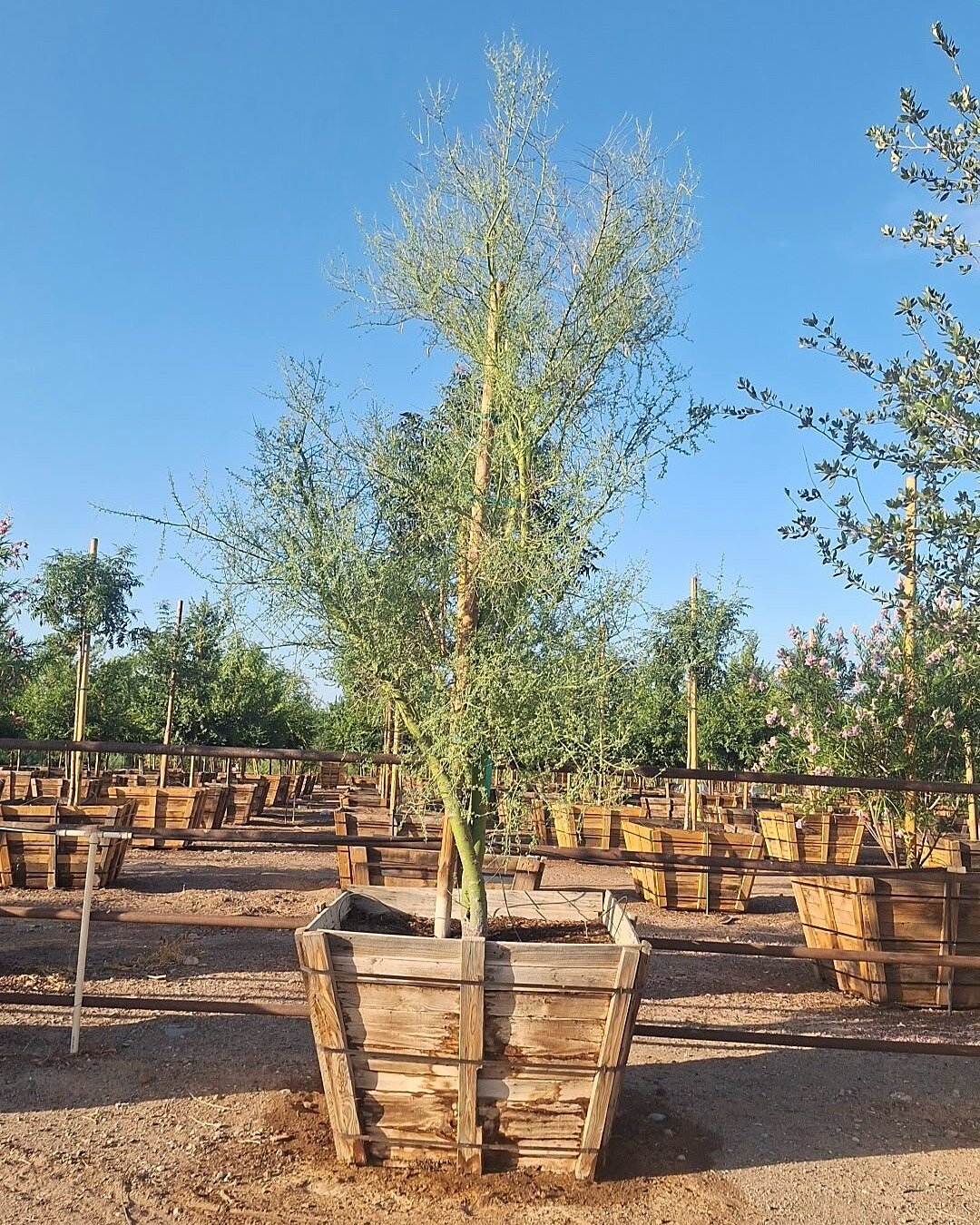


Blue Palo Verde
Blue Palo Verde
Couldn't load pickup availability
Arizona's Native State Tree — Fast-Growing with Brilliant Yellow Spring Blooms
Blue Palo Verde (Parkinsonia florida) is Arizona's official state tree and one of the most beloved native desert trees for Phoenix Valley landscapes. Its striking blue-green bark photosynthesizes year-round, and each spring it erupts in a stunning display of brilliant yellow flowers that blankets the entire canopy. It grows 3–4 feet per year and reaches 25–40 feet tall with a broad 25–40 foot spread. Whether you're creating an authentic Sonoran Desert landscape in Scottsdale, a native focal point in Chandler, or a flowering canopy in Mesa or Gilbert — Blue Palo Verde delivers unmatched native beauty with almost no water.
Blue Palo Verde Plant Details
| Attribute | Detail |
|---|---|
| Scientific Name | Parkinsonia florida (syn. Cercidium floridum) |
| Common Names | Blue Palo Verde, Arizona Blue Palo Verde |
| Mature Height | 25–40 feet |
| Mature Width | 25–40 feet |
| Growth Rate | Fast — 3–4 feet per year in Phoenix |
| Sun | Full sun (6+ hrs). Thrives in reflected heat and south-facing desert exposures. |
| Water | Very low once established. Survives on rainfall alone after year two. |
| USDA Zones | 8–11 (Phoenix is Zone 9b–10a) |
| Soil | Well-draining. Native to Arizona caliche soils — extremely adaptable. |
| Foliage | Semi-deciduous — blue-green bark photosynthesizes when leafless |
| Bloom Color | Brilliant yellow — spectacular spring display March–May |
Blue Palo Verde Uses in Phoenix Landscapes
Native Desert Focal Point and Specimen Tree
Blue Palo Verde is the quintessential native Arizona landscape tree. Its distinctive blue-green trunk color, delicate fine-textured foliage, and explosive yellow spring flower display make it one of the most visually stunning specimen trees available for Phoenix yards. Plant it as the centerpiece of a xeriscape front yard in Scottsdale or Peoria, and let the blue-green bark provide year-round color interest even when dormant in winter. Pair with Brittlebush, Jojoba, or Desert Marigold for an authentic Sonoran Desert garden.
Desert Canopy and Patio Shade
Blue Palo Verde provides excellent dappled shade for patios, outdoor seating areas, and pool surrounds. Its open canopy filters the intense Phoenix sun rather than fully blocking it, reducing patio heat while allowing airflow. Plant it 15 feet from the patio edge to allow full canopy spread while keeping roots clear of hardscape. The yellow spring flowers create a spectacular seasonal show right over your outdoor living space.
Wildlife and Pollinator Garden
Blue Palo Verde is a keystone species in the Sonoran Desert ecosystem. Its flowers attract native bees, butterflies, hummingbirds, and other pollinators each spring. The open canopy provides nesting habitat for desert birds, and the seed pods are eaten by native wildlife. If you're creating a pollinator garden or wildlife-friendly landscape in Tempe, Chandler, or Mesa, Blue Palo Verde is an essential anchor species. Plant alongside Desert Willow, Velvet Mesquite, and Foothill Palo Verde for a complete native habitat planting.
Street Tree and High-Heat Locations
Blue Palo Verde is among the most heat-tolerant trees available for Phoenix street-side planting. It handles the reflected heat of asphalt, concrete, and south-facing walls that would stress other trees. It's widely used across the Phoenix metro as a street tree, parkway planting, and commercial landscape specimen because of its low maintenance, native adaptability, and stunning seasonal display.
Best Time to Plant Blue Palo Verde in Phoenix
Fall — October through November — is the ideal planting window for Blue Palo Verde in Phoenix. Warm soil supports active root establishment while cooler air temperatures dramatically reduce transplant stress. A fall-planted Blue Palo Verde gets 6–8 months of root development before its first full Phoenix summer. Spring planting (February through April) is also excellent. Avoid planting in peak summer heat; if you must, provide daily irrigation and afternoon shade cloth for the first 30 days.
How to Plant Blue Palo Verde
- Dig wide, not deep — 2–3 times the width of the root ball, same depth. Palo Verde spreads its roots wide — the width of the hole matters more than the depth.
- Check for caliche — Break through any hardpan layer to ensure drainage. Standing water is fatal. This is essential in Arizona soils.
- Backfill with native soil — Blue Palo Verde is a native tree that thrives in lean, well-drained soil. Avoid heavy potting mixes or excessive amendments.
- Spacing — 20–25 feet from other trees and structures for full canopy development.
- Water basin — Build a 3–4 inch soil ring at the drip line to direct irrigation to the root zone.
- Mulch — Apply 3 inches of bark or gravel mulch to retain moisture during establishment.
Watering Blue Palo Verde in Phoenix
First Year Watering Schedule
Consistent first-year irrigation establishes the deep roots that make Blue Palo Verde so drought-tolerant:
- Weeks 1–2: Every 1–2 days, deep and slow (20–30 min)
- Month 1–2: Every 3–4 days
- Month 3–6: Every 7–10 days (every 5 days in peak summer)
- After Year 1: Every 2–3 weeks in summer; monthly or less in winter
Drip Irrigation
Place drip emitters 18–24 inches from the trunk and run long, deep irrigation cycles to encourage deep root development. Use 1–2 GPH emitters. After year two, established Blue Palo Verde survives on Phoenix's natural rainfall alone — one of the most water-independent trees available. It needs only minimal supplemental irrigation during the peak of summer.
How fast does Blue Palo Verde grow in Phoenix?
Blue Palo Verde grows 3–4 feet per year in Phoenix under normal conditions. With consistent first-year irrigation and full sun, some trees add 4–5 feet annually. Most homeowners see a full canopy and meaningful shade within 4–6 years of planting from a 5-gallon or 15-gallon container.
Is Blue Palo Verde truly drought-tolerant?
Yes — it's one of the most drought-tolerant trees in Arizona. After year two, Blue Palo Verde survives on Phoenix's average annual rainfall (about 7–8 inches) with no supplemental irrigation. It's one of the few trees you can essentially plant and never water once established.
What's the difference between Blue Palo Verde and Desert Museum Palo Verde?
Blue Palo Verde is the native species; Desert Museum Palo Verde is a thornless hybrid developed for landscaping. Desert Museum has more impressive flowers and no thorns, while Blue Palo Verde has a more natural, wild form and is preferred for native and wildlife gardens. Both are outstanding landscape trees for Phoenix.
Does Blue Palo Verde have thorns?
Yes, Blue Palo Verde has thorns, which is typical of native Palo Verde species. Position it away from high-foot-traffic areas and playgrounds. For a thornless option, consider Desert Museum Palo Verde or Sonoran Emerald Palo Verde instead.
When does Blue Palo Verde bloom in Phoenix?
Blue Palo Verde typically blooms March through May in Phoenix, with peak flowering in April. The entire canopy turns brilliant yellow — one of the most spectacular natural flower shows in the desert. Established trees put on an increasingly impressive display each year.
You May Also Like
- Desert Museum Palo Verde — The thornless Palo Verde hybrid with the most spectacular flower display and cleanest appearance for residential landscapes.
- Sonoran Emerald Palo Verde — A fast-growing hybrid with brilliant emerald-green bark and vivid yellow spring blooms.
- Foothill Palo Verde — A smaller, more compact native Palo Verde with bright yellow blooms; great for tighter spaces.
- Palo Brea — A closely related species with a distinctive sculptural form and yellow spring flowers; excellent xeriscape specimen.
- Willow Acacia — Graceful weeping canopy tree that pairs beautifully with Blue Palo Verde in native-inspired desert landscapes.
How Many Blue Palo Verde Do I Need?
Blue Palo Verde is a specimen and canopy tree, not a hedge. It matures at 25 to 40 feet wide, so a single tree anchors most front yards or shades a patio. For a native grove or street-tree rhythm, space the trees so their open canopies just touch.
| Planting | Spacing Guidance |
|---|---|
| Single focal specimen | 20 to 25 ft from structures and hardscape |
| Native grove (informal) | Odd-numbered groups of 3, 20 to 25 ft apart |
| Street / parkway row | 25 ft on center |
Because it carries thorns, keep it back from walkways, pool decks, and play areas.
Blue Palo Verde Season-by-Season in Phoenix
- Spring (Feb–Apr): The headline season. The whole canopy turns brilliant yellow March through May, drawing bees, butterflies, and hummingbirds. Excellent second planting window.
- Summer (May–Sep): Thrives in extreme and reflected heat, casting cooling dappled shade. Very low water once established; monsoon rain is usually all it needs.
- Fall (Oct–Nov): Prime planting season in the Valley. Warm soil plus mild air gives roots a long head start.
- Winter (Dec–Jan): Semi-deciduous; may drop some foliage, but the blue-green bark keeps photosynthesizing and holds color. Hardy through normal Valley frost, with only tip damage in a hard freeze.
At a Glance
✔ Arizona Native ✔ Pollinator-Friendly ✔ Hummingbird-Friendly ✔ Heat-Loving (Reflected-Heat Tolerant) ✔ Drought-Tolerant ✔ Low-Maintenance ✔ Shade-Providing ✔ Cold-Hardy to 15°F
Plant It With
- Desert Museum Palo Verde: Thornless hybrid cousin for a cleaner, even showier flowering canopy nearby.
- Foothill Palo Verde: Smaller native palo verde that extends the yellow bloom into tighter spots.
- Desert Willow: Flowering native that fills the sunny understory of a habitat planting.
- Brittlebush: Silver-leaved native that carpets the ground below with matching yellow spring color.
Is Blue Palo Verde Right for Your Yard?
Blue Palo Verde is a fit for full-sun, water-wise yards with room for a 25 to 40 foot spread: xeriscapes, native and pollinator gardens, patio shade, and street plantings, all on minimal water once established. It needs sharp drainage, since standing water in caliche is fatal, and it does carry thorns. It is not a fit right over a pool or a high-traffic walkway, where the thorns and spring flower drop become a nuisance; choose the thornless Desert Museum there instead.
Share