

Bubbalicious Desert Willow
Bubbalicious Desert Willow
Couldn't load pickup availability
Phoenix's Most Colorful Native Flowering Tree — Bubbalicious Desert Willow
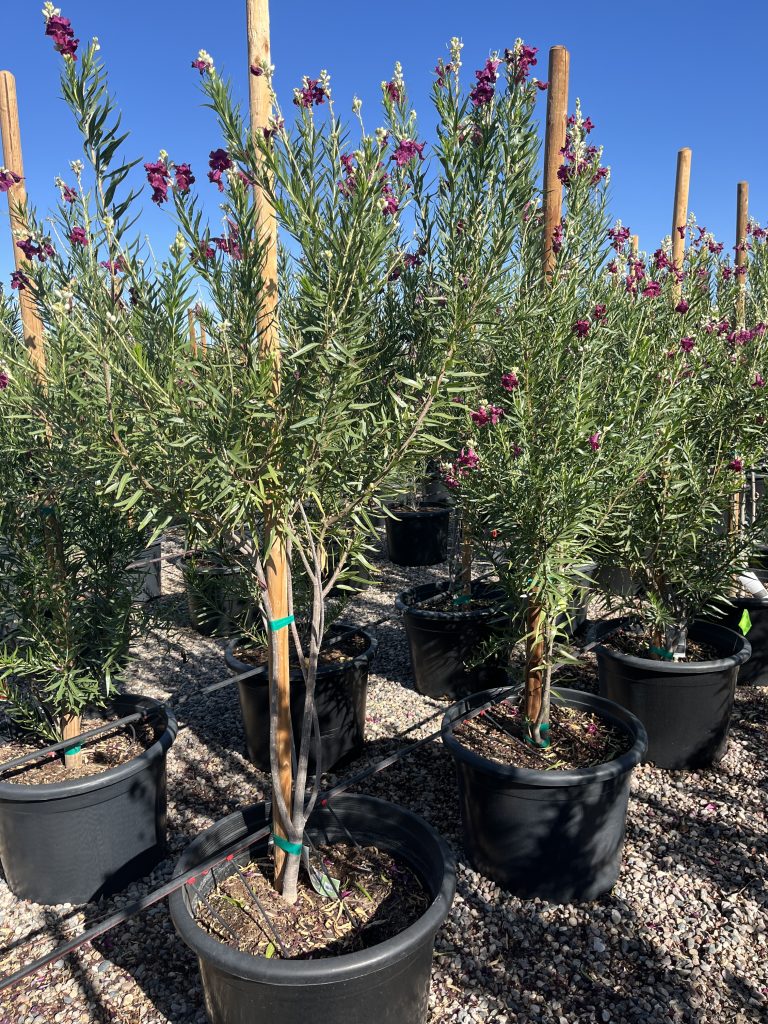
Bubbalicious Desert Willow (Chilopsis linearis 'Bubbalicious') is one of the showiest flowering trees you can grow in the Phoenix Valley. It erupts in large, trumpet-shaped blooms in deep rose, burgundy, and lavender from spring through fall — all while thriving on minimal water and punishing Arizona heat. Whether you're anchoring a front yard xeriscape in Scottsdale, adding bold color to a pool courtyard in Chandler, or creating a wildlife-friendly focal point in Gilbert — Bubbalicious Desert Willow delivers season-long drama with zero fuss.
Bubbalicious Desert Willow Plant Details
| Attribute | Detail |
|---|---|
| Scientific Name | Chilopsis linearis 'Bubbalicious' |
| Common Names | Bubbalicious Desert Willow, Desert Willow, Flowering Willow |
| Mature Height | 15–25 feet |
| Mature Width | 15–20 feet |
| Growth Rate | Moderate-fast — 2–3 feet per year in Phoenix |
| Sun | Full sun. Thrives in intense heat and reflected heat from walls and pavement. |
| Water | Very low once established. Highly drought-tolerant. |
| USDA Zones | 8–11 (Phoenix is Zone 9b–10a) |
| Soil | Well-draining. Adapts to Arizona caliche soils with ease. |
| Foliage | Deciduous — drops leaves in winter; leafs out again in spring |
| Bloom Color | Deep rose, burgundy, pink, and lavender — large trumpet flowers |
| Bloom Season | Spring through fall (multiple bloom cycles) |
| Native Status | Native to Arizona and the Sonoran Desert |
Bubbalicious Desert Willow Uses in Phoenix Landscapes
Flowering Focal Point & Specimen Tree
Bubbalicious Desert Willow is Phoenix's best native flowering tree for front yard focal points. Its large, orchid-like blooms in deep rose and burgundy are impossible to ignore from spring through fall. Plant it as a standalone specimen in a decomposed granite bed with low-growing Agave or Desert Spoon at the base — the contrast of bold blooms against structured succulents is striking and distinctly Sonoran.
Xeriscape & Low-Water Landscapes
As a native of the Sonoran Desert, Bubbalicious Desert Willow is perfectly adapted to Phoenix's low-water lifestyle. Once established, it needs very little supplemental irrigation — making it ideal for water-wise front yards, HOA buffers, and desert-style landscapes throughout Scottsdale, Mesa, and Peoria. Pair with Texas Sage, Blackfoot Daisy, or Ruellia for complementary color and texture at lower heights.
Hummingbird & Pollinator Garden
Few plants in the Phoenix Valley attract hummingbirds and native bees like Desert Willow. The large, tubular flowers are perfectly shaped for hummingbird feeding and are magnets for pollinators from the first warm days of spring through late fall. Plant near a patio or window where you can enjoy the wildlife activity up close. Bubbalicious is a top choice for certified wildlife habitat landscapes in Tempe, Chandler, and Gilbert.
Privacy Screen & Property Border
Planted 8–12 feet apart, Bubbalicious Desert Willows grow into a loose, airy privacy screen that provides filtered screening year-round (deciduous in winter). Its graceful form and flowering display make it a far more attractive option than solid block walls or evergreen hedges for modern desert and Southwestern-style properties.
Best Time to Plant Bubbalicious Desert Willow in Phoenix
Spring planting (February–April) is ideal. Desert Willow loves warmth and leafs out as temperatures rise — spring planting gives it the full warm season to establish before its first winter. Fall planting (October–November) is also excellent, allowing root development before the plant goes dormant. Avoid planting in peak summer heat (July–August) when transplant stress is highest.
How to Plant Bubbalicious Desert Willow
- Dig wide, not deep — 2–3x the root ball width, same depth as the root ball
- Check for caliche — break through any hardpan layer with a pick or bar to ensure drainage
- Backfill with native soil — no heavy amendment needed; a light 20% organic blend is fine
- Spacing — 15–20 ft apart for individual specimens; 8–12 ft for loose privacy screens
- Water basin — build a 3–4 inch soil ring around the root zone to direct water to roots
- Mulch — 2–3 inches of decomposed granite or bark mulch to retain moisture
Watering Bubbalicious Desert Willow in Phoenix
First Year Watering Schedule
- Weeks 1–2: Every 1–2 days, deep and slow (20–30 minutes)
- Month 1–2: Every 3–4 days
- Month 3–6: Every 7–10 days (5–7 days in peak summer heat)
- After Year 1: Every 14–21 days in summer; rainfall is often sufficient in winter
Drip Irrigation
Place emitters 18–24 inches from the trunk. Use 1–2 emitters per tree at 2–4 gallons per hour. Established Desert Willows are remarkably drought-tolerant — overwatering can actually promote excess leaf growth at the expense of flowers. Let the soil dry between deep waterings for best bloom production.
How fast does Bubbalicious Desert Willow grow in Phoenix?
Bubbalicious adds 2–3 feet per year in good conditions. A 15-gallon tree planted in spring can reach 10–12 feet by the end of its second growing season with proper watering.
Does it bloom all summer in Phoenix?
Yes — Bubbalicious Desert Willow has one of the longest bloom seasons of any flowering tree in Arizona. It typically flowers from March–April through October, with multiple flush cycles. Pruning spent blooms can encourage repeat flowering.
Is it truly drought tolerant?
Yes — as a native of the Sonoran Desert, Bubbalicious Desert Willow is one of the most drought-tolerant flowering trees available for Phoenix. After year 1–2, established trees often survive on Phoenix's natural rainfall alone, though supplemental summer deep watering maintains the best flower production.
Does it attract hummingbirds?
Absolutely — Desert Willow is one of the top hummingbird-attracting trees in Arizona. The tubular, orchid-like flowers are a primary nectar source for Anna's Hummingbirds (year-round in Phoenix) and migrating Rufous Hummingbirds in late summer and fall.
Is it messy or high-maintenance?
Very low maintenance. Desert Willow does drop its leaves in winter (it's deciduous), and seed pods can form after flowering — some gardeners trim these for a cleaner look. Otherwise, it requires only occasional deep watering and minimal pruning to shape.
You May Also Like
- Desert Willow — The standard species form with similar trumpet flowers; great for larger spaces where the full-size native look is desired.
- Sweet Bubba Desert Willow — A compact, sweetly fragrant cultivar of Desert Willow — perfect for smaller yards and patio areas.
- Texas Mountain Laurel — Stunning evergreen with grape-scented purple blooms in spring; pairs beautifully with Desert Willow for multi-season flowering interest.
- Cascalote Tree — Native Arizona tree with bright yellow blooms in winter and spring; perfect color contrast to Desert Willow's rose and burgundy flowers.
- Mexican Bird of Paradise — Fast-growing, bold yellow-orange blooms for summer color when Desert Willow is at its peak — a perfect landscape companion.
How Many Bubbalicious Desert Willows Do I Need?
Bubbalicious matures 15 to 20 feet wide with an open, airy crown. As a flowering focal point, plant it single in a front-yard bed or in an odd-numbered group of 3 spaced 15 to 20 feet apart so each canopy reads as its own splash of color. For a loose, blooming privacy line, tighten the spacing to about 10 feet on center.
| Run Length | Loose Screen (10 ft spacing) |
|---|---|
| 20 ft | 3 trees |
| 30 ft | 4 trees |
| 40 ft | 5 trees |
| 50 ft | 6 trees |
Bubbalicious Desert Willow Season-by-Season in Phoenix
- Spring (Feb to Apr): Leafs out as the soil warms and opens its first heavy flush of rose and burgundy trumpets. The best planting window of the year.
- Summer (May to Sep): Peak bloom right through the hottest months, including the monsoon, which often triggers a fresh surge of flowers. Thrives on reflected heat. Let the soil dry between deep soakings for the most blooms.
- Fall (Oct to Nov): Continues flowering into autumn and is a strong second planting window. Migrating hummingbirds work the late blooms.
- Winter (Dec to Jan): Drops its leaves and rests as a bare, sculptural form. Cold-hardy through Valley winters; no frost protection needed.
At a Glance
✔ Arizona Native ✔ Pollinator-Friendly ✔ Hummingbird-Friendly ✔ Heat-Loving (Reflected-Heat Tolerant) ✔ Drought-Tolerant ✔ Low-Maintenance ✔ Cold-Hardy to 10°F
Plant It With
- Desert Willow: the full-size native species for larger spaces and a matching trumpet-flower theme.
- Cascalote Tree: native tree with bright yellow winter blooms that contrast the rose and burgundy flowers.
- Texas Sage: low water-wise shrub for color and structure at the base of the tree.
- Red Yucca: architectural accent that feeds the same hummingbirds the willow attracts.
Is Bubbalicious Desert Willow Right for Your Yard?
Bubbalicious thrives in full sun and reflected heat, shrugs off caliche and alkaline soil with decent drainage, and blooms best on lean water once established. It is an ideal low-water focal or wildlife tree. Not a fit if you want year-round evergreen screening or a litter-free poolside tree: it drops its leaves in winter and forms slender seed pods after bloom, so plan it for beds and borders rather than tight pool decks.
Customer Reviews
Great prices, excellent service! I have recommended them to family and will use again :)
My willow is beautiful. Thank you for your excellent trees and your excellent service! You are the best!
Beautiful, healthy plants, already thriving & sprouting leaves!
Share