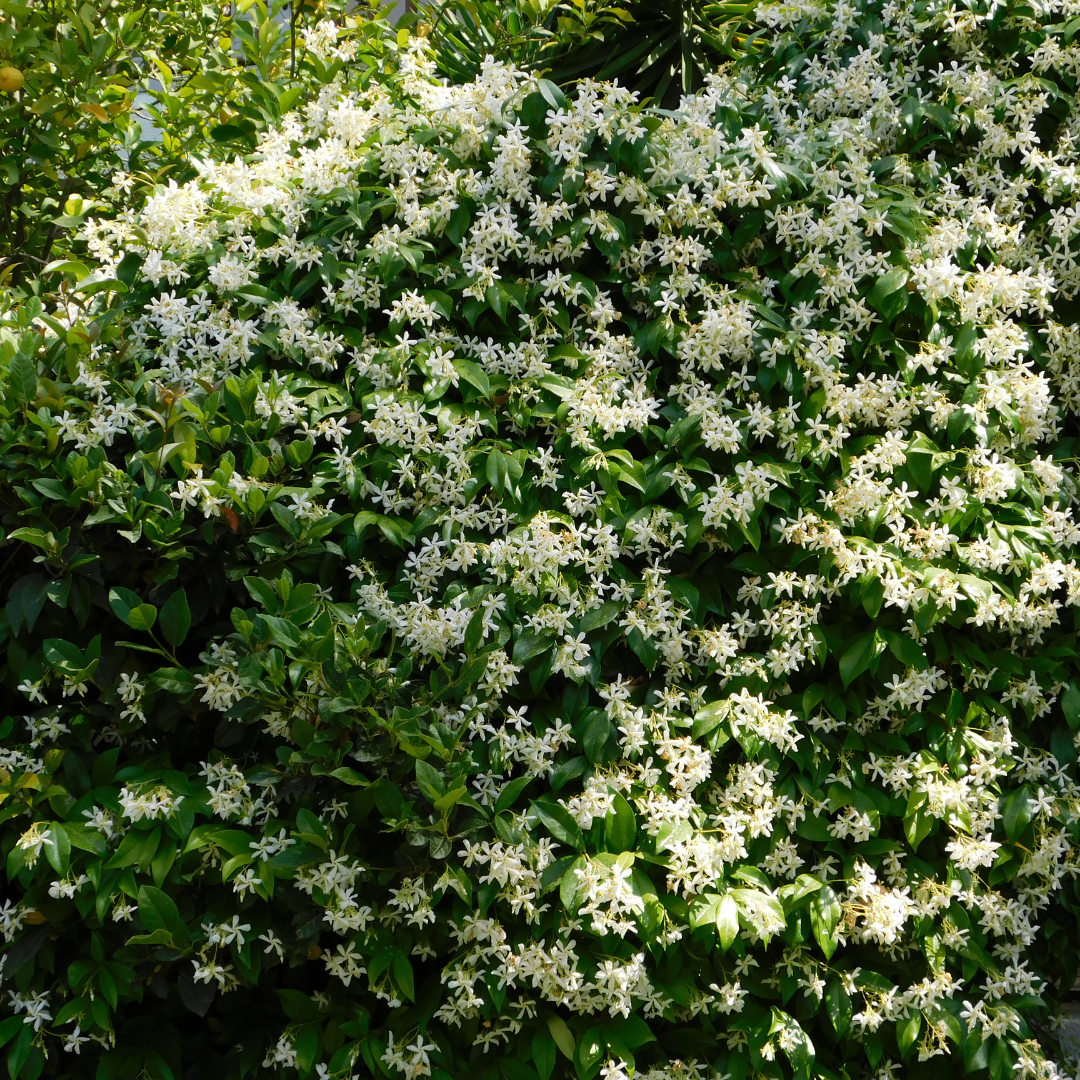

Asian Jasmine
Asian Jasmine
Couldn't load pickup availability
Phoenix's Best Low-Water Groundcover — Asian Jasmine for Shade & Full Sun
Asian Jasmine (Trachelospermum asiaticum) is the groundcover of choice for Phoenix homeowners who want a dense, evergreen carpet of lush foliage with minimal effort. Unlike struggling turf grass, Asian Jasmine thrives in both full sun and deep shade, spreads rapidly to fill large areas, and requires almost no maintenance once established. Growing just 6–8 inches tall but spreading up to 10 feet wide, this tough perennial creates a weed-suppressing, water-conserving living mulch that looks beautiful year-round. Whether you're replacing lawn under trees in Scottsdale, filling a shaded slope in Chandler, creating a clean border in Mesa, or carpeting a sunny hillside in Gilbert — Asian Jasmine is the answer.
Asian Jasmine Plant Details
| Attribute | Detail |
|---|---|
| Scientific Name | Trachelospermum asiaticum |
| Common Names | Asian Jasmine, Japanese Star Jasmine, Asiatic Jasmine |
| Mature Height | 6–8 inches (low-growing groundcover) |
| Mature Width | Up to 10 feet (spreads by trailing stems) |
| Growth Rate | Moderate to Fast — fills in quickly in Phoenix's long warm season |
| Sun | Full sun to full shade. Truly one of the most sun-adaptable groundcovers for Phoenix. |
| Water | Low to moderate once established. Highly drought-tolerant after first year. |
| USDA Zones | 7–10 (Phoenix is Zone 9b–10a) |
| Soil | Well-draining. Adapts readily to Arizona caliche soils. |
| Foliage | Evergreen — dense, glossy deep-green leaves year-round |
| Flowers | Small white or yellow fragrant flowers in late spring (less prolific than Star Jasmine) |
| Special Feature | Stays low, spreads wide — suppresses weeds, requires no mowing |
Asian Jasmine Uses in Phoenix Landscapes
Lawn Replacement Groundcover
Asian Jasmine is one of the best alternatives to traditional lawn in Phoenix. Unlike Bermuda or ryegrass, it requires no mowing, minimal watering once established, and stays green year-round without seasonal overseeding. Plant 12–18 inches apart for a dense mat that fills in within 2–3 growing seasons in Scottsdale, Tempe, and Chandler. Once established, it creates a seamless, weed-resistant carpet that saves water and maintenance hours compared to traditional turf.
Shade Groundcover Under Trees
Asian Jasmine is one of the very few plants that thrives in the deep shade under large canopy trees like Mesquites, Palo Verdes, and Sissoos in Phoenix landscapes. Where lawn and other groundcovers fail from lack of light, Asian Jasmine fills in beautifully. Plant it under mature trees in Peoria, Glendale, and Avondale yards and watch it gradually create a lush, low-maintenance forest-floor effect that requires almost no supplemental care.
Slope and Bank Stabilization
Asian Jasmine's trailing stems root as they spread, making it an excellent slope stabilizer for hillsides and banks across the East Valley. Its dense mat of stems and roots prevents erosion while creating a clean, manicured appearance. For slopes in Queen Creek, Gilbert, and Cave Creek, plant 12 inches apart and expect full coverage within 2 seasons. No need to wrestle with steep terrain — Asian Jasmine does the stabilizing work while looking great.
Pool-Safe Border and Edge Planting
Asian Jasmine's minimal leaf drop, low height, and lack of thorns make it an excellent border plant around pool decks and spa areas in Chandler and Scottsdale. It stays contained without aggressive spreading into pool water, provides a clean green edge along pool coping, and tolerates the humidity and occasional splashing around pool environments. Pair with Asparagus Fern and Tropical Bird of Paradise for a complete poolside tropical groundcover planting.
Best Time to Plant Asian Jasmine in Phoenix
Fall (October–November) is the ideal planting window — cooler temperatures reduce transplant stress while warm soil promotes root establishment before winter. A fall-planted Asian Jasmine gets 5–6 months of cool-season root growth before facing its first Phoenix summer. Spring planting (February–April) works well too. Avoid summer planting if possible — if you must plant in June–August, water daily for the first 2–3 weeks and provide shade cloth over the plants until temperatures drop below 100°F consistently.
How to Plant Asian Jasmine
- Site selection — Asian Jasmine works in virtually any exposure: full sun, partial shade, or deep shade. Choose based on the area you're filling.
- Prepare the bed — till or loosen the soil 6–8 inches deep; break through caliche layers to improve drainage. Remove weeds thoroughly — once planted, weeding through established Asian Jasmine is difficult.
- Amend lightly — mix in 20–30% organic compost with native soil for better establishment. Asian Jasmine adapts to poor soils but establishes faster with some amendment.
- Spacing — 12 inches apart for fastest coverage; 18 inches for a slightly longer fill-in time. In shaded areas, 12 inches is recommended since growth is slower.
- Water basin — for individual plants, build a small 2-inch berm; for mass plantings, ensure the entire bed gets even coverage during initial watering.
- Mulch — apply 1–2 inches of bark or gravel mulch between plants while they establish to suppress weeds and retain moisture.
Watering Asian Jasmine in Phoenix
First Year Watering Schedule
Asian Jasmine needs consistent moisture during its first year to establish a deep root system. Once established, it's remarkably drought-tolerant:
- Weeks 1–2: Every 1–2 days, deep and slow
- Month 1–2: Every 2–3 days in summer; every 3–4 days in spring/fall
- Month 3–6: Every 5–7 days in summer; every 7–10 days in cooler months
- After Year 1: Every 10–14 days in summer; every 3–4 weeks in winter (rainfall may be sufficient)
Drip Irrigation
For mass plantings, use micro-spray heads or a grid of 1 GPH emitters spaced 18–24 inches apart to ensure even coverage across the entire bed. Individual plants can be served with a single 1 GPH emitter. Once established, Asian Jasmine in full shade locations may need as little as monthly deep watering in winter — one of the most water-efficient groundcovers available for Phoenix landscapes.
How fast does Asian Jasmine spread in Phoenix?
In Phoenix's long growing season, Asian Jasmine typically spreads 1–2 feet per year from each plant. A mass planting of 1-gallon plants at 12 inches apart can achieve full coverage in 2–3 seasons. Plants in full sun spread faster than those in deep shade. Regular watering during the first two seasons significantly accelerates fill-in time.
Does Asian Jasmine stay evergreen in Phoenix?
Yes — Asian Jasmine remains evergreen through Phoenix's mild winters. In rare cold snaps below 20°F (which almost never occur in Phoenix's Zone 9b–10a climate), plants may experience slight leaf damage. But in normal Phoenix winters, Asian Jasmine stays dense and green year-round with no dieback or dormancy.
Does Asian Jasmine need to be mowed?
No — this is one of its great advantages over turf grass. Asian Jasmine stays naturally at 6–8 inches tall without any mowing. Occasional edging along borders and walkways keeps it looking neat. Some homeowners do a light once-a-year trim with a string trimmer to refresh the appearance and encourage new growth, but this is optional.
Is Asian Jasmine the same as Star Jasmine?
They're closely related but different plants. Asian Jasmine (Trachelospermum asiaticum) is a lower-growing groundcover (6–8 inches) with smaller leaves and less fragrant flowers. Star Jasmine (Trachelospermum jasminoides) grows taller (15–20 feet as a vine) with larger leaves and very fragrant white flowers. Both are excellent Three Timbers plants — Star Jasmine for walls and espaliers, Asian Jasmine for groundcover plantings.
Can Asian Jasmine handle Phoenix's reflected heat?
Yes — established Asian Jasmine handles Phoenix's full sun and reflected heat from walls and pavement. In its first summer, provide afternoon shade if planted in western or southern exposure areas with significant reflected heat. After year one, it handles Phoenix's extreme summer conditions with only bi-weekly irrigation.
You May Also Like
Star Jasmine Espalier — The taller, more fragrant cousin of Asian Jasmine — trained flat on walls and fences for dramatic vertical coverage in Phoenix landscapes.
Asparagus Fern — Another shade-tolerant evergreen perennial that works beautifully alongside Asian Jasmine in shaded Phoenix borders and groundcover combinations.
Dwarf Elephant's Food — A low-water succulent groundcover that pairs with Asian Jasmine for a textural contrast in sunny Phoenix beds.
Ruellia (Mexican Petunia) — A low-water flowering perennial that adds colorful vertical interest above Asian Jasmine groundcover beds.
Tropical Bird of Paradise — A bold, upright tropical perennial that creates dramatic height contrast above a carpet of Asian Jasmine in Phoenix poolside gardens.
How Many Asian Jasmine Do I Need?
Asian Jasmine spreads by trailing stems, so plant it on a grid for even coverage. Space plants 12 inches apart for the fastest fill, or 18 inches for a slower, more economical fill. The table below uses 12-inch spacing:
| Area to cover | Plants needed (12 in spacing) |
|---|---|
| 25 sq ft | 25 plants |
| 50 sq ft | 50 plants |
| 100 sq ft | 100 plants |
| 250 sq ft | 250 plants |
At 18-inch spacing you need roughly half as many plants, but expect an extra season for full coverage. In deep shade, keep to 12-inch spacing since growth is slower.
Asian Jasmine Season-by-Season in Phoenix
- Spring (Feb to Apr): A flush of glossy new growth, with small fragrant white-to-yellow flowers in late spring. A strong second planting window.
- Summer (May to Sep): Spreads fastest in the long warm season. Established plants take full sun and reflected heat on roughly bi-weekly water, and monsoon humidity is welcome.
- Fall (Oct to Nov): The prime planting window. Cool air plus warm soil give roots a fast, low-stress start before winter.
- Winter (Dec to Jan): Stays dense and evergreen through typical Valley winters. Only a rare hard freeze below about 20 degrees causes minor leaf nip, which it grows out of in spring.
At a Glance
✔ Heat-Loving (Reflected-Heat Tolerant) ✔ Drought-Tolerant ✔ Evergreen ✔ Pool-Friendly (Low-Litter) ✔ Low-Maintenance ✔ Cold-Hardy to 15°F
Plant It With
- Asparagus Fern: a shade-tolerant evergreen filler that layers soft texture above the jasmine carpet.
- Foxtail Fern: upright plume-like fronds for a refined textural accent in shaded beds.
- Elephant's Food: a low-water succulent for textural contrast in the sunnier sections.
- Tropical Bird of Paradise: a bold upright tropical that adds dramatic height above the groundcover.
Is Asian Jasmine Right for Your Yard?
Asian Jasmine thrives in full sun through deep shade, in well-draining or caliche soils, on low water once established. It is ideal for lawn replacement, shaded under-tree beds, slopes, and clean poolside borders. It is not a fit if you need instant coverage, since it takes 2 to 3 seasons to fill in, or in a tight bed with no edging, since it spreads widely and is hard to weed once dense.
Share