

Argentine King Mesquite CCF sizes, side by side
Typical height of the plants we have in stock now, measured from the soil to the top. Every plant is a little different.
| Size | At delivery | Price |
|---|
Argentine King Mesquite CCF
Argentine King Mesquite CCF
Couldn't load pickup availability
Phoenix's Premier Thornless Desert Shade Tree — Argentine King Mesquite
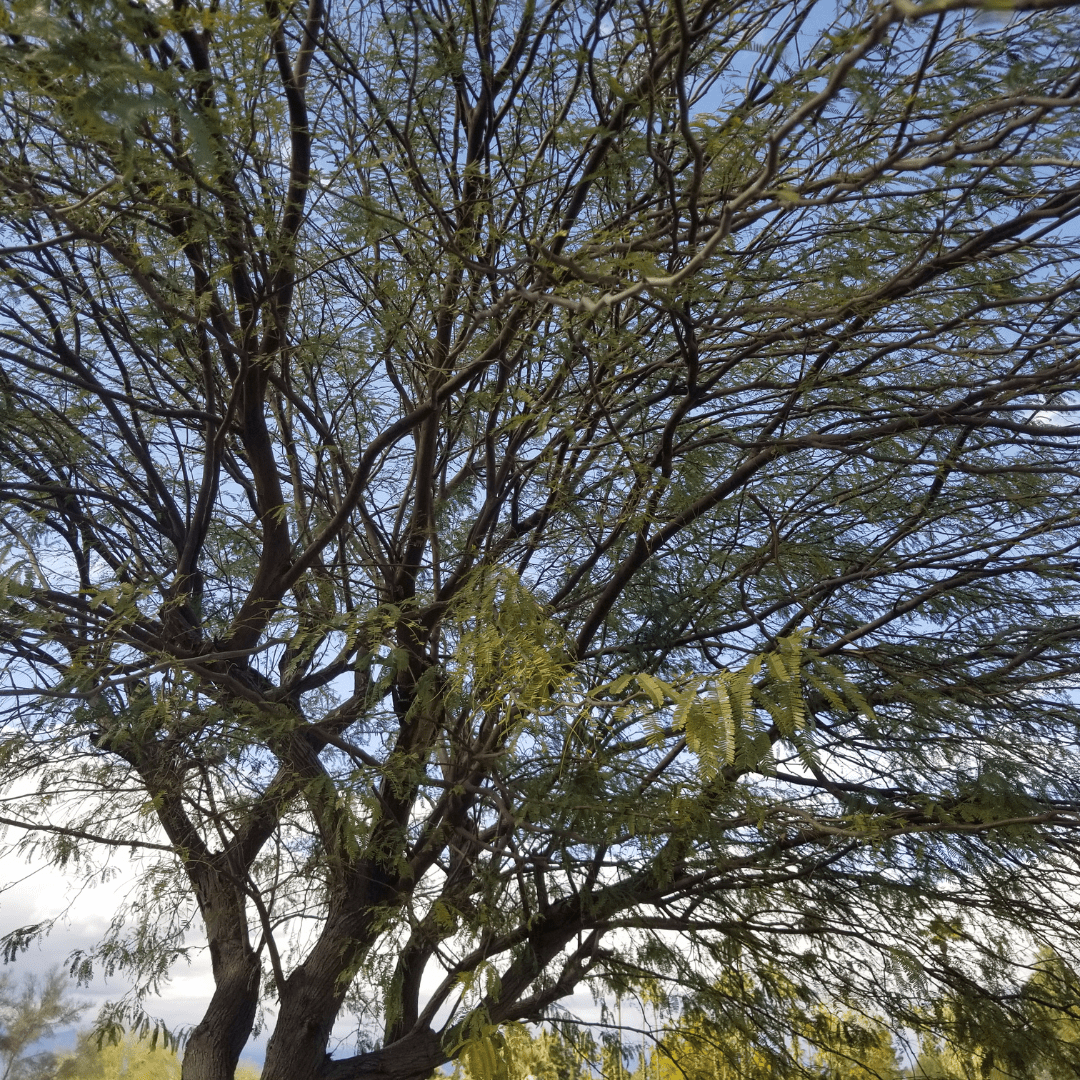
Argentine King Mesquite (Prosopis alba) is one of the most impressive thornless shade trees available across the Phoenix Valley — and a perennial favorite at Three Timbers. This elegant, large-canopy tree produces a broad, arching framework of branches draped in fine-textured, bright green foliage that delivers exceptional dappled shade while remaining perfectly adapted to Arizona's extreme heat, drought, and alkaline soils. With fragrant spring blooms, graceful weeping branch tips, and overall sculptural beauty, Argentine King Mesquite brings natural desert grandeur to landscapes in Scottsdale, Chandler, Mesa, Gilbert, and Glendale.
Argentine King Mesquite Plant Details
| Attribute | Detail |
|---|---|
| Scientific Name | Prosopis alba |
| Common Names | Argentine Mesquite, Argentine King Mesquite, White Carob |
| Mature Height | About 25 feet |
| Mature Width | About 25 feet |
| Growth Rate | Moderate to fast: a little slower than standard Argentine Mesquite |
| Sun | Full sun (6+ hrs). Handles reflected heat from walls and pavement. |
| Water | Low once established. Highly drought-tolerant. |
| USDA Zones | 9–11 (Phoenix is Zone 9b–10a) |
| Soil | Well-draining. Adapts to Arizona caliche soils. |
| Foliage | Semi-evergreen — may drop leaves briefly in cold winters |
| CCF | Cox Cactus Farm exclusive: a thornless Argentine Mesquite selection |
Argentine King Mesquite Uses in Phoenix Landscapes
Thornless Shade Canopy
Argentine King Mesquite grows a little slower than standard Argentine Mesquite, but its wide, self-branching canopy builds a cooling umbrella of dappled shade over patios, driveways, and seating areas, with no thorns and minimal trimming. Pair it with a drip system and watch it establish rapidly in Scottsdale, Chandler, or Mesa.
Large Residential and Commercial Landscapes
With a mature spread of about 25 feet, Argentine King Mesquite is perfectly scaled for large residential yards, commercial properties, and streetscapes throughout the Phoenix Valley. Its graceful, arching branch structure creates natural visual interest even in winter. Plant as a standalone specimen or space 25–30 feet apart for a parkway row or commercial canopy planting.
Low-Water Desert Landscaping
Once established, Argentine King Mesquite is remarkably drought-tolerant and requires minimal supplemental irrigation. It thrives in Phoenix's caliche-heavy, alkaline soils with no amendments needed once settled in. This makes it a top pick for eco-conscious desert landscapes and water-smart xeriscaping projects across Gilbert, Peoria, Glendale, and Tempe.
Keep It Back from the Pool
University of Arizona Extension lists mesquites among the plants to keep far away from pools. Argentine King drops fine leaflets, spring catkins, and seed pods that collect in skimmers and filters, and its wide canopy and surface roots need room. If you want shade near a pool, set the trunk at least 15 to 20 feet back from the edge, downwind if you can, so the canopy shades the yard without hanging over the water.
Best Time to Plant Argentine King Mesquite in Phoenix
Fall planting (October–November) is ideal: soil stays warm enough to stimulate root growth while cooler air temperatures reduce transplant stress. Plants get 6–8 months of root establishment before facing their first Phoenix summer. Spring (February–April) is the second-best window. Summer planting is possible with diligent watering but requires extra attention during the first few months.
How to Plant Argentine King Mesquite
- Dig wide, not deep — excavate 2–3x the width of the root ball but only as deep as the root ball itself.
- Check for caliche — break through any hardpan layer beneath the hole for proper drainage.
- Backfill with native soil — a light 20% organic amendment is optional but not required.
- Spacing — 25–30 feet apart for canopy rows; 15–20 feet for closer screening.
- Water basin — build a 3–4 inch earthen ring around the drip line to direct water to roots.
- Mulch — apply 2–3 inches of bark or gravel mulch to retain moisture and regulate soil temperature.
Watering Argentine King Mesquite in Phoenix
First Year Watering Schedule
- Weeks 1–2: Every 1–2 days, deep and slow (20–30 minutes)
- Months 1–2: Every 3–4 days
- Months 3–6: Every 7–10 days (every 5–7 days during peak summer)
- After Year 1: Every 10–14 days in summer; every 3–4 weeks in winter
Drip Irrigation
Place emitters 18–24 inches from the trunk using 1–2 GPH emitters. Run irrigation for 45–60 minutes per cycle to encourage deep root development. Once fully established (year 2+), Argentine King Mesquite needs very little supplemental water and can often thrive on Phoenix's natural rainfall alone in cooler months.
How fast does Argentine King Mesquite grow in Phoenix?
Cox Cactus Farm, the grower, notes that Argentine King grows a little slower than standard Argentine Mesquite. With deep watering during establishment it grows steadily toward a mature size of about 25 feet tall and wide.
Is Argentine King Mesquite drought tolerant?
Yes. Once established (typically after the first full growing season), Argentine King Mesquite is highly drought-tolerant and can survive on minimal supplemental irrigation. It's a natural choice for water-smart desert landscapes.
What does "CCF" mean?
"CCF" stands for Cox Cactus Farm, the Phoenix grower behind this selection. Argentine King Mesquite CCF is a Cox Cactus Farm exclusive: a thornless Argentine Mesquite with a self-branching habit that needs minimal trimming.
Can Argentine King Mesquite handle Phoenix's reflected heat?
Absolutely. Argentine King Mesquite thrives under reflected heat from stucco walls, concrete driveways, and pavement — making it ideal for the urban heat island conditions found throughout the Valley in Scottsdale, Tempe, and Phoenix proper.
How is Argentine King Mesquite different from Chilean Mesquite?
Both are popular Phoenix shade trees, but Argentine King Mesquite CCF (Prosopis alba) is a thornless, self-branching selection with slightly larger leaves than Chilean Mesquite (Prosopis chilensis). Argentine King is also prized for its more formal branch structure, making it an excellent street or parkway tree.
You May Also Like
- Chilean Mesquite — A fast-growing mesquite with a graceful weeping canopy, ideal for backyard shade in Phoenix and Scottsdale.
- Leslie Roy Mesquite — A large-canopy hybrid mesquite with an expansive spread, perfect for large estates and commercial properties.
- Cooperi Mesquite — A compact hybrid mesquite with a refined, tidy canopy ideal for smaller yards in Chandler and Gilbert.
- Desert Museum Palo Verde — A thornless, fast-growing native tree with brilliant yellow spring blooms — a pool-friendly desert landscape favorite.
- Foothill Palo Verde — Arizona's native state tree with striking yellow blooms and a rugged, architectural form suited to low-water xeriscape design.
How Many Argentine King Mesquite Do I Need?
Argentine King is a large shade tree (about 25 feet wide at maturity), planted as a single canopy specimen or spaced in a row for a parkway, driveway, or commercial planting. Use its mature width to set spacing: 25 to 30 feet apart for fully separated crowns, or 15 to 20 feet for faster canopy overlap on a screening row.
| Row length | Trees needed (at 28 ft spacing) |
|---|---|
| 28 ft (single specimen) | 1 tree |
| 56 ft | 2 to 3 trees |
| 84 ft | 3 to 4 trees |
| 120 ft | 5 trees |
For a single backyard shade tree, one Argentine King is plenty. Give it 20-plus feet of clearance from structures, and keep the trunk at least 15 to 20 feet off a pool edge so the wide canopy and surface roots have room.
Argentine King Mesquite Season-by-Season in Phoenix
- Spring (Feb to Apr): Strong new-growth flush and fragrant creamy catkin flowers that feed bees. Best second planting window once nights stay above freezing.
- Summer (May to Sep): Peak growth and shade. The fine canopy shrugs off 110-plus degree heat and reflected heat off walls and pavement. Monsoon storms (Jul to Sep) drive its main growth flush. Cox notes its deep root system keeps it stable in strong wind; stake young trees until they root in.
- Fall (Oct to Nov): Prime Phoenix planting season. Seed-pod drop tapers and the tree settles in on little water.
- Winter (Dec to Jan): Semi-evergreen, holding most leaves but dropping some in a cold snap. Hardy to about 20°F, so it rarely shows real frost damage in the Valley.
At a Glance
✔ Pollinator-Friendly ✔ Heat-Loving (Reflected-Heat Tolerant) ✔ Drought-Tolerant ✔ Low-Maintenance ✔ Shade-Providing ✔ Cold-Hardy to 20°F
Plant It With
- Chilean Mesquite: a weeping-canopy cousin that mixes well in a large mesquite grove or shade row.
- Desert Museum Palo Verde: a thornless native with brilliant yellow spring bloom to contrast the mesquite's green canopy.
- Leslie Roy Mesquite: a broad hybrid mesquite for estates and commercial canopy plantings.
- Foothill Palo Verde: Arizona's rugged native state tree for a low-water companion accent.
Is Argentine King Mesquite Right for Your Yard?
Argentine King thrives in full sun and reflected heat, adapts to alkaline caliche soils (break through hardpan at planting), and wants about 25 feet of width plus room for spreading surface roots. It is a thornless Cox Cactus Farm selection. It is not the right fit for a small yard or a barefoot pool deck, since the canopy and roots grow large and it can drop seed pods.
Share