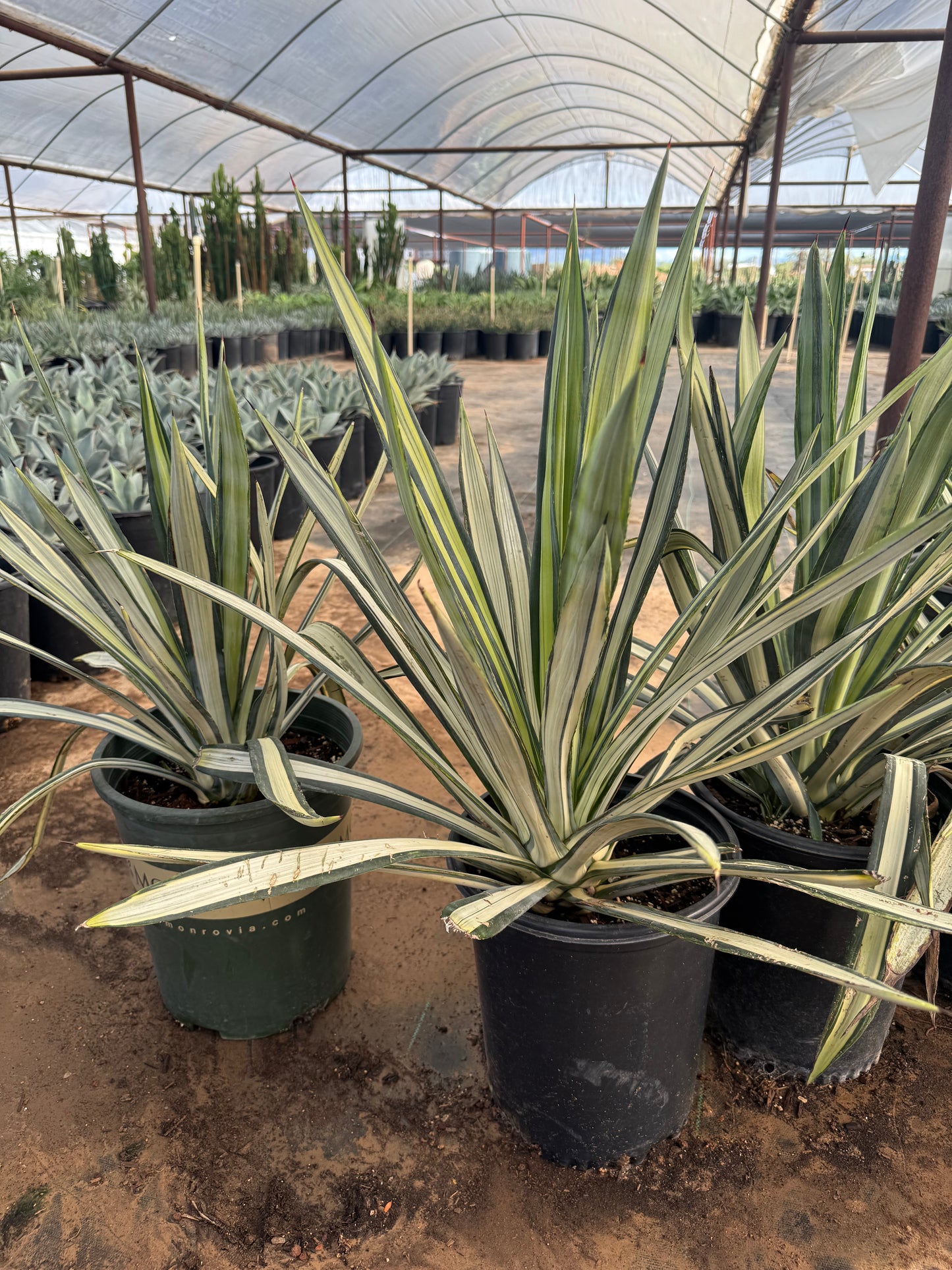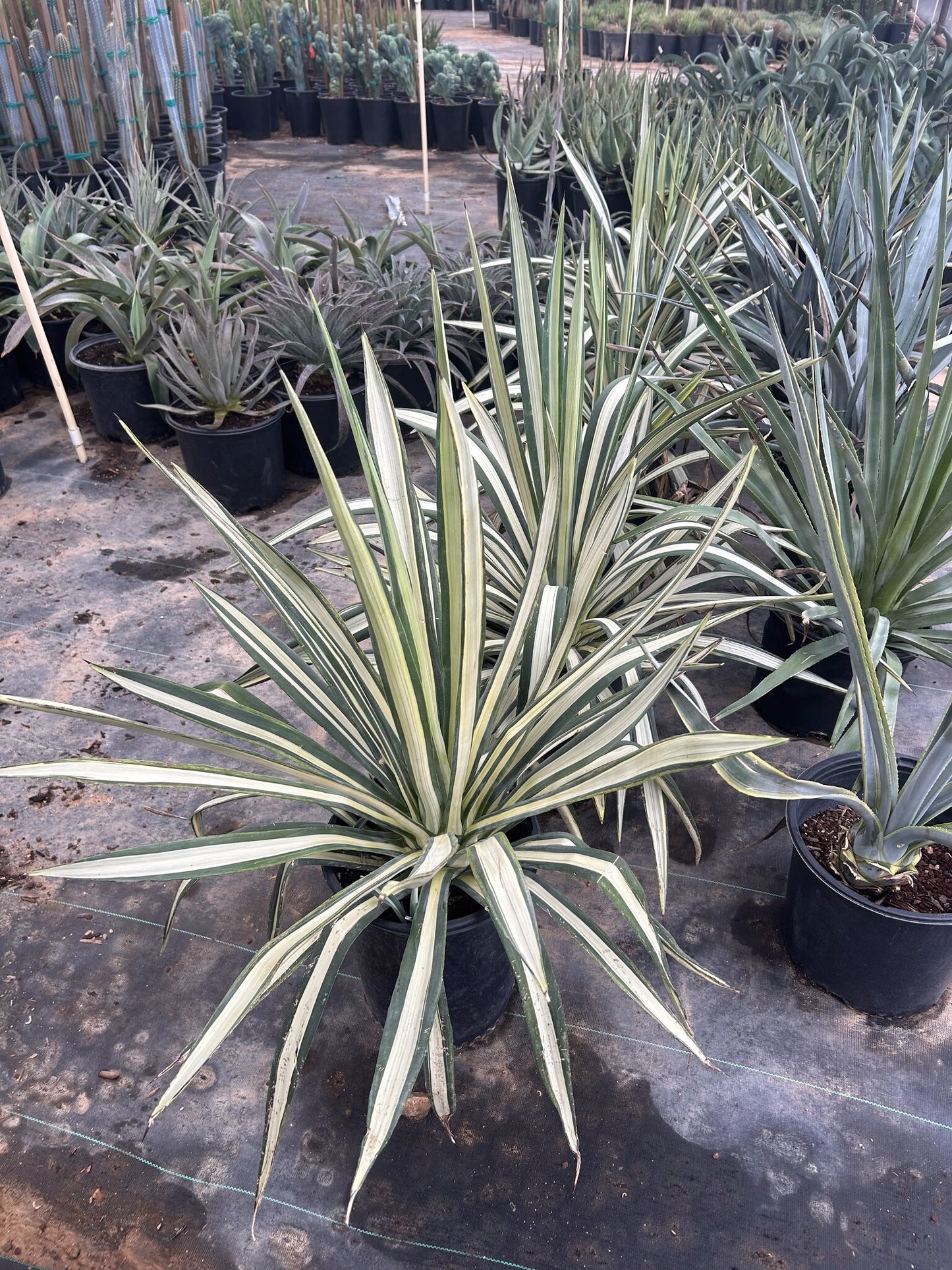


Agave Sisalana-variegated
Agave Sisalana-variegated
Couldn't load pickup availability
Phoenix's Boldest Variegated Agave for Large Desert Landscapes
Agave sisalana 'Variegata', commonly known as Variegated Sisal Agave, is one of the most visually dramatic large agaves available for Phoenix Valley gardens. Its tall, sword-like leaves are boldly striped with cream and green — creating a massive, eye-catching rosette that dominates any landscape. Extremely heat-tolerant and drought-hardy once established, this agave thrives across Scottsdale, Mesa, Chandler, Gilbert, and Tempe with minimal care. Whether you're making a grand entrance statement in Paradise Valley, anchoring a large xeriscape bed in Peoria, or adding tropical flair to a desert garden in Glendale — Variegated Sisal Agave delivers unmatched scale and color.
Agave Sisalana Variegated Plant Details
| Attribute | Detail |
|---|---|
| Scientific Name | Agave sisalana 'Variegata' |
| Common Names | Variegated Sisal Agave, Agave Sisalana Variegated |
| Mature Height | 5–7 feet |
| Mature Width | 5–8 feet |
| Growth Rate | Moderate — reaches full size in 5–8 years in Phoenix |
| Sun | Full sun (6+ hrs). Handles reflected heat from walls and pavement without issue. |
| Water | Low once established. Highly drought-tolerant. |
| USDA Zones | 9–11 (Phoenix is Zone 9b–10a) |
| Soil | Well-draining required. Adapts to Arizona caliche and rocky native soils. |
| Foliage | Evergreen — bold cream and green striped sword-like leaves with terminal spines |
| Bloom | Creamy-white to yellow flower spike up to 20 feet tall (monocarpic — blooms once) |
Agave Sisalana Variegated Uses in Phoenix Landscapes
Grand Entrance & Focal Point
With a mature spread of 5–8 feet and striking variegated foliage, this agave commands attention as a standalone specimen. Plant at the entrance to a driveway, in a roundabout, or at the center of a front yard desert bed. Its bold cream-and-green stripes are visible from a distance, creating instant curb appeal.
Tropical Desert Design
The variegated foliage adds a tropical feel to desert landscapes — perfect for resort-style homes, pool areas, and outdoor living spaces. Pair with fan palms, Bird of Paradise, and bougainvillea for a lush, colorful desert-tropical look that still thrives on low water.
Large Xeriscape & Commercial Landscapes
Ideal for commercial properties, HOA common areas, and large residential lots where dramatic scale is needed. Once established, it needs no supplemental irrigation. Its architectural form and bold coloring make it a favorite for landscape architects working on Phoenix-area projects.
Best Time to Plant Agave Sisalana Variegated in Phoenix
Fall (October–November) is ideal. Warm soil promotes root growth while cooler air reduces transplant stress, giving the plant 6–8 months to establish before its first Phoenix summer. Spring (February–April) is the second-best window. Avoid planting in peak summer — especially important for larger container sizes.
How to Plant Agave Sisalana Variegated
- Dig wide, not deep — 2–3x the root ball width, same depth as the container.
- Check for caliche — break through any hardpan layer for proper drainage.
- Backfill with native soil — a light 20% pumice or gravel amendment helps in heavy clay.
- Spacing — give each plant at least 6–8 feet of clearance to accommodate its large mature spread.
- Water basin — build a 4–5 inch soil ring to direct water to the root zone during establishment.
- Mulch — 3–4 inches of decorative gravel or decomposed granite around the base.
Watering Agave Sisalana Variegated in Phoenix
First Year Watering Schedule
Weeks 1–2: Every 2–3 days, deep and slow (20–30 min for larger sizes). Month 1–3: Every 5–7 days. Month 3–6: Every 10–14 days. After Year 1: Every 2–3 weeks in summer; little to no water in winter.
Drip Irrigation
Place two 2 GPH emitters 18–24 inches from the base on opposite sides. Established plants need very little supplemental water — overwatering causes root rot.
How big does Variegated Sisal Agave get?
It's a large agave, reaching 5–7 feet tall and 5–8 feet wide at maturity. Plan for its full size when choosing a location — it needs plenty of room.
What makes it different from regular Sisal Agave?
The variegated form features bold cream and green striping on each leaf, compared to the solid green of the standard species. The variegation makes it far more ornamental and sought-after for landscape use.
Is it drought tolerant?
Highly. Once established after the first year, it thrives on Phoenix rainfall alone and handles extended dry periods without stress.
Does it produce pups?
Yes, it can produce offsets and bulbils (small plantlets on the flower stalk). Pups can be divided and replanted to expand your collection.
You May Also Like
- Agave Marmorata — Massive marbled agave for grand landscape statements.
- Agave Lopantha — Colorful striped agave in a more compact size.
- Agave Guadalajarana — Wide blue-gray sculptural agave with bold presence.
- Desert Spoon (Dasylirion wheeleri) — Silvery native accent plant for desert landscapes.
How Many Agave Sisalana Variegated Do I Need?
This is a large specimen agave (5 to 8 ft wide at maturity), so it is planted singly or in small, well-spaced groups rather than as a hedge. Give each rosette room to show its full variegated form and keep terminal spines clear of walkways and pool decks.
| Use | Spacing & Count |
|---|---|
| Single focal point | 1 plant, center of a bed or entry with 8 ft of open clearance |
| Sculptural trio | 3 plants in an odd-numbered cluster, 6 to 8 ft apart so each rosette stands clear |
| Large bed / commercial procession | Space 8 ft on center; about 3 plants per 24 linear ft |
Agave Sisalana Variegated Season-by-Season in Phoenix
- Spring (Feb–Apr): Strong root and leaf growth resumes as soil warms. A prime second window to plant and the best time to divide pups or bulbils.
- Summer (May–Sep): Loves the heat and shrugs off reflected heat from walls and paving. Needs only occasional deep water. Monsoon rain (Jul–Sep) is usually plenty; do not let it sit in standing water.
- Fall (Oct–Nov): The ideal planting season in Phoenix. Warm soil and mild air let it establish before winter.
- Winter (Dec–Jan): Stays evergreen and holds its cream-and-green color. This is a frost-tender agave: leaves can scar below about 28°F. On hard-frost nights cover the rosette with frost cloth, especially while young.
At a Glance
✔ Heat-Loving (Reflected-Heat Tolerant) ✔ Drought-Tolerant ✔ Evergreen ✔ Low-Maintenance ✔ Deer & Rabbit-Resistant
Plant It With
- Agave Marmorata: another massive marbled specimen for matching grand scale.
- Agave Lophantha: a colorful striped agave in a more compact size for the foreground.
- Agave Guadalajarana: a wide blue-gray sculptural agave that contrasts the variegated leaves.
- Desert Spoon: a silvery native accent that softens the bold rosette with fine texture.
Is Agave Sisalana Variegated Right for Your Yard?
It thrives in full sun and reflected heat, in fast-draining caliche or rocky native soil, with room to reach 5 to 8 ft across. Give it space away from foot traffic so the terminal spines stay clear. It is not a fit if you have a small or narrow bed, heavy soil that holds water, or a frost-prone low spot where you cannot cover it on the coldest nights.
Share