

Agave Lophantha
Agave Lophantha
Couldn't load pickup availability
Phoenix's Most Colorful Striped Agave for Desert Gardens
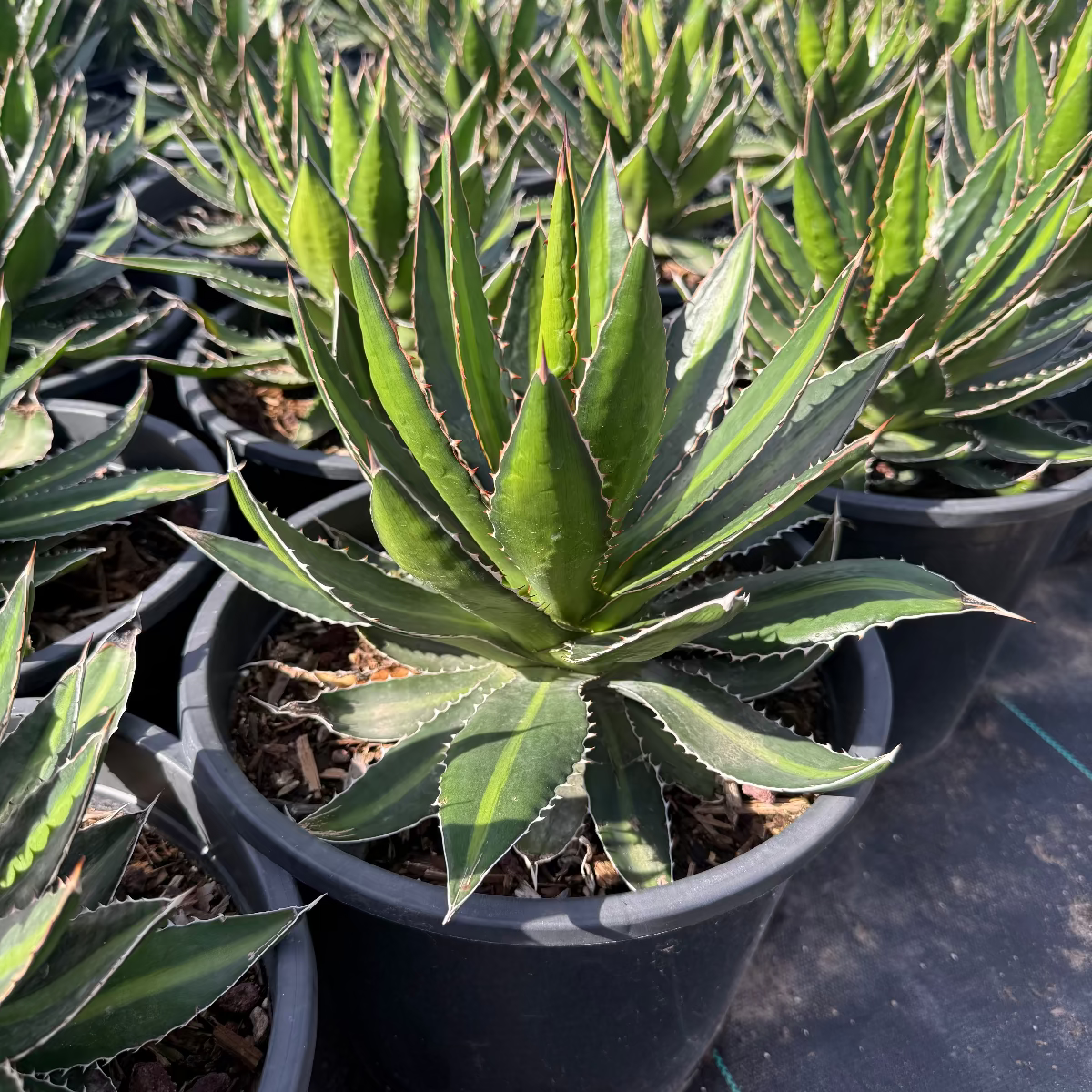
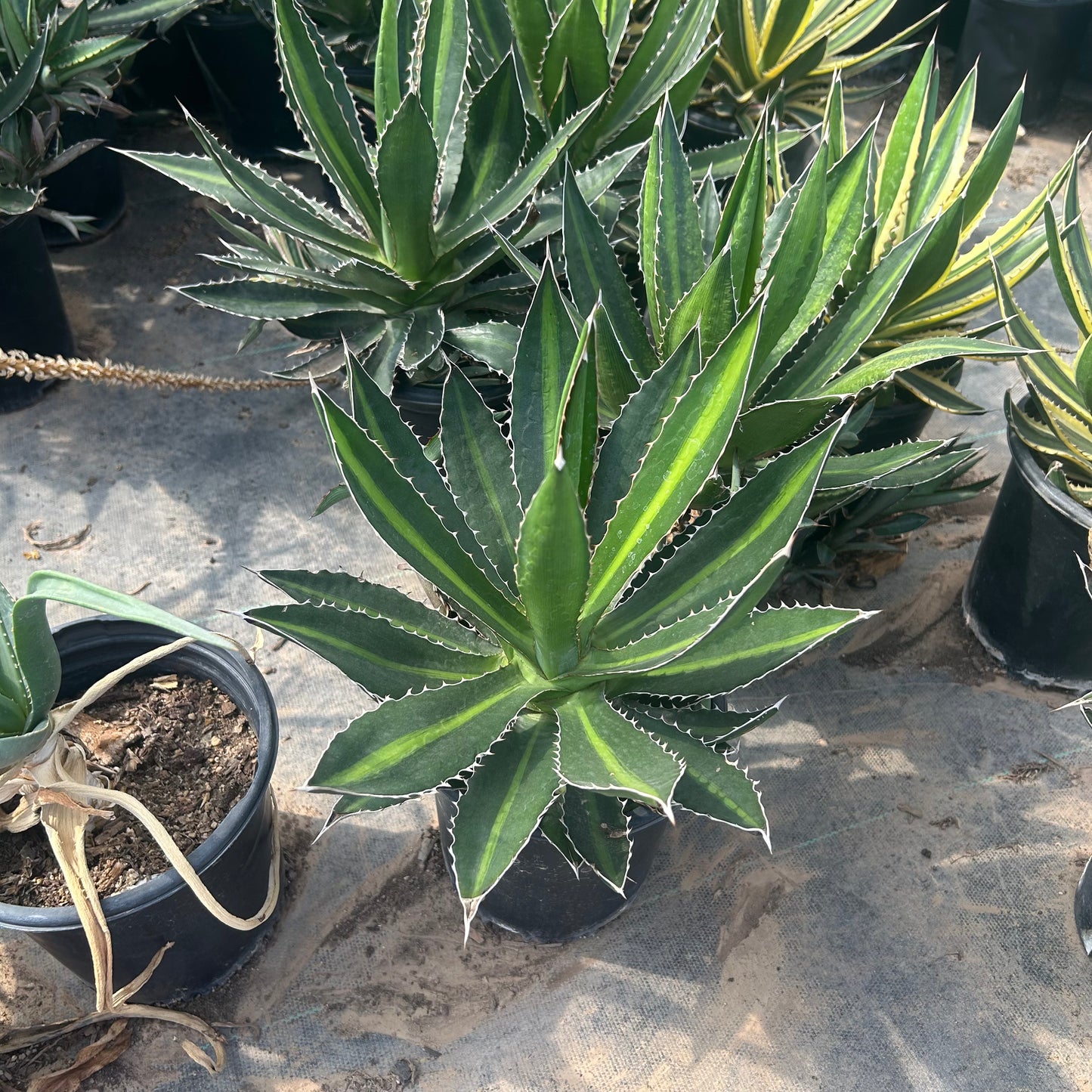
Agave lophantha, commonly sold as Agave Lopantha or Quadricolor Agave, is one of the most visually striking agaves for Phoenix Valley landscapes. Its narrow green leaves are edged with bold cream and yellow stripes and lined with small teeth — creating a multicolored rosette that stands out in any setting. Fast-growing for an agave and extremely heat-tolerant, it thrives across Scottsdale, Mesa, Chandler, Gilbert, and Tempe with minimal water once established. Whether you're adding a burst of color to a xeriscape bed in Paradise Valley, creating a container display in Peoria, or building a mixed succulent garden in Glendale — Agave Lopantha delivers year-round visual punch.
Agave Lopantha Plant Details
| Attribute | Detail |
|---|---|
| Scientific Name | Agave lophantha |
| Common Names | Agave Lopantha, Quadricolor Agave, Center Stripe Agave |
| Mature Height | 2–3 feet |
| Mature Width | 3–4 feet |
| Growth Rate | Moderate to fast — reaches full size in 3–5 years in Phoenix |
| Sun | Full sun (6+ hrs). Handles reflected heat from walls and pavement. Tolerates partial shade. |
| Water | Low once established. Highly drought-tolerant. |
| USDA Zones | 8–11 (Phoenix is Zone 9b–10a) |
| Soil | Well-draining required. Adapts to Arizona caliche and rocky native soils. |
| Foliage | Evergreen — green leaves with cream/yellow center stripe and marginal teeth |
| Bloom | Greenish-yellow flower spike (monocarpic — blooms once after many years) |
Agave Lopantha Uses in Phoenix Landscapes
Color Accent in Desert Gardens
The quadricolor striping on Agave Lopantha makes it a natural accent plant wherever you need a pop of color without relying on flowers. Plant it as a focal point in a gravel bed or rock garden, where its striped foliage contrasts beautifully with solid-colored agaves and cacti nearby.
Container & Patio Display
Its moderate size and striking colors make Agave Lopantha perfect for decorative pots on patios, pool decks, and entryways. Choose a wide, shallow container with drainage and use a fast-draining cactus mix. It adds instant desert character to any outdoor living space.
Mixed Succulent & Agave Gardens
Pair Agave Lopantha with solid green or blue agaves like Agave Celsii or Agave colorata for striking textural and color contrast. Add Desert Spoon or Red Yucca for varied heights and forms. Space plants 3–4 feet apart in groupings for a designer desert look.
Best Time to Plant Agave Lopantha in Phoenix
Fall (October–November) is ideal. Warm soil promotes rapid root growth while cooler air reduces transplant stress, giving the plant 6–8 months to establish before its first Phoenix summer. Spring (February–April) is the second-best window. Avoid planting in peak summer if possible.
How to Plant Agave Lopantha
- Dig wide, not deep — 2–3x the root ball width, same depth as the container.
- Check for caliche — break through any hardpan layer for drainage.
- Backfill with native soil — a light 20% pumice or gravel amendment works for heavy clay.
- Spacing — 3–4 feet apart for grouped plantings; give single specimens at least 4 feet of clearance.
- Water basin — build a 3–4 inch soil ring to direct water to the root zone.
- Mulch — 2–3 inches of decorative gravel or decomposed granite.
Watering Agave Lopantha in Phoenix
First Year Watering Schedule
Weeks 1–2: Every 2–3 days, deep and slow (15–20 min). Month 1–3: Every 5–7 days. Month 3–6: Every 10–14 days. After Year 1: Every 2–3 weeks in summer; little to no water in winter.
Drip Irrigation
Place one 2 GPH emitter 12–18 inches from the base. Established plants need minimal supplemental water. Avoid overwatering to prevent root rot.
How fast does Agave Lopantha grow in Phoenix?
It's one of the faster-growing agaves, reaching its full 3–4 foot spread in about 3–5 years. It also produces pups freely, so expect a small colony to form over time.
What does "Quadricolor" mean?
The quadricolor form shows four distinct colors on each leaf: dark green center, pale green mid-stripe, cream edge markings, and reddish-brown marginal teeth. The variegated forms are especially prized by collectors.
Is Agave Lopantha cold-hardy?
Yes, it tolerates temperatures down to about 10°F, making it one of the more cold-tolerant agaves. Phoenix winters pose no threat whatsoever.
Does it produce pups?
Yes, it's a prolific pupper. Offsets form around the base and can be divided to create new plants or left to form an attractive cluster.
You May Also Like
- Agave Celsii — Blue-green agave with graceful recurving leaves and easy care.
- Agave Striata — Narrow-leaved urchin-like agave for fine-textured contrast.
- Agave Titanota — Compact collector's agave with dramatic white teeth.
- Red Yucca (Hesperaloe parviflora) — Grass-like desert plant with coral flower spikes.
How Many Agave Lopantha Do I Need?
Lopantha matures to about 3 to 4 ft wide and pups into a small colony, so plan a little extra room around each rosette. Size your order from how you are using it:
| Use | Spacing | Plants needed |
|---|---|---|
| Single color accent / focal rosette | n/a | 1 (allow 4 ft of clearance) |
| Designer grouping in a gravel bed | 3 to 4 ft apart | 3 to 5 in an odd-numbered cluster |
| Striped low mass, 12 ft run | 4 ft apart | 3 to 4 plants |
| Striped low mass, 24 ft run | 4 ft apart | 6 to 7 plants |
Leave space for offsets: a single plant slowly widens into a cluster, so do not crowd it against curbing or other rosettes.
Agave Lopantha Season-by-Season in Phoenix
- Spring (Feb to Apr): The striped foliage colors up strongly in bright spring light and the plant pushes its fastest new growth. A solid secondary planting window.
- Summer (May to Sep): Handles extreme and reflected heat with ease. In the hottest reflected-heat pockets a little afternoon shade keeps the variegation crisp. Monsoon rain (Jul to Sep) covers most of its water needs.
- Fall (Oct to Nov): Prime planting season. Warm soil and cooling air give roots a head start before winter.
- Winter (Dec to Jan): Stays evergreen and colorful. Cold-hardy to about 10°F, so Valley frost nights are no concern.
At a Glance
✔ Heat-Loving (Reflected-Heat Tolerant) ✔ Drought-Tolerant ✔ Evergreen ✔ Low-Maintenance ✔ Deer & Rabbit-Resistant ✔ Cold-Hardy to 10°F
Plant It With
- Agave Celsii: Solid blue-green recurving leaves set off the quadricolor stripes.
- Agave Striata: Fine urchin texture contrasts with the bold striped blades.
- Agave Titanota: Chunky white-toothed rosette adds a heavyweight focal point nearby.
- Red Yucca: Coral flower spikes rise above the low striped rosettes for season-long color.
Is Agave Lopantha Right for Your Yard?
This is a fit for full sun to light afternoon shade with fast-draining or amended caliche soil, and it is forgiving enough for containers on a hot patio or pool deck. It needs little water once established and ignores Valley cold. Not a fit if you want a strictly solo, non-spreading specimen: it pups into a cluster over time and the leaf margins carry small teeth, so give it room away from tight walkways.
Share