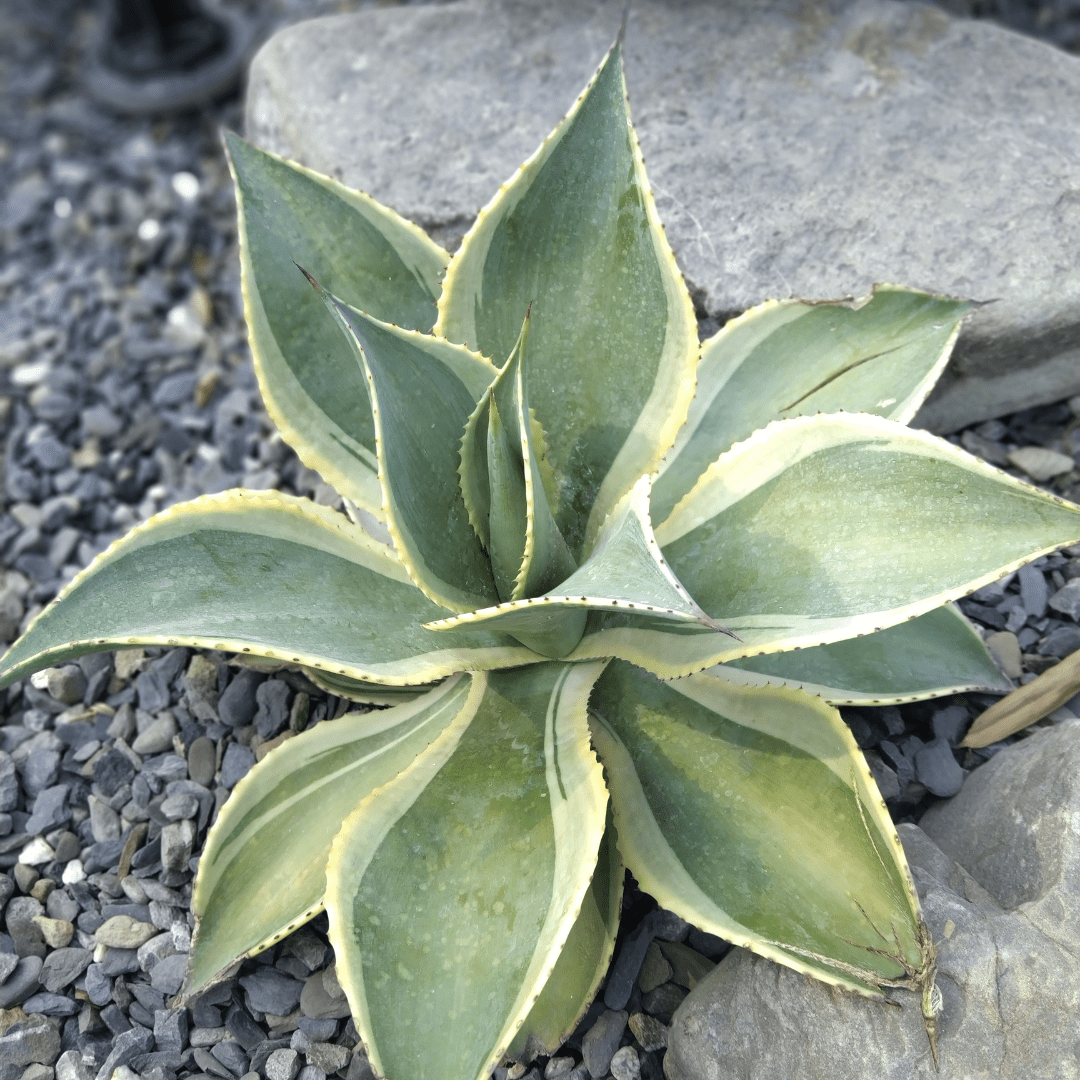

Agave Celsii
Agave Celsii
Couldn't load pickup availability
The Compact Shade-Tolerant Agave That Phoenix Landscapers Love
Agave Celsii (Agave celsii), also known as Cels's Agave, is one of the most versatile and forgiving agaves you can plant in the Phoenix Valley. This compact, sculptural succulent forms a symmetrical rosette of soft blue-green leaves that tops out at just 2–3 feet tall — making it perfectly sized for courtyards, containers, and tight garden spaces where larger agaves overwhelm. Unlike many agaves, Agave Celsii tolerates partial shade remarkably well, opening up planting options under palo verde trees, on north-facing walls, and in covered patios. Whether you're designing a modern xeriscape in Scottsdale, adding architectural accents in Gilbert, or building a low-water succulent garden in Chandler — Agave Celsii delivers elegant desert form with virtually zero maintenance.
Agave Celsii Plant Details
| Attribute | Detail |
|---|---|
| Scientific Name | Agave celsii |
| Common Names | Cels's Agave, Agave Celsii, Agave mitis |
| Mature Height | 2–3 feet |
| Mature Width | 3–4 feet |
| Growth Rate | Slow to moderate — reaches mature size in 3–5 years in Phoenix |
| Sun | Full sun to partial shade. One of the most shade-tolerant agaves. |
| Water | Very low once established. Extremely drought-tolerant. |
| USDA Zones | 8–11 (Phoenix is Zone 9b–10a) |
| Soil | Well-draining required. Thrives in Arizona caliche and rocky native soils. |
| Foliage | Evergreen — soft blue-green rosette with minimal terminal spines |
| Bloom | Yellowish-green flower spike (monocarpic — blooms once at maturity after 10–15 years) |
Agave Celsii Uses in Phoenix Landscapes
Courtyard & Container Focal Point
Agave Celsii's compact size and symmetrical form make it a natural choice for containers, courtyard plantings, and entryway accents. A single 10/15-gallon specimen in a decorative pot instantly elevates a patio or front entrance. The soft leaf tips (compared to more aggressive agaves) make it safer for high-traffic areas near doorways and walkways.
Shade-Tolerant Succulent Garden
Unlike most agaves that demand full sun, Agave Celsii thrives in partial shade — making it invaluable for north-facing garden walls, covered patios, and under the canopy of desert trees. Pair it with Tiger Aloe, Soft-Leaf Yucca, and shade-loving succulents for a cohesive low-water garden in spaces that most agaves can't handle.
Modern Xeriscape & Rock Garden
The clean rosette silhouette pairs beautifully with angular boulders, decomposed granite, and minimalist hardscape. Mass-plant 3–5 Agave Celsii at varying sizes for a gallery-quality desert garden. Space plants 3–4 feet apart for a connected grouping, or 5+ feet for individual sculptural specimens.
Best Time to Plant Agave Celsii in Phoenix
Fall (October–November) is the ideal planting window. Warm soil encourages root growth while cooler air reduces transplant stress, giving the plant a full cool season to establish before summer. Spring (February–April) is a strong second option. Avoid summer planting — while Agave Celsii is heat-tolerant once established, transplant shock in extreme heat can stall growth for months.
How to Plant Agave Celsii
- Dig wide, not deep — hole should be 2–3x the root ball width, same depth as the container.
- Check for caliche — break through any hardpan layer. Agave Celsii will rot in waterlogged soil.
- Backfill with native soil — no amendments needed. Avoid rich compost that retains moisture.
- Spacing — 3–4 feet apart for groupings; 5+ feet for individual specimens.
- Water basin — build a shallow 2-inch ring for initial watering; remove after establishment.
- Mulch — 2–3 inches of gravel or decomposed granite. Never use bark mulch against the rosette base.
Watering Agave Celsii in Phoenix
First Year Watering Schedule
Weeks 1–2: Every 3–4 days, deep and slow. Month 1–2: Every 5–7 days. Month 3–6: Every 10–14 days. After Year 1: Every 2–4 weeks in summer; monthly or less in winter. Established Agave Celsii needs very little supplemental water.
Drip Irrigation
Place one 1-GPH emitter 12–18 inches from the plant base. For groupings, one emitter per plant is sufficient. Overwatering causes root rot faster than underwatering causes stress — always err dry.
How fast does Agave Celsii grow in Phoenix?
Agave Celsii grows at a slow to moderate pace. A 5-gallon plant will fill out its 3–4 foot rosette within 2–3 years. Larger 10/15-gallon or 25-gallon specimens provide near-instant impact and typically reach full maturity within 1–2 years of planting.
Is Agave Celsii safe around pets and children?
Agave Celsii has softer terminal spines than most agaves, making it one of the safer choices for gardens near walkways and play areas. However, the leaf margins can still be sharp — plant it with a 2-foot buffer from high-traffic paths.
Does Agave Celsii produce pups?
Yes — it freely produces offsets (pups) around the base of the mother plant over time. These can be left for a natural clumping effect or carefully removed and replanted to expand your collection. Pups are typically ready to separate when they reach 6–8 inches tall.
What happens when Agave Celsii blooms?
Like all agaves, Agave Celsii is monocarpic — the mother rosette dies after sending up its flower stalk (typically after 10–15 years). However, it usually leaves behind multiple pups that continue growing, so the display carries on. The yellowish-green flower spike can reach 8–10 feet and is quite dramatic.
You May Also Like
Agave Chiapensis — Another compact, shade-tolerant agave that pairs perfectly alongside Agave Celsii.
Desert Spoon — A larger rosette-forming succulent for dramatic scale contrast in agave gardens.
Tiger Aloe — A compact striped succulent that thrives in the same partial shade conditions as Agave Celsii.
Red Yucca — Coral flower spikes add vertical interest and color contrast to agave groupings.
Angelita Daisy — Bright yellow ground cover that fills spaces between agave specimens with cheerful blooms.
How Many Agave Celsii Do I Need?
This is a compact specimen agave that also clumps over time. Use it solo in a container, or in small odd-numbered groups for a connected succulent bed:
| Use | Spacing | Notes |
|---|---|---|
| Container / entry accent | 1 plant | Softer tips make it patio-friendly with a short buffer from doorways. |
| Connected grouping | 3–5 plants, 3–4 ft apart | Rosettes knit into a cohesive low bed; pups fill the gaps over time. |
| Sculptural specimens | 5+ ft apart | Each rosette reads as a clean individual form in a rock garden. |
For a 100 sq ft succulent bed, roughly 7 to 9 plants at 3.5 ft spacing gives full coverage as they mature and pup.
Agave Celsii Season-by-Season in Phoenix
- Spring (Feb–Apr): Strong second planting window. New leaves flush from the center and pups appear at the base.
- Summer (May–Sep): Handles full sun but is one of the few agaves that also takes afternoon shade, making it ideal under palo verde or on east walls. Ease off water during monsoon so the crown stays dry.
- Fall (Oct–Nov): Prime planting season. Warm soil and cooling air give the best establishment of the year.
- Winter (Dec–Jan): Evergreen and steady. Hardy to about 20°F, so normal Valley winters pose no problem; cover only in a rare hard freeze.
At a Glance
✔ Heat-Loving (Reflected-Heat Tolerant) ✔ Drought-Tolerant ✔ Evergreen ✔ Low-Maintenance ✔ Deer & Rabbit-Resistant ✔ Cold-Hardy to 20°F
Plant It With
- Agave Chiapensis: another compact shade-tolerant agave that pairs naturally beside Celsii.
- Desert Spoon: a larger rosette for dramatic scale contrast in the same bed.
- Red Yucca: coral bloom spikes add vertical color above the low agave rosettes.
- Artichoke Agave: tight blue-green rosettes that echo the form at a different size.
Is Agave Celsii Right for Your Yard?
It is a great fit for a compact spot in full sun or partial shade with fast-draining or rocky caliche soil, including north walls and tree canopy where most agaves struggle. It needs little water and shrugs off normal Valley frost. It is not a fit if your soil stays wet, since soggy crowns rot quickly, or directly against a high-traffic path without a small buffer from the leaf margins.
Share